Archive for the ‘Jim Thorpe’ Category

Lone Star Gets His Due

May 24, 2012

Tonight, the National Museum of the American Indian (NMAI) in Washington, DC holds a reception to kick off its new exhibit, “Best in the World: Native Athletes in the Olympics,” to celebrate the athletic achievements of Native Americans on the 100th anniversary of the 1912 Stockholm Games that featured legendary performances by Jim Thorpe and Lewis Tewanima. I am attending because Bob Wheeler, Jim Thorpe’s Boswell, is to speak there. While making preparations for attending this event, I received some unexpected news.

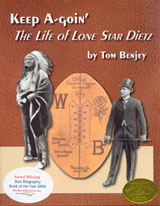
The National Football Foundation (NFF) released its selections for induction in the College Football Hall of Fame Class of 2012 and Lone Star Dietz was finally on the list. As blog followers probably know, Greg and John Witter, first cousins and rabid Washington State football fans, and I campaigned to get Dietz placed on the Hall of Fame ballot some years ago. Getting his won-loss record corrected was the key to getting him nominated but there were larger obstacles yet to come.

Lone Star Dietz died in 1964 and there are few people still alive that knew him. Also, he coached at schools with smaller alumni bases and less clout than the major football factories. Washington State, for example, couldn’t muster the support for him that, say, Ohio State could for John Cooper or Michigan could for Lloyd Carr. While both these recent coaches had very good careers, neither had the impact on the history of the game as did Dietz. It’s one thing to inherit a strong program and be a good steward, but it is quite another to rebuild a floundering program from the ground up, something that Lone Star did multiple times.

The closest he came was in 2006 when the selectors chose Bobby Bowden and Joe Paterno instead of the people who were on the ballot. A couple of years ago, when Lone Star’s name was dropped from the ballot, I gave up all hope of him ever being selected. I didn’t even know that his name was on the Divisional ballot this year, so was shocked when I started receiving phone calls from reporters on Tuesday afternoon.

All I can say is that it’s long overdue. Although he’s being brought in through the back door, so to speak, he will finally be in. He’s the first Carlisle Indian to be inducted as a coach; the rest were as players. Whether this honor is enough to offset the many indignities Dietz suffered and mollify the Lone Star Curse is yet to be seen.

http://seattletimes.nwsource.com/html/cougarfootball/2018262997_dietz23.html

http://www.spokesman.com/stories/2012/may/23/blanchette-wsu-legend-dietz-gets-his-due/

1912 Pentathlon Part 2

May 17, 2012

Jim Thorpe won the 1500 meter run, the last event of the pentathlon, with a time of 4 minutes 44.8 seconds. Avery Brundage did not finish but was awarded seven points, comparable to a last place finish. Whether he started and did not finish or just didn’t bother to run at all is unclear. Ironically, Thorpe could have finished dead last in the 1500 meters and still won the pentathlon but he probably never considered loafing to save his energy for the decathlon. Brundage finished in sixth place overall, ahead of Hugo Wieslander, who finished fourth in the 1500 meters. The best Brundage could hope for if he came in first, second or third was a bronze medal because, even if he finished dead last, Ferdinand Bie of Norway would have had only 22 points overall as he had only 15 points coming into the 1500 meters where Brundage already had 24. A first place finish would have given Brundage 25. A fourth place finish would have given him 28 points, still good enough for a bronze because James Donahue and Frank Lukeman both finished with 29 points in a tie for third place. The tie was broken by recalculating their results using the method used for the decathlon with the result that Donahue was awarded the bronze medal

According to Wikipedia, Brundage chose not to compete in the final event of the decathlon, again the 1500 meter run, and later regretted the decision. It may be that he also chose not to run the 1500 meters in the pentathlon as well. Perhaps his biographer, Allen Guttman, can shed some light on this but it has been decades since he wrote about Brundage and he may have forgotten the details.

Something that is clearer now is that the Brundage who came in second to Frank Cayou in a track meet held at the University of Illinois on April 28, 1900 probably was Avery. Although still in high school in Chicago, his times were already good enough to compete with college boys.

1912 Olympics Pentathlon

May 15, 2012

Six days before beginning the decathlon competition, Jim Thorpe won the Men’s Pentathlon (not to be confused with the Modern Pentathlon which will be discussed later). Unlike the decathlon, all five pentathlon events were held on the same day, July 7, 1912. The first event was the long jump which Jim Thorpe won with a jump of 7.07 meters. Average Brundage’s 6.83 meter jump was good enough for fourth place. Next up was the javelin which was won by Hugo Wieslander of Sweden with a throw of 49.56 meters. Thorpe’s 46.71 was good enough for third place while Brundage’s 42.85 was ninth. The third event was the 200-meter run which Thorpe won with a time of 22.9 seconds. Brundage came in 15th.

After three events were completed, only the top twelve were allowed to continue; the rest were eliminated. It isn’t clear to me if the rules called for only the top twelve to continue or if those with composite scores higher than 25 were eliminated. Either scheme arrives at the same place in this case. Jim Thorpe was the overall leaders at this point with two firsts and a third place finish for five points total (1+3+1). Avery Brundage’s 22 points (4+7+11) kept him in the game tied for seventh place.

Only the top six competitors were allowed to continue after the fourth event, the discus. Jim Thorpe won that one too with a throw of 35.57 meters. The discus throw must have been Avery Brundage’s best event because he placed second in it. When overall scores were recalculated to determine who made the cut, Thorpe was, of course, well ahead in first place at six points. Surprisingly, Brundage was tied for third with 22 points. Because two men tied for sixth place, seven were allowed to compete in the last event.

 <continued next time>


100th Anniversary of 1912 Olympics

May 10, 2012

This year is the 100th anniversary of the 1912 Olympic Games that were held in Stockholm, Sweden.  What makes that important to us is the participation of two Carlisle Indians: Jim Thorpe and Lewis Tewanima.  Writers across the country and even from England are working on articles about these games and the two men who starred in those games.  The National Museum of the American Indian (NMAI) in Washington, DC is even opening an exhibit concerning American Indians’ participation in the Olympics on May 24.  As a result, experts such as Bob Wheeler are being interviewed by various reporters and other writers.  Even I am being asked to verify details.

The other day, I got a phone call from someone about a detail about which I had never given any thought: exactly when was the decathlon competed in the 1912 Olympics?  Fortunately, with the use of the Internet, the answer could readily be found.  The 1912 Decathlon was competed over three days.  On the first day, July 13, the 100 meters, long jump, and shot put were held.  The second day, July 14, hosted four events: 400 meters, high jump, discus throw, and 110 meter hurdles.  On the third day, July 15, were the pole vault, javelin throw, and 1,500 meters.

Something that I find interesting is that Jim Thorpe tied for third in the pole vault, an event for which his physique was not well suited.  Pole vaulters tend to be wiry, something that Thorpe wasn’t.  Yes, he had tremendous upper body strength, but that was offset by his overall body mass as muscle is heavy.  His great leg strength and running speed probably made up for his weight as he cleared 3.25 meters (10 feet 7.95 inches) in those pre-fiberglass pole days.

The decathlon was a battle of endurance as much as anything.  Of the 29 athletes who started the event on the first day, only 12 finished all 10 events. Among the non-finishers was Avery Brundage.  After finishing 10th in the pole vault, Brundage dropped out without competing in the javelin or 1,500 meters.  Even at that, he is listed as placing 16th in the decathlon.


More About Warner’s 1912 Book

March 30, 2012

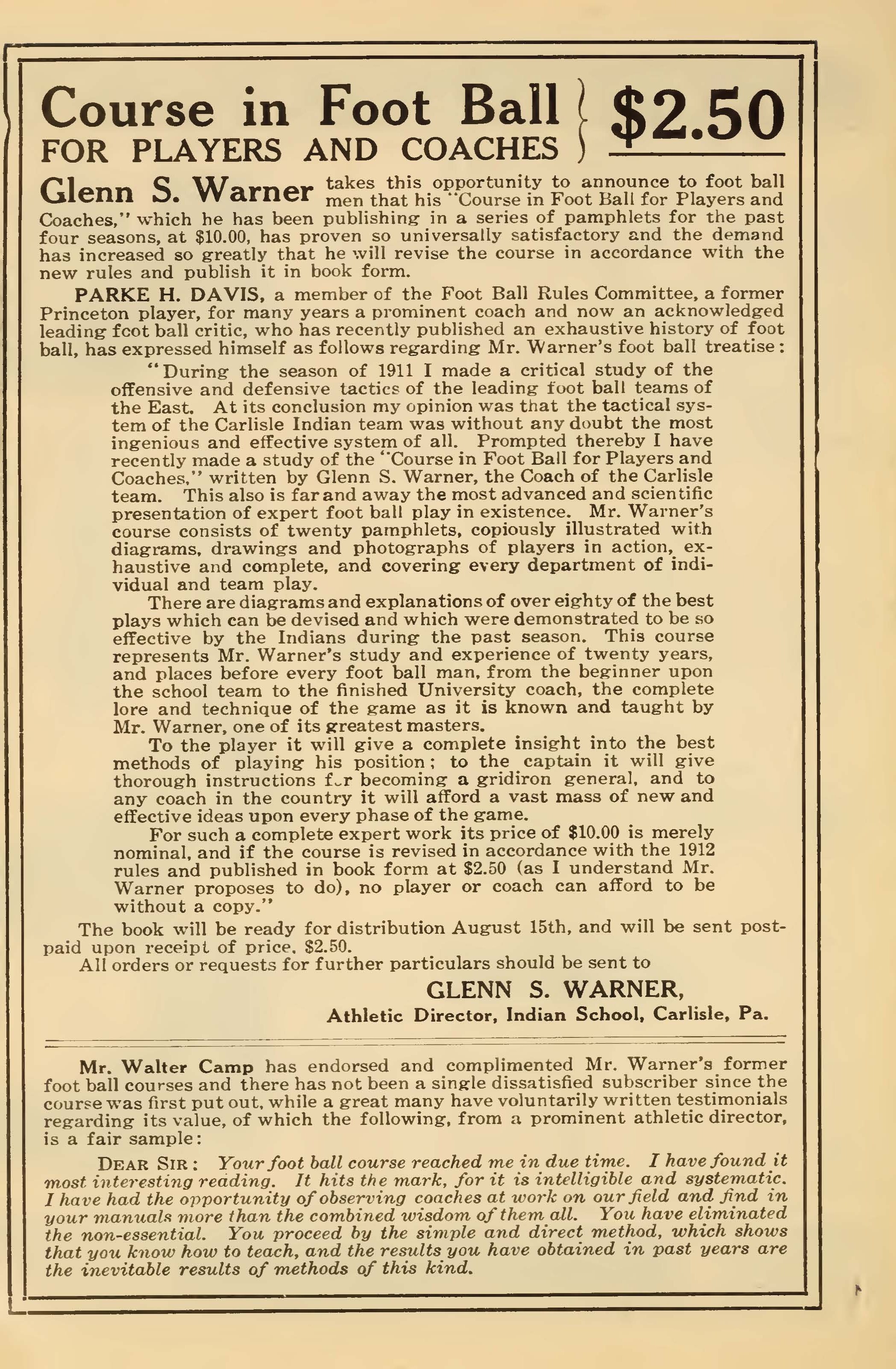
The endorsements at the bottom of the 1912 ad were the same as previously: one from Walter Camp and the other from an unnamed prominent athletic director.  Most of the ad is an endorsement written by Parke H. Davis.  The first paragraph is most interesting.

During the season of 1911 I made a critical study of the offensive and defensive tactics of the leading foot ball teams of the East.  At its conclusion my opinion was that the tactical system of the Carlisle Indian team was without any doubt the most ingenious and effective system of all.  Prompted thereby I have recently made a study of the ‘Course in Foot Ball for Players and Coaches,’ written by Glenn S. Warner, the Coach of the Carlisle  team.  This also is far and away the most advanced and scientific presentation of expert foot ball play in existence.  Mr. Warner’s course consists of twenty pamphlets, copiously illustrated with diagrams, drawings and photographs of players in action, exhaustive and complete, and covering every department of individual and team play.

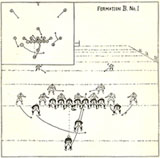
Warner may have done the drawings or he may have enlisted Lone Star Dietz to do them or they each may have done some as they later did for Warner’s 1927 book.  That Dietz did the cover art for the 1912 book argues for his having done some of the interior illustrations.  Various “famous players” are photographed performing various football skills including kicking, punting, and catching punts.  Frank Mt. Pleasant is the only player specifically identified with a photo as Warner included three frames of Mt. Pleasant throwing a forward pass.  Each frame represents a different part in the throwing motion.  What looks to be a young, skinny Jim Thorpe is shown dropping the ball to punt it.  Gus Welch (possibly) is shown following through after punting the ball.

<more on the book next time>

Christmas at Carlisle 1911

December 23, 2011

Like Father, Like Son

December 5, 2011

The title of this message is a bit misleading. Like parents, like son would be more accurate. Rob Wheeler is the son of Robert W. “Bob” Wheeler and Florence “Flo” Ridlon and, like the proverbial apple, didn’t fall far from the tree. Bob is perhaps best known as the author of the definitive biography of Jim Thorpe. Flo is not well known for her greatest discovery, but should be. It was Flo who found a long-lost copy of the rules for the 1912 Olympics misfiled behind a row of books on a shelf in the stacks of the Library of Congress. The rules made possible the restoration of Jim Thorpe’s Olympic medals. Bob and Flo should be better known for their efforts and ultimate success but probably won’t be. Their only child, Rob, has undertaken the task of getting Jim Thorpe’s remains moved to Oklahoma. Philadelphia lawyers are hereby on notice that Rob is on the case.

Rob Wheeler is a senior at MIT double-majoring in Aeronautics and Aerospace Engineering AND Physics, so cannot devote full time to the effort as his parents did for some years in their effort. Fortunately, he doesn’t have to do it all himself as Thorpe family members are heavily involved. It is because of one particular Thorpe that Rob is so dedicated to this task, but you will have to visit Rob’s website, www.JimThorpeRestInPeace.com, to learn the details of that relationship.

Rob conceived, designed and maintains the website. His Phi Sigma Kappa brothers, David Somach and Arkady Blyakher, assisted in creating the website. Michael Lehto  provided vital encouragement and technical expertise. Since the website was put on-line, Rob has been interviewed by Native News anchor for IndianCountryTV.com, Paul DeMain. That interview can be viewed at http://www.youtube.com/watch?v=DHPQ0jTwSmM&feature=channel_video_title.

Don’t be surprised if we read more about Rob Wheeler in the news.

The 1911 Carlisle Upset of Harvard – Part 2

November 17, 2011

Carlisle received the opening kick off and moved the ball quickly to Harvard’s end of the field but were unable to push the ball across the goal line. They turned the ball over on downs at the Harvard 2-yard line. On their second possession, the Indians bogged down well into Harvard territory and Jim Thorpe kicked a field goal from the 15-yard line to open scoring for the game. Harvard soon countered when Hollister drop-kicked a field goal of his own to tie the score. There was no further scoring in the first quarter. In the second quarter, Carlisle rushed the ball to Harvard’s 40-yard line but could get no further on this drive. Thorpe then kicked his second field goal of the game from 47 yards out. Unfortunately for the Indians, they would later fumble the ball and a Harvard player, Hollister, recovered it on the 50-yard line. On the next play, Reynolds broke through the Indians’ line and, after the Indians thought he was down, popped to his feet and ran for a Harvard touchdown and 9-6 lead at halftime. Note that touchdowns were worth 5 points and the goal after 1 point while field goals counted 3 points at that time.

After a series of line plunges late in the third quarter, Alex Arcasa pushed the ball over for Carlisle’s only touchdown of the day. Thorpe kicked the point after. Thorpe also kicked another field goal to close out scoring for that quarter. Harvard put in its fresh first team for the fourth quarter and made good yardage at first, but the Indian line eventually held. Thorpe kicked his fourth field goal of the day to complete Carlisle’s scoring. Harvard would get its second touchdown for the day when Storer blocked Thorpe’s punt from the 36-yard line, recovered the ball, and ran it in for a touchdown. Fisher completed the scoring for the day at 18-15 by kicking the point after touchdown. Carlisle almost had a touchdown of their own in a similar fashion but, instead of falling on the ball, several players attempted to pick it up and run with it. A Harvard player eventually fell on the ball behind his goal line for a touchback.

Possum Powell excelled at line plunging throughout the day while Gus Welch, Arcasa and the badly injured Thorpe ran around the ends. The Carlisle line, without Captain Sam Bird for the whole game and Bill Newashe for most of it, outplayed the Crimson line making the backs’ gains possible.

This game has been rated as one of the greatest college football games of all times by experts.

Joseph Twin

February 23, 2011

I received a message from the great granddaughter of James Joseph Twin on my Facebook account. Because Facebook doesn’t send notices when messages are received and because I don’t check Facebook all that often, I didn’t become aware of the message for several days after it was sent. This is not the first time this has happened. If you want to get in touch with me, please email me at the address on this page.

Because Twin was a baseball player and, I think, the writer of a column for the Carlisle Indian School newspaper, I was aware of his name but don’t know much about him. Being away from my files at present, I can’t do much research on him but can do a little. I quickly found some baseball box scores from the spring of 1909 in which his name was listed. Twin was the Indians’ regular third baseman that year. In the first few games, he batted sixth but was soon moved up the order to the second spot. The reasons for that shift may have been because he seemed to have a propensity to get hit by pitchers and awarded a free base (perhaps he batted lefthanded) and also was successful at sacrificing–bunting one assumes.

Batting and fielding averages as of May 4 were printed in The Carlisle Arrow. Joe found himself with the ninth highest batting average at .209, which was among the lowest of the regulars. He also had a very low fielding average, but had few fielding chances for a regular. One would have expected a third baseman to have had more chances than he did. Perhaps pitchers William Garlow and Joseph Tarbell overpowered the hitters and kept them from pulling the ball down the third base line.

Jim Thorpe’s name wasn’t listed in the statistics because he didn’t join the baseball team until May 25, when he pitched a no-hitter against Eastern College of Front Royal, Virginia at Hagerstown, Maryland. Prior to that, he was occupied with track.

Significant time will be needed to learn more about Mr. Twin. My sense is that he was very much involved in school activities.

Was Percy Haughton Present at 1911 Carlisle-Harvard Game?

February 1, 2011

Recently James Vautravers asked me a question about the 1911 Carlisle-Harvard game which was arguably the Indians’ greatest victory:

Everything I have ever read about the 1911 Carlisle-Harvard game says that Percy Haughton was in New Haven scouting Yale that day. But almost everything I’ve read about the game is false. So I was wondering if this might be false too.
 
Wheeler’s Jim Thorpe book (which omits all the popular false info about this game) does not directly confirm or deny the story, but he has a quote from Haughton which seems to imply that Haughton was at the game to witness it.
 
Do you know whether or not Percy Haughton was actually in New Haven that day?

Most of what Wheeler included about Percy Haughton regarding the 1911 Carlisle-Harvard game was quoted from Pop Warner as indicated in Wheeler’s endnotes. A reader could easily interpret what Warner said to imply that Haughton was present at the game. However, Warner attended only one of Iowa State’s games in 1895, the year that he coached two teams: Iowa State and Georgia. Actually being present at a game was less important for a head coach than it is today for several reasons. First, coaches not only did not call the plays then, they were prohibited from doing so. Coaches’ legal involvement in the flow of the game was greatly limited as compared to today. Second, team captains played a much larger role then than now. Lone Star Dietz even had to resort to bribery to get his quarterbacks to call pet plays that they didn’t like. Captains were much more involved in the running of the team than they are today. And there was generally only one captain because players played both ways and very often were on the field for the whole game. So, it is plausible that Haughton may have been away scouting Harvard’s rival for their upcoming grudge match. A parallel would have been Bo Schembechler skipping the Michigan-Wisconsin game to scout the Buckeyes.

To be continued…