Archive for the ‘Jim Thorpe’ Category

Returning Indians to Prominence in Football

October 6, 2008

Coming across a 1937 newspaper article in which Gus Welch launched a movement to return Indians to prominence in football. He was quoted as saying:


“The Indian is disappearing from football just like he disappeared from the forests. There used to be a lot of good Indian athletes—Thorpe, Guyon Mount Pleasant, Sweet Corn, Jim Levi, Tiny Roebuck and Mayes McLain. Pop Warner developed a dozen great ones at Carlisle and Haskell Institute produced a number. But they are fast dwindling. Most of the Indians we see in athletics today are impostors, or at best half-breeds. And they might as well be cigar store Indians in so far as I’m concerned.”


The article went on to say that Gus and his wife had recently adopted a baby girl. He insisted that the next child would be a boy adopted from one of what he considered the two fiercest tribes.


“I’m going to visit the Sioux reservation first and look over their crop of babies. If they don’t have anything to my liking, I’m going to pay the Cheyennes a call. I’m determined to find a real all-American and restore the Indian to his proper place in football.”


You already know that didn’t work out, but did you know that Bacone College attempted to revive Indian football after it was de-emphasized at Haskell Institute during the Great Depression? It was a natural thing for the little Muskogee, OK college to do because the school’s original name when it was founded in 1880 at the Cherokee Baptist Mission in Tahlequah by Almon C. Bacone was Indian University. Oklahoma’s longest-running institution of higher education was renamed Bacone Indian University in 1910. Later, its board of trustees gave it its current name. An irony is that Bacone and Haskell, both now four-year schools, play each other.

Gus Welch between Possum Powell and Jim Thorpe

Best Subtitle of 2008

September 23, 2008

Today while conducting an email conversion regarding some advertising, I received an unexpected stroke. Maryann Batsakis, Sales Representative for ForeWord Magazine, informed me that the subtitle of my new book was the best she had seen in her seven years at ForeWord. She also informed me that she started in the mailroom where she opened every package that came in and saw every book. Since then she has seen all the award-winning books. So, she speaks with some authority. However, I may have a leg up because she appreciates my sense of humor. One time I mentioned a password I sometimes use and she responded that she liked it. I explained that it was too difficult to use Of all the gin joints in all the towns in the world she has to walk into mine. That cracked her up.


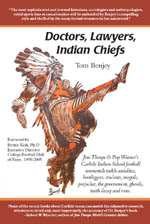
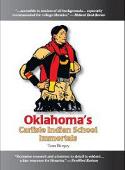
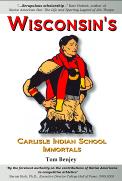
So if Doctors, Lawyers, Indian Chiefs doesn’t receive any other awards, I can feel good that my subtitle, Jim Thorpe & Pop Warner’s Carlisle Indian School football immortals tackle socialites, bootleggers, students, moguls, prejudice, the government, ghouls, tooth decay and rum, is the best.


Some may wonder why I was so verbose. Subtitles are used to help describe what the book is about and also to help search engines find the book for readers who might be interested in it. Doctors, Lawyers, Indian Chiefs covers so much ground that a long subtitle is needed. This might help explain why some books, especially very technical ones, have lengthy subtitles that contain a lot of jargon.


More on Indian Sports Leadership

September 5, 2008

Yesterday’s email brought a curious announcement. I am going to receive a free, signed copy of a new book to be released soon. The Toilet Paper Entrepreneur by Mike Michalowicz, about which I know nothing, was looking for humorous bathroom graffiti. I sent in my all-time favorite from the back of the men’s room door at The Blessed Oliver Plunket, a bar/restaurant featuring live entertainment located across the street from the Cumberland County Historical Society. The Plunket, as it was better known, has numerous stories to tell but I’m not the one to tell them. In the late 70s, as I was leaving the men’s room, I noticed a scribble on the door:

No sign of intelligent life…Kirk Out

Apparently that witticism has found its way into a book.

Back to Donna Newashe McAllister’s question…

I expected that more people would comment on this and would like to see more myself. So, I’ll share some of my thoughts.

My wife and I have discussed this issue to some degree and I think it is an issue with multiple facets. First, I’m not so sure that American Indian athletes have necessarily declined. Judging today’s athletes with those who were at the Carlisle Indian School may not be fair. Those guys were world-class athletes coached by one of the most innovative coaches of all time. Pop Warner is criticized much today but few question his knowledge or his ability to coach football. During its heyday, Haskell had fine athletes and was led by Dick Hanley, Lone Star Dietz and Gus Welch, all of whom were excellent coaches. Dietz belongs in the College Football Hall of Fame. Neither Haskell nor the tribal colleges can afford to hire coaches of their caliber today.

Bob Wheeler tells me that Bill Thorpe shoots better than his age, 80, in golf. To compare anyone with Jim Thorpe is unfair. He was the greatest athlete of all time and could do anything well. I can’t imagine how he could be competitive in the pole vault, but he was. Sam Bird’s grandchildren and great-grandchildren are big in the rodeo. Some of the others didn’t have children and many settled off the reservation. For example, Joe Guyon was a big star at Carlisle, Georgia Tech and in the NFL where Joe Guyon, Jr. played for Catholic University.

But you seem to be focused more on leadership than on athletic ability. It appears to me that many of the better leaders did not return to the reservation after finishing at Carlisle or Haskell. Several were officers in WWI and were leaders in the service but didn’t return to lead their tribes. Some kept one foot in each world and their children found more opportunity in white society. For example, Thomas St. Germain’s son, grandson and great-grandson were/are renowned research physicians at Tulane University School of Medicine.

It may be that Indians are playing leadership roles individually but not together as a group. MANY of the Carlisle players went into coaching but Dietz, Exendine and Welch were about the only ones who made it their life’s work. Coaching was an even more precarious occupation then than now and only the best schools paid well. So, most devoted their considerable talents to other occupations. Even Exendine and Welch practiced law in the off-season.

Surely, other people have some insight into this issue.

Players’ First Names Aren’t Easy to Find

August 28, 2008

One of the most difficult and time-consuming things my editor has me do is to provide players’ full names. Now James G. Sweeney, a lawyer from Goshen, New York and a 50-year West Point supporter, has requested that I help him identify a number of players. Sweeney is writing an article about the 1905 Carlisle-Army game that was approved by the War Department but can’t find players’ first names in newspaper reports. Apparently because I write about Carlisle Indian School football, he thought I’d know all the players’ names. I wish it were so.


Finding the biggest stars’ first names isn’t too difficult and, by now, I can give most of them off the top of my head, assuming that I don’t have a senior moment. Even identifying them wasn’t a piece of cake. One of the reasons for that was that some of them played under multiple names. For example, Emil Hauser was better known as Wauseka and his brother, Pete, was also a star player; Charles Guyon went by Wahoo and, to confuse things further, his younger brother, Joe, came along a few years later and made an even bigger name for himself; and William H. Dietz played as Lone Star. Linda Witmer’s The Indian Industrial School: Carlisle, Pennsylvania 1879-1918 includes a list of students that attended Carlisle. Although incomplete, it nonetheless is a useful tool. One of the problems in identifying players is that many siblings and cousins attended the school. Determining which one is the correct person is a challenge.


Carlisle Indian School publications are invaluable resources. In 1905 the school newspaper went by The Arrow. The school had no literary magazine at that time. Most of the big games were covered by The Arrow. Often articles from big-city papers were reprinted in it. From them we get our cast of characters, if only by their last names. Varsity football players were often active in the literary and debating societies because they were among the oldest on campus. Write ups of these societies’ activities often included full names. Football stars often got press for more mundane activities because they were famous. These pieces often included their first names. Players other than stars received less coverage.


Graduation coverage included full names for the graduating class and much coverage of the individuals in that class. Because most students had little proper schooling before coming to Carlisle and often at advanced ages, they were unwilling or unable to commit to lengthy courses of study that would lead to graduation.


My ace in the hole is the athletic or football (it varied) banquet. This time I hit pay dirt because the coverage of the 1905 football banquet (held in early 1906) included not only the menu for the banquet and the toasts given, but a complete roster of the players on the team with those who lettered identified with Xs. Well not exactly complete. Chauncey Archiquette’s name was omitted. Perhaps Jeffrey Powers-Beck has the reason for his omission from the list in Chief: The American Indian Integration of Baseball, 1897-1945 when he states that Archiquette, then 28, was an 1898 Carlisle grad who had played football and other sports during his days at the school and returned as staff in 1905 but played again. This was the same Archiquette a 1953 Los Angeles Mirror article claimed was Jim Thorpe’s boyhood idol.

1905 Carlisle vs. Army

1912 Olympics – Part V

August 14, 2008

The team held an exhibition meet on June 13 in New York City at which Thorpe and Tewanima stood out. The diminutive Hopi outran the country’s two best middle-distance men in the 3,500 meters and Jim Thorpe outjumped the world record holder in the high jump by clearing 6’5”. After the event was over, the record holder also cleared 6’5”. The 1912 U.S. Olympic team set sail for Stockholm on a Red Star liner, The Finland, arriving on June 30 to a hearty reception.


In the first day’s events, Jim Thorpe won the pentathlon (Avery Brundage tied for third) and qualified for the high jump finals. Lt. George S. Patton finished 5th in the Modern Pentathlon, an entirely different event designed specifically for military officers. Lewis Tewanima qualified for the finals of the 1,500 meter run. Later that day he placed second and won the silver medal. Tewanima was also entered in the marathon.


Andrew Sockalexis described the conditions for the marathon as, “…the worst I ever saw. The roads were very poor. A thick mud, the color of cement, covered them, and out of this protruded small sized rocks, which made the running anything but comfortable….The morning was cool enough, but how the sun did come out getting near noontime. I think the temperature was between 90 and 95 degreees.” He went on to say that he had never found it so warm in America.


The conditions may have affected the little Hopi as he finished a disappointing 16th. Andrew Sockalexis finished 4th but later kicked himself for losing the race for “failing to use my head at the proper time cost me first place in the great race.” His mistake came at the halfway point of the race when he observed that the two leaders, South Africans McArthur and Gitsham, were clinging tight to each other and that McArthur was frothing at the mouth. Sockalexis planned on starting his spurt when McArthur dropped out of the race. He never did and won the race in record time.


Jim Thorpe did not medal in the high jump due to failing to clear the bar when raised to 189 centimeters, a height he had cleared earlier in the year.  He finished tied for 4th in an event in which six of the top seven finishers were American.


In the decathlon, Jim placed 3rd in the 100-meter dash at 11.2 seconds, 3rd in the broad jump at 6.79 meters, 1st in the shotput at 12.89 meters, 1st in the high jump at 1.87 meters, 4th in the 400-meter dash at 52.2 seconds, 3rd in the discus throw at 36.98 meters, 1st in the 110-meter hurdles at 15.6 seconds, tied for 3rd in the pole vault at 3.25 meters, 4th in the javelin throw at 45.70 meters, and 1st in the 1500-meter run at 4minutes, 40.1 seconds. Avery Brundage finished 16th.


Thorpe’s 1912 Olympic performance is the stuff of legends, even at the time. At the medal ceremony, King Gustav V said, “You, sir, are the greatest athlete in the world.” To which Thorpe famously replied, “Thanks, King.”


Jim Thorpe receiving Olympic gold medal from King Gustav V of Sweden

Jim Thorpe receiving Olympic gold medal from King Gustav V of Sweden

1912 Olympics – Part IV

August 11, 2008

Thorpe received a lot of hype, even before dominating the Pentathlon tryouts. One such example is shown below. As coach of the Carlisle track team, Pop Warner placed himself in charge of Thorpe’s and Tewanima’s training for the Olympics. As part of their training regime he had them sit out most of the school’s spring meets. So, for the first time in several years, a team other than Carlisle won the Pennsylvania Intercollegiate Athletic Association’s track meet held on Hargest’s Island (today’s City Island) at Harrisburg. Thorpe did not attend the meet but Tewanima made an appearance. He ran 18 miles from the Indian School to Hargest’s Island, arrived at the field when the 2-mile run was underway. According to the report in The Carlisle Arrow, “he circled the field amid the cheers and applause of’ nearly everyone on theground. Tewanima made the eighteen-mile run in a little less than one hour and fifty minutes and seemed fresh at the finish and able go many more miles.”


Thorpe’s absence gave others an opportunity to shine. Bruce Goesback placed 1st in the 220 hurdles, 3rd in the 120 hurdles, 4th in broad jump and high jump. Possum Powell finished 2nd in both high jump and shot put. John Squirrel was 3rd in both 440-yd dash and broad jump. Sampson Bird came in 2nd in the hammer throw and 4th in discus. Gus Welch place 2nd in the half-mile and won the 440-yd dash but was disqualified of “alleged interference” with another runner. Arthur Coons placed 3rd in pole vault, Joel Wheelock came in 4th in both hurdle events, and Blackdeer, the only distance man to score points, came in 4th in the 2-mile run.


Carlisle still placed second to Penn State without its Olympians and beat all other colleges in the meet.

Jim Thorpe's Physique

Jim Thorpe's Physique


1912 Olympics – Part III

August 7, 2008

The press was filled with articles about Carlisle’s expected participation in the upcoming games. Various track meets, competitions and races winnowed the field down to those who would eventually participate.


The Boston Marathon, which was run on April 20, was used to select the U.S. long distance team. Prior to the race Pop Warner thought that Mitchell Arquette, St. Regis Mohawk, would do even better than Tewanima. However, Michael J. Ryan, of the Irish American A.C. unexpectedly won the race and in world-record time. Andrew Sockalexis, Penobscot from Maine and not enrolled at Carlisle, came in second in conditions so muddy that runners had to run on sidewalks to get decent footing. After the conclusion of the race, the U.S. Olympic marathon team was set: Ryan and Sockalexis were selected as was Lewis Tewanima, the only Carlisle distance runner on the 1912 U.S. Olympic team. Apparently, the other Carlisle distance men didn’t do well enough in spring meets to qualify.


Jim Thorpe had a good spring. He was running so well that Warner was quoted as saying , “the man who beats him in the 120 yard [hurdle] event at the Pennsylvania relay meet will have to stagger the world’s record.” In May Thorpe competed in a tryout for the Olympic Pentathlon, a new event that consisted of five track and field competitions: 1) Running broad jump, 2) javelin throw with best hand, 3) 200-meters flat race, 4) discus throw with best hand, and 5) 1,500-meters flat race. He had not thrown the javelin previously but was expected to pick that up quickly. Also new to him was the 1,500-meters run in which his stamina was expected to carry him. Thorpe easily qualified for the Olympic team by winning three events: broad jump, discus and 200-meter run. He placed second in the other two, losing to the national champion in the javelin and finishing two yards behind the leader in the 1,500-meters. His prospects for a successful Olympics were good. Also named to the U.S. team to compete against Thorpoe in the pentathlon and decathlon was Avery Brundage.


Tewanima wins race & Arquette comes in 5th

Tewanima wins race & Arquette comes in 5th


1912 Olympics – Part I

July 31, 2008

Some think that 1912 was the year Native American broke onto the Olympic scene but, as shown in the last few blogs, they arrived much earlier. But 1912 was to be better for American Indians in the Olympics than the previous games. But it was not surprising.

As early as New Year’s Day 1912 and as far away as Fairbanks, Alaska, newspapers carried an article with a Carlisle, Pa. byline promoting Jim Thorpe for the upcoming Olympics. That article was surely generated by Pop Warner’s PR machine. An excerpt illustrates the exuberance in which he was promoted:

This youthful redskin hunts, plays lacrosse, tennis, indoor baseball, handball and hockey, all with equal skill, and can fill almost any position on a football team with credit. As halfback he probably is seen at his best, whirling, twisting, dashing and plunging, for one moment bewildering his opponents with lithe, panther like leaps, and the next crushing his way through the mass of would-be tacklers with the ferocity of a mad bull.


The piece ends with what may have been a preemptory defense against claims of professionalism:


Although busy with track work while here, he practiced baseball and played amateur baseball since leaving Carlisle, refusing numerous offers to play on minor league teams.


But Carlisle’s track team was not a one-man operation. Less than two weeks later papers gave Thorpe’s teammate some coverage:


Louis Tewanima of Carlisle Indian School will be a starter in this year’s Boston Athletic Association Marathon race and hopes to make the American Olympic Games team.


Pop Warner announced in early January that he expected Tewanima and Thorpe to make the Olympic team. On March 1st the commentator, who wrote the Diamond Gossip that was distributed widely, opined that the reason so many athletes were deciding against attending the Games was that Thorpe was going to Stockholm. Less than a week later, Warner’s PR machine announced that several other students wanted to make the Olympic team. Warner himself said that he thought five of his Carlisle trackmen might make the cut. He expected that Arquette would “make the foreigners scamper in the 10,000 meters,” but refused to identify the other two. “I don’t care to let any one know as yet who my two new phenoms are. One of them is one quarter-miler of exceptional ability. The other will be entered in the 400 and 500 meters races.”


I have read that Gus Welch made the team but was unable to compete due to injury. Could he have been one of Warner’s mystery men?

Indian School movies

June 27, 2008

Carlisle Indian School has been of interest to Hollywood since the movie industry’s earliest days. In 1901, American Mutoscope and Biograph shot a documentary short at the school. Footage included both male and female students swinging clubs. Still photos of this type of exercise can often be found on ebay. Also included in the documentary were a military-style parade of the students including the renowned school band, girls doing a dumbbell drill, boys demonstrating gymnastics events, boys playing a basketball game, and members of the track team high jumping and pole vaulting. No, Jim Thorpe was not filmed because he was not at Carlisle at that time.

In 1913, Selig Polyscope filmed The Tie of the Blood at the school. Little is known about the film other than its main cast members. In 1915 Pathe Weekly filmed the installation of the first Indian Boy Scouts of America troop at the school. Also participating in the parade, exhibitions and ceremonies were local boy scouts and the Indian School’s Campfire Girls. And other films that I do not know about may have been filmed at the school.

Several alumni worked in motion pictures as actors, stuntmen and in other capacities. Lone Star Dietz even invested in the Washington Motion Picture Company and lost his investment. Jim Thorpe not only worked in pictures but had his life story told on film in the 1951 Warner Brothers release, Jim Thorpe – All-American. Interest in putting the Indian school on film waned but in recent years has grown.

In April 2002, Variety Film reported, “Fox 2000 has snapped up a pitch by Craig Sherman and Bob Jury on legendary football coach Glenn S. “Pop” Warner and his first season at the Carlisle Indian School.” In April 2004, Walden Media announced that John Sayles would be bringing Carlisle School to the big screen. In 2005 Steven Spielberg brought Carlisle Indian School to the little screen as part of his Into the West miniseries. And there’s more, so much more interest that Freddie Wardecker has lost count of how many filmmakers have come into his store to look at artifacts. Barb Landis at the Cumberland County Historical Society thinks that she gets at least a call a month from someone interested in doing a movie about the school or Pop Warner or Jim Thorpe or … I even ran into one of them in the Dickinson College archives last year.

The problem is that a historically-accurate film needs to be made but, despite all the talk, no one has stepped up to make it. Do you have any ideas?

Steckbeck Collection Donated

June 12, 2008

Yesterday’s Sentinel contained an article of interest to those interested in the Carlisle Indian School and related topics: http://www.cumberlink.com/articles/2008/06/11/news/local/doc484fd5b21a214085579032.txt

Janet Zettlemoyer and Ilene Whitacre, daughters of John S. Steckbeck, donated their late father’s Carlisle collection to Cumberland County Historical Society. Steckbeck wrote Fabulous Redmen: the Carlisle Indians and their famous football teams in 1951 but the collection that fills 16 copier paper boxes is not limited to Carlisle football items. I’m told that it isn’t limited to Indian School-related items, that it contains a few things of interest to Carlisle (the town) history. However, there is so much stuff to sort through and catalog that it will be some time before collection items are made available to the public.

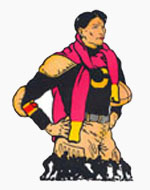
Photographs accompanying the newspaper article include parts of an oil painting and a pen and ink drawing that looks familiar. Discussions with my sources revealed that the oil painting was done by Frank Maze, Dickinson College head football coach 1950-51. It is based on the famous graphic done by Lone Star Dietz that is used as the frontispiece for Steckbeck’s book and on the masthead of this blog. However, Maze put a different head on his version. But whose head was it?

The pen and ink drawing – there turned out to be three in the collection – are Dietz originals of the artwork that adorned the cover of The Red Man magazine. Apparently the collection includes several Dietz items that Steckbeck purchase from the old warrior after he fell on hard times. I can’t wait to see this stuff.

Jim Thorpe historians will not be disappointed as the collection includes an audiotape of Steckbeck’s interview of Thorpe. I hope excerpts from this find their way into the audiobook version of Bob Wheeler’s landmark biography of Thorpe.

The collection also includes glass photo negatives of portraits of Indian School students. Who knows what else might be found in that collection?