Archive for the ‘Jim Thorpe’ Category

Carlisle Not Only Town With Jim Thorpe Mural

February 5, 2009

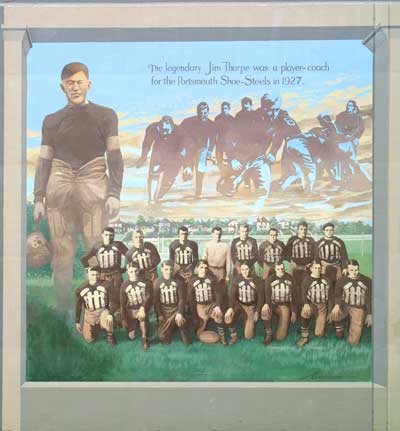
Carlisle isn’t the only town with a mural that features Jim Thorpe. Portsmouth, Ohio also has a mural that features Big Jim in his Canton Bulldogs uniform flanking the Portsmouth Shoe-Steels, a semi-pro football team on which he was player-coach in 1927. That mural, one of about 50, adorns part of the 2,090 feet long 20 feet high concrete wall that protects Portsmouth from Ohio River floodwaters. Artist Robert Dafford of Lafayette, Louisiana began painting the murals in 1993. Jim Thorpe was painted early in the project, being completed in 1994.

The Portsmouth Shoe-Steels were largely recent local high school grads who played football in their free time while working day jobs to support themselves. The Shoe-Steels played their eight home games on LeBold Field. Thorpe lead them to a 7-4 season, beating the Columbus Bobb Chevrolets and the Ironton Tanks late in the season after losing to them earlier. The other two loses were to Cincinnati National Guard and Ashland Armcos, two teams that they only played once.

The next year most of these players, with a season of experience under their belts, played for a new local semi-pro team, the Portsmouth Spartans. In 1930 the Spartans joined the NFL after being sponsored by the Green Bay Packers. Portsmouth was mired in mediocrity until 1934 when Dick Richards bought the team, moved them to Detroit, and renamed them the Lions. That team is definitely not mired in mediocrity as its current 0-16 record attests.

Jim Thorpe & Portsmouth Shoe-Steels mural

Jim Thorpe & Portsmouth Shoe-Steels mural

No Super Bowls for Carlisle Indians

February 2, 2009

Carlisle Indian School football players retired from football decades before Super Bowl I in 1967. In fact, many, including Jim Thorpe and Lone Star Dietz, if not the majority, were already dead. The closest tie to either of this year’s competitors: the Cardinals and the Steelers, is that Jim Thorpe played for the Cardinals in 1928. Thorpe was over 40 then and came out of retirement, after hanging up his cleats at the end of the 1927 season as player-coach of the Portsmouth Shoe-Steels, for what was probably the last time to help the hapless 1-4 Cardinals in a Thanksgiving charity game against their cross-town rivals, the Bears. Big Jim was well past his prime and didn’t play much in this 34-0 pasting, their fifth shutout loss of the year and third in six days. Thanksgiving Day games didn’t replace a Sunday game in those days, they were just inserted into the schedules. The Cardinals lost to Frankfort 10-0 on Saturday, November 24, 19-0 to the New York Yankees the next day, and closed out their season on Thursday, November 29 against the Bears. Thorpe didn’t have enough left in his tank to help a team that gave up 63 unanswered points in these three games.

The Chicago Cardinals were a charter member of the NFL, which originally called itself the American Professional Football Association, but weren’t the Chicago Cardinals in 1920 when the league was first formed. The oldest and losingest team in the league traces its roots back to a sandlot team in Chicago before the turn of the last century. The team claimed its name in 1901 when, a derisive description of his team’s faded maroon jerseys that had been surplussed by the University of Chicago, caused team owner Chris O’Brien to spin that lighter color into cardinal red. They have been the Cardinals ever since. At the time the pro league was formed they were known as the Racine Cardinals because they were located on Racine Street. In 1960 they moved to St. Louis and in 1988 to Arizona. Along the way they won two championships, but one, for 1925, is disputed by the Pottsville Maroons faithful. Thorpe didn’t have much time to think about the loss because his All-Indian basketball team started its season on December 2 against the Detroit Tool Shop Club.

sportraitsthorpe

Common Misconceptions About Carlisle Indian School

January 26, 2009

Google Alerts inform me of “news” on the internet regarding Lone Star Dietz, most of which I ignore. Although the most recent alert was a message largely concerned with Moses Friedman, that blog contains some misconceptions that are probably widely held. Matt is understandably confused by some of the entries on Friedman’s draft card (below) but those inconsistencies aren’t the worst problems. The misconceptions I consider serious are discussed in the paragraphs that follow.

  1. He could pass off the Moses as a given name perhaps, but not Friedman, especially considering that students kept an anglicized version of their Native name.

While it is true that some students were assigned anglicized versions of their original names, my experience researching Carlisle Indian School football players has been that the Anglicized names were generally assigned to an elder in the family, often at the agency in which the family was recorded. By the time Carlisle started fielding a football team in the 1890s, there had been so much intermarriage between Indians and whites that the majority of players I researched carried the family name of a white ancestor. For a small example, I seriously doubt if any of the six Carlisle Indians who were inducted into the College Football Hall of Fame carried Anglicized names, bastardized perhaps, as in the case of Guyon. Those names are:

a.     Albert Exendine (may have originally been Oxendine)

b.    Joe Guyon (probably Guion originally)

c.     James Johnson

d.    Ed Rogers

e.    Jim Thorpe

f.      Gus Welch

Had Friedman’s father married an Indian woman, he could easily been named Moses Friedman, although I am unaware of any evidence that indicates that he has Indian heritage. The point is that his name said nothing, one way or the other, about whether he had Indian heritage or not. Another point is that the Anglicized versions that are known for these men, Bright Path (Jim Thorpe) for one, are nothing like the names they were known by at Carlisle.

  1. My initial thoughts were of Lone Star Dietz, but why would he attempt to pass himself off as Indian with such a German sounding name?

As shown by the sample of European names above, by the 1890s a mixed-blood Indian could carry almost any European surname. Germans may have intermarried less than the French, English and Irish, but surely some did. Having the last name of Dietz (or Deitz as his father spelled it), is probably the weakest argument against him.

  1. However, Native-Americans were not exempt from the draft, …

Non-citizen Indians were exempt from the draft, but citizens weren’t. Indians as a group weren’t granted citizenship until after WWI, so most were not required to serve. However, the fact that so many volunteered and served with distinction speaks well for their bravery and patriotism. A significant number even went to Canada to enlist before the U. S. entered the war.

  1. As an aside, even though I have his date of birth I cannot find any Moses Friedman born in America, let alone Cincinatti [sic], on that date or even in 1874!

It was not unusual at all for births not to be recorded at that time. My own paternal grandmother had no birth certificate and she was born over a decade later.

Friedman’s draft registration is surely confusing, most likely because he was confused. As to why he would check the white box for race and also check the citizen box for Indian: my guess is that, knowing people of any race could be citizens or non-citizens, he ignored the Indian heading when he checked the citizen box. I am unaware of any attempt by Friedman to claim Indian heritage.

A look at his then current employment might shed some light as to why he put Carlisle as his permanent address. He was then doing “special work as stockman for NY Supreme Court” in Taos, NM. After resigning from his position as Superintendent of Carlisle Indian School and being acquitted in Federal Court, Friedman was probably taking any work he could get. His work in Taos sounds like it was temporary and Friedman may have had as yet established a permanent location after leaving Carlisle.

http://ciis.blogspot.com/2009/01/moses-friedman-and-lone-star-dietz-both.html
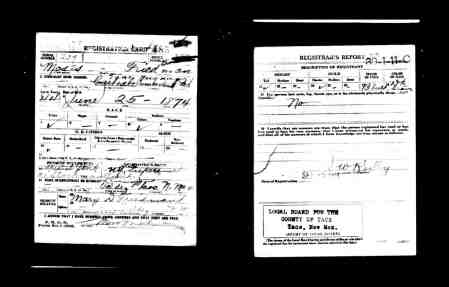
wwidraftcard-friedman

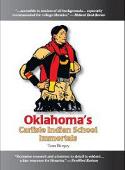
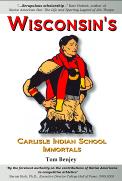
Ebook Created for Carlisle Indian School Football Immortals

January 5, 2009

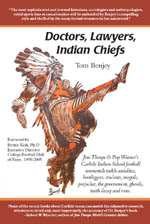
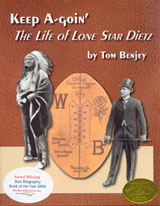
This weekend was productive – maybe. Walt Shiel offered some advice on converting print books to ebook format on a small publishers forum. The first step was to open an rtf file containing the book in question with Microsoft Word. Fortunately for me, Keevin Graham, the graphic designer who lays out my books, had already provided me with an rtf of Doctors, Lawyers, Indian Chiefs. The second step was to save the book as Web Page, Filtered, which produces an html file. So far, so good. The third step was to open the html file with Notepad and save it again, thus eliminating the “secret codes” Word embeds in documents. The resulting file was ready to import into Mobipocket’s ebook creator (available free on the Mobipocket site). There was one small glitch. Doctors, Lawyers, Indian Chiefs has a number of photos, illustrations and tables, items which ebooks don’t display well and which require considerable manual manipulation. FWIW, Keep A-goin’: the life of Lone Star Dietz has a lot more, a factor which will keep it from being converted into an ebook for some time. The illustrations are such an integral part of that book that I’m reluctant to publish an ebook of it without them.

My solution to the problem was to create a new book from Doctors, Lawyers, Indian Chiefs that includes only the background/overview chapters and none of the players’ biographies. Also, at 160,000 words some find the entire book too long and detailed for their taste. Carlisle Indian School Football Immortals: a brief introduction provides the key information about the history of the Carlisle football program and will be of interest to those who are not interested in reading about the individual players. Even this conversion required a lot of manual HTML coding because of all the illustrations and tables are a particular headache. After some “learning experiences” with the Mobibook creator, a prc file was created and uploaded to the Mobipocket site. The prc file was also converted by the Amazon.com Kindle converter and uploaded to its site. I’m waiting to hear back from Sony.

For those who become interested in the players or seeing better quality illustrations after reading the ebook, Tuxedo Press is giving ebook buyers free shipping on print books purchased from them. The net result is that the ebook cost is essentially being refunded because its list price is only $4.99 and Amazon.com is currently offering the Kindle version for $3.99.

a brief introduction

Carlisle Indian School Football Immortals: a brief introduction

Captain of Industry at Thorpe Premier

December 25, 2008

Another Brown end made the trip to Pasadena. Furber I. Marshall was born in New Hampshire to a Avard L., originally form Nova Scotia, and Mabelle, from New Hampshire. When Furber was quite young the family moved to Newport, RI where Avard managed the Newport Beef Company which was affiliated with Swift and Company. Furber played football only one year in high school but starred at basketball. He played center on Rogers High School state championship team in 1913. Later that year as President of the Rogers High School Athletic Association, he presided over a meeting in which it was decided to admit girls as members. In December he served as the chief press agent for the operetta “Bul-Bul” that was put on by the Rogers Glee Club. In February the basketball team lost its captain when Furber contracted blood poisoning in his foot. In September 1914, the man who had been president of the class of 1914 at Rogers High School became the freshman class president at the University of Pennsylvania. September 1915 found him enrolled at Brown University and playing end on its football team. Furber was in Pasadena but saw the game from the bench, most likely, as his name didn’t show up in game reports. In the 1916 season he became a star.

In August 1917, after the U.S. entered WWI, Furber Marshall joined the Army Aviation Corps and was commissioned as a 1st lieutenant after completing flight training in May of 1918. After the war, he completed his degree at Brown as a member of the class of 1919. He then worked in the petroleum industry for eight years, got married, and lived in Chicago for a time. After that he started his own company, Marshall Asbestos Corp, which he operated in Troy, NY. Later, he merged his company with Bendix Aviation Corporation as the Marshall-Eclipse Division and was president of Bendix Service Corp for many years. In 1943 he took over as president of Pharis Tire & Rubber in Newark, OH. The 1950s found him in central PA where he was president of Carlisle Corp., which was best known at that time for making bicycle tires and tubes.

Thus, this captain of industry was in Carlisle in 1951 for the premier of “Jim Thorpe–All American.” The Cumberland County Historical Society has a photo of him with Jim Thorpe and Governor John S. Fine at ceremonies before the premier. He surely talked with his old nemesis at that event, because Lone Star Dietz, coach of the Washington State team that beat Brown in the 1916 Rose Bowl, was also present.

Marshall died in 1957 in Carlisle, leaving behind his wife, the former Sarah Hall, and his mother. He was inducted into the Brown University Hall of Fame in 1975.

Cherokee Wins Heisman

December 15, 2008

Recently a question was raised on this blog about American Indian leadership in athletics. Saturday’s action by the Downtown Athletic Club to award the Heisman Trophy to Sam Bradford may spread this discussion to a broader audience. The Oklahoma University quarterback, being 1/16th Cherokee, is enrolled in the tribe. Last year an ESPN announcer was unintentionally humorous when he stated that Bradford was “certified Cherokee.” The announcer was cut some slack because the enrollment process is very complicated.

Sam’s great-great-grandmother, Susie Walkingstick, was full-blood Cherokee. His father, former OU lineman Kent Bradford, is 1/8th blood Cherokee. It is appropriate that this Heisman winner plays for Oklahoma University because Oklahoma has the largest American Indian population of any state. Fellow Oklahoman Sac & Fox Jim Thorpe did not win the Heisman because that award wasn’t initiated until 1935 when the University of Chicago’s Jay Berwanger became the first recipient of the trophy with the famous pose. Jim Plunkett, being Mexican-American, was probably the first person with significant quantities of Indian blood to win the Heisman when he was named in 1970. Since then, it hasn’t been close. Not even fellow Cherokee Sonny Sixkiller who played quarterback for the Washington Huskies two decades later contended seriously.

A USA Today cover story http://www.usatoday.com/sports/college/football/big12/2008-12-09-bradford-cover_N.htm discusses the impact Bradford’s candidacy has already had on Indian children. Like Sixkiller, Bradford did not live on a reservation and grew up with little exposure to his Cherokee heritage. Anadarko, OK was home for College Football Hall of Famer Albert Exendine, star end at Carlisle. Anadarko is also the town in which Exendine, in the summer of 1911, encouraged Jim Thorpe to return to Carlisle. Alongside this history exists Riverside Indian School, a place where one would expect football to thrive. But that hasn’t been the case. Riverside dropped football a few years ago but, due to Bradford’s inspiration, fielded a team this year. Forty boys came out for the team – not bad for a school that has only 400 students who range in age from 4th grade to high school. The Braves only won one game but this was their inaugural season. The important question is: Are they running the single-wing?

USA Today photo of Sam Bradford with his Heisman Trophy

USA Today photo of Sam Bradford with his Heisman Trophy

Premier at Carlisle Theatre

December 8, 2008

On Friday Antonio Banderas conducted the U.S. premier of his film, El Camino de los Ingleses (The English Road), titled Summer Rain in the U.S., at Carlisle Theatre. This was not the first movie to be premiered at this 1939 Art Deco picture palace. In August of 1951, Jim Thorpe returned to Carlisle to premier his film biography, Jim Thorpe: All American, in which he was portrayed by a young actor by the name of Burt Lancaster. Unfortunately, that film is now dated and needs to be remade, or better yet, an entirely new film needs to be made. Perhaps that will happen.

It seems that a filmmaker interested in shooting a film about Jim Thorpe, Pop Warner or the Carlisle Indian School breezes through town every couple of months gathering information for his or her next production. The most notable, perhaps, of those in recent years was announced in 2004 John Sayles was writing the script for Carlisle School for Walden Media. Nothing further has been seen about that film and that may be for the better. The Hollywood Reporter wrote that Carlisle School, “follows a ragtag group of young Native Americans who achieve prolific victories on the football field that lead them to national prominence. The players, among them future sports legend Thorpe, attended the boarding school in Pennsylvania that, from 1879-1918, housed Native Americans from childhood through college.”

Anyone who knows anything at all about Carlisle Indian School is well aware that its teams were anything but ragtag. To the contrary, Carlisle was frequently criticized for being just the opposite. The recent books about Thorpe and Carlisle have not been the most accurate either. But better things may be in the offing. Kate Buford’s biography of Jim Thorpe is to be released in 2008 and there aren’t many days left in the year. Bob Wheeler is finishing up his audiobook on Jim Thorpe. This is something to look forward to. Thorpe’s Boswell is not just reading his landmark book on Thorpe, he is also including clips from the interviews he made decades ago of people, many of whom are now long dead. It will be great to hear Ike talk about playing against Thorpe in his own voice. I can’t wait.

Jaycees’ Petition

November 6, 2008

I had occasion to talk with Robert W. Wheeler, the author of the definitive biography of Jim Thorpe, and used this opportunity to discuss the hearings, the Jaycees, etc. Bob does not know Mr. Sheaffer so cannot comment on his efforts. However, in 1978 he had significant contact with the Jaycees on a national level, but I’m getting ahead of myself.

Almost immediately after Jim Thorpe’s Olympic honors were stripped from him in 1913, campaigns were started to restore his medals and his records. Bob recalled that what seemed like hundreds of campaigns involving were such people as Damon Runyon, FDR, and Branch Rickey, but all were unsuccessful. The unsuccessful list includes the one Sheaffer mentioned that was from Yale, OK and was headed by Grace Thorpe.

In 1978, the Jaycees redoubled their efforts and gathered over a million signatures on a petition to have Jim Thorpe’s Olympics triumphs restored. Bo Wheeler recalls that the Jaycees’ petitions were a major part of the nationwide effort which gathered over three and a half million signatures. As part of this effort Bob Wheeler and Jack Thorpe addressed the Jaycees’ national convention. Unfortunately, that was not the year of the final breakthrough. That would happen a few years later when Bob’s wife and researcher-in-her-own-right, Florence Ridlon, found the 1912 Olympic rule book lost in the stacks of the Library of Congress. The rest, as they say, is history.

A Hearing for Jim Thorpe part II

November 3, 2008

Freddy Wardecker did some research and found some old newspaper clipping related to Project Jim Thorpe. Freddy thought it might have been an initiative of the Carlisle Jaycees and his hunch paid off. He found a May 12, 1973 article from the Carlisle Sentinel titled “Carlisle JCs Renew Jim Thorpe Issue. It mentioned that the Project Jim Thorpe was started in 1969 with the goals of reinstating Jim Thorpe in the International Olympic record book and to have his medals and trophies returned. Apparently the medals and trophies were to have been housed in a proposed track and field hall of fame museum in Carlisle. One cannot tell from the article whether the museum was the one proposed by Joel Platt or not. No mention was made of the committee chair.

Reporter Bob Jackson wrote, “…After running into continual  obstacles created by the International Olympic Committee, “Project Jim Thorpe” lost momemtum and was dropped as an active project in 1971. Sensing that the Jim Thorpe Committee from Jim’s hometown of Yale, OK was about to have some success after the demise of Avery Brundage, the Jaycees launched a petition drive in which citizens were asked to sign a petition that was to be sent to President Nixon.

Freddy also found a January 29, 1974 article that announced the Jim Thorpe Memorial Exhibition to be held on March 29-31 of that year. Residents were asked to lend photos and memorabilia related to Thorpe. The exhibition was to be held at the Carlisle Jaycee Home, 311 East North Street, Carlisle. Michael L. Sheaffer was named as chairman of the Memorial commi

A Hearing for Jim Thorpe

October 31, 2008

A press release just came across my virtual desk that informs me of an event to be held in Carlisle on May 28, 2009. It’s not clear to me if this is to just be a booksigning or a reenactment of the fictional trial described in “A Hearing for Jim Thorpe, An Exercise in Frustration” by Michael L. Sheaffer. Mr. Sheaffer’s website http://mikesheaffer.com/researchmaterials.htm is not clear about where the signing will take place. The Cumberland County Courthouse is depicted as the site of the hearing, but is not identified as the location of the booksigning. It is my understanding that it is not scheduled to be held at Whistlestop Bookshop where many such events take place.

I am at a loss to understand why this book was written and, since it was written, why Bob Wheeler and Florence Ridlon, the people who got Thorpe’s medals restored, weren’t involved.

I don’t know the author and probably move to Carlisle after he left. I will email him about this blog to give him a chance to comment on it. I have not been able to find out anything about Project Jim Thorpe. I have enlisted Freddie Wardecker to help me locate someone who would have been around at the time and might know about that project.

Perhaps the author will tell us more. Who knows? We might like it after we know more about it. It is my hope that Mr. Sheaffer researched original sources and not recent fictionalized accounts. However, his research materials lists only websites.