Archive for the ‘Jim Thorpe’ Category

Jenkins and Anderson Omit 1905 Army Game

May 26, 2009

The May 2009 College Football Historical Society newsletter includes an article that debunks the basic premise for the 2007 books by Sally Jenkins and Lars Anderson, The Real All Americans: the team that changed a game, a people, a nation and Carlisle vs. Army: Jim Thorpe, Dwight Eisenhower, Pop Warner, and the forgotten story of football’s greatest battle, respectively. In “Jude and the Prince,” James G. Sweeney, a lawyer, former prosecutor and, most importantly, an Army fan for 50+ years, describes the epic Carlisle-Army game in detail. The difference between his article and their books is that Sweeney writes about the first time Carlisle met Army on a football field where Jenkins and Sweeney write about the second meeting – without acknowledging the first game. Their omission could be overlooked if the 1905 meeting was played by scrubs or special rules or something of the kind. In fact, the November 11, 1905 Carlisle-Army game was, as Sweeney put it, “was ‘the’ game of the day.” Sweeney also quoted The New York Tribune: “Never before has a football game at West Point been witnessed by a more distinguished gathering. Seated on the grandstand was Prince Louis of Brattenberg, surrounded by army officers, both British and American. The gold lace and trappings of military men, mingled with the gay dresses and flags of pretty girls, made a sight worth seeing.”

By the way, Carlisle won the game 6-5 to settle the score with the “long knives” seven years before the meeting Jenkins and Anderson touted in their books. In Anderson’s case, it may be a matter of ignorance. At the talk he gave in Carlisle, Lars Anderson mentioned that, in order to get his book in print at the same time as Jenkins, he employed a researcher. The researcher probably didn’t look at anything outside the narrow scope he was given. Sally Jenkins, on the other hand, appears to have been aware of the 1905 game. About the 1905 season, she wrote, “The Indians were a predictable disappointment under [Advisory Coach George] Woodruff….They were 10-5 and lost every significant game, and more important, they lost their uniqueness. Their only real fun came in a 36-0 defeat of crosstown rival Dickinson.” John S. Steckbeck, The Arrow and CFbDatawarehouse.com all reported a 10-4 record for the 1905 Indians, with losses to Penn, Harvard, Massillon A. C. and Canton A. C. Jenkins ends what game coverage she had for the 1905 season with the loss to Harvard on a soft field. She apparently doesn’t consider the wins over Penn State, Virginia, Army, Cincinnati, Washington and Jefferson, and Georgetown as significant. Nor does she consider beating Army, thumping Cincinnati 34-5, beating Washington and Jefferson 11-0, or embarrassing Georgetown 76-0 to be fun.

On page two of her book, Jenkins implies that she knew the 1905 game had taken place without mentioning the game or sport when she wrote, “…this was only the second time government authorities had allowed the two parties to meet on an athletic field.” Perhaps Ms. Jenkins will explain why Carlisle’s 1905 victory over Army was neither significant nor worthy of mention.

Prince Louis Battenberg, 1905

Prince Louis Battenberg, 1905

Film Footage of Jim Thorpe

May 12, 2009

Recently, a friend and I bemoaned the lack of film footage of Jim Thorpe. We conjectured that footage of the 1912 Stockholm Olympics must exist somewhere. Then I stumbled across an article about an auction of articles related to the great Thorpe. In an article titled “Jim Thorpe Mementoes in Demand at Sports Immortals Sale,” Rosemary McKittrick wrote about an auction conducted jointly by Guernsey and Hunt. Apparently, the auction was held last October in Atlantic, NJ. The source of the memorabilia wasn’t clear from the article. However, she used “Sports Immortals” in the article’s title, so these items may have come from their collection. The item that caught my eye was “Film and footage; Thorpe playing for the Canton Bulldogs; rare, early glimpse of Thorpe in action on football field; $1,155.” I don’t know if these items sold for the amounts listed or if they were just the auctioneer’s projections. As pleased as I was to discover that footage of Jim Thorpe still exists, it wasn’t of the Olympics. Oh well.

IMDB.com list a 1996 made-for-TV documentary, “100 Years of Olympic Glory,” directed by Bud Greenspan. The film includes archive footage of Jim Thorpe with King Gustav at the 1912 Olympics. Now to find a copy of that video.

A further look at IMDB.com uncovered a listing titled “The Giants-White Sox Tour.” The 1913 World Series was filmed. Perhaps that action prompted Jim Thorpe to sell the movie rights to his marriage to Iva Miller in Carlisle. Immediately after their wedding, the Thorpes joined the New York Giants for their around-the-world-tour with the Chicago White Sox. This film documented that tour. Perhaps it includes footage of the wedding. I can hope. Now to find a copy of it this, the first full-length documentary.

IMDB.com also lists archival footage of Jim Thorpe appearing in “Idols of the Game,” a 1995 video hosted by Dabney Coleman. That gives me three films to look for.

Jim Thorpe

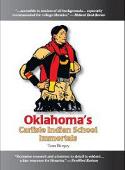
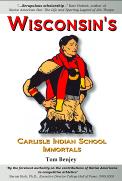
Oklahoma’s Carlisle Indian School Immortals

May 7, 2009

Galleys for Oklahoma’s Carlisle Indian School Immortals, the first book in my upcoming series on Native American Sports Heroes, have arrived. At about 160,000 words, Doctors, Lawyers, Indian Chiefs is too long for most middle school and many high school students to read. So, I am splitting it up into a series by state, the first of which is Oklahoma because it has the largest Indian population of any state. It also was home to many of the Carlisle stars. Splitting up the book into smaller volumes has another advantage; it makes room for some more players. Doctors, Lawyers, Indian Chiefs got to be so long that I had to stop adding players, but now I have places to tell their stories. For example, Henry Roberts and Mike Balenti  are in Oklahoma’s Carlisle Indian School Immortals but aren’t in Doctors, Lawyers, Indian Chiefs.

The new book will be in hardback so that it is attractive to libraries and is under 200 pages long, including the index and appendices. My hope is that school and public libraries across Oklahoma, and elsewhere, add this book to their collections. A book reviewer suggested that grandparents may be interested in giving this book to their grandchildren as gifts. I would like that because my readers to date tend to be over 40. Young people should know about the lives and achievements of Carlisle Indian School students.

Like my other books, Oklahoma’s Carlisle Indian School Immortals is heavily illustrated with rarely seen period photos and cartoons. Bob Carroll of the Professional Football Researchers Association even drew portraits of all the players for the book. This book will be released in September.

09774486812

Indians Dissed by Halls of Fame

May 4, 2009

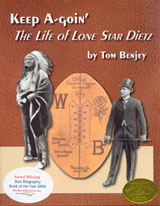
Last week was a bad week for Indian athletes. Both players and coaches continue to be overlooked for honors they deserve. Lone Star Dietz was passed over again for Induction into the College Football Hall of Fame as a coach. He was inducted into the prestigious Helms Foundation years ago but the College Football Hall of Fame didn’t even think he was eligible until a few years ago. It wasn’t until Washington State super-alum Greg Witter and I did some research and got Dietz’s win-loss record corrected that they put his name on the ballot. By then he had been dead for almost 40 years and very few people are still alive that remember him. But he’s not the only Indian the College Football Hall of Fame has dissed or the only Hall of Fame to diss an Indian athlete.

Last week the West Shore Chapter of the Pennsylvania Sports Hall of Fame inducted its new class. Frank Mt. Pleasant, who I nominated last year, wasn’t picked. It’s hard to imagine how the chapter local to his greatest achievements could overlook one of the greatest of the Carlisle Indians, but they did. Fortunately, the West Shore Chapter isn’t the only option. He was already inducted into the Indiana University of Pennsylvania Hall of Fame for his work there as a coach after his playing days were over. Maybe their chapter will induct him.

Recently, questions have come in about the Haskell Institute star John Levi. He was considered to be as good as Jim Thorpe in every aspect of the game but kicking. Thorpe himself considered Levi to be the best athlete he had ever seen. Unfortunately for John, Carlisle Indian School did not exist when he came of age. The mantle of Indian sports leadership passed to Haskell Institute in Lawrence, KS after Carlisle closed. Although Levi and his Haskell teammates had great records under Coach Richard Hanley, they seldom played in front of the eastern media. That kept John Levi from being named to the major All America teams. He was named to minor ones but that wasn’t enough to get him elected to the Hall of Fame. J

im Thorpe wasn’t the only Indian to lead the nation in scoring (198 points in 1912); John Levi outscored everyone in both 1923 and 1924 (149 and 112 points, respectively). His teammate, Mayes McLain outdid him and everyone else in 1926 with 259 points. Barry Sanders holds the all-time single-season scoring record with 234 points. By my math, he scored 25 fewer points than Mayes McLain. Why doesn’t McLain hold the record?

Legendary coach Charles Moran isn’t in either although he had a great record, including the legendary 1921 defeat of Harvard by his Centre College Praying Colonels. Maybe it’s because he coached Mike Balenti and Victor “Choc” Kelley in his first year at Texas A & M.

Iva Miller’s Parents Objected to Jim Thorpe

April 24, 2009

I was surprised to read “He was in love with a Carlisle student named Iva Miller, but her parents forbade the marriage and she went home to California” on page 287 of The Real All Americans: The Team That Changed a Game, a People, a Nation by Sally Jenkins. The reason for my reaction was that it was my understanding that Iva’s parents died when she was quite young, a fact that made forbidding their daughter to marry Jim Thorpe over a decade later quite difficult. I wondered if Ms. Jenkins discovered that they had faked their deaths or found that they had risen from the dead. However, her book mentioned nothing of the sort. That earlier books on Thorpe reflected something considerably different from what Jenkins claimed prompted me to do some research. Jenkins sources for this discovery would provide a good starting point. However, unlike for many other points in her book, she provided no reference for this statement.

Iva Miller’s Carlisle Indian School records seemed to be a good place to start. They arrived this week and provided some interesting information. Her parents did not sign her enrollment papers; Grace Gray-Morris, who likely was her older sister or aunt, signed the papers and swore that Iva’s dead mother was half-blood Cherokee from North Carolina. Iva’s Physical Record indicated that her father was living and in good health as were three brothers and a sister. Another brother had died of pneumonia and consumption had taken her mother. Iva had attended Chilocco Indian School before coming to Carlisle and Ms. Gray-Morris probably assisted with her enrollment at that facility due to her geographic proximity in Arkansas City, Kansas, the town closest to Chilocco.

I haven’t found Iva’s father on censuses after 1900 but that doesn’t mean he wasn’t still alive and living in California in 1912 when Iva graduated from Carlisle and supposedly returned home to her parents. She may have visited family members in California for a bit but wasn’t held there because she was soon in Oklahoma. Her letters to Carlisle that were published in the school newspaper indicated that she spent the summer in Oklahoma and the fall working at the Otoe Agency. My findings differ significantly from what Jenkins published.

Iva Miller Thorpe's Wedding Photo

Iva Miller Thorpe's Wedding Photo

Pete Hauser’s Demise Clarified

April 8, 2009

Today I received a fax of the front page of the July 22, 1935 edition of the Pawhuska Daily Journal Capital from the Oklahoma Historical Society. The combination news article/obituary clears up the questions regarding Pete Hauser’s untimely demise.

Pete spent the evening of Saturday, July 20, 1935 at a baseball game in Bartlesville, Oklahoma with two friends. Pete, Chauncey Archiquette and George Frass were about 4 miles out of Pawhuska on the Bartlesville Road when their car had a flat tire. For reasons unstated, they parked Archiquette’s car in the middle of the road. A good guess might be that at 3:00 a.m. on a Sunday morning in rural Oklahoma in 1935, they didn’t expect any traffic. As Pete was tightening the lug nuts, Archiquette stood in front of the car and waved at an oncoming vehicle to pass it on the left because there was more room. Miss Violet Stuart of Bartlesville was driving the oncoming car which was owned by her passenger, A. C. Applegate of Dewey. She attempted to pass the stopped car on its right and clipped its left front fender and killed Hauser by breaking his neck.

Pete and Chauncey were long-time friends as both had attended and played football at Haskell Institute and Carlisle Indian School. Pete was living with Chauncey at the time of the accident and was employed by a Depression-era government program, the Indian Emergency Conservation Work, a division of the Civilian Conservation Corps (CCC).

Pete was active in the American Legion after serving at Fort McArthur, Texas during WWI. His Legion Funeral Rites were held at Johnson Chapel. A Legion quartet sang at his funeral and a rifle squad fired a salute at graveside. Honorary pallbearers included old football chums Pop Warner, Jim Thorpe, Albert Exendine, Walter Mathews and Archiquette.

Carolyn Williams was essentially correct in her understanding of the accident.

Indians Apply for Dickinson College Job

April 1, 2009

When looking through the Dickinson College archives for something else, the first paper I saw was a 1931 newspaper article announcing that Jim Thorpe had applied for the vacant head football coach position at that institution. Thorpe only wanted to coach there for a year because he was involved in business matters in the Oklahoma oil industry that were expected to occupy more of his time in the future. He was also negotiating with Mississippi A&M. Dickinson alum Gus Welch also applied for the position as did 50 others.

Neither of the Indians got the job as it was formally accepted by Joseph M. McCormick at the “D” banquet held on March 25th at the Molly Pitcher hotel. McCormick had been coaching at prep schools such as Mercersburg Academy and The Hill School. He had most recently coached at Roxbury School in Cheshire, CT. He led Dickinson’s Red Devils to their best season in six years. Thorpe took a job digging the foundation for a new hospital in Los Angeles. There was some truth to Thorpe’s story about the oil business, but it was in East Hawthorne, CA. The Jim Thorpe Petroleum Syndicate acquired 100 acres of land formerly owned by Gilbert Bessemyer. Jim was president of the syndicate and his cousin, Hawthorne’s chief of police, was one of the directors. In late April, the Putnam City school district announced that Thorpe had been hired as director of athletics for the rural school district located five miles west of Oklahoma City. In late June, he went into the movies to play, not surprisingly, Indian parts. He had small roles in a number of films. He spent New Year’s Day of 1932 watching the Rose Bowl, is first, as an Associate Press reporter.

Gus Welch became the head coach at Haskell Institute in 1933 after Lone Star Dietz departed for the NFL.

Bogus Jim Thorpe Photo on ebay

March 19, 2009

Carlisle memorabilia collector Frank Loney asked my opinion about a photo that is currently up for sale on ebay. Immediately upon bringing up the item on ebay, I noticed that the photo could not be as advertised due to the seller’s description of it:


THIS IS AN INCREDIBLY RARE PIECE. IT IS AN ORIGINAL VINTAGE 1910 JIM THORPE FOOTBALL PHOTO. THIS WAS TAKEN AT THE CARLISLE INDIAN SCHOOL. THIS IS A 3×5″ PHOTO OF THE GREATEST ATHLETE OF ALL TIME WITH HIS TEAMMATES. INCREDIBLY AWESOME ! IF YOU HAVE ANY QUESTIONS ABOUT THE HISTORY OF THIS PHOTO, PLEASE DON’T HESITATE TO ASK.

As anyone who is at all familiar with Jim Thorpe knows, he was not at Carlisle in 1910. So, right off the bat, the date is wrong. One of the first things one sees when looking at the photo are his teammates’ names. The only problem is that those names aren’t the names of Carlisle Indian School football players. The uniforms the players are wearing are not Carlisle uniforms. This must be some other team. When one looks closely at Thorpe’s image on the photo, it is not Jim Thorpe, or at least not the Jim Thorpe who played at Carlisle. This is clearly not a photo of a Carlisle Indian School football team.


Frank contacted the seller before I looked at the photo and got this response:


this was purchased at sotheby’s auction. after examination by auction house. it was determined to be between 1908-1912. the picture came from his estate and is 100% legit. the other players were from the carlisle indian school which was a college. thank you.”


As we all know, Carlisle was never a college and never purported to be one. If Sotheby’s actually examined the photo, which I doubt, they blew it. All they needed was five minutes with Steckbeck’s book to determine this was neither Jim Thorpe nor the Carlisle Indians. This may well be an interesting photo but of different people and another team.


Be careful out there. Things aren’t always what they seem.

misindentified-carlisle-photo 

Jim Thorpe Fitness Center

March 16, 2009

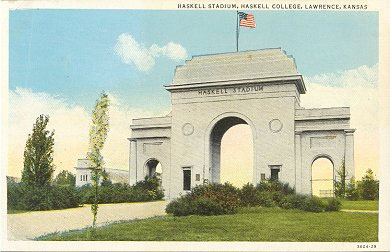
Not long ago it was my pleasure to inform readers that Carlisle, PA isn’t the only town to have Jim Thorpe on a mural. Now I can share that Carlisle Barracks isn’t the location of the only Jim Thorpe Fitness Center. Haskell Indian Nations University (HINU, Haskell Institute in Big Jim’s day) also has a Jim Thorpe Fitness Center. In fact, Haskell has had a Jim Thorpe Fitness Center for a couple of years – in a building constructed and named after the great athlete 50 years ago. A sign that formerly adorned the building’s exterior now hints to the building’s former use now hangs inside the building.

On Monday, March 9, 2009, Robert W. Wheeler, author of “Jim Thorpe: World’s Greatest Athlete,” gave a talk at the re-dedication of the Jim Thorpe Fitness Center as part of the commemoration of the 125th anniversary of Haskell’s founding. The building formerly known as the Jim Thorpe Power Plant now houses machines designed to help humans maintain their muscle tone rather than machines to eliminate the need for human muscle power.

In the audience was someone who also is familiar with Carlisle. Before joining the faculty of the University of Kansas, Bernie Kish was executive director for the College Football Hall of Fame for a decade. I met Dr. Kish there when researching Lone Star Dietz. Bernie recalled his time in Carlisle:

“I was a career military officer, serving in the US Army for over 29 years. In 1981, I attended the Army War College at Carlisle Barracks—the site of the Carlisle Indian School—in Carlisle, Pennsylvania. It was my privilege to play basketball in the same gymnasium and run laps on the same track as Thorpe, Lone Star, and Gus Welch. The biggest annual extra-curricular event at the War College is Jim Thorpe Sports Day. It is competition in ten sports among the military’s senior service schools, the Army, Navy and Air Force War Colleges plus the National War College and the Industrial College of the Armed Forces. For two days, these future generals forget their military studies and compete for the honor of taking home the Jim Thorpe Sports Day Trophy. I was the Athletic Director for the 1982 Sports Day and in that capacity came to know Carl Thorpe, Jim’s son, quite well. I still treasure the photo of Carl and me presenting the Sports Day awards.”

haskell-football-stadium

A Visit to Sports Immortals

February 12, 2009

Last week I was finally able to visit the Sports Immortals museum in Boca Raton, FL. Joel Platt has collected over a million items of memorabilia from the various major American Sports (read don’t expect to see a lot of soccer and cricket stuff). Do expect to see championship belts won by Joe Louis and John L. Sullivan, the most expensive baseball card, Jim Thorpe’s football helmet, and a plethora of other items squeezed into a small space. Platt has embarked upon a campaign to raise $100M to build the ultimate sports museum. To that end Platt is putting together a traveling exhibit to tour the country and raise seed money to get the fundraising started in earnest. A much larger facility is needed. Mayor Reed of Harrisburg would surely love to have the Sports Immortals for the All-Sports Museum he wants to build on City Island near the Senator’s field. However, the price tag for Platt’s collection would have to be out of Reed’s reach. Considered by many to be the most complete sports memorabilia collection to have ever been put together, only the federal government would have the resources to both acquire the collection and build a worthy building in which to house it. Until the Smithsonian decides to do something, Joel will keep following his dream. Of particular interest to me was a painting of old Pittsburgh that Lone Star Dietz painted in 1951. Below is a photo of Joel Platt holding that painting. Dietz entered the painting in the Advertising Artists of Pittsburgh Annual Show and won third prize. Lone Star lived in Pittsburgh after WWII and operated the Liberty Academy on Liberty Avenue. “Pittsburgh Just Grew” was done in a style different from others I have seen in Dietz’s work. The colors in this painting still jump off the canvas over 50 years later.

Pittsburgh Just Grew