Archive for the ‘Haskell Institute’ Category
January 1, 2014
***Update January 14, 2014*** Joseph Sullivan, Assistant Managing Editor and Sports Editor for The Boston Globe, responded to my request that The Globe correct at least some of the numerous errors in its December 29, 2013 article, writing, “None of your points warrant a correction. It’s time to move on.” This is further evidence of why newspapers, such as The Boston Globe, are in such sad shape today.
Ninety-eight years ago today, Lone Star Dietz was toasted by football fans across the country after defeating Brown University on New Year’s Day in Pasadena, California. This great victory in an historic game not only established the Rose Bowl and all the others that followed but put long inferior West Coast football on an even footing with the East Coast powers. In recent years, media activists bent on changing the Redskins’ name have found it convenient to assassinate Dietz’s character. Many thought Lone Star’s long awaited and much deserved 2012 induction into the College Football Hall of Fame would end this disrespectful treatment.
Instead, their hatred appears to have intensified based on the scurrilous opinion piece—the article is so riddled with errors and half truths it can’t be considered news—by The Boston Globe staff writer Kevin Paul Dupont for the December 29 edition.
http://www.bostonglobe.com/sports/2013/12/29/redskins-wonder-what-name-the-answer-traces-back-boston/GmfYbPTnHx1Ht5NgqN1EOM/story.html
To some extent, Lone Star is collateral damage because George Preston Marshall is activists’ primary target. However, they apparently think it’s necessary to smear Dietz in order to get Marshall. Their strategy has been, and still is, to destroy Marshall’s claim that the team was named in honor of its coach and (four) players who followed Dietz from the government Indian school at Lawrence, Kansas to Beantown. Simply put: assassinate Dietz’s character, eliminate Marshall’s premise, and forget the Indian players.
Much of this latest smear takes a different tack from earlier ones by posing the point that it was less expensive for Marshall to change the team’s moniker to Redskins than to some other non-Indian-related name. Central to Dupont’s argument is a point he made no less than four times in that piece: Marshall was sitting on a pile of perfectly good uniforms and saved a bundle by continuing to use them. The major problem with this, apparently unresearched, argument is that Marshall bought a whole new set of jerseys for his 1933 team!
<to be continued>
Tags:Boston Braves, George Preston Marshall, Kevin Paul Dupont, redskins, The Boston Globe
Posted in Carlisle Indian School, Football, Haskell Institute, Lone Star Dietz, Washington Redskins | 6 Comments »
December 27, 2013
I neglected to mention that Paul LaRoque played hurt in the last game of the 1905 season against Georgetown. He started the game with a broken rib but probably didn’t play long in this 76-0 blow out. So, diseased or injured, he probably completed the 1906 season on the field for the Indians. His grandson informed me that, instead of sitting quietly at home, he played for the “North Dakota Bison” in 1907. That prompted me to do a little more research.
I quickly found newspaper clippings of a couple of North Dakota Agricultural College (today’s North Dakota State) games in which LaRoque was on the line—right tackle against South Dakota and right end against Haskell Institute. “Gloomy” Gil Dobie coached the North Dakota Aggies (as they were generally called) in 1906 and 1907 contrary to what Wikipedia states. One would think NDSU fans would want to see Dobie mentioned as one of their successful coaches. However, CFBDATAWAREHOUSE.com has that right. That site lists the Aggies having played only three games that year. They likely played more but I haven’t found them. One wonders if playing for “The Apostle of Grief” convinced Paul to return to Carlisle or if the announcement of Warner’s return swayed him or if that was his plan all along. We’ll probably never know for sure.
Something that readers may find confusing is that LaRoque played on the line but was mentioned in newspaper reports as having made good gains carrying the ball. In those days, linemen were sometimes positioned in the backfield and also were handed the ball on criss-cross plays. It was a much different game then, particularly before teams adapted to the 1906 rule changes.
Tags:Gil Dobie, North Dakota State, South Dakota
Posted in Carlisle Indian School, Football, Haskell Institute, Pop Warner | Leave a Comment »
May 6, 2013
Professor Joseph Gordon Hylton posed some opinions and asked a question with regard to the naming of the Redskins NFL team yesterday. He stated that George Preston Marshall, owner of the Boston NFL franchise, had a life-long fascination with Indians. That is believable because another NFL owner, Walter Lingo, believed there existed a mystical connection between Indians and the Airedales he raised and sold. His team was formed a decade before Marshall’s and was named the Oorang Indians. Now to Dr. Hylton’s question:
“Has anyone pinpointed the day that the name change was announced?”
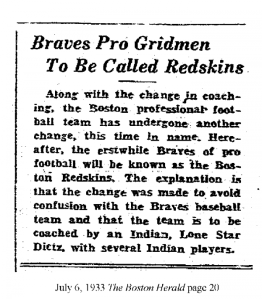
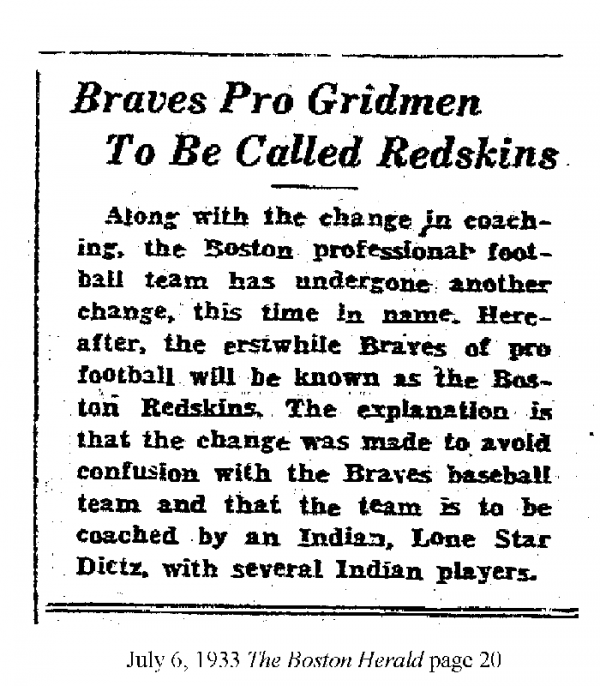
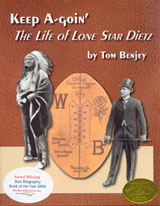
I previously located letterhead for the Boston Braves that listed Lone Star Dietz as the head coach (see p. 278 of Keep A-goin’: the life of Lone Star Dietz) but hadn’t tried to pinpoint the exact date of the name change. A little research turned up the date Dietz was named head coach in a March 8, 1933 issue of The Boston Herald. The team was referred to as the Redskins on the sports page by the end of August, so it had to renamed before that. A little more research located the announcement of the team’s name change. The July 6, 1933 issue of The Boston Herald included a short article titled Braves Pro Gridmen to be Called Redskins (see below). This article establishes the fact that the Redskins were renamed well after Dietz’s hiring and includes the team’s published reason, “…the change was made to avoid confusion with the Braves baseball team and that the team is to be coached by an Indian, Lone Star Dietz, with several Indian players.”
This article supports the contention made by George Preston Marshall’s granddaughter several decades later.
Tags:Boston Braves, Boston Redskins, George Preston Marshall, redskins, Washington Redskins
Posted in Football, Haskell Institute, Lone Star Dietz | 3 Comments »
October 26, 2012
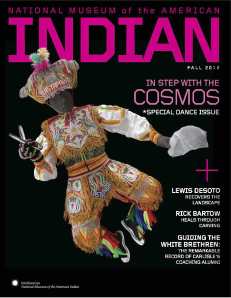
The electronic version of the Fall 2012 edition of the magazine for the National Museum of the American Indian (NMAI) is finally out. My article on Carlisle Indians who went on to coach other teams is on page 46 (page 44 of print version). The idea for this article came to me after attending Lone Star Dietz’s enshrinement ceremony into the College Football Hall of Fame. He is the only Carlisle Indian to be inducted as a coach. Six others, some of whom also coached, were enshrined previously but as players. It is unlikely that any others will receive this honor because no other Carlisle Indian coached as long or with nearly as much success as Dietz.
American Indian athletic prowess is getting much attention this year due to 2012 being the 100th anniversary of Jim Thorpe’s extraordinary triumphs in the pentathlon and decathlon at the 1912 Stockholm Games. Anyone unfamiliar with Native Americans’ success in the Olympics can read my several previous blog entries on this topic.
Worthy of note is that Dietz and the others had great success coaching white college and professional players. Many of them, including Dietz, coached Indian teams at one time or another but the vast majority of their coaching careers were with white college teams. Having played with Carlisle and knowing the Warner System gave these men instant credibility and opened doors for them. After going through those doors, success or the lack of it was the deciding factor. After all, sports have always been a meritocracy. Performance matters above all. Carlisle players succeeded on the field both as players and coaches. The graduate system of coaching that was tried in the early 20th century limited coaching opportunities for those who hadn’t attended major colleges but numerous smaller schools welcomed Carlisle Indians to lead their teams. Although far from an ideal situation, these men were given the opportunity to succeed or fail on their own merits and they largely succeeded.
http://content.yudu.com/A1yt4b/fall2012/resources/index.htm?referrerUrl=http%3A%2F%2Fwww.americanindianmagazine.org%2Fabout-us
Tags:1912 Olympics, coaching football, College Football Hall of Fame, National Museum of the American Indian, NMAI, Stockholm Games
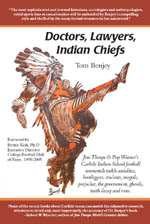
Posted in Albert Exendine, Bemus Pierce, Caleb Sickles, Carlisle Indian School, Doctors, Lawyers, Indian Chiefs, Football, Frank Cayou, Frank Mt. Pleasant, Gus Welch, Haskell Institute, James Phillips, Jim Thorpe, Joe Guyon, Joel Wheelock, Lone Star Dietz, Pop Warner, William Baine, William Gardner | Leave a Comment »
June 20, 2012
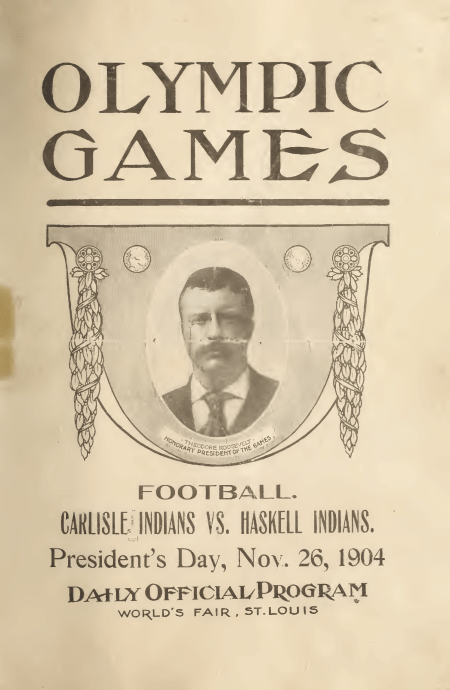
Tex Noel recently sent me a link to a list of numerous books, programs and other football memorabilia that have been digitized and are available on-line. Included in the list was the program for the 1904 Carlisle-Haskell game which was held at the St. Louis World’s Fair, in part, for the entertainment of President Roosevelt who visited the fair but did not attend the game.
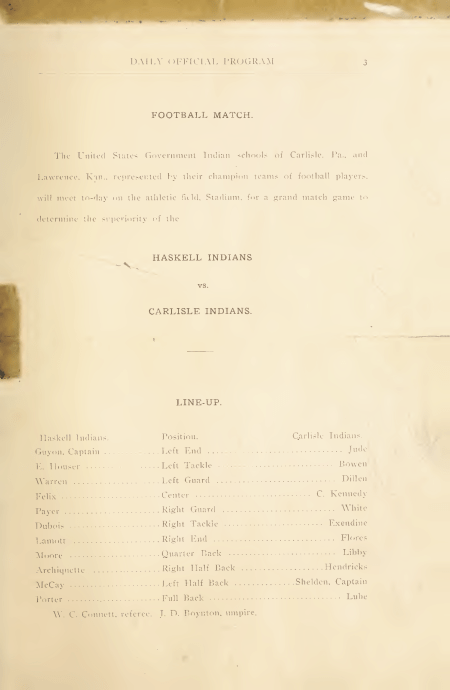
Page 3 of the program contains the proposed line ups for the two teams. At first glance, the Haskell line up looked similar to the one Steckbeck included in Fabulous Redmen,but the Carlisle line up was significantly different:
Program Steckbeck
Jude LE Rogers
Bowen LT Bowen, Gardner
Dillen LG Dillon
Kennedy C Shouchuk
White RG White
Exendine RT Exendine
Flores RE Tomahawk
Libby QB Libby
Hendricks RH B. Pierce, Hendricks
Shelden LH Sheldon, Lubo
Lube FB H. Pierce
Jude, Kennedy and Flores didn’t get in the game. Coaches Ed Rogers and Bemus Pierce suited up for the game. Hawley Pierce and long-time player Nikifer Shouchuk also played. The reason given for loading up the line up was that rumors swirled around that Haskell was even recruiting white ringers for the big game. That doesn’t seem to have happened. What did happen was that some of the best players ever to play at Carlisle could be found on both sides of the ball. Some, like Archiquette had previously played for Carlisle but were at Haskell in 1904 (and would return to Carlisle in 1905). Others like Charles Guyon (Wahoo), Pete Hauser and Emil Hauser (Wauseka), would star at Carlisle in the years that followed. The two line ups amounted to a who’s who in Indian football at that time.
Tags:Aiken, Charles Dillon, DuBois, Feliz, Fritz hendricks, Gokey, Lamott, McClean, McLean, Moore, Nikifer Shouchuk, Oliver, Payor, Scott Porter "Little Boy", Tomahawk, Warren, White
Posted in Albert Exendine, Antonio Lubo, Archie Libby, Arthur Sheldon, Bemus Pierce, Carlisle Indian School, Charles Guyon, Chauncey Archiquette, Doctors, Lawyers, Indian Chiefs, Ed Rogers, Emil Hauser, Football, Haskell Institute, Hawley Pierce, Joe Libby, Pete Hauser, Wauseka, William Gardner | Leave a Comment »
June 12, 2012
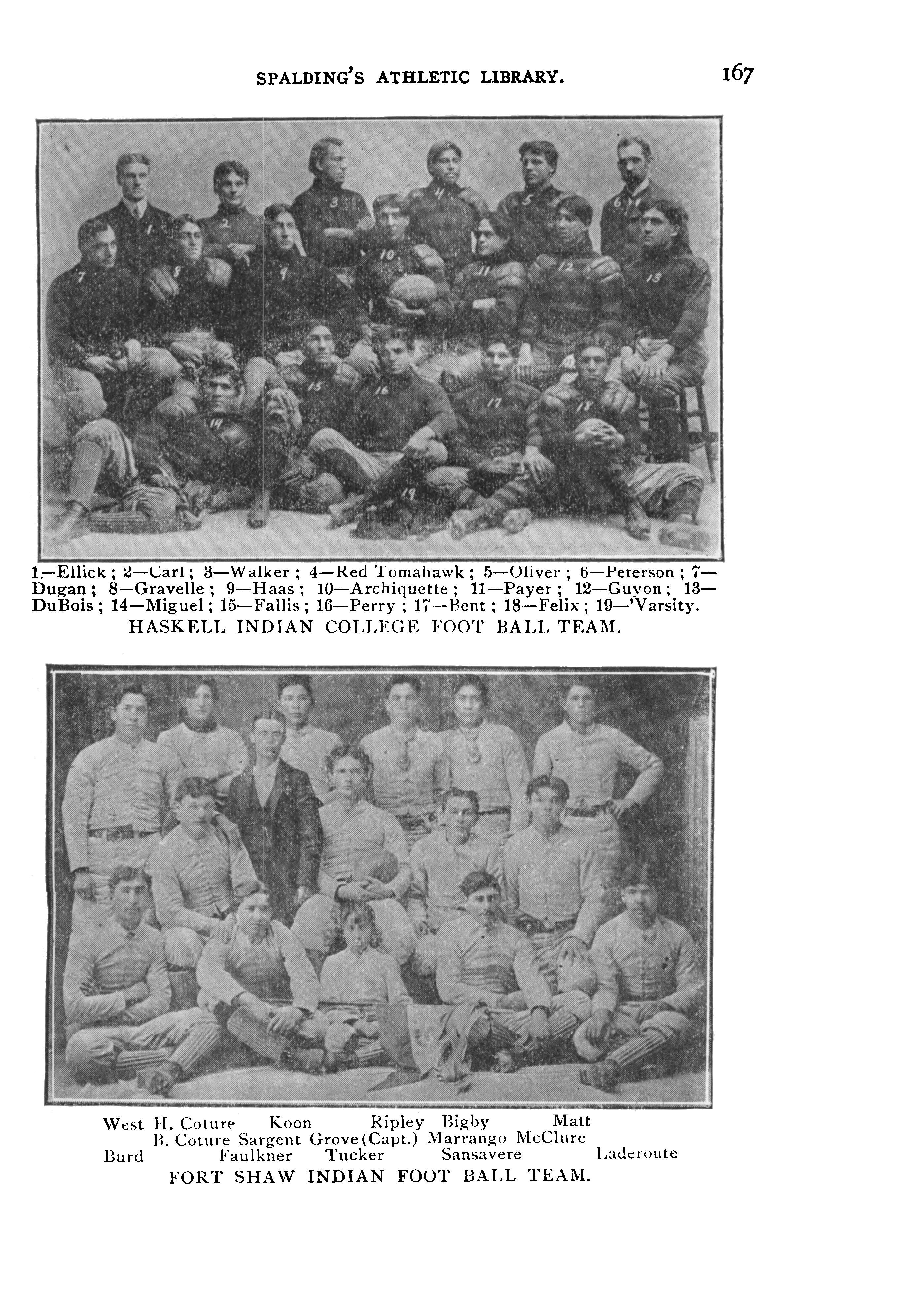
While preparing the 1901 Spalding’s Guide for printing, I noticed that some future Carlisle players could be found in two photos on page 167. The first photo was of the 1900 Haskell Institute team but was mislabeled as being “Haskell Indian College,” in much the same way as Carlisle Indian Industrial School was often referred to as Carlisle College. Perhaps the whites who elevated these government Indian schools to collegiate status felt embarrassed that the Carlisle and Haskell Indians routinely defeated teams from the elite schools with players who had less education, money or experience playing football.
The first names to register with me were Archiquette and Guyon. I already knew that Chauncey Archiquette, captain of the 1900 Haskell team had played for Carlisle prior to coming to Haskell. He again played for Carlisle after returning from Haskell a few years later. I also knew that Charles Guyon played for Carlisle after enrolling there in 1905. However, as a joke, he went by the name Wahoo.
The list of players’ names under the photo included some other familiar ones but they weren’t Carlisle stars; they were Haskell players who battled against Carlisle in the 1904 St. Louis World’s Fair game and later transferred to the eastern school. Steckbeck identified DuBois as another Haskell player who transferred to Carlisle along with several others who were on the 1904 team but not on the 1900 team. However, there were some players on the 1900 Haskell team that were also on the 1904 edition: Oliver, Felix, and Payer (or Payor).
Immediately below the Haskell photo is the Fort Shaw Indian School team photo. The person sitting in the first row, far left is Burd. Sampson Bird, captain of the great 1911 Carlisle team attended the Fort Shaw school before coming east, so this is probably him in the photo. An Indian agent probably spelled the name with a “U” instead of an “I” because the Burd family name was known to many.

Tags:DuBois, Felix, Fort Shaw Indian School, Oliver, Payor
Posted in Carlisle Indian School, Charles Guyon, Chauncey Archiquette, Football, Haskell Institute, Sampson Bird | Leave a Comment »
April 26, 2012
I thought I’d continue with the theme of Carlisle Indians who played football in WWI by looking through the 1919 Spalding Guide for references to the Carlisle team or its players. Before starting that, I checked to make sure that I hadn’t done it before as my memory isn’t as good as it once was. In January of this year, I did a piece about the Carlisle students whose names I wasn’t familiar with who were playing on military teams. I recollect having mentioned that, although the 1918 Spalding Guide included Carlisle’s schedule for that year, none of these games were played because the school was closed shortly before the beginning of the football season in 1918. Fortunately, some names I do recognize can be found in the 1919 book, too.
Om page 22 is the photograph of the 1918 Georgia Tech “Golden Tornado.” Joe Guyon is #8 and John Heisman is #12. Charles Guyon (Wahoo) isn’t in the photo. Perhaps, Heisman got rid of him by then. Page 188 displays headshots of players and coaches for the 1918 Mare Island Marines team. Lone Star Dietz, #3, coached this team composed mainly of his former Washington State players. So may of them were on this team that this photo was published as part of the Washington State yearbook for that year. The New Year’s Day game in Pasadena on January 1, 1919 was the second one for those who had also been on the 1915 Washington State squad that had played in Pasadena in 1916.
Page 263 includes a write up for the Base Section No. 5 team from Brest, a major port of embarkation: “On January 19, 1919, a Base foot ball squad was organized under Lieut. W. C. Collyer, former Cornell half-back. This squad was composed of the above mentioned engineers, together with several stars gathered together from different outfits. Of these, the most prominent was Artichoke, a former Haskell and Carlisle Indian star.” Not being aware of anyone named Artichoke, I am confident that the player in question was Chauncey Archiquette, Jim Thorpe’s early idol. Unfortunately, a team photo wasn’t included to see that Artichoke was indeed Archiquette.

Tags:Artichoke, Base Section 5, Brest, Golden Tornado, John Heisman, Mare Island Marines, Rose Bowl
Posted in Carlisle Indian School, Charles Guyon, Chauncey Archiquette, Football, Haskell Institute, Joe Guyon, Lone Star Dietz, Washington State University | Leave a Comment »
March 1, 2012
Due to misreading a few lines in an article, I thought they have played another game that wasn’t included in Steckbeck’s Fabulous Redmen, but a closer reading cleared up the confusion. Before rereading it, I came across an article in a Wisconsin newspaper about the 1904 Carlisle-Haskell game that included a couple of statements that caught my eye:
The program stated that every one of the players was a full-blooded Indian, but we doubted it in the case of one man with curley [sic] hair, and in the case of another who formerly played with the U. W. [University of Wisconsin–Madison] team and at least made no claim of Indian ancestry at that time. Most of them really were Indians, though they didn’t look the part except when they wrapped themselves in red blankets waiting to begin.
It is well known that a number of the Haskell players later enrolled at Carlisle, but not so well known that some players played on major college football teams before or after playing for Carlisle or, in a few cases, both.
I haven’t figured out which University of Wisconsin player the newspaper reporter had in mind yet. The only player on the 1903 Wisconsin squad that I know for sure played for either Carlisle or Haskell was William Baine. But he didn’t play in the World’s Fair game. However, two former University of Minnesota players played for their old alma mater, Carlisle. Perhaps, the writer confused players for his neighboring state’s team with those of his home state. Ed Rogers and John B. Warren both played for Minnesota in 1903. Rogers played for Carlisle from 1897 to 1901 before enrolling at the University of Minnesota law school. John B. Warren eventually came to play for Minnesota but by a more circuitous route. The April 22, 1904 edition of The Red Man & Helper included an article about him that included his football history. He played for Carlisle in 1898 and 1899. After graduating in 1900, he enrolled at the Indiana Pa. Normal School where he continued to play football in 1900 and 1901. He enrolled at Minnesota in 1902 and lettered at right tackle. In 1903, Warren shifted to right guard and Rogers was elected captain of the Minnesota squad.
1904 found both Ed Rogers and John Warren working as football coaches. Rogers coached at Carlisle and Warren was hired as coach and athletic director of Chilocco Indian School. Because Chilocco played a major role in the operation of the model government Indian school exhibit at the World’s Fair, Warren and his athletes spent the summer at the Fair, most likely playing baseball. He could have easily made contact with Haskell officials that summer and fall. On the Saturday after Thanksgiving, Rogers suited up as a player for Carlisle and Warren donned the moleskins for Haskell.

Tags:St. Louis World's Fair, William Baine
Posted in Carlisle Indian School, Ed Rogers, Football, Haskell Institute | Leave a Comment »
February 28, 2012
Delaney went on to declare Haskell a better team than his St. Louis U. team: The title of Champions of the Southwest must unquestionably be conceded to the Haskell Indians. Their record is as follows: they defeated Texas, 4 to 0; Kansas, 23 to 6; Missouri, 39 to 0; Washington [of St. Louis], 47 to 0; Nebraska, 14 to 6. They were beaten at the Stadium by the Carlisle Indian team, score 38 to 4.
Next thing of interest to us in Delaney’s column was the selection of his picks for All Southwestern Eleven first and second teams. Haskell players stood out there as they had as a team. He placed DuBois at right tackle, Fallis at quarter, and Pete Hauser at right halfback on his First team. Two more Fighting Indians made his Second Team: John Warren at left guard and Chauncey Archiquette at right halfback. Please note that sports writers of that day took liberties when assigning players to backfield positions on their All Star teams. It wasn’t unusual, for example, to see someone who played halfback put in the fullback position if he thought that halfback was better than any of the fullbacks that year.
Delaney not only selected players but provided some rationale for picking them: Right Tackle should go to DuBois of Haskell Indians for ability and experience. Left Guard—Warren of Haskell seems to be the most likely man for substitute and plays an unusually good game. Center—The best fight seems to be here, for there are three men about equal in Michelson of Kansas, Prugh of Rolla and Felix of Haskell. [He said nothing more about Felix and didn’t put him on either first or second team.] Quarter-backs—this year who have gained considerable notice are Fallis of Haskell Indians and Pooler of Kansas University, they both being very good in a broken field. Fallis seems to have the edge on Pooler in speed and is an expert dodger, good on running back punts and is a sure tackler. His ability to size up a play, his grand leadership and control of his men, combined with his coolness in action, makes him the man to lead the team. Right Half-back—unquestionable belongs to P. Hauser of Haskell with Archiquette of Haskell, his team-mate, substitute, they being so nearly matched that only after some time was P. Hauser selected. Both played hard, brilliant football, and it was their work that won for Haskell Indians the Southwestern championship. Archiquette is better running back punts and on a broken field, while Hauser is very fast running with the ball, a good line bucker and end runner, and plays a harder and more consistent game than his team-mate….
The back-field consists of careful, fast and heavy players, not easily drawn from their positions and unusually good in bracing up a line. All are good punters, excellent dodgers and sure handling punts. Everything considered, this is easily the best team ever representing the All Southwest.

<Next Time—Another missing Carlisle game?>
Tags:1904 All Southwest, DuBois, Fallis, Felix, John Warren
Posted in Carlisle Indian School, Chauncey Archiquette, Doctors, Lawyers, Indian Chiefs, Football, Haskell Institute, Pete Hauser | Leave a Comment »
February 23, 2012
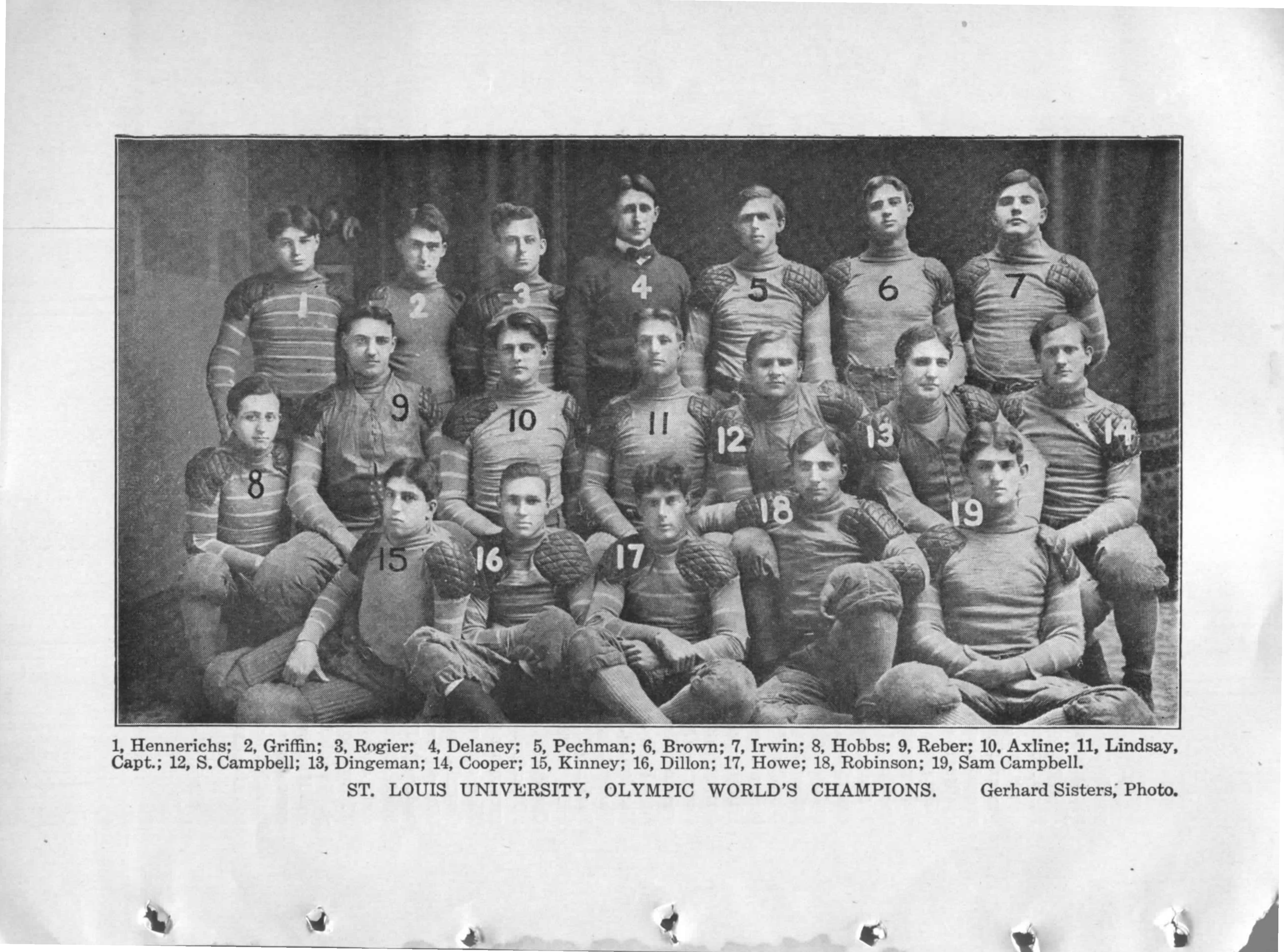
 It is well known that Carlisle Indian School shellacked Haskell Institute at the 1904 St. Louis World’s Fair on the Saturday after Thanksgiving. What isn’t widely known is that the St. Louis University team was deemed the Olympic Champions that year by virtue of playing, and winning, all their home games at the fair site which doubled as the location of the 1904 Olympics. The 1905 Spalding’s Guide includes a photo of the team titled “St. Louis University, Olympic World’s Champions.” While the pre-Billiken St. Louis U. footballers went undefeated, untied, and unscored upon through their eleven-game schedule, they were probably not even the second or third best team to play in front of an Olympic audience that year. The only major schools played were Kentucky, Arkansas and Missouri.
The Haskell Institute Fighting Indians were also undefeated in regular season play that year but gave up six points each to Nebraska and Kansas. They had also beaten Texas and Missouri. At that time, comparative scores were considered but Haskell and St. Louis had only one common opponent: Missouri. St. Louis shut them out 17-0 where Haskell humiliated them 38-0. Additionally, Haskell played a much tougher schedule, mostly on the road. Martin A. Delaney, Coach of St. Louis University’s football team, wrote about the World’s Fair/Olympics impact on football in the region:
During the season of 1904 football in the Southwest received a stimulus which did more to develop the game in this section than ten years of independent effort on the part of the various teams could possibly have done. This stimulus was given by the Physical Culture Department of the Louisiana Purchase Exposition. The department took charge of the schedules of St. Louis’ principal teams—those of Washington and St. Louis Universities—furnished them grounds, and brought the best teams in the section to meet them. As a consequence, these teams and the teams who played them had a season of unexampled success and development.
<More Next Time>
Tags:1904 Olumpic Games, Forest Park, Louisiana Purchase Exposition, Martin Delaney, Spalding's Official Football Guide for 1905, St. Louis University, St. Louis World's Fair, Washington University
Posted in Carlisle Indian School, Football, Haskell Institute | Leave a Comment »





 Tom Benjey's Weblog
