Archive for the ‘Gus Welch’ Category
January 14, 2010
Conventional wisdom has it that Carlisle Indian School declined after the 1914 congressional investigation until it died a natural death in 1918. I came across some items that raise doubt about that conclusion. The May 24, 1918 issue of The Carlisle Arrow and Red Man listed the schedule for the upcoming football season. The 9-games scheduled included such powerhouses as Pitt and Army but didn’t include many of the powers the Indians faced during their glory days. It seems unlikely that this schedule would have been arranged if the school was expected to close before the start of the next school year.
Newspaper coverage of the school’s commencement activities held on June 6 did not even hint that the school was about to close. Mid-June newspapers announced that the government was considering the lengthening of Carlisle’s enrollment by two years to allow students to complete a college preparatory program. In addition to the educational advantages, the school would be able to attract star athletes. It wasn’t reported if this bill was ever decided upon, probably because it was overtaken by events.
In mid-July the government announced that the school was to be closed and the army was taking Carlisle Barracks back to be used as a hospital to treat soldiers that were wounded in WWI. The transition took place in less than six weeks, so it is fair to assume that it was not as orderly as it would have been had it been planned for some period of time.
Enrollment was down to about 680 students at the time of closing, due in significant part to students and potential students enlisting in the armed forces. Carlisle and the Indian community at large were overrepresented in the military although non-citizen Indians were not subject to the draft. Some even went to Canada to join their forces before the U. S. entered the war. After the U. S. entered the fray, Carlisle school newspapers were filled with items about Carlisle alums who had joined up. Those who were commissioned officers, such as Gus Welch, Frank Mt. Pleasant and William Gardner, received extra coverage.
It would have been interesting to see what might have happened if the army had delayed its decision until November 11, 1918. It will also be interesting to read what Gen. Pratt had to say about the school’s closing.
Tags:Carlisle Arrow and Red Man, WWI
Posted in Carlisle Indian School, Football, Frank Mt. Pleasant, Gus Welch, Richard Henry Pratt, William Gardner | Leave a Comment »
November 12, 2009
A new documentary about Jim Thorpe has been released and is playing on some PBS stations. Moira Productions announced that Jim Thorpe: The World’s Greatest Athlete has been finished and is available for viewing. The film appears to largely be the work of Tom Weidlinger (producer, director, writer) and Joesph Bruchac (producer, writer). There were rumors that James McGowan was involved with the film but his name is not listed in its credits on imdb.com: http://www.imdb.com/title/tt1381609/fullcredits
Bruchac has written books about Jim Thorpe and is thus probably the lead writer on this documentary. He tends to write in the first person as if Thorpe, who he probably never met, is telling the story himself. A brief excerpt from the first chapter of Jim Thorpe: Original All-American states that young Jim was called stupid, something he disliked:
Stupid. That was what the teacher called me. And not just one teacher, either.
Stupid. I hated that name. That was one of the worst ones. Not the very worst, but close. It hurt so much because I wondered if it was true.
Stupid is not how Jim’s teacher in the Commercial Course at Carlisle, Marianne Moore, described him. Bill Crawford reported her as saying, “In the classroom he was a little laborious, but dependable; took time—head bent earnestly over the paper; wrote a fine, even clerical hand—every character legible; every terminal curving up—consistent and generous….The commercial students, about thirty, were an ideal group. Among them were James Thorpe, Gus Welch, and Iva Miller…They were my salvation, open-minded, also intelligent.”
The Balenti brothers, who were among the brightest students at the school, sometimes made fun of Jim. However, being less intelligent than them doesn’t mean he was stupid.
Moira Productions’ website lists the TV schedule for the 1-hour documentary: http://www.jimthorpefilm.com/events/index.html
The listing implies that it shows at 5:30p.m. Sunday on WITF’s HD channel only, but Comcast’s website lists it as showing on both channels 004 and 240. That implies that it will also be broadcast on the regular WITF channel as well.
Tags:Joseph Bruchac, Marianne Moore, Moira Productions, Tow Weidlinger
Posted in Carlisle Indian School, Football, Gus Welch, Jim Thorpe, Mike Balenti, Pop Warner | 4 Comments »
August 12, 2009
While researching Carlisle Indian School alums who played in the NFL, I came across an unexpected name—Frank Lonestar. Everyone is well aware that Lone Star Dietz coached the Redskins in 1933 and 1934 but I bet few know that Frank Lonestar played for the Columbus Panhandles in 1920, the league’s inaugural year. A website stated that he played three games at guard for the Panhandles that year. So far, I’ve found newspaper coverage for one game with his name in the lineup. That one was a losing effort against the Detroit Heralds.
I was well aware that Frank, a Chippewa from Wisconsin, was much involved in extracurricular activities such as the Invincible Debating Society and was an officer in his class (the same one as Gus Welch), but had no idea that he was a football player of note. He probably played for his shop team, the Printers, but many boys did that. I was unaware of him being on the varsity squad and doubt that he was. He apparently left Carlisle around 1911 to practice his trade after getting useful experience printing school publications. But that’s about all I know about him.
Also on the 1920 Columbus Panhandles, at least for awhile, was Littleboy, or someone with a similar name. The October 17, 1920 Fort Wayne Journal-Gazette included a photo of four stars the local team, the Friars, would be facing when taking on the Columbus Panhandles later that day. Included in the photo and expected lineup was someone named Littleboy. A little research should determine if this person was Carlisle’s Little Boy. This Littleboy played left halfback in the Columbus-Detroit game mentioned previously.
I’m also learning about another Carlisle student who played in the NFL but doesn’t appear to have starred on the legendary Indian teams. Joe “Little Twig” Johnson began his NFL career with the 1922 Oorang Indians, but, unlike the majority of his teammates, had a significant pro career after Oorang’s demise. It appears that the Carlisle Indians were more involved in the early NFL than I thought.
Tags:Columbus Panhandles, Detroit Heralds, early NFL history, Fort Wayne Friars, Frank Lonestar, Indians in the NFL, Joe Little Twig, Littleboy, Oorang Indians
Posted in Carlisle Indian School, Football, Gus Welch, Lone Star Dietz | Leave a Comment »
April 1, 2009
When looking through the Dickinson College archives for something else, the first paper I saw was a 1931 newspaper article announcing that Jim Thorpe had applied for the vacant head football coach position at that institution. Thorpe only wanted to coach there for a year because he was involved in business matters in the Oklahoma oil industry that were expected to occupy more of his time in the future. He was also negotiating with Mississippi A&M. Dickinson alum Gus Welch also applied for the position as did 50 others.
Neither of the Indians got the job as it was formally accepted by Joseph M. McCormick at the “D” banquet held on March 25th at the Molly Pitcher hotel. McCormick had been coaching at prep schools such as Mercersburg Academy and The Hill School. He had most recently coached at Roxbury School in Cheshire, CT. He led Dickinson’s Red Devils to their best season in six years. Thorpe took a job digging the foundation for a new hospital in Los Angeles. There was some truth to Thorpe’s story about the oil business, but it was in East Hawthorne, CA. The Jim Thorpe Petroleum Syndicate acquired 100 acres of land formerly owned by Gilbert Bessemyer. Jim was president of the syndicate and his cousin, Hawthorne’s chief of police, was one of the directors. In late April, the Putnam City school district announced that Thorpe had been hired as director of athletics for the rural school district located five miles west of Oklahoma City. In late June, he went into the movies to play, not surprisingly, Indian parts. He had small roles in a number of films. He spent New Year’s Day of 1932 watching the Rose Bowl, is first, as an Associate Press reporter.
Gus Welch became the head coach at Haskell Institute in 1933 after Lone Star Dietz departed for the NFL.
Tags:Joseph M. McCormick
Posted in Dickinson College, Football, Gus Welch, Jim Thorpe | Leave a Comment »
January 26, 2009
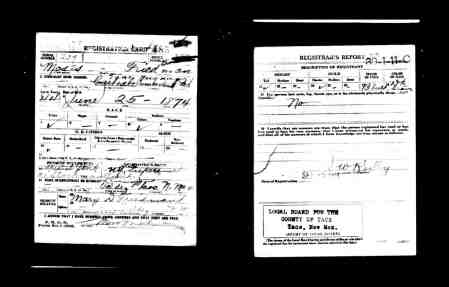
Google Alerts inform me of “news” on the internet regarding Lone Star Dietz, most of which I ignore. Although the most recent alert was a message largely concerned with Moses Friedman, that blog contains some misconceptions that are probably widely held. Matt is understandably confused by some of the entries on Friedman’s draft card (below) but those inconsistencies aren’t the worst problems. The misconceptions I consider serious are discussed in the paragraphs that follow.
- He could pass off the Moses as a given name perhaps, but not Friedman, especially considering that students kept an anglicized version of their Native name.
While it is true that some students were assigned anglicized versions of their original names, my experience researching Carlisle Indian School football players has been that the Anglicized names were generally assigned to an elder in the family, often at the agency in which the family was recorded. By the time Carlisle started fielding a football team in the 1890s, there had been so much intermarriage between Indians and whites that the majority of players I researched carried the family name of a white ancestor. For a small example, I seriously doubt if any of the six Carlisle Indians who were inducted into the College Football Hall of Fame carried Anglicized names, bastardized perhaps, as in the case of Guyon. Those names are:
a. Albert Exendine (may have originally been Oxendine)
b. Joe Guyon (probably Guion originally)
c. James Johnson
d. Ed Rogers
e. Jim Thorpe
f. Gus Welch
Had Friedman’s father married an Indian woman, he could easily been named Moses Friedman, although I am unaware of any evidence that indicates that he has Indian heritage. The point is that his name said nothing, one way or the other, about whether he had Indian heritage or not. Another point is that the Anglicized versions that are known for these men, Bright Path (Jim Thorpe) for one, are nothing like the names they were known by at Carlisle.
- My initial thoughts were of Lone Star Dietz, but why would he attempt to pass himself off as Indian with such a German sounding name?
As shown by the sample of European names above, by the 1890s a mixed-blood Indian could carry almost any European surname. Germans may have intermarried less than the French, English and Irish, but surely some did. Having the last name of Dietz (or Deitz as his father spelled it), is probably the weakest argument against him.
- However, Native-Americans were not exempt from the draft, …
Non-citizen Indians were exempt from the draft, but citizens weren’t. Indians as a group weren’t granted citizenship until after WWI, so most were not required to serve. However, the fact that so many volunteered and served with distinction speaks well for their bravery and patriotism. A significant number even went to Canada to enlist before the U. S. entered the war.
- As an aside, even though I have his date of birth I cannot find any Moses Friedman born in America, let alone Cincinatti [sic], on that date or even in 1874!
It was not unusual at all for births not to be recorded at that time. My own paternal grandmother had no birth certificate and she was born over a decade later.
Friedman’s draft registration is surely confusing, most likely because he was confused. As to why he would check the white box for race and also check the citizen box for Indian: my guess is that, knowing people of any race could be citizens or non-citizens, he ignored the Indian heading when he checked the citizen box. I am unaware of any attempt by Friedman to claim Indian heritage.
A look at his then current employment might shed some light as to why he put Carlisle as his permanent address. He was then doing “special work as stockman for NY Supreme Court” in Taos, NM. After resigning from his position as Superintendent of Carlisle Indian School and being acquitted in Federal Court, Friedman was probably taking any work he could get. His work in Taos sounds like it was temporary and Friedman may have had as yet established a permanent location after leaving Carlisle.
http://ciis.blogspot.com/2009/01/moses-friedman-and-lone-star-dietz-both.html
Tags:Moses Friedman
Posted in Albert Exendine, Carlisle Indian School, Ed Rogers, Gus Welch, James Johnson, Jim Thorpe, Joe Guyon, Lone Star Dietz | 10 Comments »
October 6, 2008
Coming across a 1937 newspaper article in which Gus Welch launched a movement to return Indians to prominence in football. He was quoted as saying:
“The Indian is disappearing from football just like he disappeared from the forests. There used to be a lot of good Indian athletes—Thorpe, Guyon Mount Pleasant, Sweet Corn, Jim Levi, Tiny Roebuck and Mayes McLain. Pop Warner developed a dozen great ones at Carlisle and Haskell Institute produced a number. But they are fast dwindling. Most of the Indians we see in athletics today are impostors, or at best half-breeds. And they might as well be cigar store Indians in so far as I’m concerned.”
The article went on to say that Gus and his wife had recently adopted a baby girl. He insisted that the next child would be a boy adopted from one of what he considered the two fiercest tribes.
“I’m going to visit the Sioux reservation first and look over their crop of babies. If they don’t have anything to my liking, I’m going to pay the Cheyennes a call. I’m determined to find a real all-American and restore the Indian to his proper place in football.”
You already know that didn’t work out, but did you know that Bacone College attempted to revive Indian football after it was de-emphasized at Haskell Institute during the Great Depression? It was a natural thing for the little Muskogee, OK college to do because the school’s original name when it was founded in 1880 at the Cherokee Baptist Mission in Tahlequah by Almon C. Bacone was Indian University. Oklahoma’s longest-running institution of higher education was renamed Bacone Indian University in 1910. Later, its board of trustees gave it its current name. An irony is that Bacone and Haskell, both now four-year schools, play each other.

Tags:Bacone College, Haskell Indian Nations University, Haskell Institute
Posted in Carlisle Indian School, Football, Gus Welch, Jim Thorpe, Stancil Powell | Leave a Comment »
September 5, 2008
Yesterday’s email brought a curious announcement. I am going to receive a free, signed copy of a new book to be released soon. The Toilet Paper Entrepreneur by Mike Michalowicz, about which I know nothing, was looking for humorous bathroom graffiti. I sent in my all-time favorite from the back of the men’s room door at The Blessed Oliver Plunket, a bar/restaurant featuring live entertainment located across the street from the Cumberland County Historical Society. The Plunket, as it was better known, has numerous stories to tell but I’m not the one to tell them. In the late 70s, as I was leaving the men’s room, I noticed a scribble on the door:
No sign of intelligent life…Kirk Out
Apparently that witticism has found its way into a book.
Back to Donna Newashe McAllister’s question…
I expected that more people would comment on this and would like to see more myself. So, I’ll share some of my thoughts.
My wife and I have discussed this issue to some degree and I think it is an issue with multiple facets. First, I’m not so sure that American Indian athletes have necessarily declined. Judging today’s athletes with those who were at the Carlisle Indian School may not be fair. Those guys were world-class athletes coached by one of the most innovative coaches of all time. Pop Warner is criticized much today but few question his knowledge or his ability to coach football. During its heyday, Haskell had fine athletes and was led by Dick Hanley, Lone Star Dietz and Gus Welch, all of whom were excellent coaches. Dietz belongs in the College Football Hall of Fame. Neither Haskell nor the tribal colleges can afford to hire coaches of their caliber today.
Bob Wheeler tells me that Bill Thorpe shoots better than his age, 80, in golf. To compare anyone with Jim Thorpe is unfair. He was the greatest athlete of all time and could do anything well. I can’t imagine how he could be competitive in the pole vault, but he was. Sam Bird’s grandchildren and great-grandchildren are big in the rodeo. Some of the others didn’t have children and many settled off the reservation. For example, Joe Guyon was a big star at Carlisle, Georgia Tech and in the NFL where Joe Guyon, Jr. played for Catholic University.
But you seem to be focused more on leadership than on athletic ability. It appears to me that many of the better leaders did not return to the reservation after finishing at Carlisle or Haskell. Several were officers in WWI and were leaders in the service but didn’t return to lead their tribes. Some kept one foot in each world and their children found more opportunity in white society. For example, Thomas St. Germain’s son, grandson and great-grandson were/are renowned research physicians at Tulane University School of Medicine.
It may be that Indians are playing leadership roles individually but not together as a group. MANY of the Carlisle players went into coaching but Dietz, Exendine and Welch were about the only ones who made it their life’s work. Coaching was an even more precarious occupation then than now and only the best schools paid well. So, most devoted their considerable talents to other occupations. Even Exendine and Welch practiced law in the off-season.
Surely, other people have some insight into this issue.
Tags:Bill Thorpe, Blessed Oliver Plunket, Bob Wheeler, Dick Hanley, Mike Michalowicz, The Toilet Paper Entrepreneur
Posted in Albert Exendine, Carlisle Indian School, Football, Gus Welch, Jim Thorpe, Joe Guyon, Lone Star Dietz, Pop Warner, Sampson Bird, Thomas St. Germain, William Newashe | 2 Comments »
August 11, 2008
Thorpe received a lot of hype, even before dominating the Pentathlon tryouts. One such example is shown below. As coach of the Carlisle track team, Pop Warner placed himself in charge of Thorpe’s and Tewanima’s training for the Olympics. As part of their training regime he had them sit out most of the school’s spring meets. So, for the first time in several years, a team other than Carlisle won the Pennsylvania Intercollegiate Athletic Association’s track meet held on Hargest’s Island (today’s City Island) at Harrisburg. Thorpe did not attend the meet but Tewanima made an appearance. He ran 18 miles from the Indian School to Hargest’s Island, arrived at the field when the 2-mile run was underway. According to the report in The Carlisle Arrow, “he circled the field amid the cheers and applause of’ nearly everyone on theground. Tewanima made the eighteen-mile run in a little less than one hour and fifty minutes and seemed fresh at the finish and able go many more miles.”
Thorpe’s absence gave others an opportunity to shine. Bruce Goesback placed 1st in the 220 hurdles, 3rd in the 120 hurdles, 4th in broad jump and high jump. Possum Powell finished 2nd in both high jump and shot put. John Squirrel was 3rd in both 440-yd dash and broad jump. Sampson Bird came in 2nd in the hammer throw and 4th in discus. Gus Welch place 2nd in the half-mile and won the 440-yd dash but was disqualified of “alleged interference” with another runner. Arthur Coons placed 3rd in pole vault, Joel Wheelock came in 4th in both hurdle events, and Blackdeer, the only distance man to score points, came in 4th in the 2-mile run.
Carlisle still placed second to Penn State without its Olympians and beat all other colleges in the meet.

Jim Thorpe's Physique
Tags:Arthur Coons, Blackdeer, Bruce Goesback, City Island, Hargest's Island, Lewsi Tewanima
Posted in Carlisle Indian School, Gus Welch, Jim Thorpe, Joel Wheelock, Pop Warner, Sampson Bird, Stancil Powell | Leave a Comment »
July 31, 2008
Some think that 1912 was the year Native American broke onto the Olympic scene but, as shown in the last few blogs, they arrived much earlier. But 1912 was to be better for American Indians in the Olympics than the previous games. But it was not surprising.
As early as New Year’s Day 1912 and as far away as Fairbanks, Alaska, newspapers carried an article with a Carlisle, Pa. byline promoting Jim Thorpe for the upcoming Olympics. That article was surely generated by Pop Warner’s PR machine. An excerpt illustrates the exuberance in which he was promoted:
This youthful redskin hunts, plays lacrosse, tennis, indoor baseball, handball and hockey, all with equal skill, and can fill almost any position on a football team with credit. As halfback he probably is seen at his best, whirling, twisting, dashing and plunging, for one moment bewildering his opponents with lithe, panther like leaps, and the next crushing his way through the mass of would-be tacklers with the ferocity of a mad bull.
The piece ends with what may have been a preemptory defense against claims of professionalism:
Although busy with track work while here, he practiced baseball and played amateur baseball since leaving Carlisle, refusing numerous offers to play on minor league teams.
But Carlisle’s track team was not a one-man operation. Less than two weeks later papers gave Thorpe’s teammate some coverage:
Louis Tewanima of Carlisle Indian School will be a starter in this year’s Boston Athletic Association Marathon race and hopes to make the American Olympic Games team.
Pop Warner announced in early January that he expected Tewanima and Thorpe to make the Olympic team. On March 1st the commentator, who wrote the Diamond Gossip that was distributed widely, opined that the reason so many athletes were deciding against attending the Games was that Thorpe was going to Stockholm. Less than a week later, Warner’s PR machine announced that several other students wanted to make the Olympic team. Warner himself said that he thought five of his Carlisle trackmen might make the cut. He expected that Arquette would “make the foreigners scamper in the 10,000 meters,” but refused to identify the other two. “I don’t care to let any one know as yet who my two new phenoms are. One of them is one quarter-miler of exceptional ability. The other will be entered in the 400 and 500 meters races.”
I have read that Gus Welch made the team but was unable to compete due to injury. Could he have been one of Warner’s mystery men?
Tags:1912 Olympics, Arquette, Lewis Tewanima, Mitchell Arquette, Native American Olympians, Stockholm
Posted in Carlisle Indian School, Gus Welch, Jim Thorpe, Pop Warner | Leave a Comment »
May 27, 2008
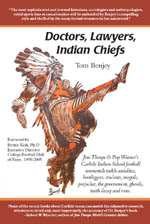
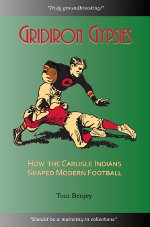
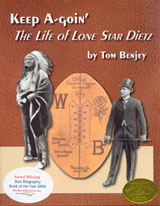
The advance reading copies (called ARCs in the trade) arrived for my new book and are being sent out to reviewers. This is a big moment in a writer’s life: seeing thousands of hours of hard work turned into something tangible. In the old days (pre-computer), ARCs were called galleys, bound galleys or galley proofs. Authors, editors and publishers go over these babies with a fine-tooth comb looking for errors, typos or things that have changed since writing was complete. It is an impossible task because, after all this scrutiny, some typos escape and find their way into the final book. But we try.
Another important use of ARCs is to see how the photos and artwork come out in print. Overall they came out very well, better than expected. But a cartoon about the Oorang Indians from a 1922 Baltimore newspaper is too dim. The challenge now is to figure out how to darken it without losing the detail.
This weekend I received some additional information and a correction regarding Louis Island from a family member who happened to see a previous blog. That was fortuitous because I want the book to be as accurate as possible. This blog is already proving to be of some value. That encourages me to continue with it.
Having these ARCs provides local booksellers the opportunity to provide their customers something extra. People can look at an ARC and pre-order the book if they choose. The bonus, besides being sure of getting a copy of the book as soon as it comes out, is to receive an inscription of his or her choice signed by the author. On-line booksellers also take pre-orders but personalized inscriptions are impractical.

Tags:Add new tag, ARC, biography, book, galleys, Louis Island
Posted in Albert Exendine, Alex Arcasa, Antonio Lubo, Archie Libby, Arthur Sheldon, Bemus Pierce, Benjamin Caswell, Caleb Sickles, Carlisle Indian School, Charles Guyon, Charles Williams, Dickinson College, Doctors, Lawyers, Indian Chiefs, Ed Rogers, Elmer Busch, Emil Hauser, Football, Frank Cayou, Frank Hudson, Frank Mt. Pleasant, Fred Broker, George May, George Tibbits, George Vedernack, Gus Welch, Hawley Pierce, Henry Broker, Hugh Wheelock, Isaac Seneca, James Johnson, James Phillips, Jim Thorpe, Joe Bergie, Joe Guyon, Joe Libby, Joel Wheelock, John B. Flinchum, Leon Boutwell, Lone Star Dietz, Louis Island, Martin Wheelock, Nicholas Bowen, Nick Lassa, Pete Calac, Pete Hauser, Pop Warner, Sampson Bird, Single-Wing, Stacy Matlock, Stancil Powell, Thomas St. Germain, Victor Kelly, Washington Redskins, Washington State University, Wauseka, William Baine, William Gardner, William Garlow, William Newashe | Leave a Comment »




 Tom Benjey's Weblog
