Archive for the ‘Frank Mt. Pleasant’ Category
March 30, 2012
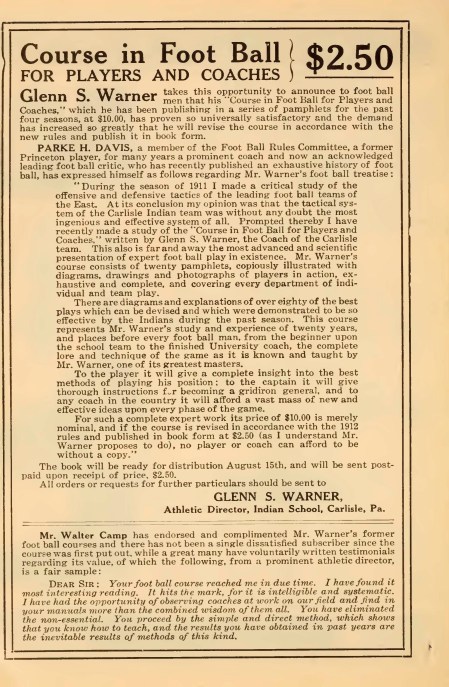
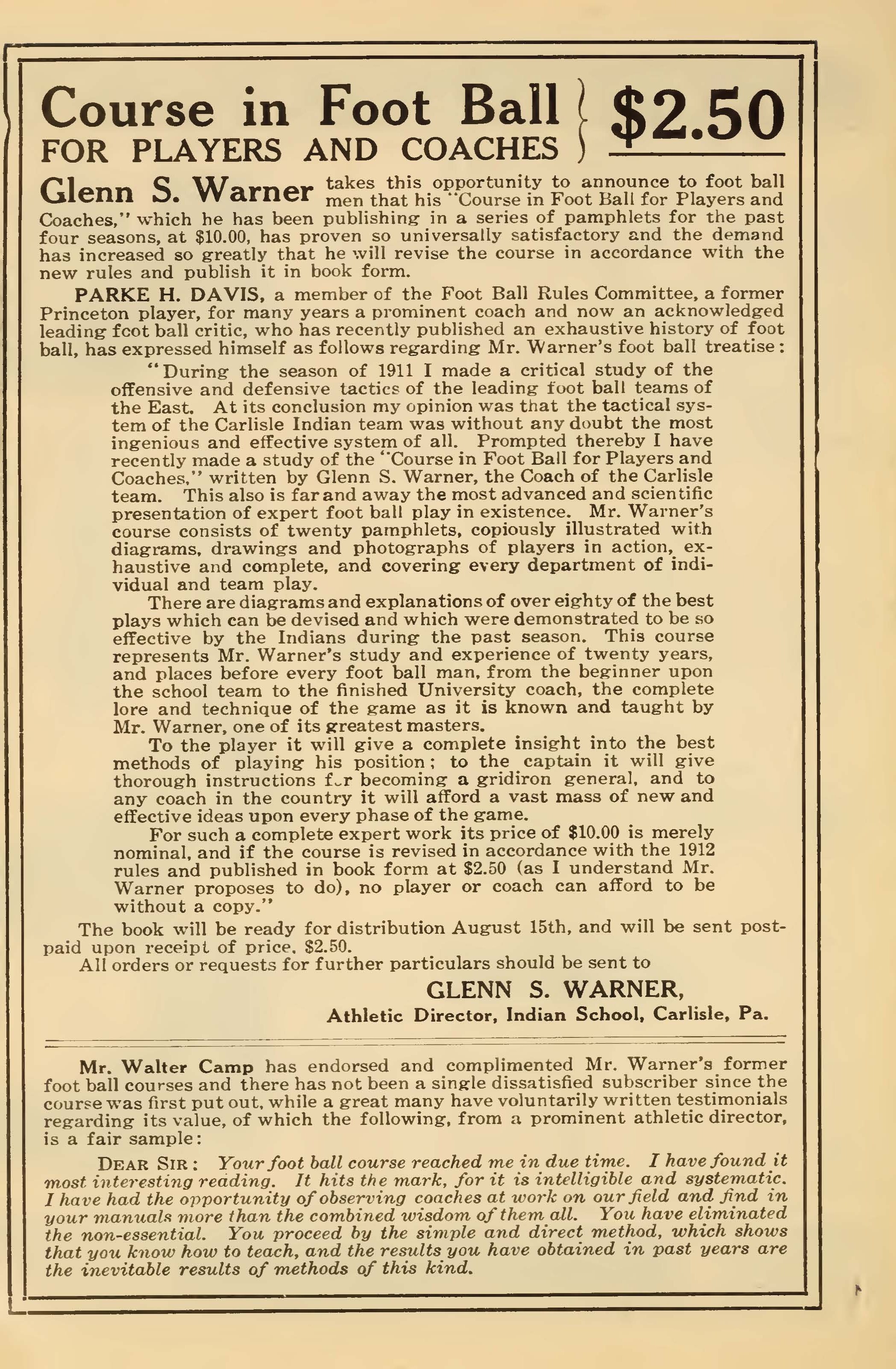
The endorsements at the bottom of the 1912 ad were the same as previously: one from Walter Camp and the other from an unnamed prominent athletic director. Most of the ad is an endorsement written by Parke H. Davis. The first paragraph is most interesting.
During the season of 1911 I made a critical study of the offensive and defensive tactics of the leading foot ball teams of the East. At its conclusion my opinion was that the tactical system of the Carlisle Indian team was without any doubt the most ingenious and effective system of all. Prompted thereby I have recently made a study of the ‘Course in Foot Ball for Players and Coaches,’ written by Glenn S. Warner, the Coach of the Carlisle team. This also is far and away the most advanced and scientific presentation of expert foot ball play in existence. Mr. Warner’s course consists of twenty pamphlets, copiously illustrated with diagrams, drawings and photographs of players in action, exhaustive and complete, and covering every department of individual and team play.
Warner may have done the drawings or he may have enlisted Lone Star Dietz to do them or they each may have done some as they later did for Warner’s 1927 book. That Dietz did the cover art for the 1912 book argues for his having done some of the interior illustrations. Various “famous players” are photographed performing various football skills including kicking, punting, and catching punts. Frank Mt. Pleasant is the only player specifically identified with a photo as Warner included three frames of Mt. Pleasant throwing a forward pass. Each frame represents a different part in the throwing motion. What looks to be a young, skinny Jim Thorpe is shown dropping the ball to punt it. Gus Welch (possibly) is shown following through after punting the ball.
<more on the book next time>
Tags:1912 Spalding's Guide, Parke H. Davis, Walter Camp
Posted in Carlisle Indian School, Football, Frank Mt. Pleasant, Gus Welch, Jim Thorpe, Lone Star Dietz, Pop Warner | 1 Comment »
August 8, 2011
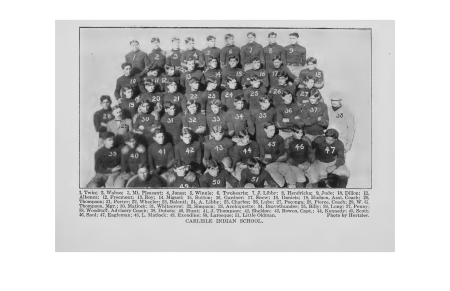
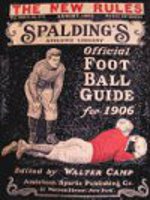
While preparing Spalding’s Official Football Guide for 1906 for reprinting, I noticed a few things about the Carlisle Indian School football team’s 1905 season. These things caught my eye because it was this very team under Advisory Coach George Woodruff that Sally Jenkins maligned in her 1907 book. Caspar Whitney ranked the Indians as the 10th best team in the country for 1905. He also placed Frank Mt. Pleasant as a substitute at quarterback on his All America team.
George Woodruff placed three Carlisle Indians to his All Eastern Eleven for 1905: Frank Mt. Pleasant at quarterback, Charles Dillon at guard, and Wahoo (Charles Guyon, older brother of Joe Guyon) at end. N. P. Stauffer placed Dillon at guard on his All Eastern Eleven as well.
That an authority of the stature of Caspar Whitney considered Carlisle as the 10th best college football team in the country means something and that something is that the Indians were viewed as having had a very good season. Not their best ever, mind you, but a successful one at that.
These selections, along with George Orton’s observations that were posted in the June 27, 2011 message, show that Jenkins’s assessment of the type of play and success of the 1905 Carlisle Indian football team is at odds with the opinions of the experts of the day who actually saw the teams play.
1905 Carlisle Indian School football team from Spalding’s Official Football Guide for 1906
Tags:Chauncey Archiquette, Frank Jude, George Orton, George Woodruff, Littleboy, N. P. Stauffer, Oscar Hunt, Sally Jenkins, Scott Porter, Wilson Charles
Posted in Albert Exendine, Archie Libby, Arthur Sheldon, Bemus Pierce, Carlisle Indian School, Charles Guyon, Football, Frank Hudson, Frank Mt. Pleasant, Joe Libby, Mike Balenti, Nicholas Bowen | Leave a Comment »
March 11, 2011
The 2011 ballot for the College Football Hall of Fame came out this week with Lone Star Dietz’s name removed. This is yet another snub to a Carlisle Indian School player. Dietz has also been snubbed by the Rose Bowl Hall of Fame as a demonstration of their ingratitude. After all, where would the Rose Bowl be without Dietz? Nothing the College Football Hall of Fame does surprises me anymore. A few years ago, when Dietz should have been inducted, the selection committee ignored the votes for the seven coaches on that year’s ballot and selected two coaches who were not on the ballot because they were not eligible for induction due to the fact that they were still actively coaching. So, the ironically named Honors Committee, in an Animal Farm-like move, changed the rules to make these two eligible and selected them even though no voter received a ballot with their names on it. Unfortunately, Dietz isn’t the only Carlisle Indian to be snubbed by a Hall of Fame.
The Pennsylvania Sports Hall of Fame has failed to induct Olympian Frank Mt. Pleasant into even a regional chapter is astounding. If Mt. Pleasant’s football and track accomplishments at Carlisle aren’t enough, consider what he did elsewhere in Pennsylvania. That he has already been inducted in both the Dickinson College and the Indiana University of Pennsylvania Halls of Fame indicates that he accomplished quite a bit while at each of those institutions on top of what he did at Carlisle. Frank is no stranger to being snubbed, as Walter Camp, who only gave him Honorable Mention on his 1907 All America team for being not rugged enough because he was too injured to play in the Chicago game, the Indians’ 11th game of the season. I’m not holding my breath for the PA Sports Hall of Fame doing the right thing anymore than I am for the College Football HoF. But these aren’t the only Carlisle Indians deserving of honors.
The College Football Hall of Fame does not have a category for athletic trainers but it does have a catch-all category called contributor, though. Wall ace Denny pioneered the role of athletic trainer first as a student at the Indian school and, later, as a member of the staff, and for decades after that with Pop Warner at Stanford and Temple. Before Denny started assisting Pop Warner with the care of the players’ bodies, there was no such thing as an athletic trainer as we know it. But Wallace Denny changed all that and should be remembered for it.
If Carlisle Indian School had a large alumni organization and could guarantee large ticket sales for induction events, these men might have a chance, but they don’t and little money would be raised by their selection.
Tags:1908 Olympics, All-America team, College Football Hall of Fame, Pennsylvania Sports Hall of Fame, Rose Bowl Hall of Fame, Wallace Denny, Walter Camp
Posted in Carlisle Indian School, Football, Frank Mt. Pleasant, Lone Star Dietz | Leave a Comment »
December 2, 2010
Pop Warner made many observations regarding his Carlisle Indian players, almost all regarding their behavior, much of which he thought was a result of their culture. But on one occasion he discussed an anatomical difference he had observed. Warner claimed that the lower legs of white boys and Indians were different. It was his observation that one group’s lower legs dropped straight down from the knee whereas the other’s curved outward.* It was this difference that gave the Indian boys an advantage in kicking the football over white boys.
Warner often mentioned how his Indian players would practice some skill endlessly, in some case for years, until they perfected it. An example was Frank Hudson who drop-kicked footballs year round including when there was snow on the ground. He simply moved indoors to the gym during inclement weather. Hudson also practiced with both feet until he became ambidextrous (it’s not clear if ambipedal is a word) and was able to dropkick field goals with either foot. He also became the game’s best dropkicker, arguably of all time. In addition to practicing a skill, Warner noticed that that the Indians watched proficient players’ closely to learn a skill. An example he gave was of Mike Balenti kicking four field goals, two from over 40-yards away, against Navy without having attempted one in a game before. Balenti attributed the success to his having watched Hudson and Frank Mt. Pleasant.
Warner thought that many more Carlisle players were good at kicking than were the white players he coached before and after because of a physiological advantage. He believed that the shape of Indians’ lower legs was better suited to kicking. It would be interesting to know if Warner was seeing things or if what he said is true.
*I misplaced the article in which Warner stated this and would appreciate it greatly if someone could inform me as to where I can find it.
Tags:Drop kick, dropkick, field goal
Posted in Carlisle Indian School, Football, Frank Hudson, Frank Mt. Pleasant, Mike Balenti, Pop Warner | 4 Comments »
November 2, 2010
Now that we’ve dealt with some obvious errors in Rich Manning’s article, let’s get to the original issue: formations. The single-wing section in the Carlisle Indian School article in LeatherHelmetIllus.com starts this way:
In 1907, ‘Pop’ Warner returned to Carlisle. Together he and the Indians developed a new formation that would revolutionize football. The single wing shifted the halfback out wide, to outflank the opposing tackle. The new offense formed a shape that look like a wing. It opened up options and disguised intentions. The ability to show one thing and do another combined with the new rules made it possible to run, throw or kick at any time. ‘Pop’ Warner unveiled the new formation against the University of Pennsylvania, on Oct. 26, 1907.
I have read that the single-wing was unleashed in several different years due to Pop Warner’s inconsistent memory and writers’ imaginations. After researching this topic a bit, I came to believe that the single-wing did not arrive fully formed as the unbalanced-line, direct snap version depicted as Formation A in Warner’s 1927 book. I have concluded that the formation evolved over time as Warner implied on page 136 of his 1927 classic where he stated that it was first used by the Carlisle Indians and that he had used it or variations of it since the rules change of 1906. That he spent a week in Carlisle before the start of the season preparing coaches Bemus Pierce and Frank Hudson for the rule changes gives credibility for it having been first used by the Indians in 1906 when he wasn’t their coach. Fortunately, some documentation exists.
Warner began marketing a correspondence course on football in 1908 for which I have located and have reprinted the Offense pamphlet along with its annual updates. The 1908 pamphlet includes a number of offensive formations, which is not surprising as Warner was noted for tinkering with them. That newspaper coverage of the 1907 Penn game mentioned that multiple formations were used is not surprising. However, it is far from clear that end-back formation, the earliest documented version of Warner’s single-wing, was the formation being described for many of the plays as it didn’t feature a direct snap to a running back. That would come later. However, the punt formation did allow direct snaps to the backs and Warner had devised a set of running and passing plays from this formation.
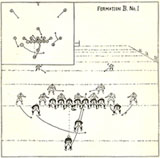
He even described Play No. 17 thusly, “This is the long forward pass play used so successfully last season.” Last season would have been 1907, so this is likely the formation from which Frank Mt. Pleasant and Pete Hauser completed all those passes, not an early incarnation of the single-wing.
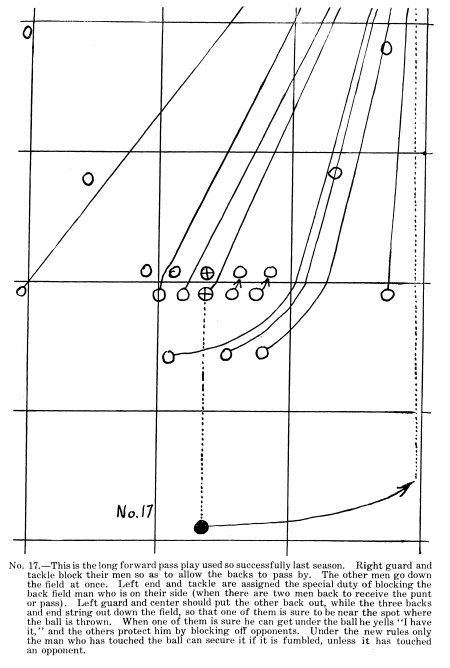
Play No. 17 from 1908 correspondence course Offense pamphlet
Tags:LeatherHelmetIllus.com, Rich Manning
Posted in Albert Exendine, Bemus Pierce, Carlisle Indian School, Football, Frank Hudson, Frank Mt. Pleasant, Jim Thorpe, Pete Hauser, Pop Warner, Single-Wing | Leave a Comment »
October 27, 2010
I was recently asked if Pop Warner unveiled the single-wing against Penn in the Carlisle Indians’ fifth game of the 1907 season. Penn was actually Carlisle’s 7th opponent that year but that was probably just a typo made by the person asking the question. This was the first time I had heard (or read) that the single-wing was first used in that particular game. I have seen it attributed to several other times but not that one. A little research found a source for this claim but quite possibly not the only person to make it. Follows is an extract from an article on the Carlisle Indians in LeatherHelmetIllus.com:
‘Pop’ Warner unveiled the new [single-wing] formation against the University of Pennsylvania, on Oct. 26, 1907. So far that season no team had crossed the Quaker’s goal line. Carlisle was undefeated. A large crowd of 22,800 fans looked on. They were expecting a good game but they got more than they bargained for. Carlisle scored on the second play: a 40 yard pass from Hauser to Gardner, caught on the run. The diversified offense racked up 402 yards, to 76 yards for Penn., Carlisle went 8 of 16 passing. The game also marked the debut of Jim Thorpe. He broke free for 45 yards the second time he touched the ball. The Indians won 26 – 6.
After finding this, I set about locating game accounts in period newspapers. Before resolving the issue of the single-wing, I noticed a significant error—or the sports writers of the day had it all wrong. Nowhere did I find mention of (William) Gardner scoring a touchdown or anything else in that game. What I did find in the coverage by The Washington Post, The New York Times, United Press and other wire service accounts was that the Indians’ first score came on a field goal kicked by Pete Hauser early in the game. That score was followed by Fritz Hendricks’ 100-yard touchdown run after picking up Hollenbach’s fumble. Payne closed out the first-half scoring with a touchdown of his own around Penn’s end from the 4-yard line. Penn played better in the second half and didn’t allow Carlisle an offensive touchdown. However, Little Boy scored his touchdown by diving on a Penn punt that Albert Exendine had blocked and fell behind their goal line. Hauser closed out Carlisle’s scoring with a second field goal. Frank Mt. Pleasant kick the extra points after each touchdown. Although Mt. Pleasant and Hauser received much praise for their passing in this game, none of their tosses went for a touchdown to Gardner or anyone else.
The next blog will deal with the errors related to Jim Thorpe and the single-wing.
Tags:Albert Payne, Fritz hendricks, LeatherHelmetIllus.com, Little Boy, Rich Manning
Posted in Albert Exendine, Carlisle Indian School, Doctors, Lawyers, Indian Chiefs, Football, Frank Mt. Pleasant, Jim Thorpe, Pete Hauser, Pop Warner, Single-Wing, William Gardner | Leave a Comment »
June 21, 2010
I have wondered for some time where John S. Steckbeck found some of the the anecdotes he used in Fabulous Redmen. The other day while searching for something else—the usual situation—I came across a Project Gutenberg file for Football Days: Memories of the Game and of the Men Behind the Ball, a 1916 book by William H. Edwards, Princeton 1900, with an introduction by Walter Camp. In one section of the book, Edwards retells some of stories told by former Yale star Carl Flanders, who helped coach the Indians in 1906.
Because Flanders related these stories within a decade of them happening, they stand a better chance of being accurate than those that were told a half century, or longer, after that. Of particular interest was the topic of nicknames:
“The nicknames with which the Indians labeled each other were mostly those of animals or a weapon of defense. Mount Pleasant and Libby always called each other Knife. Bill Gardner was crowned Chicken Legs, Charles, one of the halfbacks, and a regular little tiger, was called Bird Legs. Other names fastened to the different players were Whale Bone, Shoe String, Tommyhawk and Wolf.”
I do wonder if Edwards got a couple of the names reversed or if Flanders remembered them incorrectly. During WWI, Bill Gardner was referred to in newspaper columns as “Birdie,” something that leads me to suspect that his nickname was Bird Legs not Chicken Legs. If that is so, then Wilson Charles was probably called Chicken Legs. Perhaps a descendent of his will let us know which was his correct nickname.
Tags:Carl Flanders, Fabulous Redmen, John S. Steckbeck, nicknames, Walter Camp, William H. Edwards, Wilson Charles
Posted in Archie Libby, Carlisle Indian School, Football, Frank Mt. Pleasant, Joe Libby, William Gardner | Leave a Comment »
May 11, 2010
A reader sent me this photo in an attempt to determine if the team in the photo is the 1910 Dickinson College Red Devils and if the player seated at the left in the front row is Frank Mt. Pleasant.
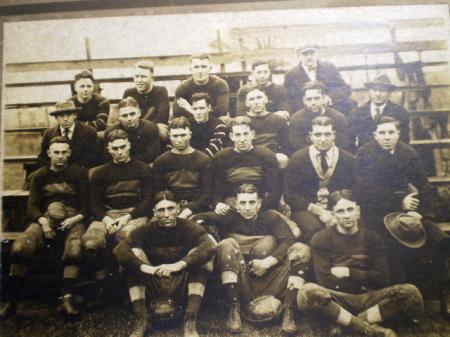
A photo of the 1910 Carlisle Indians-Dickinson College game can be found at this link: http://chronicles.dickinson.edu/studentwork/eyeongame/1910foot.htm. The player at the far left is wearing a Carlisle jersey. The forearm stripes may not have been unique, but were different from most other teams’ uniforms. All the jerseys in the photo are different from the jerseys worn by Dickinson in 1910. Also, Frank Mt. Pleasant graduated in the spring of 1910 and coached Franklin and Marshall that fall.
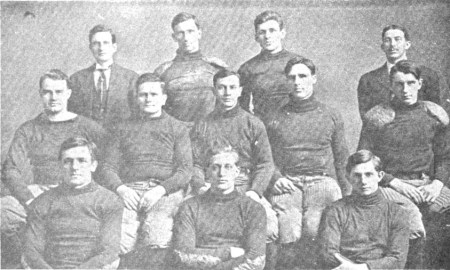
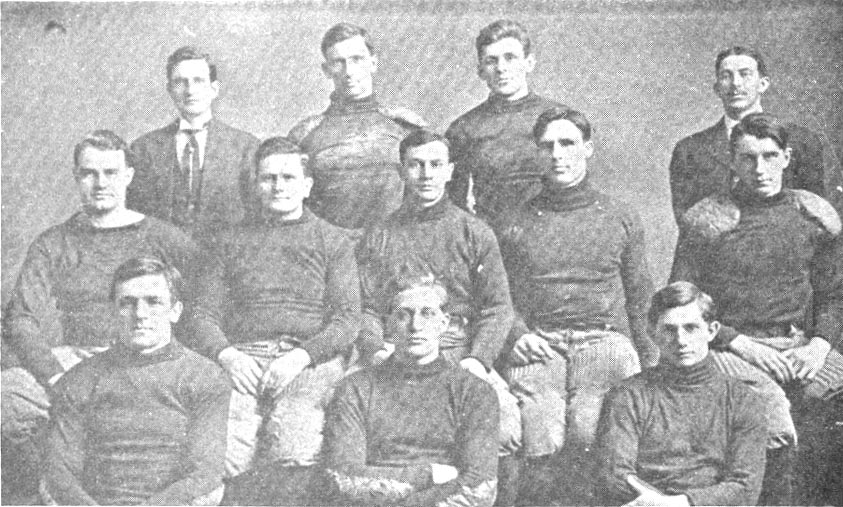
Follows is a photo of the 1909 Dickinson team of which Mt. Pleasant was captain. Wilbur J. Gobrecht in his history of Dickinson College football reported that in 1903, Dickinson switched to black jerseys and black stockings with half-inch red and white stripes. This uniform design was used for 25 years. As captain, Frank Mt. Pleasant is seated in the middle of the center row in the photograph. I am not very good at identifying people from photographs, so take my opinion with plenty of salt. The player in the first photo looks very different to me than the Captain of the Dickinson squad.
Perhaps someone seeing this photo can identify the team, the year and the players.
Tags:Wilbur Gobrecht
Posted in Carlisle Indian School, Dickinson College, Frank Mt. Pleasant | Leave a Comment »
April 24, 2010
We interrupt the discussion of the 1910 Harvard Law School team to report on the annual Jim Thorpe Sports Days that kicked off yesterday with a flyby of two F-16 fighter jets from the Vermont Air Guard. Students from the war colleges of the various branches of the military compete in races and games each year on Indian Field at Carlisle Barracks, PA to continue a tradition that began in 1974. Indian Field is no stranger to athletic competitions; it is the field on which the Carlisle Indian School football teams played their home games. Jim Thorpe, Frank Mt. Pleasant and most of the others played their home games here. However, the Indians’ earliest games weren’t played on this field because it didn’t yet exist.
Superintendent Pratt reported on the football field in the September 1898 edition of The Red Man, the school’s newspaper at that time:
“The football team has not only continued to hold the high record it made, but through the earnings of the game a large and fine athletic field has been added to the school advantages. Ground adjoining the school was bought, leveled off, and a large, oval turf field, with a quarter mile running track, is now near completion.”
The field today is different from its 1898 configuration. The topsoil and its base were replaced over a century ago; a sprinkling system was added not many years after Indian Field was put into service; the track was upgraded a few times; and bleachers were eventually installed. Those wooden bleachers were replaced by the limestone-clad concrete grandstand years ago.
John Thorpe, grandson of Jim Thorpe, and George Yuda, son of Montreville Yuda, descendents of Carlisle Indian School students were present at the festivities.
The Sentinel’s coverage of Jim Thorpe Sports Days can be found at http://www.cumberlink.com/articles/2010/04/24/news/local/doc4bd25f2f21aa0440783186.txt
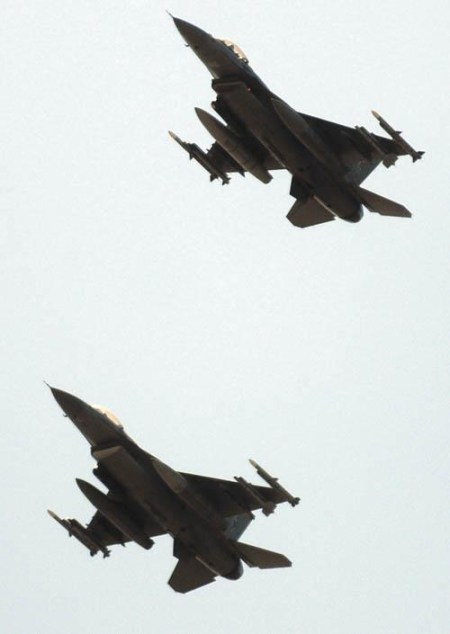
Carlisle Sentinel photo
Tags:Carlisle Barracks, F-16 Flyover, George Yuda, Indian Field, Jim Thorpe Sports Days, John Thorpe, Montreville Yuda
Posted in Carlisle Indian School, Frank Mt. Pleasant, Jim Thorpe | Leave a Comment »
January 14, 2010
Conventional wisdom has it that Carlisle Indian School declined after the 1914 congressional investigation until it died a natural death in 1918. I came across some items that raise doubt about that conclusion. The May 24, 1918 issue of The Carlisle Arrow and Red Man listed the schedule for the upcoming football season. The 9-games scheduled included such powerhouses as Pitt and Army but didn’t include many of the powers the Indians faced during their glory days. It seems unlikely that this schedule would have been arranged if the school was expected to close before the start of the next school year.
Newspaper coverage of the school’s commencement activities held on June 6 did not even hint that the school was about to close. Mid-June newspapers announced that the government was considering the lengthening of Carlisle’s enrollment by two years to allow students to complete a college preparatory program. In addition to the educational advantages, the school would be able to attract star athletes. It wasn’t reported if this bill was ever decided upon, probably because it was overtaken by events.
In mid-July the government announced that the school was to be closed and the army was taking Carlisle Barracks back to be used as a hospital to treat soldiers that were wounded in WWI. The transition took place in less than six weeks, so it is fair to assume that it was not as orderly as it would have been had it been planned for some period of time.
Enrollment was down to about 680 students at the time of closing, due in significant part to students and potential students enlisting in the armed forces. Carlisle and the Indian community at large were overrepresented in the military although non-citizen Indians were not subject to the draft. Some even went to Canada to join their forces before the U. S. entered the war. After the U. S. entered the fray, Carlisle school newspapers were filled with items about Carlisle alums who had joined up. Those who were commissioned officers, such as Gus Welch, Frank Mt. Pleasant and William Gardner, received extra coverage.
It would have been interesting to see what might have happened if the army had delayed its decision until November 11, 1918. It will also be interesting to read what Gen. Pratt had to say about the school’s closing.
Tags:Carlisle Arrow and Red Man, WWI
Posted in Carlisle Indian School, Football, Frank Mt. Pleasant, Gus Welch, Richard Henry Pratt, William Gardner | Leave a Comment »





 Tom Benjey's Weblog
