Archive for the ‘Football’ Category
June 10, 2010
A person interested in writing a biography of Pop Warner contacted me last night with some questions that got me thinking about what is not commonly known about Warner. One thing I uncovered is his last game as head coach of the Carlisle Indians. Steckbeck didn’t cover it, most likely because the school paper didn’t say anything about it.
Warner considered the 1914 season to be a disaster and made it his last. Up through the end of November, Carlisle’s season was to end with the annual Thanksgiving game with Brown University. When writing about the Brown game in the December 4, 1915 issue of The Carlisle Arrow, Assistant Coach John McGillis announced three postseason games: 1. Former Harvard All Stars in Boston, 2. University of Georgia at Atlanta, and 3. University of Alabama at Birmingham. The Boston game, in which Carlisle lost 13-6, had already been played by that time. Then the Indians beat Alabama 20-3. It should be noted that Bama still plays some of its big games in Birmingham rather than on-campus in Tuscaloosa.
The Georgia game was never played or had been confused with Auburn because the Indians played the unscored-up Auburn team four days later. However, nothing was written about it in the Carlisle school newspaper, even after it was played. That was probably because Pop Warner had decided to take the Pitt job and leave. Later, Warner wrote that he had been approached by Pitt officials after the Carlisle-Pitt game on October 17 about the head coaching job and he decided to take it.
After the joint congressional investigation earlier in 1914, Warner’s publicity machine appears to have been shutdown, leaving the writing of articles to the coaches. Already mentally in Pittsburgh, Warner didn’t bother to write up anything about the Auburn game. More on that game next time.
Tags:Auburn University, John Steckbeck, University of Pittsburgh
Posted in Carlisle Indian School, Elmer Busch, Football, Pop Warner | Leave a Comment »
June 8, 2010
Recently, biographer David O. Stewart asked “Who’s Checking the Facts?” in his blog at: http://207.56.179.67/david_stewart/2010/05/whos-checking-the-facts.html. In that blog, Stewart pointed out a gross error in a book that “just received a respectful review from NPR.” The book in question described Aaron Burr as “tall, elegantly dressed…” when it is widely known that Burr was short and that he was called “little Burr.” Stewart wonders “Why don’t book reviewers catch such howlers? Laziness? Ignorance? You tell me…” I have asked myself similar questions with regard to the 2007 books on Jim Thorpe by Sally Jenkins and Lars Anderson. Stewart’s question caused me to revisit Jenkins’s glaring omission of the 1905 Carlisle-Army game.
While trying to determine where Jenkins came up with a 10-5 record for the Carlisle Indians (she apparently included the Second Team’s loss to Susquehanna University on the same day the Varsity lost to Harvard), I noticed that Advisory Coach George Woodruff is generally credited by usually accurate sources, such as the College Football Hall of Fame and cfbdatawarehouse.com, with Carlisle’s 10 wins and 4 losses that year. This error is understandable because head coaches normally lead their teams for the entire season. That was not the case for George Woodruff and the 1905 Carlisle Indians.
After the Indians beat the Cadets at West Point on November 11, 1905 (the first time the Indians played Army), Woodruff left the team and headed to Washington, DC for a government job. Thus, his record for 1905 was 7-2. The remaining 5 games should have been awarded to Woodruff’s assistant, Ralph Kinney. Woodruff’s old friend, Gifford Pinchot, had taken the helm of the newly formed U. S. Forest Service and needed legal counsel. Woodruff accepted the position as the first Chief Legal Officer for the Forest Service.
Eliminating the 3 wins and 2 losses for games played after he was no longer coaching Carlisle does not dilute Woodruff’s worthiness for induction in the College Football Hall of Fame in the least. It’s just that records should be accurate.
Tags:1905 Carlisle Army game, 1912 Carlise-Army game, Aaron Burr, College Football Hall of Fame, David O. Stewart, Forest Service, George Woodruff, Lars Anderson, Little Burr, Sally Jenkins, University of Pennsylvania, West Point
Posted in Carlisle Indian School, Football, Jim Thorpe | Leave a Comment »
June 4, 2010
A collector contacted me about two cabinet cards he had purchased from what was purported to be the estate of John B. Warren in an attempt to verify that they were in fact photographs of Carlisle Indian School students. The collector wasn’t familiar with Warren and I only knew that he played on the Carlisle Indian School football team at some point. Identifying the first one was easy. The collector was correct in that it was a photo of Martin Wheelock. He was a star on the teams from 1894 to 1902, serving as captain of the 1899 and 1901 teams. In 1899 and again in 1901, Walter Camp named Martin Wheelock as a tackle on his All America second team. Thus, his face was well known and readily identifiable. This was not the case for Warren.
Steckbeck, the first place to look for information on Carlisle Indian School football, listed a Warren as being a member of the 1899 team. The photo of the 1899 team in Steckbeck’s book identified him as being the person second from right in the middle row, next to Jonas Metoxen. He was not mentioned in the book’s text, so more research was required.
Newspaper coverage of the 1899 games had Warren as playing right guard and tackle in parts of some games. Although not a starter, Warren got some playing time that year. That was probably the extent of John’s varsity play because he graduated in March of 1900 and is included in his class photo in the commencement issue of the school newspaper.
The June 26, 1903 issue of The Red Man and Helper mentioned that “John Warren, class 1900 Carlisle, who has been attending the Minnesota State University is home.” The October 3, 1902 edition reported that his sister, “Grace Warren married a white man and is disappointed.” More research is clearly required.
Tags:Grace Warren, John B. Warren, John Steckbeck, Jonas Metoxen
Posted in Carlisle Indian School, Football, Martin Wheelock | Leave a Comment »
May 31, 2010
Not long ago, I wrote about a 1910 game that had received little coverage. Now, Adam Miller has written about a 1903 game that received even less attention. In 1903, Pop Warner put together a post-season road trip to the West Coast on which the Indians were to play Reliance Athletic Association, a team of the best former college players from the state of California, on Christmas Day in San Francisco. Perhaps Warner thought his team would need a scrimmage to break up the trip, or he saw an opportunity to make a little money along the way. Regardless of the reason, he booked a game with the University of Utah to a game to be played on December 19 in Salt Lake City. Miller’s piece covers that game: http://utahfootballcountdown.blogspot.com/p/december-19-1903-utah-vs-carlisle.html. It also includes one of those great period newspaper cartoons.
Pre-game hype heaped hyperbolic praise on James Johnson, who Walter Camp had recently named as quarterback of his All America First Team. Whether Johnson’s head had inflated after reading his newspaper clippings or if Warner was feeling threatened is not known. Warner wrote in what became his autobiography that he benched Johnson the morning of the game over a rule infraction. Because this happened before the game, the rule Johnson had broken was likely a team rule. Warner wrote that he played Joe Baker in his place and that Baker “did an admirable job that afternoon” in the 22-0 victory on a snowpacked field. Newspaper coverage of this game varies from Warner’s recollection.
The Salt Lake Herald’s play-by-play had Johnson playing the entire first half plus kicking a point after touchdown and missing a field goal. Baker replaced Johnson for the second half and led the Indians to three more touchdowns by using the then-new wing-shift play to good advantage.
It may be that Warner’s memory failed him as to when he benched Johnson, but he does appear to have done just that. Johnson’s reaction is the subject of another story.
Tags:Adam Miller, Joe Baker, Reliance A. A., University of Utah, Wing-Shift play
Posted in Carlisle Indian School, Football, James Johnson, Pop Warner | Leave a Comment »
May 27, 2010
While looking through some 1911 newspapers about the 1911 Carlisle-Syracuse game for an article Ray Schmidt is doing for the College Football Historical Society, I came across a piece about Jim Thorpe having eye surgery. The December 12, 1911 edition of The Washington Post included a special from Carlisle, Pa. dated Dec. 6 titled, “Thorpe Under Knife” and subtitled “Great Indian Athlete Is Operated On for Eye Trouble.” This was news to me. I was completely unaware that Jim Thorpe had had eye trouble when he was young.
A quick scan of Thorpe biographies revealed nothing nor did the Carlisle Indian School newspaper and literary magazine. Apparently, wire services didn’t pick up this article and Thorpe biographers didn’t stumble across it. A reason for that may be that trachoma was so prevalent among Indians at that time that it was not surprising that Jim would have had it. Richard Henry Pratt devoted several pages to eye disease among the Indians in his autobiography because it was a large problem with which he dealt.
Dr. Cornelius R. Agnew of New York City visited Fort Marion and became interested in improving conditions for the Indians. Agnew was a frequent visitor at Carlisle and a significant benefactor. On each visit, he would examine ill students and recommend treatments for them. He also treated students with trachoma at his office in New York. After his demise, his protégé, Dr. L. Webster Fox, of Philadelphia stepped up and treated students for free, charging the school only a dollar a day for room and board in his hospital. Fox treated Carlisle students for 20 years and, during this time, trained the school’s physicians in performing certain treatments. So, by the time Jim Thorpe developed trachoma, the school’s physician was probably able to do the surgery himself.
The article pointed out that Thorpe was unable to read Walter Camp’s article in which he named Thorpe to his All America first team, but was able to listen to someone read it to him. Apparently, the surgery was successful because good vision is necessary to hit a major league fastball.
Tags:All America, Cornelius Agnew, eye surgery, L. Webster Fox, Richard Henry Pratt, trachoma, Walter Camp, Washington Post
Posted in Carlisle Indian School, Football, Jim Thorpe | 2 Comments »
May 19, 2010
A couple of days ago, I got an email from a local collector of Carlisle Indian School artifacts enquiring about the legitimacy of a photo currently offered for sale on ebay. I looked at the item and noticed that the seller claims it is either a 1903 or, more likely in his estimation, a 1913 photo of the Shoemakers football team from Carlisle Indian School. I had never seen a photo of a shop team before but was well aware that such teams existed. Large shops had their own teams while smaller shops would have joint teams. Debating societies had teams. The band even had a team! When he was superintendent, Major Mercer claimed to have 14 teams to outfit. Each year the varsity would get new uniforms. Their old ones would be passed down to another team. Besides the varsity, the second team played a schedule of games as did the junior varsity. Selling athletic equipment to Carlisle was a lucrative business.
The seller said that he bought the photo from an enrolled member of the White Earth reservation in Minnesota. On the rear of the photo is written “Joe Libby Dec. 19, 1903.” Joe Libby was from the White Earth reservation and didn’t make the varsity until a few years later. I would say that this photo is real.
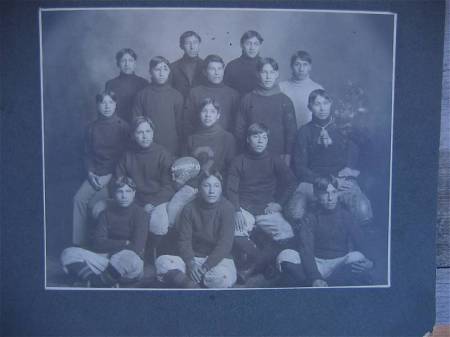
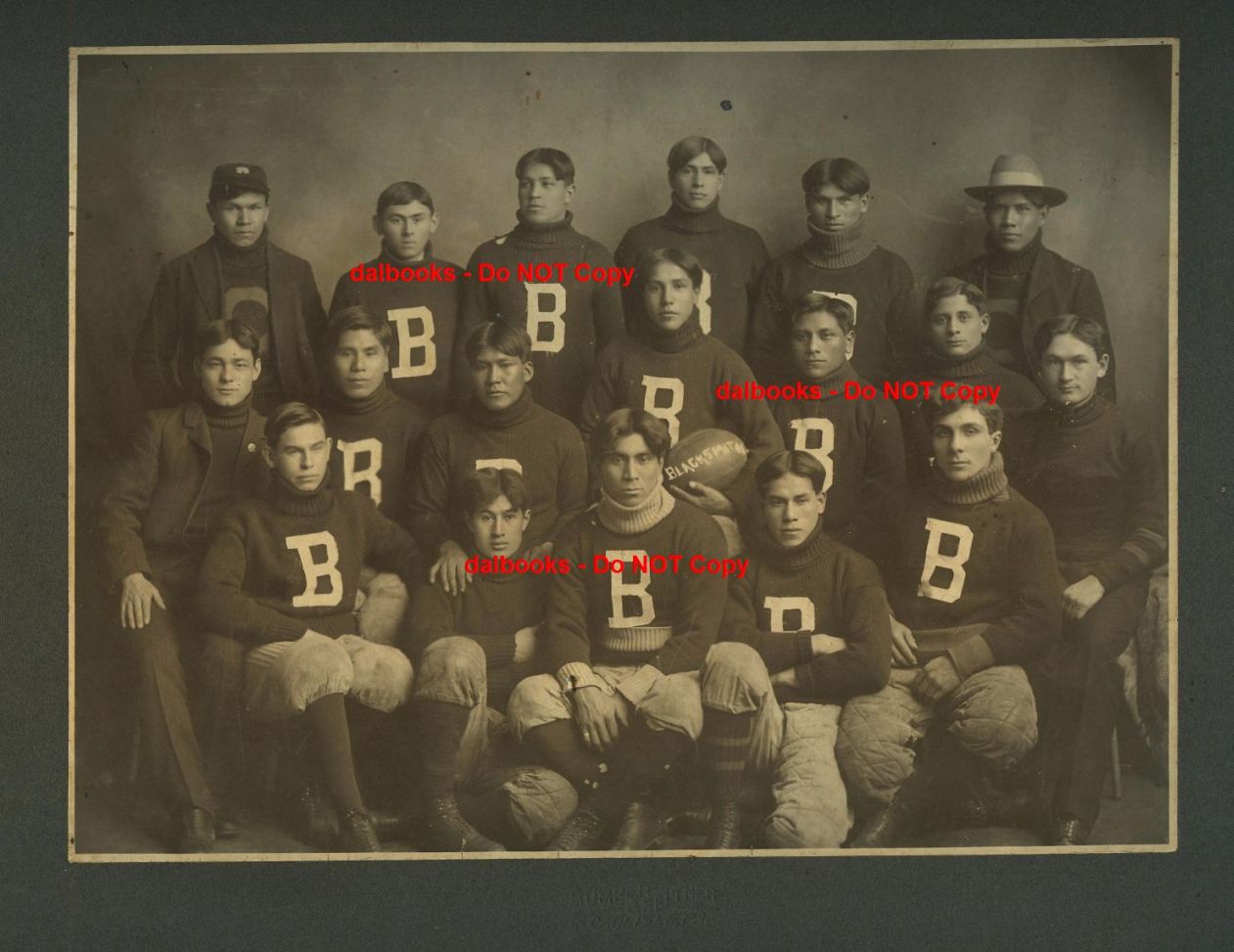
The very next day, I came across a collection of items that appear to have come from Mitchell Pierce’s estate. One of the items was a photograph of the Blacksmiths team. I think this photo is also real. Note the two lettermen on either end of the back row. They were probably experienced players who were coaching the Blacksmiths, most probably because that was their trade.

Both the Shoemakers photo and the collection that includes the Blacksmiths photo are still up for sale as of this writing, but the Shoemakers won’t be up much longer.
Tags:Blacksmiths, Mitchell Pierce, Shoemakers, White Earth Agency
Posted in Carlisle Indian School, Football, Joe Libby | Leave a Comment »
May 13, 2010
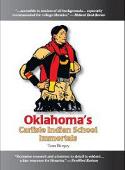
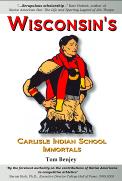
Yesterday, a reader asked about Wisconsin’s Carlisle Indian School Immortals, wondering if it would be a series of blogs or a book. That tells me it’s time to talk about it a bit. Last year I wrote Oklahoma’s Carlisle Indian School Immortals, Volume I of the Native American Sports Heroes Series. I have now completed Volume II of that series. Wisconsin’s Carlisle Indian School Immortals will be released on September 1. Like the earlier book, it follows 17 football stars with ties to a particular state, Wisconsin in this case, from their childhoods on the reservation, generally, to their time at Carlisle, and through their later lives. Background chapters on Carlisle Indian School, its legendary football teams, and coach “Pop” Warner set the stage for the individual biographies.
Not included are busts of the players drawn by Bob Carroll. Bob graciously drew those for Oklahoma’s Carlisle Indian School Immortals just before the end of his life. In their place, is a map that shows all the Indian Reservations in the state of Wisconsin which is intended to assist the reader in knowing where these people spent their early childhoods and, in some cases, returned to after finishing at Carlisle.
Chapters are included for:
Chauncey Archiquette
Wilson Charles
Wallace Denny
Lone Star Dietz
Louis Island
James Johnson
Frank Lone Star
Jonas Metoxen
Thomas St. Germain
Caleb Sickles
George Vedernack
Gus Welch
Joel & Hugh Wheelock
Martin Wheelock
Charles Williams
William Winneshiek
It is my hope that historians, teachers and librarians review this book and make it more available to students who would learn a lot about how disadvantaged people overcame obstacles to excel.
Copies of the softcover version of Oklahoma’s Carlisle Indian School Immortals are now in stock for June 1st release.
Tags:Frank Lone Star, Oklahoma's Carlisle Indian School Immortals, Wallace Denny, William Winneshiek, Wilson Charles, Wisconsin's Carlisle Indian School Immortals
Posted in Caleb Sickles, Carlisle Indian School, Charles Williams, Chauncey Archiquette, Football, George Vedernack, Gus Welch, Hugh Wheelock, James Johnson, Joel Wheelock, Lone Star Dietz, Louis Island, Martin Wheelock, Pop Warner, Thomas St. Germain | 2 Comments »
May 6, 2010
Today’s mail brought a new article by Jim Sweeney entitled, “Hang Time for a Watermelon: Did Thorpe Really Do It?” Jim first read about Thorpe’s celebrated feat in Bill Crawford’s 2005 biography, All American: the rise and fall of Jim Thorpe. Later, he read Steckbeck’s matter-of-fact recounting that implied superhuman feats were routine for the world’s greatest athlete.
The day was October 21, 1911; the place was Pittsburgh, Pennsylvania; and the opponent was the University of Pittsburgh. In the middle of Carlisle’s greatest season, Thorpe put on an exhibition that is still being talked about 99 years later. The Carlisle Arrow carried several accounts of the game from Pittsburgh newspapers, but the Dispatch told the story in the most detail:
“So fast were the Carlisle players that only twice during the many punting duels engaged in were Pittsburg players able to bring out the ball after it had been booted into their territory. Indeed, on two occasions, Thorpe, who kicked wonderfully well for Car lisle, got down the field under his own bootings, capturing the ball each time. Once he kicked a beautiful long spiral almost into the midst of five Pitt players and got down the field in time to grab the Pigskin, shake off three or four would-be tacklers and dart 20 yards across the line for a touchdown.”
Sweeney doubted that it was humanly possible to do what the reporter said Thorpe did. No one today could punt the ball from deep behind his line, recover from the awkward position a punter is in after kicking the ball, race downfield through his teammates and the opposition, position himself under the ball, and outjump others for it. Jim analyzed each aspect of the alleged feat to determine if it was even possible. When his article is published, I’ll inform you as to where it can be found so you can learn of his conclusions.
Tags:Bill Crawford, James Sweeney, John Steckbeck, Pittsburgh Dispatch, University of Pittsburgh
Posted in Carlisle Indian School, Football, Jim Thorpe | Leave a Comment »
May 4, 2010
On New Year’s Eve, the day after the game in Nashville, the Harvard Law School All Stars played an All-Southern All Star team in Memphis. This was apparently the game that had been previously rained out. Hamilton Fish played even though his nose was broken the day before by a rough blow from “Smith” of Michigan. Even with the injuries, Harvad Law’s line-up changed little from the previous game:

Dowey replaced Galbreath at right end and Hamm started at right guard rather than relieving Hoar. Their opponents weren’t identified as to their college affiliation. However, a game write-up provided a few details. Again, the game was played on a soggy field. Kennebrew, Carter, Barker and Lee were from Ole Miss and Marro was a former Notre Dame star, one assumes, from the South. Perhaps a reader will provide more information on the Southern All Stars.
Once again, the game was a defensive struggle with the only scoring came in the third quarter on a 25-yard pass play from Harvard Law’s quarterback Gallati to left end Silas Williams, ironically captain of the 1910 Sewanee team. The kick after touchdown was not made, resulting in a 5-0 win for the Harvard Law All Stars.
January 2, 1911 found the Harvard Law School All Stars in Baton Rouge, Louisiana playing a team of former LSU stars. Fish’s squad was even more banged up after the Memphis game and had to make more changes in its line-up. Forcheimer started at right end; Crumpacker shifted to right guard; Hall played left tackle; and McVeagh called signals from the quarterback position. The old LSU stars, many of whom hadn’t played in two or three years, acquitted themselves well. Harvard Law showed the effects of travel and the two previous games. In what a sports writer called, “the finest exhibition of football ever given in this state,” field conditions prevented spectacular play. Strong winds hampered passing and played havoc with punts. The game ended as a scoreless tie.
Afterwards, Hamilton Fish took his men to New Orleans for some rest, relaxation and recuperation. While there, the University of Havana challenged Harvard Law to a game in Cuba. Fish declined. Thus ended Harvard Law School football.
Tags:Gallati, Hamilton Fish, LSU, Marro, Notre Dame, Ole Miss, Sewanee, Silas Williams, University of Havana
Posted in Football | 2 Comments »
April 30, 2010
The December 7 New York Times announced that Hamilton Fish’s Harvard Law School All Stars were not through playing; they would be playing two southern teams over the Christmas holidays. On December 28, they would be playing “the pick of Vanderbilt and Suwanee elevens” at Memphis and on the 31st, their opposition was to be “the best men from the University of Louisiana and one or two other colleges” at New Orleans. Things, however, didn’t turn out as planned.
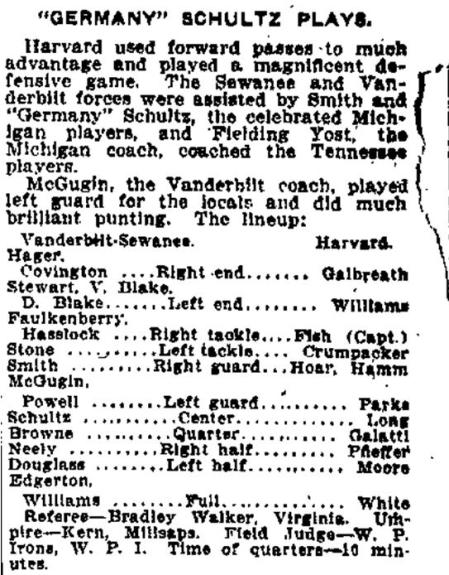
A December 26 wire service article reported that Fielding Yost “may don the moleskin again” as he was coaching a “western all-southern eleven” that would be playing Harvard Law School in two days. Joining him from his Michigan squad were Germany Schultz and Smith. The Wikipedia page for the 1910 Wolverines lists no Smith on the Michigan squad. So, it is possible that Smith wasn’t the player’s real name. Perhaps he was a coach or former player.
The evening papers on the 28th reported that heavy rain caused the game to be postponed due to wet grounds. “The Harvard team will leave for Nashville tonight, and will play in that city tomorrow. After playing games in Nashville and Baton Rouge, La., they will return to Memphis Saturday next and play the postponed game. Newspapers were about as accurate then as now.
The postponed game between the Harvard Law School All Stars and the Vanderbilt-Sewanee-Michigan players was played on December 30 in Nashville. The muddy field did not slow the players as Hamilton Fish made a 100-yard run only to be stopped by Neely Browne of Sewanee 10 yards short of the goal. (The field apparently had not been reduced to its present length yet.) The game ended as a scoreless tie. The following coverage of the game omits the names of the players’ colleges:
 Next time: the next game.
Tags:Dan McGuigan, Fielding Yost, Germany Schultz, Harvard Law School, Sewanee, Suwanee, Vanderbilt
Posted in Football | 4 Comments »




 Tom Benjey's Weblog
