Archive for the ‘Football’ Category

Historian Demands Redskins Name Be reinstated

September 7, 2023
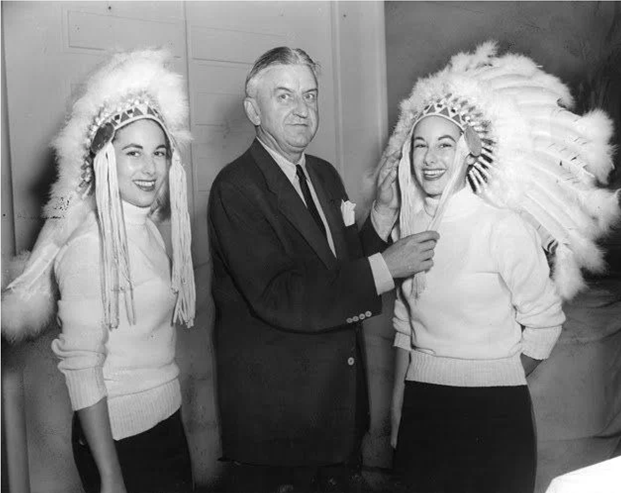
George Preston Marshall (center)

Andre Billeaudeaux, historian and co-founder of Native American Guardians Association (NAGA), thinks opponents of the Redskins name don’t know what they’re talking about. “These people are just ignorant. It’s toxic ignorance. It’s group think. It’s the psychology of a group that has no idea what they’re doing, but they won’t listen to us [NAGA], either.”

The origin of the Redskins name and logos go back to 1912 when James Gaffney, of New York’s Tammany Hall, purchased the Boston Rustlers National League baseball team. He renamed the team as the Braves and used an image inspired by Saint Tammany for the team’s logo. That image is prominent on the left sleeve of Babe Ruth in a photo taken in 1935.

When a group including Washington laundry magnate George Preston Marshall purchased an idle NFL franchise and established a team in Boston, they named the team the Braves. It was common for upstart NFL teams to name themselves after established baseball teams, particularly when they shared the same field. The new Braves’ uniforms didn’t include an Indian motif. Instead they wore jerseys of a simple design in Marshall’s company’s colors: blue and gold.

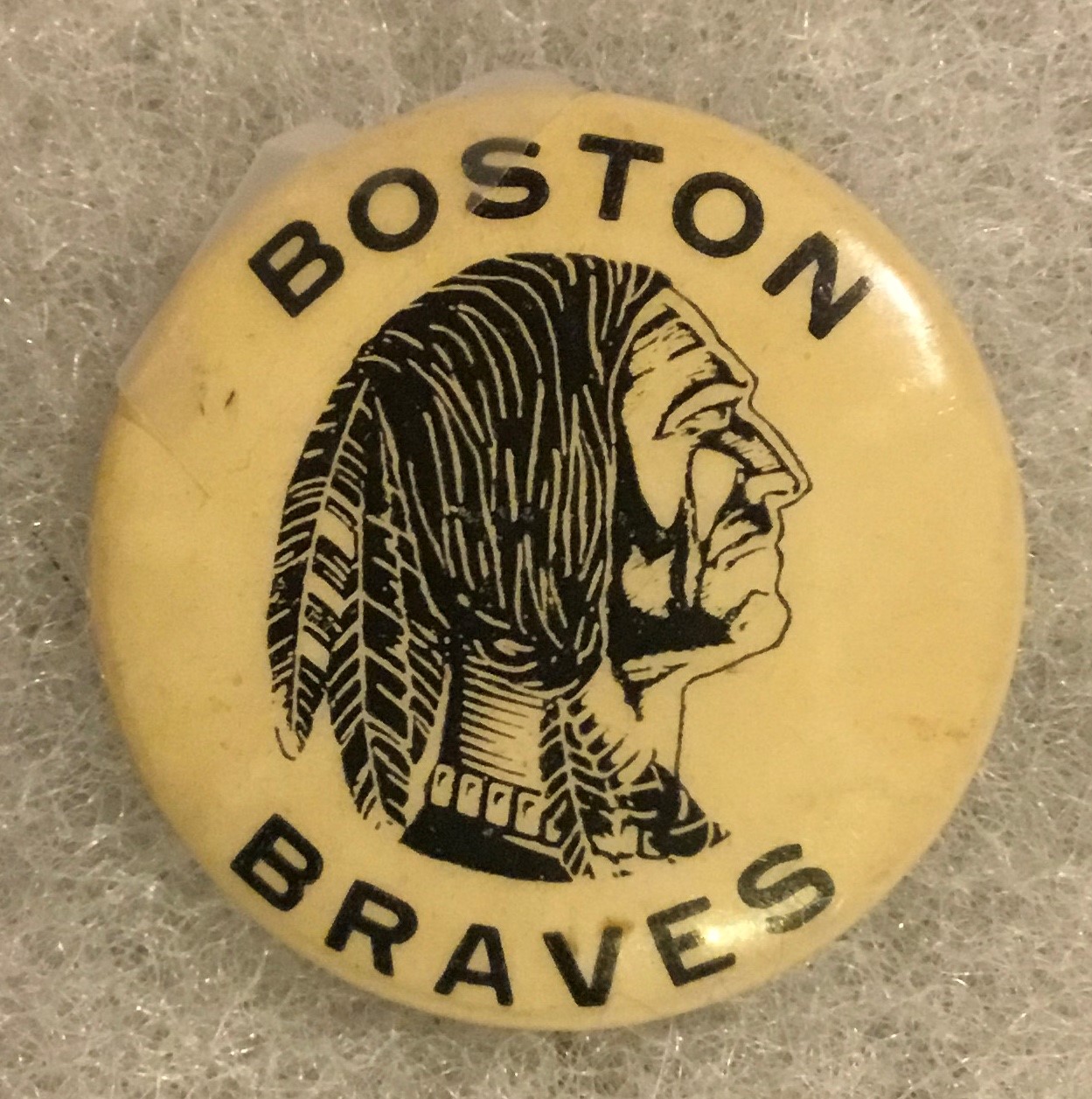
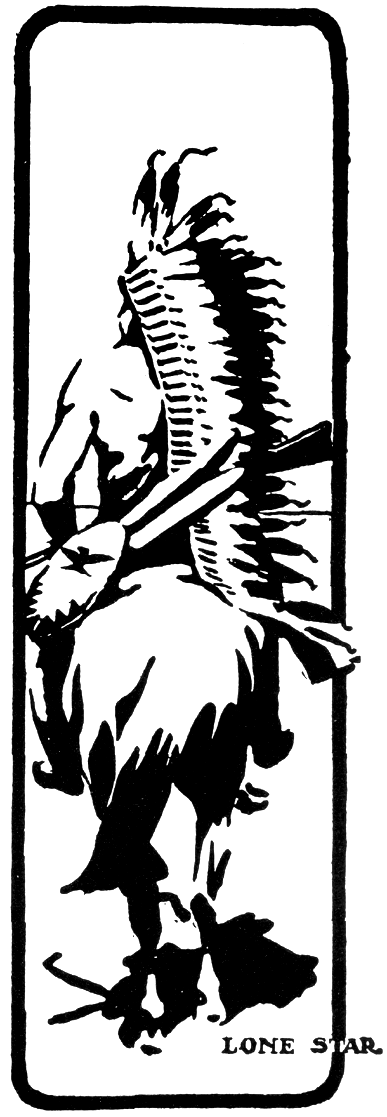
As a .500 first season, Marshall’s cohorts left, leaving him as sole owner of the team. He fired the coach, Lud Wray, and hired Lone Star Dietz, a Carlisle Indian School alum who had had success coaching at the college level. Dietz brought four of his Haskell Institute (today’s Haskell Indian Nations University) Fighting Indians star with him. The figure on the Braves’ letterhead and pin is different than the one used by the baseball team. On the baseball team logo, the man wore a headdress where the football logo image only had three feathers. I’m not qualified to determine if the football team used Saint Tammany’s profile or not. Having red on the letterhead suggests that the team’s colors changed shortly after Dietz became their head coach. The existence of the pin argues against Dietz changing the logo because he was only with the team a short amount of time before the team name was changed and it was during the off season. So, the logo on the button was probably created for the 1932 season.

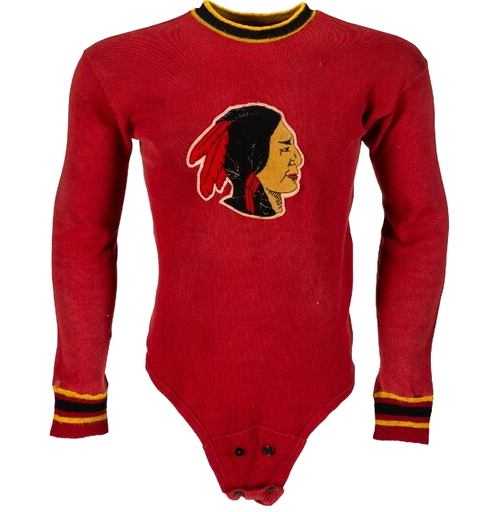
One question never asked is: Why did Marshall change the team’s colors? A 1933 jersey shown below has red as the primary color and is trimmed with gold and black bands. These colors are similar to Carlisle’s colors and the stripes on the cuffs are reminiscent of the below-the-elbow stripes on the Indians’ jerseys. Some have attributed the design of the Redskins’ logo to Lone Star Dietz. The image may have preceded him; it’s not clear when the team adopted it. Dietz likely borrowed the concept from the NHL Blackhawks’ design and placed the logo on the front of the jersey.

Probably to save money, Marshall moved the team from Braves Field to Fenway Park. To eliminate confusion with the baseball team, he felt he had to change the name. Some think red was chosen because they were then based on the Red Sox home field. A Boston newspaper writer claimed that Marshall chose the name to save money by not having to buy new uniforms. As shown in this piece, both colors and design of the team’s uniforms changed when the team’s name changed. However, the team had to wear the old uniforms in the first game of the 1933 season because the new ones hadn’t arrived yet.

Billeaudeaux thinks otherwise. “Redskins is not about race. It’s a warrior who’s gone through the bloodroot ceremony. “They shave their heads and surrender their souls to their Creator. They paint themselves red as if they were born new into the world.”

“The Redskins were the only minority representation in the entire NFL and it was a real person, not a mascot,” said Billeaudeaux. “The name Redskins is a national treasure and for that reason it should be protected. It’s a cultural treasure and deserves to be protected and understood. It’s not just about the football team. It’s about the DNA of the nation.”

NAGA members aren’t the only people who prefer Redskins for the team name. As of this writing, 130,790 people had signed NAGA’s petition demanding the team name be changed back to Redskins. “Redskins Fans Forever,” a Facebook group with 61,600 members, refers to the team only by its historic name. 

Ninety percent of Native Americans around the country supported the Redskins name in a Washington Post poll in 2016, as the woke assault on the traditional name grew stronger.

Red Mesa High School on a Navajo reservation in Arizona recently installed a new football field with the Washington Redskins logo on the 50-yard line.

A Likely Outcome

August 29, 2023

Two posts ago I opined that, had Jim Thorpe not left Carlisle in 1909 to play summer baseball and instead returned to school, he would have had a good chance of receiving tutelage as a minor league baseball player. I need to revise this conjecture and not just because he had tried out unsuccessfully for the 1908 Olympic games.

Had Thorpe returned to Carlisle for the 1909 fall term, he would have likely had another good season, his third year of eligibility for football, improving the Carlisle team’s 8-3-1 record. He might even have made Walter Camp’s Second Team. If he ran track in spring 1910, he would have used up his four years of eligibility and there were no Olympic tryouts that summer or the next. His track career would probably have come to an end because no economic opportunities existed for track and field at that time. Had he played football in the fall of 1910, he would surely have improved on Carlisle’s 8-6 record and might have made Camp’s All-America First Team, but he wouldn’t have been as dominating as he was in 1911 and 1912 because his body wouldn’t have the extra year of growth it had when he returned in 1911.

Jim would have used up all his college football and track eligibility by the end of 1910. With football not having a professional league yet, only semi-pro teams existed at the time. The irregular and unreliable income from semi-pro football would not have been enough to support him. His only likely professional athletic opportunity at that time would have been minor league baseball. He had already tried that route. While it’s impossible to know if the 1911 baseball season would have worked out better this way than it already did. Perhaps a better team in a more stable league would have picked him up. But, with two summers already under his belt, the team that signed him that summer was in a league that was insolvent, resulting in Jim being out of a job and back in Oklahoma with no good options on the horizon.

Returning to Carlisle would not have been an option because all his eligibility had been used up. Other schools would have been reluctant to enroll him because of the reactions to Frank Mt. Pleasant playing for Dickinson College in 1908 after having played for Carlisle. Some schools refused to play Dickinson if Mt. Pleasant was on the field. The four-years-of-eligibility rule was being enforced.

Had Jim returned to Carlisle after the 1909 summer, he would likely have had fewer options in 1911 than he had after not returning in 1909. Ranching would have been a good outcome for him.

Native American Guardian’s Association

August 14, 2023

I had not heard of the Native American Guardian’s Association (NAGA) prior to Google informing me that they were fighting to have the Washington NFL team reinstate the Redskins name. Perusing their website, https://www.nagaeducation.org/, I found their motto, “Educate Not Eradicate,” and their mission statement:

“The Native American Guardian’s Association (NAGA) is a 501c3 non-profit organization advocating for increased education about Native Americans, especially in public educational institutions, and greater recognition of Native American Heritage through the high profile venues of sports and other public platforms.”

Also on the front page was a large photo of the Red Mesa Redskins’ new football field. Red Mesa is a high school on the Navajo reservation.

The History tab states, “NAGA celebrates and promotes the rich history, legacies, and many national contributions of First Nation’s people which have historically been woven into the fabric of American identity.” It is a statement of inclusion and being part of what has been called “The American Experiment.” It is accompanied by a photo of men wearing red garrison caps reminiscent of the ones one often sees American Legion members wear. There’s a good chance many of these men are veterans because American Indians serve in the armed forces at a higher rate than the population at large, particularly during wartime.

This website is information rich, containing a lot more information than I can mention in a blog message. I urge you to peruse the site to see for yourself. Of particular interest is the Top Misconceptions tab. It has links to ten pages, starting with “Redskins is Racist.” Another link discusses polls that show vast numbers of American Indians do not consider Redskins or Redmen to be racist. One link shows that leaders who oppose the name speak only for themselves. The link on the 90% polls explains that the polls were conducted using normal polling methods and have, at least, a 95% confidence level. Some are as high as 98%.

Check out this site to learn more about how people in Indian Country think about things.

Redskins Revisited

August 11, 2023

Look forward to seeing Lone Star Dietz’s name in the news soon as the origin of the Washington Redskins name will surely be discussed again. Native American Guardians Association is circulating a petition that had over 67,000 signatures as of Tuesday morning. The group’s president, Eunice Davidson (Sisseton Dakota), sent a letter to the Washington NFL team requesting that the team’s name be changed back to Redskins, citing a poll of Native Americans, 90% of whom did not find the name offensive. She referenced as examples, the Kansas City Chiefs and Chicago Blackhawks, recognizing the names carry “an obligation of honor and respect.” She requested “that the team revitalize its relationship with the American Indian community by (i) changing the name back to ‘The Redskins’ which recognizes America’s original inhabitants and (ii) using the team’s historic name and legacy to encourage Americans to learn about, not cancel, the history of America’s tribes and our role in the founding of this Great Nation.”

She also suggested a boycott similar to the national boycott that lost Anheuser Busch about $27 billion without a single brick being thrown. This may not be successful as many fans have already abandoned the team for it poor play as well as its wretched new name.

Daniel Snyder was long despised as the team’s owner but fans supported him on his pledge to keep the team name. After he caved on that promise, his future as owner was doomed. He is now being pressured to sell the team for something like $4 billion. This brought mind the time the NBA force a racist coot into selling a team for twice its value.

My opinion at the time the name was changed was that Commanders as a name for a pro football team was lame. It hasn’t improved. Perhaps the new owners plan on changing their colors to olive drab and black and attaching visors with scrambled eggs on them to the helmets. Even before this latest news conjectures arose that the new ownership would bring with them a new name. One hopes they do a better job this time. If they must select a Washington-relevant name, they should consider the following: beltway bandits, swamp creatures, budget busters, influence peddlers, and child molesters. Redskins is a far more noble name than those more appropriate ones. More noble than that city deserves.

Will the new owners bring the team back to Carlisle for summer camp in an attempt to win Super Bowls again?

….

One commenter has suggested a return to the team’s original name when it first played in Boston.

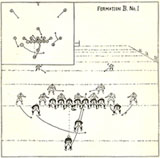
Single Wing vs T-formation

August 9, 2023

The August 2023 edition of the College Football Historical Society journal includes a most interesting article and I’m not just saying that because it also includes one of mine. The piece I’m talking about has to do with the College All-Star Game of 1948. For those not old enough to remember these games, a group of the top college players played against the reigning NFL champion in Chicago before the start of the year’s football season. The coach of the AP mythical national champions led the collegians. This year it was Notre Dame’s Frank Leahy. This series ran from 1934 through 1974.

The pros were represented by the Chicago Cardinals, a team that seldom earned this honor. More unusual were the numbers of Notre Dame and Michigan players on the college roster: fourteen Irish and eight Wolverines. In those days, the single-wing reigned in Ann Arbor where the T-formation ruled in South Bend. Aficionados of each system extolled the virtues of their offense of choice. Leahy, a T-formation man, saw his chance to prove which was the better approach with so many highly skilled players of each system on his roster.

So, he split his team into two squads based on which formation they were accustomed to running. Thirty-three single wingers and twenty-nine from T-formation schools. He assigned assistants—his assistants for the game were head coaches from other schools—familiar with the single wing to coach that squad while he and assistants who used the T-formation coached the other one. He told the players he hadn’t decided which scheme to use in the big game against the pros and would have the squads play each other to determine which system he would use in the big game.

The contest was held on August 14, 1948 in front of a crowd of 23,450 wildly cheering fans at Northwestern’s Dyche Stadium. To find out what happened that day and six days later when the college boys went against the Cardinals in front of 101,220 spectators at Soldier Field, you’ll have to get your hands on the journal. To receive your own copy, email rayscfhs@msn.com or write:

  • Ray Schmidt
  • PO Box 6460
  • Ventura, CA 93006

Mystery Man Identified?

July 24, 2023

On June 1, 2020 I posted a photograph taken at Union Station in St. Louis in 1908. Five Carlisle Indian School football players posed in a Thomas automobile used as a prop by a photographer who operated in the train station. Cecilia Balenti-Moddelmog, grandaughter of Carlisle star quarterback Mike Balenti, identified four of the five young men in the photo but could not identify the person on the far right.

The others are l-to-r Little Boy (Scott Porter), Wauseka (Emil Hauser), Mike Balenti and Fritz Hendricks.

Now Dennis Parrish has identified the player on the far right as John Balenti, Mike’s brother. In the team photo below, he is in the back row fourth person from the left. At least that is what the Pittsburgh Press said.

Why Mike’s granddaughter didn’t recognize her great uncle is a reasonable question. However, I had an uncle I never met even though he was alive decades into my adult life. I am so bad at picking people from old photos that I’m little help sorting out this one.

Honoring Joe Bergie

April 26, 2023

I previously mentioned receiving communications from descendants of the Carlisle Indians. This week an email came from Joe Bergie’s oldest surviving granddaughter discussing his induction into the Montana American Indian Athletic Hall of Fame in 2020. Because of Covid, like many other things, his enshrinement was delayed until 2021. She credited her cousin, Carol Gilham, with doing the considerable amount of work necessary to get a star athlete who played his last game a century ago recognized.

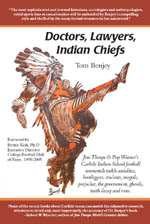
Joe Bergie was not a minor football player at Carlisle, an entire chapter of Doctors, Lawyers, Indian Chiefs is devoted to him. Space doesn’t permit including all of that here. I’ll just hit the high spots. Joe arrived at Carlisle in 1910 and played on the scrubs as he learned the rudiments of the game. He played center, an important position for teams employing the single- and double-wing formations, on the great 1911 and 1912 teams. He excelled at defense and carried the ball well when given the opportunity at fullback. Pop Warner considered him to be the greatest center to ever don a Carlisle uniform. In the spring, he also starred at lacrosse when it replaced baseball at Carlisle.

After leaving Carlisle, Joe played on several pre-NFL semi-pro teams, even serving as the coach while playing for one of them. World War I, in which he served in the Army and was shipped overseas, where he remained until January of 1919. After his discharge, a hand injury ended both his football career and his brief turn as a professional wrestler.

Author’s note. A guy in my outfit in the service was named Bergie. We pronounced it Bergee. Recently, I was informed the proper pronunciation is Berjee.

Joe Bergie in Carlisle Indian School football uniform.

Changes in Lone Star Dietz’s Artwork Style

March 23, 2023

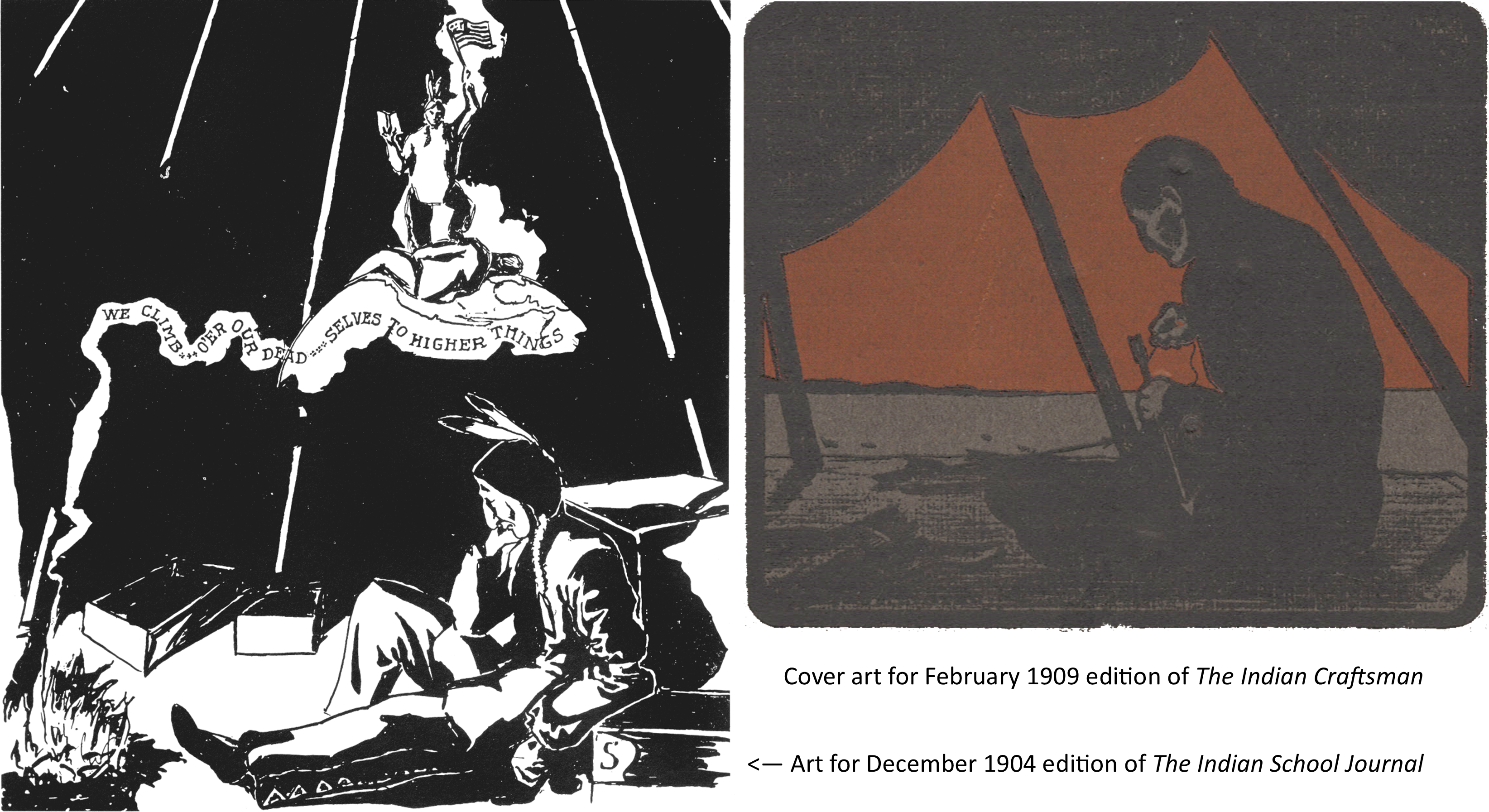
On Tuesday evening I attended a presentation by the Dickinson College Archives’ Carlisle Indian School Resource Center about their digital scanning project. The handout for this program included cover images of two Carlisle Indian School publications: The Indian Craftsman and The Red Man. They caught my eye because Lone Star Dietz and his bride—he and Angel DeCora had been married a little over a year when the first edition appeared—created and produced the school’s literary magazine. Dietz contributed the artwork and almost all of the cover images. The title of the magazine was changed starting with the second year because of confusion with Stickley’s popular journal The Craftsman.

The differences between the first cover art and that Dietz made for later works was striking. It was similar to a drawing he made for the December 1904 edition Chilocco Indian School’s The Indian School Journal. Although that school claimed him as a student and arranged his transportation to Chilocco, there is no evidence that he actually arrived there. The piece used on the February 1909 magazine might have originally been intended for a Chilocco publication.

The first piece of Dietz’s art to appear in a Carlisle document was on page 3 of the June 19,1908 edition of the school’s newspaper The Arrow. This design was published about the time the school acknowledged Dietz’s elopement with the head of the Native Art Department. The shift in style was likely due to DeCora’s influence. Dietz would never return to the previous style.

The other cover image used of the handout came from a later edition of The Red Man magazine—cover art was often used multiples times across several years. Dietz’s style would evolve but never back to how it was for Chilocco publications.

A New Review of My Latest Book

February 8, 2023

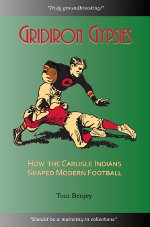
In all of the years that I have been reading and studying about college football, the team representing the Carlisle Indian School has always taken on somewhat legendary proportions. Much of this probably came from reading about Jim Thorpe and his association with the school, or in reading about other schools that had to play the dreaded Carlisle Indians. Over the years I have read several books that deal at least in part with the Carlisle football team. However, I have never come across any publication that tells the entire story of that team, until now.  Therefore, when I was asked to review this significant new book I leapt at the opportunity.

The active time for the Carlisle team was from 1893-1917, with 1894 being the first year to feature a complete schedule of about 10 games. When you consider that this was well over 100 years ago, and that for at least it’s first few years the Carlisle team was hardly known around Pennsylvania, much less the rest of the country, the amount of material that the author has uncovered from this time period is truly amazing. There is no bibliography included in the book; but, the notes listed for each chapter (no less than 25 pages of them) in essence serve as the book’s bibliography. If anyone cares to research a game or a season further, the references are right there.

Although the author acknowledges many people for their help with this project, the story could have used some better editing in two areas. The first is to clear up the player identification ambiguities that are often encountered in the game accounts. Virtually every game that Carlisle ever played is covered in detail based on the available newspaper accounts. With all of this material to decipher and organize, the telling of the story of each season’s games at times suffers. The names of the players from both teams in a game are often used without clearly identifying the team to which they belong; especially confusing when the Carlisle players have non-Indian names. This leads to some confusion for the reader and the need to reread the account to make sure of each player’s team affiliation.

Secondly, the author does a great job in trying to recreate the game action based on what the newspapers reported. However, these recreations stick too closely to the often dry reporting of an early 20th century newspaper sports reporter, a reporter from an era before the reporting of football really took off. Using more exciting prose, without changing any of the facts of the play or the game, would have definitely livened up these accounts and resulted in a more exciting read.

There are two sections of the book which I also feel are placed incorrectly. Appendix A, Origin of the School, tells the story of the Carlisle Indian School from its founding to just before the organizing of the school’s first football team. When I was first perusing the book and came across this Appendix, I decided to read it first. I was correct in doing so, as it is a natural introduction to the rest of the book and should have been used as either Chapter 1 or as the Introduction.

The other section that appears to be misplaced is Chapter 8, Captain Leadership, which relates in great detail something that took place during the 1902 season. Instead of including this material in Chapter 6, which covers the 1902 season, or making it Chapter 7, it is placed after the material covering 1903, which seems out of place to me.

Despite the imperfections mentioned above, they are minor when compared to the total amount of material presented and the research done, i.e., the overall excellence of this work. This is an incredibly detailed story of one of the most legendary of college football teams, one whose reputation is still strong more than 100 years after its final game was played. Few programs have been covered in such detail. If you are a student of college football, this book is a must for your football library.

Since this is a brand new book, there are no copies currently available from any of the used book sources. My suggestion would be to order directly from the source, www.Tuxedo-Press.com (See ad in this issue), or Amazon.

                                                                                                                                         Timothy Hudak

                                                                                                     Sports Heritage Specialty Publications

The End of an Era

December 31, 2022

There was a time when there were no New Year’s Day football bowl games to watch or listen to on the radio. There weren’t even bowl-shaped stadiums to host them. In fact, what we call bowl games today weren’t called that. Records have been changed to “grandfather in” major New Year’s Day games that were played in this primordial period .

Needing a place to accommodate large crowds to its football games–the schools referred to as Ivy League today were football powers back then and attracted more spectators than just the players’ parents and alumni living locally—Yale University broke ground for a stadium with a seating capacity of 70,896 in 1913. It opened for the 1914 36-0 drubbing by rival Harvard. More than 68,000 spectators nearly filled the new stadium, named The Yale Bowl because of its bowl-like configuration.

After Washington State’s upset of Brown in 1916, the New Year’s Day contest between eastern and western powers in Pasadena became an annual event. But it didn’t have a proper home. When the game’s future seemed certain, the City of Pasadena acquired land in Arroyo Seco on which to build a football stadium. They broke ground in February 1922. Construction was completed in October of that year. The horseshoe-shaped facility was called “Tournament of Roses Stadium” or “Tournament of Roses Bowl” prior to the 1923 New Year’s game. It was then officially named “Rose Bowl” as a reference to the Yale Bowl, although it wasn’t a bowl at that time. But it would accommodate 57.000 spectators.

The first game played in the new stadium was the regular-season meeting of the University of California (Cal) and University of Southern California (USC). Cal won 12-0 but declined the invitation to defend the honor of the West on the upcoming New Year’s Day. USC, having the Cal loss as the only blemish on her record, accepted the invitation to defend against the Eastern interloper, 6-2-1 Penn State. The Nittany Lions’ head coach, Hugo Bezdek, was no stranger to Pasadena. He had taken his Oregon team to victory there in 1917 and again in 1918 when some of his old players, then preparing for combat in WWI, got him to coach their Mare Island Marines team for that game. He wasn’t so successful in 1923 because USC prevailed 14-3.

Over the years, the Rose Bowl was expanded to become a complete bowl and seating was increased to 104,594 (later reduced to 92,542). The number of bowl games (few of which were played in actual bowl stadiums) expanded over the years to 26. However, the rise of the FCS playoffs has impacted the bowl games significantly. The 2024 expansion to twelve teams in the playoffs, with the Rose Bowl probably hosting a quarter-finals game, brings an end to the Rose Bowl’s prominence.

The 2023 game ends the 100-year-long sequence of significant games, broken only by World War II, in the Rose Bowl. It is only fitting that Penn State is again the eastern contender as it was in 1923. Their head coach, James Franklin, lost his first appearance in the Rose Bowl to USC in 2017, also on January 2nd. It is a sad, but fitting, end to a great run for Penn State to bookend the birth of the stadium and the end of its glory.

The Rose Bowl under construction.
Note the horseshoe shape.