Archive for the ‘Football’ Category
December 7, 2011
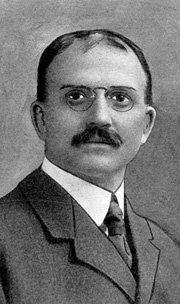
An article by Bob Barton in the November 2011 issue of the CFHS newsletter, among other things, discusses the elevation of Penn’s football program under George Woodruff’s leadership. Given the treatment that Woodruff received from Sally Jenkins, it seems necessary to present a more balanced view of his career. George Washington Woodruff (1864-1934) attended Yale University in the late 1880s, graduating in 1889. While at Yale, he played on the football team, rowed crew and ran track.
In 1892, he enrolled in law school at the University of Pennsylvania and took on the duties of coaching football and rowing crews. (One assumes that he initially took on these jobs to support himself while in law school.) Yale supporters did not take Woodruff’s shift of allegiance well as Woodruff had been a guard for the Eli. They also didn’t like the change in competiveness. The eleven games played between Yale and Penn between 1879 and 1892 all ended in victories for the Eli, often in a rout. Scores in Yale’s favor of 60-0 and 48-0 were quickly reduced by Woodruff to 28-0 and 14-6 in 1893. Claiming that Woodruff had recruited ineligible players although the rules weren’t in place before the 1893 season started, Yale broke with Penn and didn’t play them for 32 years. That didn’t seem to bother George much as his 1894 team went undefeated with victories over Princeton and Harvard and was retrospectively named National Champions. He repeated the feat in 1895 without Princeton, who remained off the schedule until 1935. Not only did George Woodruff bring the quality of Penn’s football to the highest level, he maintained it at that level, going 124-15-2 for the ten years he coached the Quakers. After dropping out of coaching following the 1901 season, he returned to the arena twice: first in 1903 to lead the Illini to an 8-6 season and again in 1905 to go 7-2 with the Carlisle Indians. His charges beat Army, Penn State and Virginia but lost to Harvard and Penn.
Woodruff’s .885366 winning percentage was far above the minimum required for induction into the College Football Hall of Fame.
Tags:Bob Barton, College Football Historical Society, Sally Jenkins, University of Pennsylvania, Yale
Posted in Carlisle Indian School, Football | Leave a Comment »
November 17, 2011
Carlisle received the opening kick off and moved the ball quickly to Harvard’s end of the field but were unable to push the ball across the goal line. They turned the ball over on downs at the Harvard 2-yard line. On their second possession, the Indians bogged down well into Harvard territory and Jim Thorpe kicked a field goal from the 15-yard line to open scoring for the game. Harvard soon countered when Hollister drop-kicked a field goal of his own to tie the score. There was no further scoring in the first quarter. In the second quarter, Carlisle rushed the ball to Harvard’s 40-yard line but could get no further on this drive. Thorpe then kicked his second field goal of the game from 47 yards out. Unfortunately for the Indians, they would later fumble the ball and a Harvard player, Hollister, recovered it on the 50-yard line. On the next play, Reynolds broke through the Indians’ line and, after the Indians thought he was down, popped to his feet and ran for a Harvard touchdown and 9-6 lead at halftime. Note that touchdowns were worth 5 points and the goal after 1 point while field goals counted 3 points at that time.
After a series of line plunges late in the third quarter, Alex Arcasa pushed the ball over for Carlisle’s only touchdown of the day. Thorpe kicked the point after. Thorpe also kicked another field goal to close out scoring for that quarter. Harvard put in its fresh first team for the fourth quarter and made good yardage at first, but the Indian line eventually held. Thorpe kicked his fourth field goal of the day to complete Carlisle’s scoring. Harvard would get its second touchdown for the day when Storer blocked Thorpe’s punt from the 36-yard line, recovered the ball, and ran it in for a touchdown. Fisher completed the scoring for the day at 18-15 by kicking the point after touchdown. Carlisle almost had a touchdown of their own in a similar fashion but, instead of falling on the ball, several players attempted to pick it up and run with it. A Harvard player eventually fell on the ball behind his goal line for a touchback.
Possum Powell excelled at line plunging throughout the day while Gus Welch, Arcasa and the badly injured Thorpe ran around the ends. The Carlisle line, without Captain Sam Bird for the whole game and Bill Newashe for most of it, outplayed the Crimson line making the backs’ gains possible.
This game has been rated as one of the greatest college football games of all times by experts.
Tags:1911 Carlisle vs Harvard
Posted in Alex Arcasa, Carlisle Indian School, Football, George Vedernack, Gus Welch, Hugh Wheelock, Jim Thorpe, Stancil Powell, William Newashe | 2 Comments »
November 15, 2011
Current events interrupt the scheduled blog for today. The Big Ten Conference announced that they are removing Joe Paterno’s name from the conference championship trophy. I haven’t made my mind up regarding Paterno’s involvement, if any, in Penn State’s cover up of the crimes committed on its premises to young boys, but I do see the folly in bestowing honors on coaches still in the midst of their careers. If the evidence eventually exonerates Paterno, will the Big Ten return his name to the trophy? What will Penn State do about the statue of Joe Paterno that stands in front of Beaver Stadium.? Penn State would not have to make a decision regarding the statue if they had waited to put up a monument dedicated to him.
A few years ago, the National Football Foundation (NFF) interrupted the counting of votes on ballots submitted by voting members of the NFF to determine which coaches would be inducted into the College Football Hall of Fame to select two coaches for induction who were not on the ballot because they were not eligible for induction because of the rules in place at that time. The NFF quickly changed the rules in a tortured way to make Bobby Bowden and Joe Paterno eligible, disregarded the ballots that had been cast, and selected Bowden and Paterno for the upcoming induction. That might have been Lone Star Dietz’s chance to be inducted but we will never know that because all the votes for him and the other candidates on the ballot were ignored.
Because of their premature action, the NFF now has to decide to strip Paterno of their honor as has the Big Ten Conference or to let him remain in the hall in spite of what happened while he was actively coaching. If the NFF had simply followed their own rules, the NFF would not have a decision to make.
Tags:Amos Alonzo Stagg, Big Ten Conference, Bobby Bowden, College Football Hall of Fame, Joe Paterno, National Football Foundation, nff, Stagg-Paterno Trophy
Posted in Football, Lone Star Dietz | Leave a Comment »
November 12, 2011
100 years ago on November 11, 1911, Carlisle achieved perhaps its greatest victory when the Indians defeated the Harvard Crimson 18-15 at Cambridge. This game is also considered to be Jim Thorpe’s greatest and one of the best games ever played in the annals of football.
Newspaper articles in the days leading up to the game, reported that Harvard Coach Percy Haughton planned to start his second team to wear down the Indians, who were known to make few substitutions, and put his first team in later in the game to finish off the exhausted Indians. So confidant in his strategy was Haughton that he didn’t bother attending the game. Instead, he spent the day in New Haven, CT scouting Yale for the upcoming rivalry game. Warner was confident about his team’s chances even though he said Captain Sampson Bird and tackle Bill Newashe would probably be unable to play because of injuries but he said nothing about Jim Thorpe’s leg and ankle.
Prior to the game, Warner bandaged his star tailback’s leg and swollen right ankle so that he could play, even if he couldn’t run at full speed and cut to escape would-be tacklers. Warner kept Thorpe’s condition a secret as part of his game strategy. Knowing that Harvard would be keying on his All America halfback, Warner used him mostly as a decoy who blocked for the person who was actually carrying the ball. A well-run single-wing offense, with all its fakes, makes it difficult to determine who has the ball. Guessing that Thorpe had it wasn’t a winning strategy for Harvard’s defense that day. Newashe was able to start but couldn’t finish the game as Hugh Wheelock substituted for him later in the game. Thorpe was eventually replaced by Eloy Sousa but not until his damage was done.
<continued>
Tags:1911 harvard Carlisle game, Eloy Sousa, Percy Haughton
Posted in Carlisle Indian School, Football, Hugh Wheelock, Pop Warner, Sampson Bird, William Newashe | Leave a Comment »
October 29, 2011
This week I succeeded, after considerable struggle, to create ebooks for Prostate Cancer and the Veteran. Now, people who have a Kindle or a Nook or another device, including a PC with ebook software, have this book available to them—and at a lower cost than the print version. I won’t go into the gory details of converting a print book to an ebook but converting to the Kindle was easier than converting to the Nook (ePub format). I won’t bother with other formats unless there is demand for them. Also, I understand that some devices have software that allows them to read books in Kindle or Nook format.
Writing this short book and creating print and ebook versions along with receiving requests for information on various Carlisle players has caused me to think about making little books on individual players or families of brothers who played. Each book would contain the three introductory chapters that provide background on the Carlisle program, the team and Pop Warner. That would be followed by a chapter or chapters on the player or players being covered in the book. Ebooks could also be created when requested.
I don’t plan on charging off on a project to create any individual player books but will seriously consider it if enough people request them. So, if you’re interested in a single player or family of players, let me know. Otherwise, I won’t know that there is anyone out there interested in a book on a specific player. I could also create books based on a specific relationship. Two that come to mind are Carlisle Indians in the NFL and the Carlisle Indian School – Washington State College Connection.
As I said before, if there are no requests, I must assume that there is no interest.
Tags:eBook, Kindle, Nook
Posted in Carlisle Indian School, Doctors, Lawyers, Indian Chiefs, Football, Pop Warner, Publishing | Leave a Comment »
October 16, 2011
Several details regarding Carlisle’s dominance over the Big Ten teams they played need to be addressed. First off is when the games were played. The first of these games was played in 1896 and the last in 1909. 1908 is the last year for a post-season road trip as the Penn State games were regular season games played against an in-state team that wasn’t their equal. 1907 was the only one of the seasons in which these games were played that Carlisle had a one-loss season. None were played in Carlisle’s 1911-13 glory days. Warner complained that the bigger teams stopped scheduling games with Carlisle after they became strong. It appears that he was accurate in the case of Big Ten teams.
Eight of these games, a slight minority, were played when Warner wasn’t coaching Carlisle. He did coach the Indians against Chicago in 1907, Minnesota in 1907 and 1908, Northwestern in 1903, Nebraska in 1908 and Penn State in 1907-1909. Penn State was improving at the time but hadn’t reached the level of Carlisle’s major opponents. Pop Warner considered the victory over Amos Alonzo Stagg’s 1907 Chicago team to be one of his greatest because Stagg thought he had his strongest team to date that year. 1907 was the first year in which Carlisle was defeated but one time. It was also the first year the Indians defeated Harvard, one of the Big Three. The only loss was to another of the Big Three, Princeton. It was also the first year that Carlisle beat two of the Big Four, Penn and Harvard.
1908 marked the end of Carlisle’s post-season trips to play Big Ten teams. That year the Indians defeated Nebraska in the teams’ only meeting 37-6 and they lost to Minnesota 11-6, in their last meeting with the Gophers. Newspaper accounts alluded to something happening in the game to sour the two schools against playing each other, but I haven’t uncovered the details yet.
Tags:Chicago, Harvard, Minnesota, Nebraska, Princeton, Stagg
Posted in Carlisle Indian School, Football, Pop Warner | 2 Comments »
October 12, 2011
This year Nebraska joins the Big Ten bringing the number of schools in the Big Ten up to twelve and leaving the Big 12 with only 10. It came to mind that the Carlisle Indians once played Nebraska in 1908 because a history professor at Nebraska is using “Doctors, Lawyers, Indian Chiefs” as a textbook. Other than Penn State, these games were usually post-season road trips played against the Champions of the West or strong contenders for that title. That the Indians went 13-3-1 in road games against these much larger schools. This is more evidence that shows Carlisle’s record needs no embellishment.
| School |
Times
Played |
Wins |
Losses |
Ties |
Years |
| Chicago |
1 |
1 |
0 |
0 |
1907* |
| Illinois |
2 |
2 |
0 |
0 |
1897, 1898 |
| Michigan |
1 |
0 |
1 |
0 |
1901*+ |
| Minnesota |
3 |
2 |
1 |
0 |
1906*, 1907, 1908 |
| Nebraska |
1 |
1 |
0 |
0 |
1908 |
| Northwestern |
1 |
1 |
0 |
0 |
1903* |
| Ohio State |
1 |
1 |
0 |
0 |
1904 |
| Penn State |
6 |
4 |
1 |
1 |
1896, 1905-1909 |
| Wisconsin |
1 |
1 |
0 |
0 |
1896* |
| Total |
17 |
13 |
3 |
1 |
|
Notes.
1. * denotes Big Ten champions or co-champions.
2. + denotes national champions.
Tags:Big 12, Big Ten, Chicago, Nebraska, Penn State
Posted in Carlisle Indian School, Football | Leave a Comment »
August 19, 2011
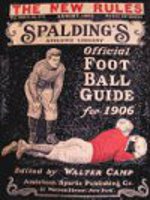
A. G. Spalding’s football guides from the early days of college football are excellent sources of information for football historians and researchers. Unfortunately, these books are now quite old and fragile, a factor that severely limits their use as research tools. To make matters worse, they have become rare enough that, when copies appear for sale, they are quite expensive.
Seeing the need for inexpensive copies of these highly useful books, Tuxedo Press is reprinting them in paperback form as they previously did for what they call Pop Warner’s Single-Wing Trilogy. Coaches, researchers and historians have found the Warner books so useful that Tuxedo Press is doing the same thing for Spalding’s Official Football Guides for the years 1883 to 1919 as copies of these books become available to them to reprint in paperback form.
Because the years from 1883 to 1893 were very small, they are bound as a single volume. Beginning with 1899, the next year Tuxedo press has found so far, each year is printed separately because those volumes are much larger. Besides the rule changes for the upcoming season, an annual volume includes Walter Camp’s three All-America team selections for the previous season, other critics picks for their All-America teams, assessments of the various teams’ successes for the previous season and outlook for the upcoming season. These books are filled with illustrated ads for Spalding equipment. The equipment illustrations could be very useful in researching the evolution of helmets and such.
More information can be found at http://www.tuxedo-press.com/index_files/Reprints.htm. The reprints of the Spalding’s Guides are also available through on-line resellers and can be ordered by your local bookstore.
Tags:A. G. Spalding, All-America team, Caspar Whitney, Spalding's Football Guide, Walter Camp
Posted in Football | Leave a Comment »
August 17, 2011
Yesterday, a little news snippet caught my ear: President Obama visited Decorah, Iowa where he stayed at the Hotel Winneshiek. While there is nothing about that that is earth shaking or will be of great historic significance, it was of interest to me. It wasn’t what the president was doing that got my attention; it was the names of the places he was that resonated with me.
Decorah (often spelled De Cora or Decora) is not just a geographical name but is also the name of an important Nebraska Winnebago family, many of whom were hereditary chiefs. The granddaughter of one of these chiefs, Little De Cora, was Angel DeCora who, after being educated at Smith College, rose to prominence in the late 19th century as the leading female Indian artist of her day and was well known in the leading eastern art circles. In 1906, she accepted the position as director of the Native Art Department at Carlisle Indian School. In late 1907, she married William Henry Lone Star Dietz who, at 25 was her student, but was still 13 years her junior. The two generated much positive press nationally for Carlisle.
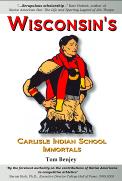
Winneshiek is the name of an important Wisconsin Winnebago, or Ho Chunk, family which has provided the tribe with many chiefs. The son of one of them was William Winneshiek who was noted more for his musical ability than his athletic prowess at Carlisle and went on to a career in music, even having his own all-Indian band. He did, however, find time to play football in the early NFL for the Oorang Indians. His biography can be found in Wisconsin’s Carlisle Indian School Immortals.
His brush with history finished, Obama left Hotel Winneshiek in Decorah for breakfast in Guttenberg.
Tags:Decorah, Guttenberg, Obama, William Winneshiek, Winneshiek, Wisconsin's Carlisle Indian School Immortals
Posted in Angel DeCora, Carlisle Indian School, Football, Lone Star Dietz | 2 Comments »
August 8, 2011
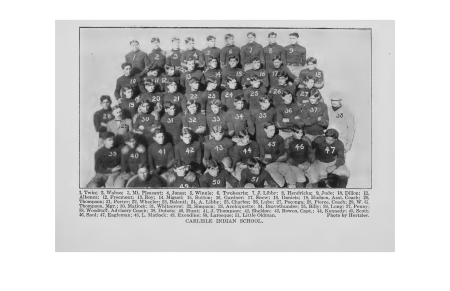
While preparing Spalding’s Official Football Guide for 1906 for reprinting, I noticed a few things about the Carlisle Indian School football team’s 1905 season. These things caught my eye because it was this very team under Advisory Coach George Woodruff that Sally Jenkins maligned in her 1907 book. Caspar Whitney ranked the Indians as the 10th best team in the country for 1905. He also placed Frank Mt. Pleasant as a substitute at quarterback on his All America team.
George Woodruff placed three Carlisle Indians to his All Eastern Eleven for 1905: Frank Mt. Pleasant at quarterback, Charles Dillon at guard, and Wahoo (Charles Guyon, older brother of Joe Guyon) at end. N. P. Stauffer placed Dillon at guard on his All Eastern Eleven as well.
That an authority of the stature of Caspar Whitney considered Carlisle as the 10th best college football team in the country means something and that something is that the Indians were viewed as having had a very good season. Not their best ever, mind you, but a successful one at that.
These selections, along with George Orton’s observations that were posted in the June 27, 2011 message, show that Jenkins’s assessment of the type of play and success of the 1905 Carlisle Indian football team is at odds with the opinions of the experts of the day who actually saw the teams play.
1905 Carlisle Indian School football team from Spalding’s Official Football Guide for 1906
Tags:Chauncey Archiquette, Frank Jude, George Orton, George Woodruff, Littleboy, N. P. Stauffer, Oscar Hunt, Sally Jenkins, Scott Porter, Wilson Charles
Posted in Albert Exendine, Archie Libby, Arthur Sheldon, Bemus Pierce, Carlisle Indian School, Charles Guyon, Football, Frank Hudson, Frank Mt. Pleasant, Joe Libby, Mike Balenti, Nicholas Bowen | Leave a Comment »

 Tom Benjey's Weblog
