Archive for the ‘Football’ Category
June 22, 2012
The current (Summer 2012) issue of National Museum of the American Indian magazine devotes most of its pages on Indian athletes, especially those who competed in the Olympics. Of course, Jim Thorpe figured prominently in several of the articles in that issue of the magazine. One of these pieces, The Jim Thorpe Backlash: the Olympic medals debacle and the demise of Carlisle, even mentions me and, of course, disagrees with me:
Whatever the facts, the investigations eviscerated the athletic program. Its surplus funds, totaling $25,640.08, were turned over to the school superintendent, and Warner left Carlisle. The football team was a shadow, losing the rest of its schedule by lopsided scores. Although the school lingered on until August 1918, when the Army took it back for war uses, the noted Carlisle scholar Tom Benjey dates its true demise to the visit of the Congressional investigating committee. And although students and faculty had many grievances, it can fairly be said that the retraction of Thorpe’s medals was the fatal blow to morale.
I can’t figure out exactly what time period is being discussed. Thorpe lost his medals in the spring of 1913. The Congressional inquiry took place in February 1912. Warner left Carlisle for Pitt in early 1915. And, the Carlisle football team never had a winless season, even in the seasons after Thorpe’s medals were returned. So, I’ll wait to address this statement until I know what time period this was supposed to have happened.
While losing his medals had to be devastating to Jim Thorpe and surely affected the morale of other Carlisle athletes, I question whether it struck “the fatal blow to morale” as suggested in the article. It seems unlikely that the Carlisle Indian School football team would have performed well if player morale was low. A 10-1-1 season for a team that lost its greatest player from the previous year sure doesn’t sound like low morale held it back. The 1913 team’s tie was against Penn, the team they lost to the previous year. The 1912 tie with Washington and Jefferson couldn’t be avenged because the teams didn’t play each other in 1913. 1913’s only loss was due to a fumbled kick return that Pitt converted into the winning touchdown. Major wins included one of Warner’s favorites: a 35-10 upset of Dartmouth. George Orton gave Warner high marks for developing such a good team when he had so many inexperienced players. 1913 was one of Carlisle’s best seasons and was not an example of demoralized players.
The Summer 2012 issue of National Museum of the American Indian magazine can be found at:
http://www.americanindianmagazine.org/issues/summer2012/
Tags:E. B. Linnen, George Orton, National Museum of the American Indian
Posted in Carlisle Indian School, Football, Gus Welch, Jim Thorpe, Pop Warner | Leave a Comment »
June 20, 2012
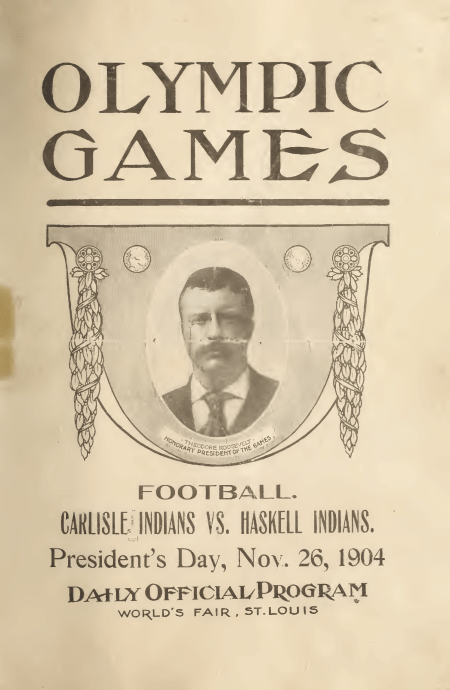
Tex Noel recently sent me a link to a list of numerous books, programs and other football memorabilia that have been digitized and are available on-line. Included in the list was the program for the 1904 Carlisle-Haskell game which was held at the St. Louis World’s Fair, in part, for the entertainment of President Roosevelt who visited the fair but did not attend the game.
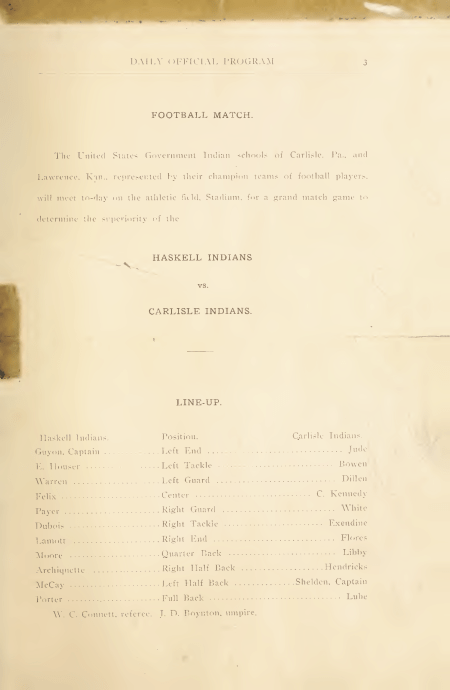
Page 3 of the program contains the proposed line ups for the two teams. At first glance, the Haskell line up looked similar to the one Steckbeck included in Fabulous Redmen,but the Carlisle line up was significantly different:
Program Steckbeck
Jude LE Rogers
Bowen LT Bowen, Gardner
Dillen LG Dillon
Kennedy C Shouchuk
White RG White
Exendine RT Exendine
Flores RE Tomahawk
Libby QB Libby
Hendricks RH B. Pierce, Hendricks
Shelden LH Sheldon, Lubo
Lube FB H. Pierce
Jude, Kennedy and Flores didn’t get in the game. Coaches Ed Rogers and Bemus Pierce suited up for the game. Hawley Pierce and long-time player Nikifer Shouchuk also played. The reason given for loading up the line up was that rumors swirled around that Haskell was even recruiting white ringers for the big game. That doesn’t seem to have happened. What did happen was that some of the best players ever to play at Carlisle could be found on both sides of the ball. Some, like Archiquette had previously played for Carlisle but were at Haskell in 1904 (and would return to Carlisle in 1905). Others like Charles Guyon (Wahoo), Pete Hauser and Emil Hauser (Wauseka), would star at Carlisle in the years that followed. The two line ups amounted to a who’s who in Indian football at that time.
Tags:Aiken, Charles Dillon, DuBois, Feliz, Fritz hendricks, Gokey, Lamott, McClean, McLean, Moore, Nikifer Shouchuk, Oliver, Payor, Scott Porter "Little Boy", Tomahawk, Warren, White
Posted in Albert Exendine, Antonio Lubo, Archie Libby, Arthur Sheldon, Bemus Pierce, Carlisle Indian School, Charles Guyon, Chauncey Archiquette, Doctors, Lawyers, Indian Chiefs, Ed Rogers, Emil Hauser, Football, Haskell Institute, Hawley Pierce, Joe Libby, Pete Hauser, Wauseka, William Gardner | Leave a Comment »
June 14, 2012
Tex Noel, Executive Director of Intercollegiate Football Researchers Association, just requested information on the “first season and ‘score’ and season for a forfeit game.” Not having previously dealt with forfeits, I took Tex’s challenge. The first place I looked was, of course, in Spalding’s Football Guides. The 1883 book is the earliest one I have but it says nothing at all about forfeitures. The next earliest year in my collection is 1888. That book mentions forfeitures of games beginning on the bottom of page 98: “Either side refusing to play after ordered to by the referee, shall forfeit the game. This shall also apply to refusing to commence the game when ordered to by the referee.” However, it says nothing about awarding points or creating a score for a forfeited game. Similar language is present in the 1892 and 1893 Spalding’s Guides.
The 1899 Spalding’s Guide, page 145, lists the Nov 24, 1898 Alabama Polytechnic Institute score as “A.P.I., 18; Univ. of Ga., 0. Forfeited. Real score 18 to 17.” On page 155 the November 12, 1898 University Medical College game with Kansas U. was forfeited but no score was given. Rule 12(a) on page 181 adds an additional reason for forfeiting a game: refusing to play after the referee shortens a game that has started too late to be completed by the time it gets too dark to play. Another reason added is delaying the game by committing fouls when the opponent has the ball close to your goal line. Committing a second infraction close to one’s own goal line triggers the forfeiture.
The 1908 Spalding’s Guide is the first one to mention awarding points for a forfeiture. Page 181 contains the section, Alterations in the Rules for 1908. The fifth paragraph states: “The score of a forfeited game is made 1-0, in order to distinguish it from any other possible scores.” In 1908 safeties were awarded 2 points, field goals 4 points, and touchdowns 5 points. A goal after touchdown was awarded 1 point but could not be earned without having already scored 5 points for a touchdown. Thus a score of one 1-0 would clearly indicate a forfeited game.
Ironically, page 139 of the 1909 Spalding’s Guide, the issue that includes scores for the 1908 games, lists Cook Academy winning by forfeit over Binghamton H. S. by a score of 2-0. And the forfeiture rule stayed the same pointwise as it was in the 1908 book!
Tags:Forfeit, Intercollegiate Football Researchers Association, points scored for forfeits, scores of forfeited games, Tex Noel
Posted in Football | Leave a Comment »
June 12, 2012
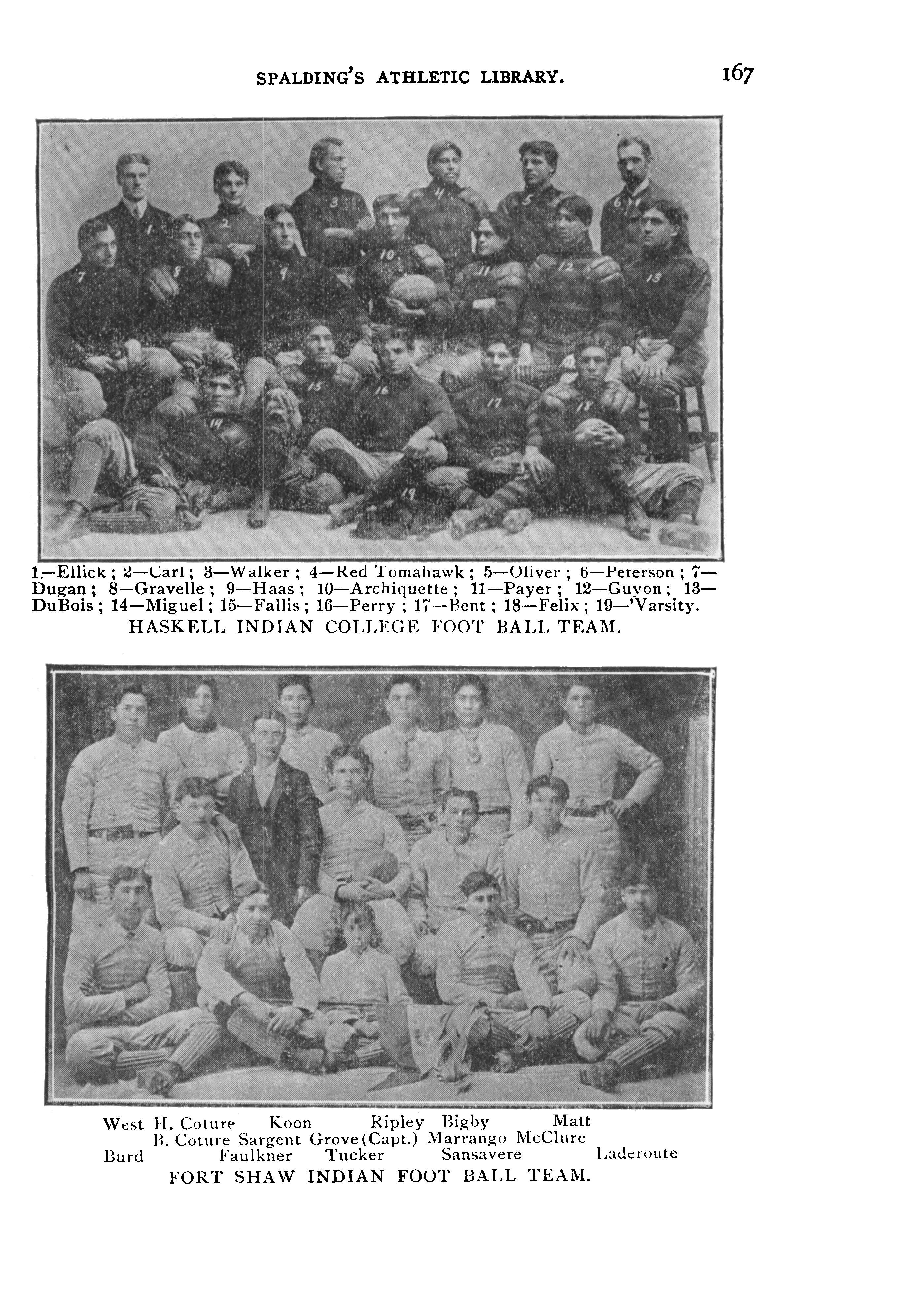
While preparing the 1901 Spalding’s Guide for printing, I noticed that some future Carlisle players could be found in two photos on page 167. The first photo was of the 1900 Haskell Institute team but was mislabeled as being “Haskell Indian College,” in much the same way as Carlisle Indian Industrial School was often referred to as Carlisle College. Perhaps the whites who elevated these government Indian schools to collegiate status felt embarrassed that the Carlisle and Haskell Indians routinely defeated teams from the elite schools with players who had less education, money or experience playing football.
The first names to register with me were Archiquette and Guyon. I already knew that Chauncey Archiquette, captain of the 1900 Haskell team had played for Carlisle prior to coming to Haskell. He again played for Carlisle after returning from Haskell a few years later. I also knew that Charles Guyon played for Carlisle after enrolling there in 1905. However, as a joke, he went by the name Wahoo.
The list of players’ names under the photo included some other familiar ones but they weren’t Carlisle stars; they were Haskell players who battled against Carlisle in the 1904 St. Louis World’s Fair game and later transferred to the eastern school. Steckbeck identified DuBois as another Haskell player who transferred to Carlisle along with several others who were on the 1904 team but not on the 1900 team. However, there were some players on the 1900 Haskell team that were also on the 1904 edition: Oliver, Felix, and Payer (or Payor).
Immediately below the Haskell photo is the Fort Shaw Indian School team photo. The person sitting in the first row, far left is Burd. Sampson Bird, captain of the great 1911 Carlisle team attended the Fort Shaw school before coming east, so this is probably him in the photo. An Indian agent probably spelled the name with a “U” instead of an “I” because the Burd family name was known to many.

Tags:DuBois, Felix, Fort Shaw Indian School, Oliver, Payor
Posted in Carlisle Indian School, Charles Guyon, Chauncey Archiquette, Football, Haskell Institute, Sampson Bird | Leave a Comment »
June 8, 2012
While preparing the 1911 Spalding’s Guide for printing, I noticed that some former Carlisle players could be seen in the numerous 1910 team photos to be found in that volume. That brought to mind an old newspaper article that I can’t lay my hands on now in which the writer opined as to why there were so few football coaches at a time when Carlisle Indian School players were grabbing headlines. I don’t recall his reasoning or conclusions but do remember having read the article.
The truth is that several Carlisle Indian School players tried their hands at coaching with varying success. The names that come quickly to mind are Bemus Pierce, Frank Cayou, Albert Exendine, Caleb Sickles, Lone Star Dietz, James Phillips, Joel Wheelock, Victor “Choc” Kelley, Mike Balenti, and Gus Welch (I keep adding names as they come to me while writing this article). I’m sure there were others. Given enough time to research this issue, I’m sure that I could come up with more. But I don’t have the time right now because I must get the 1901 Spalding’s Guide ready to print.
The lengths of their careers varied, but Exendine, Welch and Dietz all had long coaching careers. Of these, Lone Star Dietz had by far the most success and, as an acknowledgement of that success, was honored by the Helms Foundation many years ago. Next month, the College Football Hall of Fame will honor him. It is highly unlikely that any other Carlisle Indian will receive this honor because only a few had long careers and only Dietz, as far as we know, had a Hall of Fame worthy career as a coach. Also, Exendine and Welch were already inducted as players. My immediate concern is not about the Hall of Fame but with 1910 team photos that include former Carlisle players.
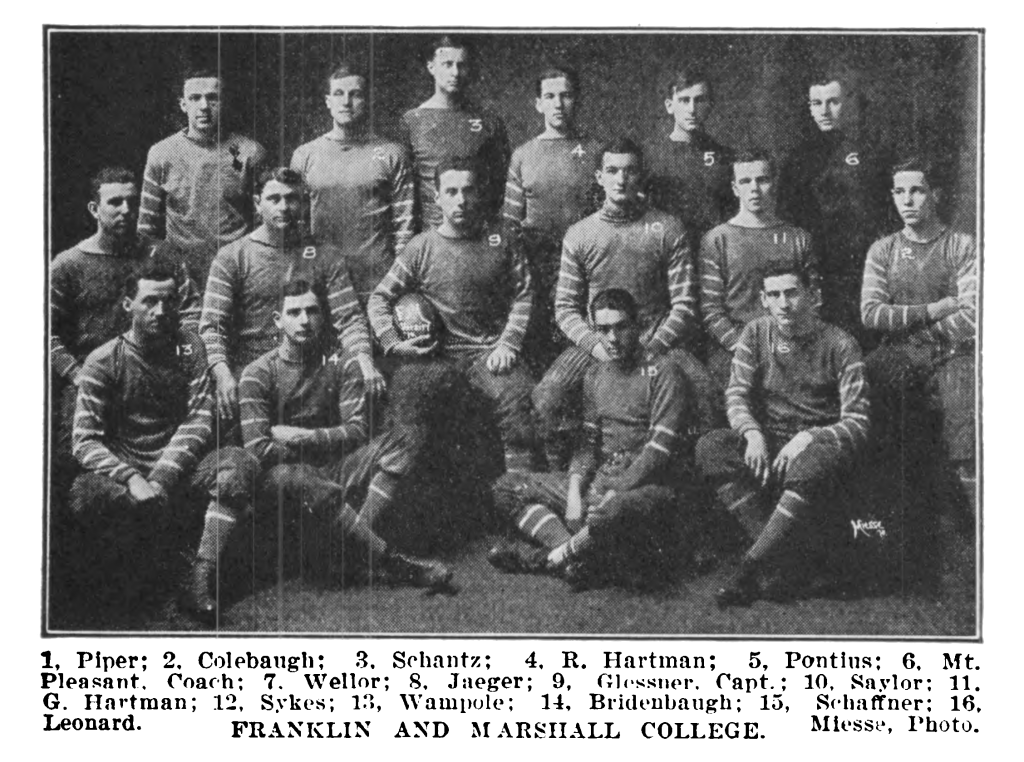
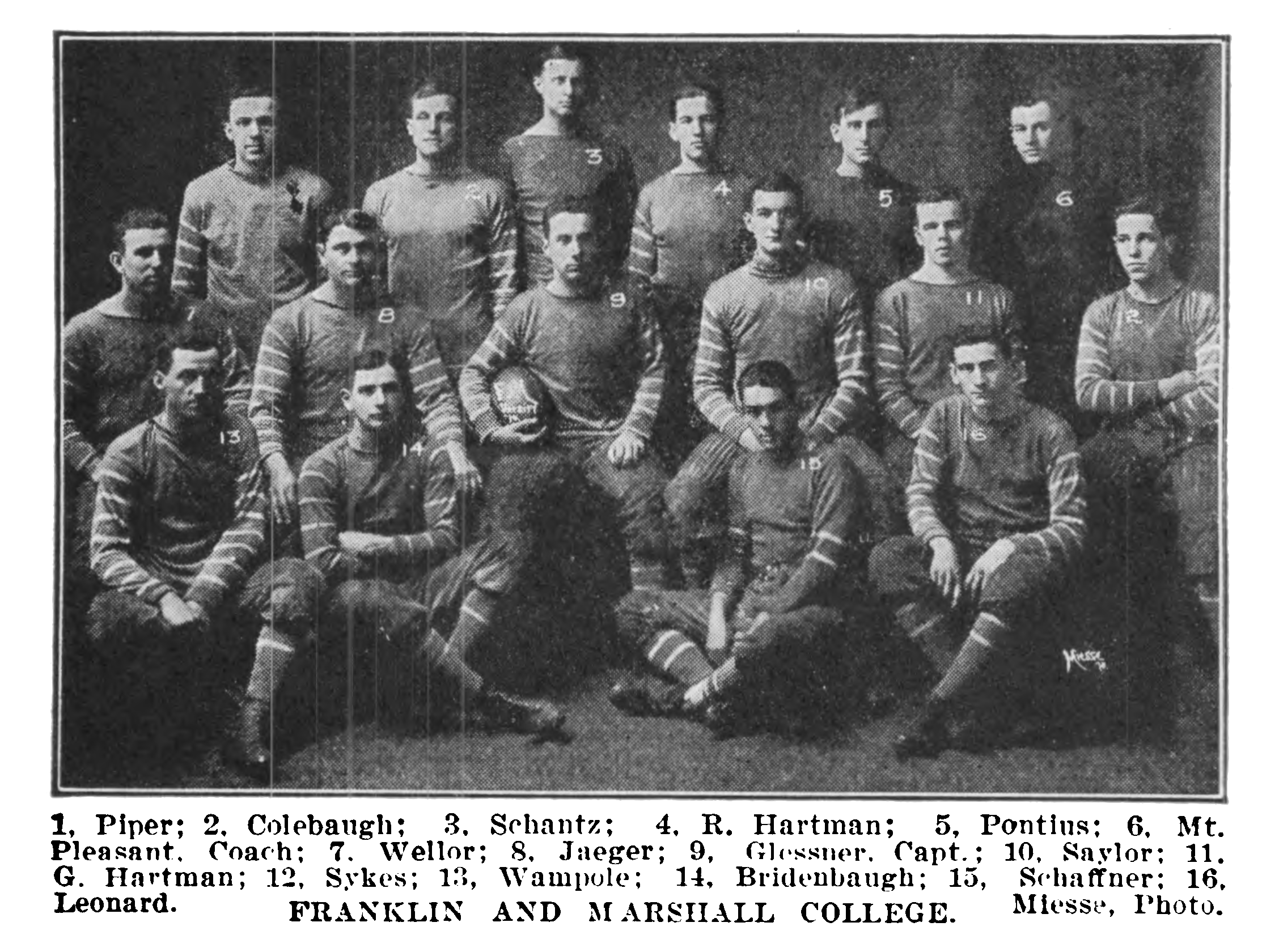
Follows are two of the 1910 team photos. I’ll leave it to the reader to find the Carlisle Indians in them, but here’s a hint: both wore their Carlisle letter sweaters. I take that as an indication of how proud they were of having been part of those great teams.

Tags:Carlisle Indian School Coaches, Franklin and Marshall College, Washington University
Posted in Albert Exendine, Bemus Pierce, Caleb Sickles, Carlisle Indian School, Doctors, Lawyers, Indian Chiefs, Ed Rogers, Football, Frank Cayou, Frank Mt. Pleasant, Gus Welch, James Phillips, Joel Wheelock, Lone Star Dietz, Mike Balenti, Victor Kelly, William Gardner | Leave a Comment »
May 31, 2012
A question that has come up recently is where Lone Star Dietz’s artwork can be purchased, because he is in the news again for being selected for induction into the College Football Hall of Fame, I suppose. I know of no place that his original artwork can be purchased. (I would like to find some myself.) However, some of his works can be seen on public display and others have been reproduced and can be purchased.
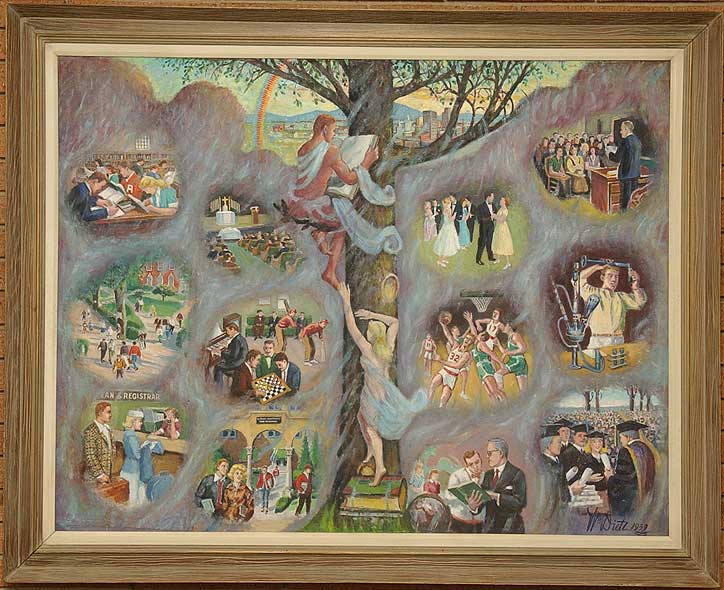
Albright College has four of his paintings on display: the Albright Lion, a portrait of Dick Riffle, a portrait of Lewis Smith, and an unusual collage of the Tree of Learning. Joel Platt has some of Dietz’s artwork in his Sports Immortals museum but they are not generally on display to the public. I was fortunate to find him in when I visited and he showed me a panoramic painting of Pittsburgh he had in his office. The back of the painting contained two titles, “My Pittsburgh” and “Pittsburgh Just Grew.” Apparently, Lone Star changed his mind as to what it should be called.
Most of Dietz’s artwork that I’m aware of is in private collections. A few of those found their way into an article done by Francine Scoboria for Albright College: http://www.albright.edu/reporter/spring2006/lonestar1.html. Occasionally, a reader will send me information on some as I have shared previously in this blog. Hopefully, more will surface in the future.
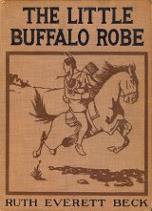
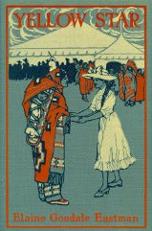
Fortunately, some of Dietz’s smaller pieces have been reproduced on items sold at History on High, Cumberland County Historical Society’s store in Carlisle and Tuxedo Press recently reprinted two books illustrated by Lone Star Dietz and his first wife, Angel DeCora. Yellow Star has four page-sized paintings done jointly by Dietz and DeCora reproduced in grayscale. The Little Buffalo Robe is chockfull of drawings done by Dietz and a few done by DeCora. It also has some full-page artwork done by DeCora. Tuxedo Press also created neckties using Dietz’s unique signature: http://www.tuxedo-press.com/index_files/OrderForm.htm

Tags:Albright College, Cumberland County Historical Society, Dick Riffle, Francine Scoboria, History on High, Joel Platt, Lewis Smith, Sports Immortals
Posted in Doctors, Lawyers, Indian Chiefs, Football, Lone Star Dietz | 8 Comments »
May 24, 2012
Tonight, the National Museum of the American Indian (NMAI) in Washington, DC holds a reception to kick off its new exhibit, “Best in the World: Native Athletes in the Olympics,” to celebrate the athletic achievements of Native Americans on the 100th anniversary of the 1912 Stockholm Games that featured legendary performances by Jim Thorpe and Lewis Tewanima. I am attending because Bob Wheeler, Jim Thorpe’s Boswell, is to speak there. While making preparations for attending this event, I received some unexpected news.
The National Football Foundation (NFF) released its selections for induction in the College Football Hall of Fame Class of 2012 and Lone Star Dietz was finally on the list. As blog followers probably know, Greg and John Witter, first cousins and rabid Washington State football fans, and I campaigned to get Dietz placed on the Hall of Fame ballot some years ago. Getting his won-loss record corrected was the key to getting him nominated but there were larger obstacles yet to come.
Lone Star Dietz died in 1964 and there are few people still alive that knew him. Also, he coached at schools with smaller alumni bases and less clout than the major football factories. Washington State, for example, couldn’t muster the support for him that, say, Ohio State could for John Cooper or Michigan could for Lloyd Carr. While both these recent coaches had very good careers, neither had the impact on the history of the game as did Dietz. It’s one thing to inherit a strong program and be a good steward, but it is quite another to rebuild a floundering program from the ground up, something that Lone Star did multiple times.
The closest he came was in 2006 when the selectors chose Bobby Bowden and Joe Paterno instead of the people who were on the ballot. A couple of years ago, when Lone Star’s name was dropped from the ballot, I gave up all hope of him ever being selected. I didn’t even know that his name was on the Divisional ballot this year, so was shocked when I started receiving phone calls from reporters on Tuesday afternoon.
All I can say is that it’s long overdue. Although he’s being brought in through the back door, so to speak, he will finally be in. He’s the first Carlisle Indian to be inducted as a coach; the rest were as players. Whether this honor is enough to offset the many indignities Dietz suffered and mollify the Lone Star Curse is yet to be seen.
http://seattletimes.nwsource.com/html/cougarfootball/2018262997_dietz23.html
http://www.spokesman.com/stories/2012/may/23/blanchette-wsu-legend-dietz-gets-his-due/

Tags:1912 Olympica, Bobby Bowden, College Football Hall of Fame, Greg Witter, Joe Paterno, John Witter, Lewis Tewanima, Lone Star Curse, National Football Foundation, National Museum of the American Indian
Posted in Carlisle Indian School, Doctors, Lawyers, Indian Chiefs, Football, Jim Thorpe, Lone Star Dietz, Washington Redskins, Washington State University | Leave a Comment »
May 8, 2012
Vance McCormick wasn’t a slacker child who lived with his wealthy parents and coached the Carlisle Indian School football team to give himself something to do, he worked in the family businesses. After he returned home from Yale in 1893, he helped his father operate his many businesses that included Central iron and Steel, Dauphin Deposit Bank, and Harrisburg Bridge Company. After his father died in 1897, Vance was in charge of the entire enterprise. The McCormicks were hard working Scots-Irish Presbyterians who attended Pine Street Presbyterian Church. At Yale, Vance split with his father on politics and became a Democrat.
In 1900 at age 27, Vance began his career in politics by running for and winning a seat on Harrisburg’s common council from the 4th ward. About the time he turned 30, he began a term as mayor of Harrisburg. McCormick’s legacy to Harrisburg is still seen today in the city’s park system. Less visible, but more impactful, are the water filtration plant that supplied clean drinking water to the residents of Harrisburg at a time when neither Philadelphia nor Boston had such a facility. He also had 45 miles of city streets paved. A reformer, Horace McFarland credited him with cleaning up Harrisburg morally as well as physically as fast as he could in his one term as mayor. And he wasn’t a full-time mayor! In 1902, he also became publisher of the Patriot-News, which he had ferreting out Republican corruption. He ran unsuccessfully for Governor in 1914 as organized labor and liquor interests opposed him. Today, he is perhaps remembered most for what he did on the national level.
McCormick’s restructuring of the moribund state Democratic party was a turning point in his political career. He was instrumental in shifting the Democrats to progressivism. Vance became a major player on the national stage. He was chairman of the Democratic National Committee (1916-19) and served as Woodrow Wilson’s campaign manager. He chaired the War Trade Board (1916-19) and served on the Commission to Negotiate Peace at Versailles in 1919.
After the war, McCormick returned to Harrisburg where he published both the Patriot-News and the Evening News. At age 52, he married for the first time to the widow of eight-term Republican congressman Marlin Olmsted. He died in 1946 at his country home, Cedar Cliff Farms, across the Susquehanna River from Harrisburg.
Tags:Cedar Cliff Farms, Evening News, Horace McFarland, Marlin Olmstead, Patriot-News, Treaty of Versailles, Vance McCormick, War Trade Board, Woodrow Wilson
Posted in Carlisle Indian School, Football | 2 Comments »
May 3, 2012
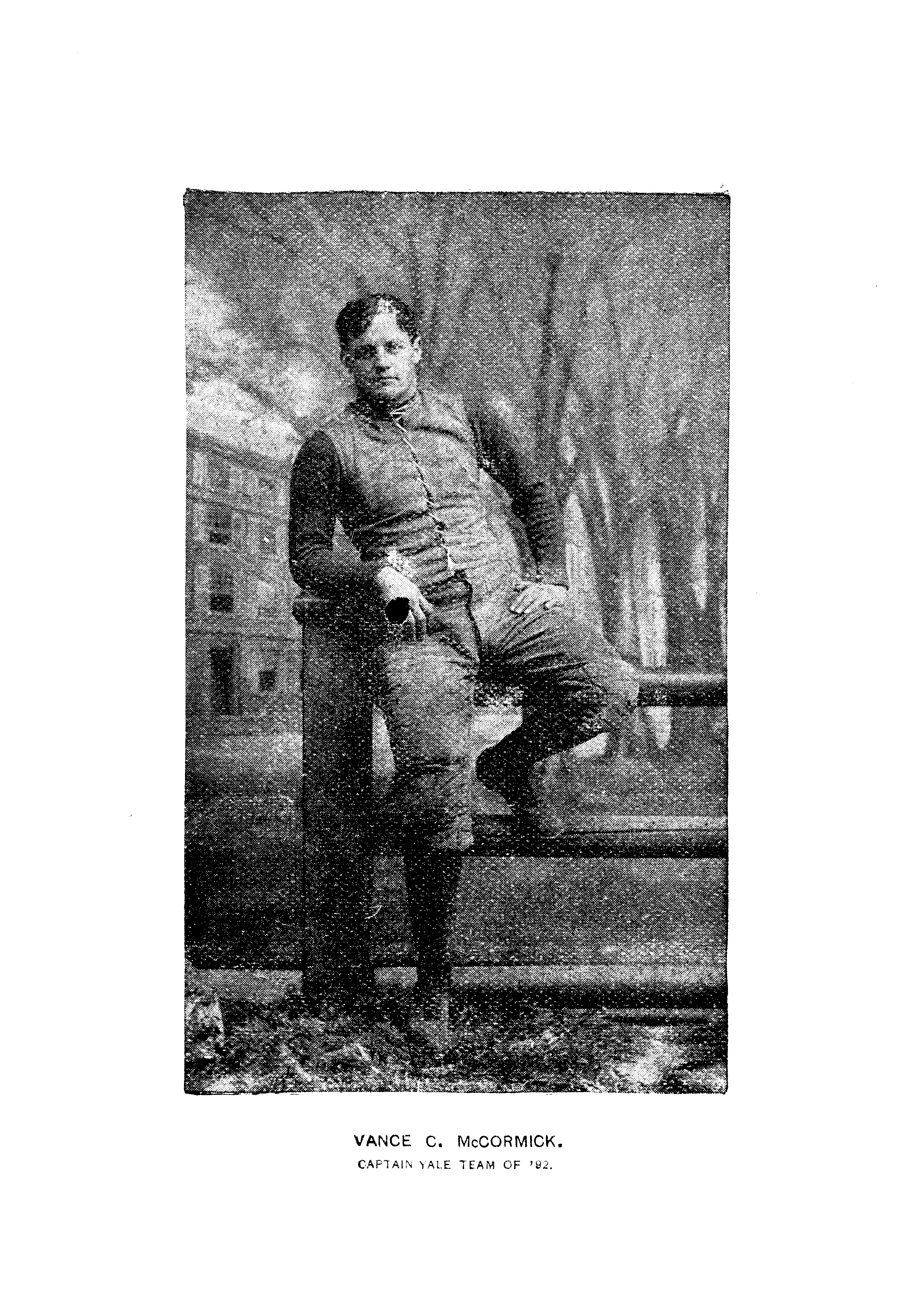
We need a little more information on Carlisle’s first coach to put the man in proper perspective. Vance McCormick was a great player, but was he a good coach? We already know he was a Walter Camp All America quarterback at Yale in 1891. Looking closer at the caption under his photo in the 1892 Spalding’s Guide reveals that he was also captain of the 1892 Yale squad. In those days being captain meant a lot more than it does today. Captains took a leadership role unknown to today’s players. They were field generals who directed their teammates’ actions when they were on the field of play. Coaches weren’t allowed to send in instructions—even via substitutions. So, a former Yale captain would have been better prepared than an ordinary player to coach a team. But this was no ordinary team. In the beginning, Carlisle Indian School football players had no previous training in the sport. Many had likely played on shop teams but those teams wouldn’t have had coaches (or at least coaches who knew anything about football) and the players would not have been taught the fundamentals of the game.
Vance McCormick probably the extent of the challenge when he took on the job. His teammates at Yale had likely been coached prior to college at the high schools or prep schools they attended and knew the fundamentals before arriving in New Haven. Moreover, they weren’t going to be on the varsity team the first year there anyway. That year would be spent on the freshman team, where they would work on the fundamentals extensively. Given McCormick’s family background, it is likely that he was well coached before arriving in New Haven. Vance McCormick wasn’t born with a silver spoon in his mouth—a whole tea set is more like it. Before coming to Yale, McCormick was educated at Harrisburg Academy and Phillips Andover, private schools that likely had coaches for their football teams.
So, Vance McCormick was probably better suited to coach a team than were his former teammates, but was likely unprepared to coach players who didn’t know the fundamentals or had little prior exposure to the English language. In spite of that, he recognized that the players were athletically gifted and got them started on the road to eventual fame on the gridiron.
Tags:1892 Yale, Harrisburg Academy, Phillips Andover, Vance McCormick
Posted in Carlisle Indian School, Football | Leave a Comment »
May 1, 2012
While cleaning up the scanned files in preparation of reprinting the 1892 Spalding’s Guide, I noticed a photograph of Vance McCormick on the page opposite page 17. Walter Camp had named the Yale star as the quarterback of his 1891 All-America team, an honor that earned his photo a page in the next year’s Spalding’s Guide. A friend, Nancy Luckenbaugh, taught at Carlisle Indian School and, in 1894, invited him to make the trip from his family’s home in Harrisburg to look over the football material that could be found there. McCormick had graduated from Yale in 1893 and was living at home and working in the family businesses at that time. Liking what he saw, he agreed to become the Indians’ first coach, albeit unpaid. Disciplinarian W. G. Thompson was put in charge of the football team in 1893 when Superintendent Pratt relented and allowed the boys to play against other schools but he was not a coach.
Pratt recalled McCormick’s exuberance in his memoir:
He was on the field one day taking part in instructing the boys how to fall on the ball when chasing it down the field. The ground was moist from recent rain, but he disregarded that and was giving them most enthusiastic incentive. The boys failed to execute the movement properly as he explained, and to show them how, without removing his hat or coat he rushed after and fell on the ball, as the game required. When he got up, his hat and clothing were some admonition against too sudden enthusiasm. The boys gave themselves up to the severest practice, and such energy they soon met all conditions.
Unfortunately, Vance wasn’t a full-time coach and, thus, couldn’t devote the time and energy necessary to lead the Indians to victory against the level of competition they played. He again helped in 1895 but couldn’t devote much time to what could best be called a hobby. He would be followed by other Yale men until 1899.

Tags:1892 Spalding's Guide, Nancy Luckenbaugh, Richard Henry Pratt, Vance McCormick, Walter Camp All America
Posted in Carlisle Indian School, Football | 1 Comment »





 Tom Benjey's Weblog
