Archive for the ‘Football’ Category

Thorpe’s Helmet & Football

November 26, 2012

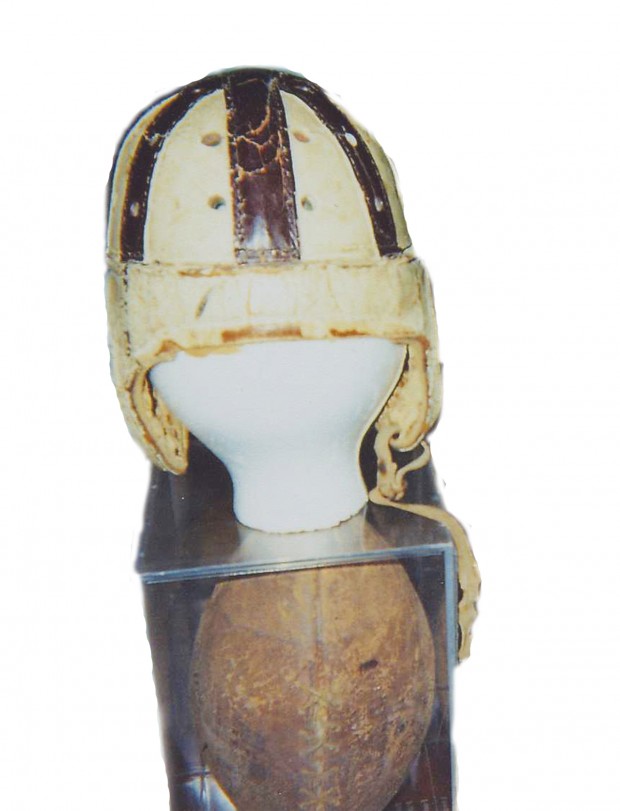
A reporter from the local newspaper called me the other day to verify someone’s claim that he possessed a helmet Jim Thorpe once wore and a football he once kicked. Both artifacts were from 1927, the year Big Jim played for the Portsmouth Shoe-Steels. Portsmouth, Ohio lies in southern part of the state along the Ohio River. The team was sponsored by a local company that manufactured metal parts for shoes.

John Carpenter, who is reputed to own the country’s largest collection of sports memorabilia, has an old helmet he believes Thorpe wore when he played for the Shoe-Steels and a football Thorpe kicked in a game. Carpenter lives across the Ohio River from Portsmouth, a factor that makes his claims more plausible. I don’t know and doubt if anyone can know with certainty if these items were ever associated from Jim Thorpe. I don’t have the expertise to determine exactly when the helmet and football were made. If they were made after 1927, they probably didn’t come from Thorpe.

The stories of how these artifacts came into Carpenter’s hands are believable because Thorpe was known for giving away things. Bob Wheeler, Thorpe’s biographer, confirmed that Thorpe’s parents raised him to be generous. While we can’t ever know for sure, there’s a good chance these things were at least touched by him at one time.

http://cumberlink.com/news/local/history/jim-thorpe-remembered-for-generous-heart/article_c933435c-377f-11e2-9659-0019bb2963f4.html

100th Anniversary of 1912 Carlisle-Army Game

November 9, 2012

Follows is the short article I was asked to write for The Torch, the monthly magazine of the U. S. Army War College, to commemmorate the 100th Anniversary of the 1912 Carlisle-Army football game:

The Cadets of West Point took the field on The Plain November 9, 1912, aiming to avenge their 1905 loss to Carlisle Indian School in the two schools’ only previous battle, also on The Plain. Missing from the second battle were the players and coaches from both 1905 teams and Major William A. Mercer, Carlisle Superintendent and Calvary officer, who had arranged that game by gaining permission from the War Department. Also AWOL in 1912 were the large crowd, dignitaries, and media interest the first game attracted. Present in 1912 were Jim Thorpe, Gus Welch, Joe Guyon, Pop Warner, Leland Devore, Dwight Eisenhower, Babe Weyand (in the bleachers), and Pot Graves, a cast surely destined for a movie.

Ominous clouds filled the sky and a cold wind blew across the field, making passing and punting risky businesses. Both sides’ emotions ran high as the combatants craved a victory. Carlisle arrived undefeated, the only blemish on their record a scoreless tie with Washington and Jefferson College, a month earlier. Army was 3-1 with a 6-0 loss to Yale. Holding the Eli of Yale to only four first downs and a low score gave the Cadets hope for success over the Indians.

Newspaper accounts after the game never considered its outcome in doubt, but those looking only at the scoreboard, at least for the first half, may have thought otherwise. The Indians bested the Cadets for most of the first half but didn’t score due to errant forward passes in the end zone. The turning point of the second quarter came when Carlisle fullback Stancil “Possum” Powell was expelled from the game for punching Army quarterback Vern “Nig” Pritchard. The 27-yard penalty combined with Powell’s ejection dampened the Indians’ spirits. Army then moved the ball forward the remaining 27 yards with fullback Geoffrey Keyes pushing the ball across the goal line. Pritchard missed the kick after the touchdown.

Momentum shifted in the Indians’ favor on the kickoff opening the second half when All-America tackle and team captain Leland Devore jumped on Joe Guyon, who had been getting the better of him all day, getting himself thrown out of the game. Army defensive backs Dwight Eisenhower and Charles Benedict knocked each other out of the game for the rest of the quarter in a failed attempt to sideline Thorpe. The Indians scored 27 unanswered points to lick Army worse than any opponent had beaten them in many years.

Guiding The White Brethren

October 26, 2012

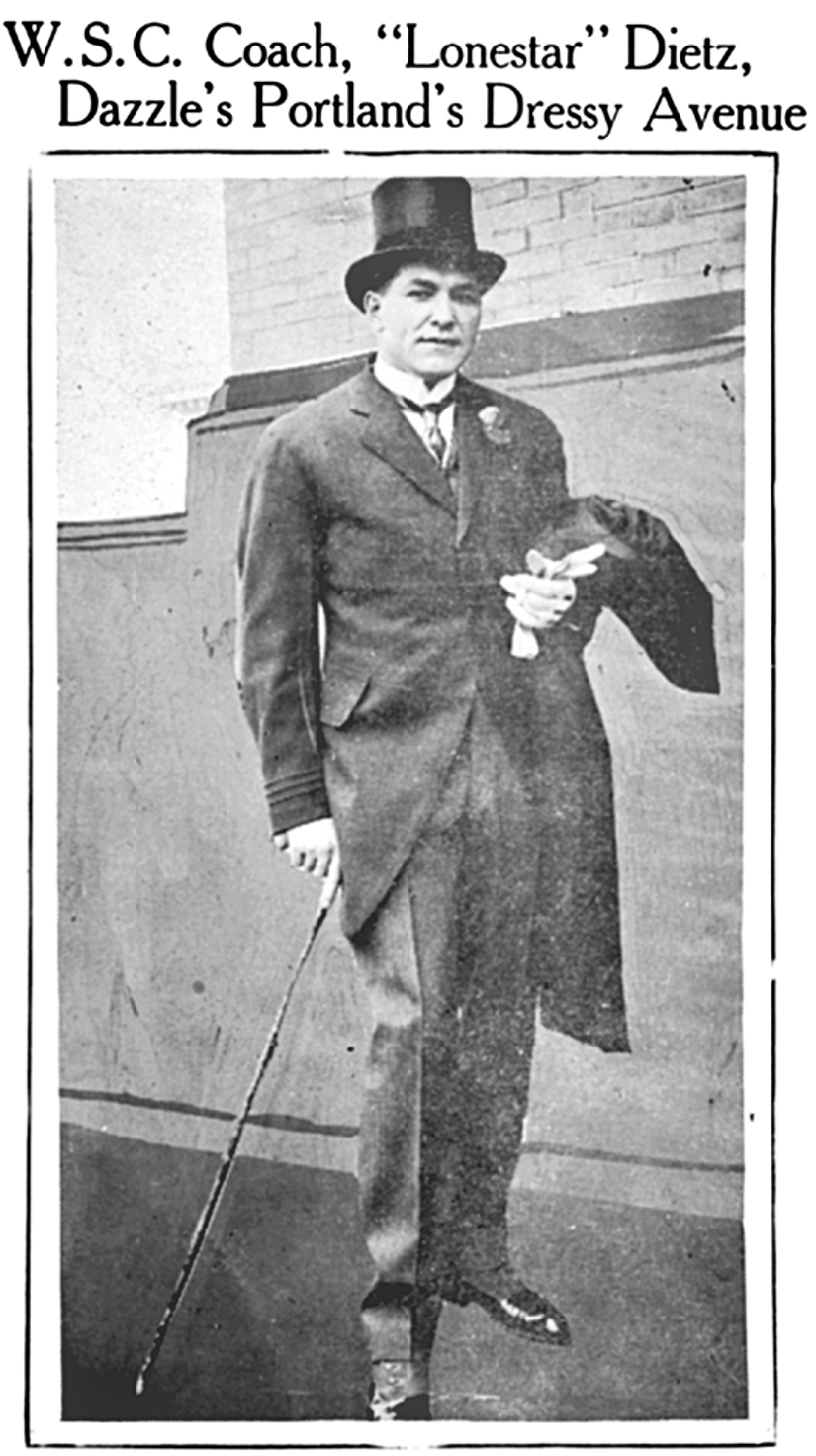
The electronic version of the Fall 2012 edition of the magazine for the National Museum of the American Indian (NMAI) is finally out. My article on Carlisle Indians who went on to coach other teams is on page 46 (page 44 of print version). The idea for this article came to me after attending Lone Star Dietz’s enshrinement ceremony into the College Football Hall of Fame. He is the only Carlisle Indian to be inducted as a coach. Six others, some of whom also coached, were enshrined previously but as players. It is unlikely that any others will receive this honor because no other Carlisle Indian coached as long or with nearly as much success as Dietz.

American Indian athletic prowess is getting much attention this year due to 2012 being the 100th anniversary of Jim Thorpe’s extraordinary triumphs in the pentathlon and decathlon at the 1912 Stockholm Games. Anyone unfamiliar with Native Americans’ success in the Olympics can read my several previous blog entries on this topic.

Worthy of note is that Dietz and the others had great success coaching white college and professional players. Many of them, including Dietz, coached Indian teams at one time or another but the vast majority of their coaching careers were with white college teams. Having played with Carlisle and knowing the Warner System gave these men instant credibility and opened doors for them. After going through those doors, success or the lack of it was the deciding factor. After all, sports have always been a meritocracy. Performance matters above all. Carlisle players succeeded on the field both as players and coaches. The graduate system of coaching that was tried in the early 20th century limited coaching opportunities for those who hadn’t attended major colleges but numerous smaller schools welcomed Carlisle Indians to lead their teams. Although far from an ideal situation, these men were given the opportunity to succeed or fail on their own merits and they largely succeeded.

http://content.yudu.com/A1yt4b/fall2012/resources/index.htm?referrerUrl=http%3A%2F%2Fwww.americanindianmagazine.org%2Fabout-us

Lone Star Dietz Article in Indian Country Today

August 14, 2012

Yesterday’s edition of Indian Country Today includes an article by Jack McNeel on Lone Star Dietz. The headline, which probably wasn’t written by Mr. McNeel, understandably focuses on Dietz’s posthumous induction recently into the College Football Hall of Fame. But the article covers more than that. He covered as much of Dietz’s highly eventful life as space would allow.

Something I particularly like is that McNeely chose to use a photograph of Dietz with the Washington State team that isn’t widely used. It’s nice to see something you haven’t seen before. In this case, I probably saw it briefly when going through the Washington State photo archives some years ago but didn’t remember seeing it.

There are a few things in the article that need a little bit of clarification. First, Tournament of Roses wasn’t arranging its annual football game in the fall of 1915 because they had only hosted a game once before and that was back in 1902. The Washington State victory over Brown in 1916 was what established the game as an annual event and much of the credit for that goes to Lone Star Dietz for putting West Coast football on the same level as the eastern powers.

The statement, “Soon after, many college sports were suspended for World War I,” may compress the timeframe too much for readers unaware of what happened during that period. Dietz’s men lost two games in 1916 and were undefeated again in 1917 but weren’t invited to Pasadena because of the popularity of military teams. It was after the 1917 season that college sports were curtailed freeing Dietz to coach many of his former players on the Mare Island Marines team.

The phrase “Indian agent from the Sioux Nation” may be misleading and cause unfamiliar readers to think the agent was an Indian. The agent was a white man assigned to the Pine Ridge Agency, one of several reservations on which Sioux live.

“Benjey’s research indicates that Dietz’s father took the dead baby…” would more accurately be phrased, Benjey’s research indicates that Dietz’s father claimed to have taken the dead baby…. However, W. W. Deitz (he spelled his name differently that Lone Star spelled it) denied that publicly.

Here is a link to the article:

http://indiancountrytodaymedianetwork.com/2012/08/13/william-lone-star-dietz-posthumously-inducted-into-football-hall-of-fame-128617

Time Out for Photos

August 8, 2012

Tex Noel just sent me a link to a Library of Congress website that contains digital images, some of which are of Indian football teams. The link he sent was http://memory.loc.gov/cgi-bin/query/r?ammem/AMALL:@field%28NUMBER+@band%28awal+2164%29%29

Tex suggested that I click on football, which I did. The problem is that I’m easily distracted. Before I could see anything related to Indian football teams, the term “Early films” jumped out at me. The first one, listed just below the sheet music for On Wisconsin!, is moving picture footage (silent of course) from the 1903 Chicago-Michigan game shot by the Edison studio. I doubt seriously if Thomas Edison himself was directly involved in making these films; employees of his probably shot them but were likely among the best in the industry, such as it was, at the time.

Four items down the list is footage of the 1903 Princeton-Yale game, also shot by Edison. A. C. Abadie is credited as being the cameraman. The footage of these old games featuring prominent teams gives one an idea what the state-of-the-art was in football uniforms and equipment at the time. The action is hard to make out at times but some things can be gleaned from replaying the clips.

Eventually, I looked at still photos. The first one I noticed, the one at the bottom of the page, is of an Alaskan Indian football team. It was also taken in 1903. Unfortunately, little in the way of detail is supplied. It would be interesting to know which team this is. Someone knowledgeable about reservations, agencies and schools around the turn of the last century might be able to shed a little light on this.

My person favorite, found on page 6 of the list, is of the 1903 University of Chicago-Haskell Institute game titled “players arguing.” From what I can tell, it looks like they’re doing a bit more than arguing. A higher resolution version might even reveal some players who later transferred to Carlisle.

Chicago & Haskell Players “arguing”

Was 1912 Thorpe’s 2,000-Yard Season?

July 31, 2012

It may be that the reporter was trying to determine if Jim Thorpe was the first to rush 2,000 yards in a single season rather than in his career at Carlisle. I say that because, in her article in the current edition of Smithsonian Magazine, Sally Jenkins wrote, “He returned to lead Carlisle’s football team to a 12-1-1 record, running for 1,869 yards on 191 attempts—more yards in a season than O.J. Simpson would run for USC in 1968. And that total doesn’t include yardage from two games Thorpe played in. It’s possible that, among the things Thorpe did in 1912, he was college football’s first 2,000-yard rusher.”

Again because stats aren’t my thing, I contacted Tex Noel about the single-season rushing statistics.Tex responded quickly with:

I do know that JT was NOT the 1st back to rush for 100+ yards in a game. (3 had best game totals; his 362 vs Pennsylvania in 1912 in 9th of 10 spots.)

Yards       Player, Team and Season                      

2032        Ken Strong, New York University, 1928

1869        Jim Thorpe, Carlisle, 1912

1500        Lindsey Donnell, Cumberland TN, 1935

1450        Glenn Presnell, Nebraska, 1927

1421        Norman “Red” Strader, St. Mary’s CA, 1924

1393        Lloyd Brazil, Detroit, 1928

1349        Earl “Dutch” Clark, Colorado College, 1928

1287        Frank Briante, New York University, 1927

1163        Morley Drury, USC, 1927

1074        John “Shipwreck” Kelly, Kentucky, 1931

Source: Stars of an Earlier Autumn (C) 2011, Tex Noel.

Tex has the same total rushing yards for 1912 that Jenkins has but without the caveat that he played in two games for which his statistics weren’t recorded. I suspect that, because Tex is so familiar with the haphazard way in which statistics were recorded in those days, he felt no need to point out that all numbers from that era are to be taken with a reasonable amount of salt.

I then looked in the 1913 Spalding’s Guide, but it made no mention of Thorpe’s (or anyone else’s) rushing yards for 1913. It did include a table of “Famous Runs” compiled by Parke Davis on which Carlisle players got their share of listings. Jim Thorpe was mentioned twice:

1) 80-yard run from scrimmage against Penn on November 16, 1911

2) 60-yard run from scrimmage against Penn on October 24, 1908

Neither of his longest runs were in 1912, the year freshest in Parke Davis’s mind, but longer runs made earlier by Charles Dillon, Gus Welch, and Thaddeus Redwater were.

I don’t know which games for which Thorpe’s rushing yardage is missing but it is possible that he ran for a combined 131 yards in them. It is just as possible that he didn’t, particularly if they were games in which Thorpe wasn’t needed and Pop Warner rested him to get a look at less experienced players in game situations. Thorpe’s 156 yards per game average for the 12 games for which records exist imply that he would have run for enough yardage to total more than 2,000 yards for the season. It’s just as possible that he watched from the sidelines so that he would be available for the tougher opponents in this grueling 14-game schedule.

P.S. Yesterday, this blog received its 50,000th view and highest monthly total (with a day to go).
The First 2,000-Yard Rusher

July 27, 2012

I got a call this week from a reporter out in Oklahoma who asked if Jim Thorpe was the first 2,000-yard rusher. Since my focus is on the people, not the statistics, I forwarded the question to statswiz Tex Noel. Tex quickly responded with career rushing statistics for the period in question:

Top 10 Career Rushing Totals*

Yards         Player, Team Career                       

4469                     Chris “Kenner/Red” Cagle, Southwestern Louisiana Institute/Army, 1922-29

3616                     Jim Thorpe, Carlisle, 1907-08, 11-12

2729                     Ted Hudson, Trinity MA, 1910-13

2516                      Bill Banker, Tulane, 1927-29

2341                      George Gipp, Notre Dame, 1917-20

2382                      Alphonse “Tuffy” Leemans, George Washington, 1933-35

2369                      Don Zimmerman, Tulane, 1930-32

2339                     Willie Heston, Michigan, 1901-04

2140                      Kayo Lam, Colorado, 1933-35

2124                      Henry Benkert, Rutgers, 1921-24

*(C) 2011 Stars of an Earlier Autumn

From this, it is clear that Jim Thorpe did run for more than 2,000 yards in his career at Carlisle—a lot more–but he wasn’t the first player to rush for more than 2,000 yards in his career. That was the great running back from the University of Michigan, Willie Heston, who, almost a decade earlier, ran for 2,339 yards between 1901 and 1904. As an aside, this is probably why Bemus Pierce named his son Heston.

According to these statistics, Thorpe was the first 3,000-yard career rusher and it took the better part of two decades for Red Cagle to surpass his record. Something to keep in mind is that Carlisle always scheduled several tough teams, all on the road, not one or two each year as Warner advised in his books and as The Big Four and most other powers did. So, Jim Thorpe’s individual records were amassed against mostly stiff competition where many other top athletes played mostly against lesser opponents. Also, Pop Warner used his early-season games against easier opponents to take a look at younger players in game conditions and protected his stars against unnecessary injuries by severely limiting their playing time when they weren’t needed to win.

Now, I’ll ask Tex for single-season records to see how Jim Thorpe stacks up in those comparisons.

Carlisle Has as Many Hall of Famers as Miami

July 24, 2012

Well, it finally happened. Lone Star Dietz was enshrined in the College Football Hall of Fame last weekend. It isn’t clear to me which activity at the event is the actual enshrinement: the blazer presentation on Friday evening or the enshrinement dinner Saturday night. Attendance apparently isn’t mandatory because Deion Sanders wasn’t present at either event. Lone Star Dietz wasn’t present because he died in 1964. Other deceased inductees were generally represented by their sons but Dietz didn’t have a son. Had I known that Dietz wasn’t going to be represented, I would have suggested that Sheldon Cohen speak on behalf of his late father, Gus, for whom Lone Star acted like a father.

When Russell Maryland, a defensive tackle, was introduced, it was pointed out that he was the eighth Hall-of-Famer from the University of Miami. Lone Star Dietz makes the seventh Carlisle Indian in the College Football Hall of Fame. The other six are: Albert Exendine, Joe Guyon, James Johnson, Jim Thorpe, and Gus Welch. A quick look at the Ball of Fame’s website revealed that six Miami players and two coaches have been inducted. Neither of the coaches played at Miami as both played for Pop Warner at Pitt.

So, as many Carlisle Indian School players have been enshrined as have Miami players. Three of Carlisle’s head coaches have been enshrined: Bill Hickok (as a player at Yale), Pop Warner, and George Woodruff. Gus Welch was Carlisle’s head coach for part of the 1915 season but he was inducted as a Carlisle player. And George Woodruff only coached Carlisle for the 1905 season. Although he led Carlisle to its first victory over Army, he would most likely have been inducted for his work at Penn alone. But one could make the argument that Pop Warner’s record and innovations at Carlisle would have gotten him into the Hall of Fame even if he hadn’t coached later at Pitt, Stanford, and Temple.

Thus, by counting the six players, Dietz and Warner, one could fairly make the argument that little Carlisle, that only fielded teams from 1894 to 1917, has as many Hall-of-Famers as the prodigious producer of professional players, Miami University, which has fielded football teams from 1927 to the present. This is further evidence of the greatness of the tiny Carlisle Indian School football program.

400th Post – Paterno Loses Halo & Dietz Vindicated

July 17, 2012

WordPress tells me that this is my 400th message. At about 300 words each, that comes to 120,000 words—a book. Sure, these messages could, with some effort, be compiled into a book, either print or ebook, but who would buy it? Darn few, most likely.

Here in Central Pennsylvania, Penn State/Sandusky/Paterno/Spanier stories dominate the media and will probably continue to do so for some time. Many have been shocked by the behavior of Penn State’s bureaucracy but I haven’t. What Sandusky did was unthinkable and criminal beyond belief. However, Penn State officials did what college and universities always do—at least when they think they can get away with it—cover it up. Colleges are insular by nature and Penn State is worse than most, possibly because of its relatively remote location. I remember reading in my student days about female students getting raped in dark campus parking lots across the country and how college administrations did their best to keep news of it from being made public. Congress finally did something about this in 1990.

The Clery Act, named for Jeanne Clery, a Lehigh University freshman who was raped and murdered in her campus residence hall in 1986, requires all colleges and universities that participate in federal financial aid programs (about all except Hillsdale College) to keep and disclose information on crimes committed on or near their campuses. Failure to report heinous crimes can result in a school being suspended from federal student aid programs.

There has been a lot of chatter about the NCAA giving Penn State’s football program the “death penalty” but, perhaps, suspending Penn State from the student aid program might be a more effective punishment. The major thing that federal student aid has accomplished has been to increase tuition costs and for schools to increase their revenues. Higher costs make working one’s way through college more difficult with the result that students rack up so much debt that many are unable to pay after leaving college. It may be that eliminating federal loans would be the best thing for students long term.

The only actions taken so far is to paint away Joe Paterno’s halo (and remove Jerry Sandusky) from a mural and to rename Paternoville to Nittanyville. The statue of Joe Paterno remains in front of Beaver Stadium and he is still in the College Football Hall of Fame.

One wonders what Lone Star Dietz is thinking as he readies his better-than-best suit for his induction this weekend. Could it be that he feels vindicated after seeing how the Paterno/Bowden fiasco turned out?

Image

Huskies Were Cougars First

July 11, 2012

A combination of beastly hot weather that drained my energy coupled with being overwhelmed with work to get out has kept me away from my blog recently. I hope things let up for the rest of the summer.

Yesterday, I received a question regarding when the Washington State teams were first called Cougars. That person wanted to know if the 1918 Spalding’s Guide referred to the 1917 WSC as Cougars. It didn’t, but didn’t call most teams by their nicknames, either.

Washington State lore places the origin of the use of that name for their teams to an unnamed Bay Area sportswriter who wrote that the WSC team “played like Cougars” in their October 25, 1919 game with Cal, the second game played under Gus Welch’s leadership. A quick scan of newspapers of that time uncovered a short article in the October 25, 1919 Oakland Tribune stated “Washington State College, the Cougars, meets the University of California here today….” The post-game coverage written by Doug Montell did not use Cougars or any other nickname for the WSC team although it did refer to the California team as the Bears. Even if Montell had called them Cougars, the WSC team couldn’t have been dubbed with that name for its play against Cal because some unnamed person at the Oakland Tribune called them that before the game was played. Regardless, this wasn’t the first time a college team in the state of Washington took that name.

The March 17, 1918 edition of the Oakland Tribune (yes, it was that same paper again) included an anonymous piece stating that the University of Washington had officially named its teams Cougars. So, a year and a half before the Tribune called the WSC team Cougars, it claimed that Washington had claimed the name. Perhaps someone in the Tribune’s sports department had a feline fetish.