Archive for the ‘Football’ Category
January 16, 2014
Although The Boston Globe’s Assistant Managing Editor and Sports Editor responded to my request that they correct the numerous errors and half truths in their 12/29/13 article: http://www.bostonglobe.com/sports/2013/12/29/redskins-wonder-what-name-the-answer-traces-back-boston/GmfYbPTnHx1Ht5NgqN1EOM/story.html with “None of your points warrant a correction. It’s time to move on,” the story isn’t over.
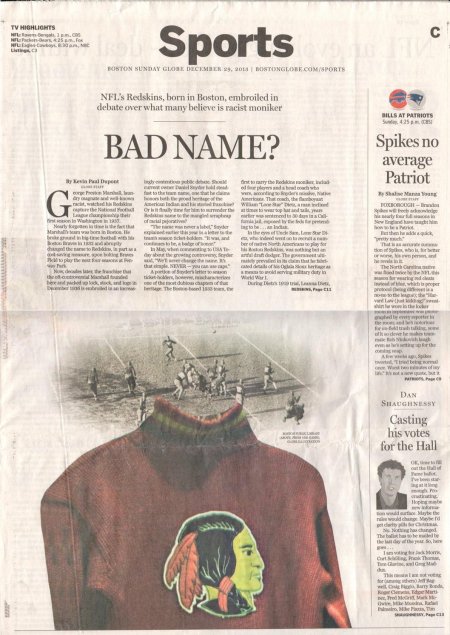
The son of one of Lone Star Dietz’s Albright College players sent me the print version of the article which was printed in the Sports Section, not on the opinion pages where it belonged. That The Globe considered this to be a major article is evidenced by the fact that, including a large color photo, it covered over three-quarters of the front page of the Sports Section and the entirety of page C11. This was not just a minor throwaway piece. It was written for a purpose: to further The Globe’s agenda.
Last Saturday, January 4, The Globe ran an editorial that evidences two major points: 1) Attacking the Redskins is a major Globe agenda item, and 2) editorial staff must have read my (or some other researcher’s comments, if someone else responded to them) and sidestepped most of the reasons previously given for changing the team’s name: http://www.bostonglobe.com/opinion/editorials/2014/01/11/redskins-born-boston-retired/9DPJSUM1k87LYqFS2y9HCJ/story.html
Saturday’s editorial refers to the December 29 Globe article but does not attempt to correct to its many errors but attacks from a different direction. Perhaps The Globe’s editorial staff finally realized their recent article had been exposed as nothing more than a hit piece for which William Randolph Hearst would have been proud. What’s new is that The Globe now states, “Unlike ‘Braves’ or ‘Chiefs’ or ‘Indians,’ the term ‘Redskins’ refers to skin color.”
So, Redskins is now unacceptable because it’s based on skin color, even if Illini created the term. However, The Globe did not demand the Congressional Black Caucus, state of Oklahoma (Choctaw for Land of the Red Man), New Black Panther Party, The National Black Justice Coalition, Associated Black Charities, Association of Black <pick a profession>, National Association for the Advancement of Colored People, or the United Negro College Fund to change their names and those names are all based on skin color. The Globe grasps for any justification to support its agenda.
Tags:The Boston Globe
Posted in Carlisle Indian School, Football, Lone Star Dietz, Washington Redskins | 2 Comments »
January 13, 2014
A November 15, 2013 article in The New York Times Magazine asked, “Who made that Redskins logo?” but didn’t attempt to answer the question. http://www.nytimes.com/2013/11/17/magazine/who-made-that-redskins-logo.html?_r=0
Summarized, my research found the following:
1. 1932 jerseys were dark blue with gold numerals.
2. 1933 colors were red with Indian heads on the front.
3. Lone Star Dietz was hired to coach the Boston Braves in March 1933.
4. Team name was changed to Redskins in July 1933.
5. New red jerseys with Indian heads on the front were worn in fall 1933.
6. Lone Star Dietz had the artistic ability, was available to do the work, and may have done it gratis. The Redskins’ new colors were similar to those of Carlisle Indian School where Dietz played football and assisted Pop Warner while teaching art instructor and illustrating school publications.
Contrary to what The Boston Globe claims, the Redskins wore new uniforms in 1933 and they were likely designed by Lone Star Dietz. Now, let’s see if The New York Times acknowledges this. Any bets?
Tags:boston globe, boston herald, Indian mascot, New York Times
Posted in Carlisle Indian School, Football, Lone Star Dietz, Washington Redskins | 4 Comments »
January 8, 2014
A little bit of research made crystal clear that The Boston Globe writer hadn’t bothered to research the 1932-1933 Braves-Redskins uniform issue at all when he wrote, “It appears the name change was nothing other than a cheap, pragmatic way for the Redskins to play under a new name at a new venue with uniforms that were but a year old.”
The Boston Herald coverage for the 1933 Redskins first home game announced, “Furthermore, they have a new coach, Lone Star Dietz; have new uniforms and some new players.” Grainy black and white period newspaper photos don’t show off the new uniforms very well, so football trading cards will have to suffice. Turk Edwards’ card shows the front pretty well where Cliff Battles gives a side view. The colors are similar to those of Carlisle Indian School, which were red and old gold. A multi-color Indian head adorns the front of the jersey and stripes are placed at the wrists. (Carlisle’s stripes were just below the elbow.) Now that we know what the Redskins wore in 1933 and later, let’s find out what the Braves wore in 1932.
The September 19, 1932 edition of The Boston Herald reported that the Braves didn’t look like a well-polished professional team when they easily defeated the Quincy Trojans in a practice game at Fore River Field on September 18, 1932. One reason was the long off-season lay-off. The other was sartorial. Because their new uniforms hadn’t arrived, they wore plain blue jerseys without numbers. Fortunately, their dark blue jerseys with gold numerals arrived before their first home game. Although the black and white photos that accompany the article aren’t in color, they clearly show numerals on the front of the 1932 jerseys in the place where the Indian heads appear in 1933. This is further evidence, again easily found, that George Preston Marshall didn’t select Redskins for the team name as an economy move.
This uniform information brought to mind something that came up when researching Lone Star Dietz’s life. A Lafayette, Louisiana attorney I interviewed had represented the One Star family pro bono some years earlier in an attempt to receive compensation from a previous owner for the artwork Dietz created for the team in 1933. The statute of limitations had expired decades earlier so the family got nothing. Unable to find physical evidence that Dietz had designed the uniforms, such as sketches he had made, I didn’t include the topic in his biography. Now, I think it’s quite likely that Lone Star designed the 1933 Redskins uniforms. The team name changed months after he was hired. The Redskins’ new colors were similar to Carlisle’s. Dietz clearly had the artistic ability to design the Indian head for the jerseys. He had a long history of making art for teams and schools and participating in artistic endeavors seldom done by football coaches. And it wouldn’t have cost Marshall anything.

1932 Boston Braves


Tags:Boston Braves, Boston Redskins, George Preston Marshall
Posted in Carlisle Indian School, Football, Haskell Institute, Lone Star Dietz, Washington Redskins | 2 Comments »
January 1, 2014
***Update January 14, 2014*** Joseph Sullivan, Assistant Managing Editor and Sports Editor for The Boston Globe, responded to my request that The Globe correct at least some of the numerous errors in its December 29, 2013 article, writing, “None of your points warrant a correction. It’s time to move on.” This is further evidence of why newspapers, such as The Boston Globe, are in such sad shape today.
Ninety-eight years ago today, Lone Star Dietz was toasted by football fans across the country after defeating Brown University on New Year’s Day in Pasadena, California. This great victory in an historic game not only established the Rose Bowl and all the others that followed but put long inferior West Coast football on an even footing with the East Coast powers. In recent years, media activists bent on changing the Redskins’ name have found it convenient to assassinate Dietz’s character. Many thought Lone Star’s long awaited and much deserved 2012 induction into the College Football Hall of Fame would end this disrespectful treatment.
Instead, their hatred appears to have intensified based on the scurrilous opinion piece—the article is so riddled with errors and half truths it can’t be considered news—by The Boston Globe staff writer Kevin Paul Dupont for the December 29 edition.
http://www.bostonglobe.com/sports/2013/12/29/redskins-wonder-what-name-the-answer-traces-back-boston/GmfYbPTnHx1Ht5NgqN1EOM/story.html
To some extent, Lone Star is collateral damage because George Preston Marshall is activists’ primary target. However, they apparently think it’s necessary to smear Dietz in order to get Marshall. Their strategy has been, and still is, to destroy Marshall’s claim that the team was named in honor of its coach and (four) players who followed Dietz from the government Indian school at Lawrence, Kansas to Beantown. Simply put: assassinate Dietz’s character, eliminate Marshall’s premise, and forget the Indian players.
Much of this latest smear takes a different tack from earlier ones by posing the point that it was less expensive for Marshall to change the team’s moniker to Redskins than to some other non-Indian-related name. Central to Dupont’s argument is a point he made no less than four times in that piece: Marshall was sitting on a pile of perfectly good uniforms and saved a bundle by continuing to use them. The major problem with this, apparently unresearched, argument is that Marshall bought a whole new set of jerseys for his 1933 team!
<to be continued>
Tags:Boston Braves, George Preston Marshall, Kevin Paul Dupont, redskins, The Boston Globe
Posted in Carlisle Indian School, Football, Haskell Institute, Lone Star Dietz, Washington Redskins | 6 Comments »
December 27, 2013
I neglected to mention that Paul LaRoque played hurt in the last game of the 1905 season against Georgetown. He started the game with a broken rib but probably didn’t play long in this 76-0 blow out. So, diseased or injured, he probably completed the 1906 season on the field for the Indians. His grandson informed me that, instead of sitting quietly at home, he played for the “North Dakota Bison” in 1907. That prompted me to do a little more research.
I quickly found newspaper clippings of a couple of North Dakota Agricultural College (today’s North Dakota State) games in which LaRoque was on the line—right tackle against South Dakota and right end against Haskell Institute. “Gloomy” Gil Dobie coached the North Dakota Aggies (as they were generally called) in 1906 and 1907 contrary to what Wikipedia states. One would think NDSU fans would want to see Dobie mentioned as one of their successful coaches. However, CFBDATAWAREHOUSE.com has that right. That site lists the Aggies having played only three games that year. They likely played more but I haven’t found them. One wonders if playing for “The Apostle of Grief” convinced Paul to return to Carlisle or if the announcement of Warner’s return swayed him or if that was his plan all along. We’ll probably never know for sure.
Something that readers may find confusing is that LaRoque played on the line but was mentioned in newspaper reports as having made good gains carrying the ball. In those days, linemen were sometimes positioned in the backfield and also were handed the ball on criss-cross plays. It was a much different game then, particularly before teams adapted to the 1906 rule changes.
Tags:Gil Dobie, North Dakota State, South Dakota
Posted in Carlisle Indian School, Football, Haskell Institute, Pop Warner | Leave a Comment »
December 24, 2013
The grandson of Paul LaRoque and the great grandson of Frank Jude both contacted me recently. LaRoque and Jude were both from Minnesota and played on the Carlisle football team together part of the time they were there. Something I learned about Frank Jude was that his family name was not pronounced as most assumed; it rhymes with today. And researching Paul LaRoque is made more difficult because his name was often spelled LaRocque. However, LaRoque is how he spelled it when he signed the Carlisle application in 1906. Today, we’ll address what he did while he was supposedly back home in 1907 healing his eye injury.
My first challenge was to determine if he had an injury or a disease (many Carlisle students had Trachoma, particularly those who came from the west). Paul’s discharge date for his 1904 enrollment was December 4, 1906. The discharge was “Bad Eyes.” That description implies a disease but Carlisle had long had an arrangement with an ophthalmologist who would likely have treated him if he had Trachoma. That his family believes he was home recuperating from an eye injury suggests that he may have been injured playing football at Carlisle. Laroque received praise in newspaper accounts for opening holes for Frank Mt. Pleasant in the November 17 game against Minnesota. Whether Paul played in Carlisle’s next game against Vanderbilt on November 22 is open to question since newspaper accounts are inconsistent. The most detailed coverage for the season-ending Thanksgiving Day game with the University of Virginia on November 29 lists him as playing his regular position of right guard. However, newspaper accounts of the day often included line-ups given to them a day or more before the game that didn’t reflect who actually played. Without names or numbers on their jerseys, reporters unfamiliar with the players didn’t know who was actually on the field unless they asked—and they often didn’t.
One report that summarized the season for Carlisle stated that the Indians had had no bad injuries during the season. That statement was most probably a matter of opinion and perspective that should be taken with a lot of salt. So, whether Paul Laroque had a football injury or an eye disease is still unclear.
<end of part I>
Tags:Frank Jude, LaRocque, Paul LaRoque
Posted in Carlisle Indian School, Football | 1 Comment »
December 15, 2013
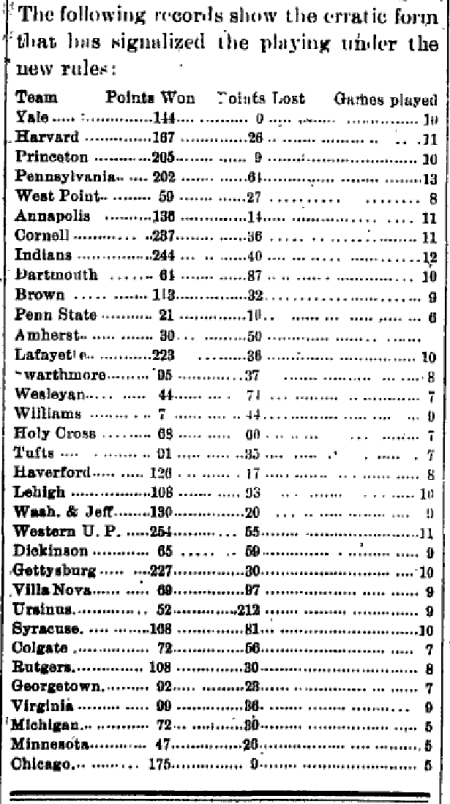
While researching the 1906 Carlisle Indian School team, I came across something that might interest my sports statistician friend Tex Noel in the December 7, 1906 edition of The Arrow, Carlisle’s school newspaper. In addition to summing up Carlisle’s season, the article titled Football Resume closed with a list of points scored and points allowed by team for the top 34 college teams. Carlisle scored 244 points for the season where Cornell scored 237. The only team to outscore them was the University of Western Pennsylvania (known as Pitt today), which racked up 254 points. Pitt not only played an easier schedule that year than did Carlisle and Cornell, they lost to them 22-0 and 23-0, respectively. It is fair to say that Carlisle and Cornell far more points than did the other major football powers that first year under the revolutionary new rules. But why?
Sure, they had good players, but some teams had All Americans. I propose that it was the offensive schemes these teams ran that made the difference. Ironically, both teams ran formations developed by none other than Pop Warner. Warner stated that the Indians were the first team to run the earliest incarnation of his single-wingback formation and they first ran it 1906. But Warner didn’t coach Carlisle in 1906 because he was at Cornell then. However, he spent a week at Carlisle before the season started coaching the Indians’ coaches, Bemus Pierce and Frank Hudson, in his new offensive schemes designed to take advantage of what the new rules allowed, including the forward pass. It’s probably true that both Carlisle and Cornell ran Warner’s single-wing that year. Given that, even though they don’t use it themselves, some modern-day coaches acknowledge that the single-wing was the most effective running formation ever devised. In those days of run mostly, even an early version of the single-wing would have given teams running it an advantage that could show up on the scoreboard.
Tags:1906, Carlisle Indian School, Cornell, Football, Pitt, Pop Warner, Single-wing
Posted in Bemus Pierce, Carlisle Indian School, Football, Frank Hudson, Pop Warner, Single-Wing | 2 Comments »
November 25, 2013
While perusing old newspapers for information on a member of the 1910 Harvard Law School All Star team for the player’s grandson, my attention shifted, as it often is to shiny objects, to an advertisement located near a tiny article about the man I was researching. The title of the ad blared “Gold Medal Duesseldorfer Beer for the ‘Brain Worker.’” Since beer isn’t often credited with having a positive relationship with intelligence, I became curious and read the text in the ad. In addition to “Being mildly stimulative, it clears and refreshes the brain, while the hops it contains have a soothing effect that banishes nervousness.”
While these claims are not nearly as radical as those made by Cliff Clavin, few would seriously consider taking them seriously. But then, 1907 was a long time ago. For those who can’t remember Cliff Clavin’s pronouncements, a little refresher may be in order.
Cliff likened brain cells to members of a buffalo herd in which the weaker and duller members were culled by predators, thus improving the gene pool of the buffaloes that survived to mate. In the case of brain cells, Cliff theorized that, when ingested into the human body, alcohol kills brain cells but not just any brain cells, it attacks the slower and weaker ones first. With the inferior cells removed, he opines, the brain is quicker and more efficient. That is why, he explains, one feels smarter after downing a few beers.

Tags:Been, Brain Worker, Cliff Clavin, Dan Triggs, Duesseldorfer, Harvard Law School, hops
Posted in Carlisle Indian School, Football | Leave a Comment »
May 6, 2013
Professor Joseph Gordon Hylton posed some opinions and asked a question with regard to the naming of the Redskins NFL team yesterday. He stated that George Preston Marshall, owner of the Boston NFL franchise, had a life-long fascination with Indians. That is believable because another NFL owner, Walter Lingo, believed there existed a mystical connection between Indians and the Airedales he raised and sold. His team was formed a decade before Marshall’s and was named the Oorang Indians. Now to Dr. Hylton’s question:
“Has anyone pinpointed the day that the name change was announced?”
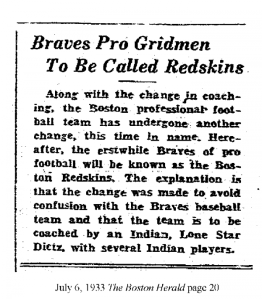
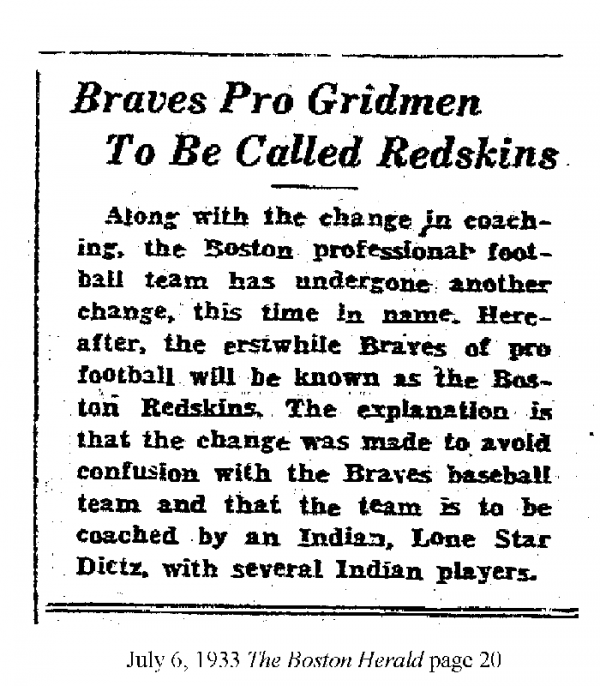
I previously located letterhead for the Boston Braves that listed Lone Star Dietz as the head coach (see p. 278 of Keep A-goin’: the life of Lone Star Dietz) but hadn’t tried to pinpoint the exact date of the name change. A little research turned up the date Dietz was named head coach in a March 8, 1933 issue of The Boston Herald. The team was referred to as the Redskins on the sports page by the end of August, so it had to renamed before that. A little more research located the announcement of the team’s name change. The July 6, 1933 issue of The Boston Herald included a short article titled Braves Pro Gridmen to be Called Redskins (see below). This article establishes the fact that the Redskins were renamed well after Dietz’s hiring and includes the team’s published reason, “…the change was made to avoid confusion with the Braves baseball team and that the team is to be coached by an Indian, Lone Star Dietz, with several Indian players.”
This article supports the contention made by George Preston Marshall’s granddaughter several decades later.
Tags:Boston Braves, Boston Redskins, George Preston Marshall, redskins, Washington Redskins
Posted in Football, Haskell Institute, Lone Star Dietz | 3 Comments »
May 1, 2013
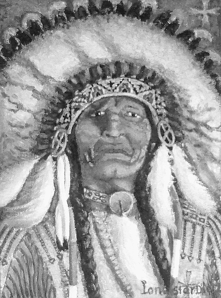
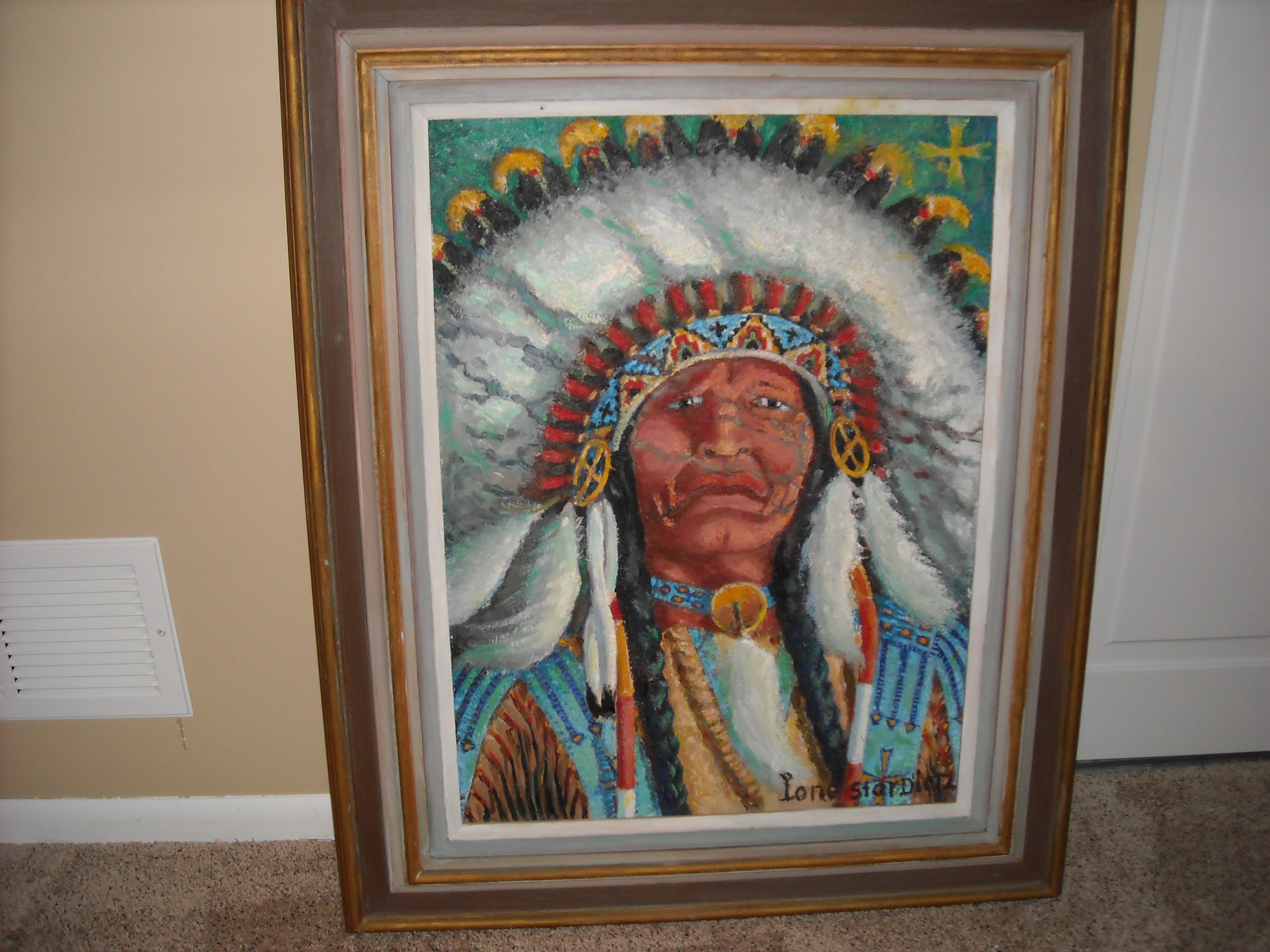
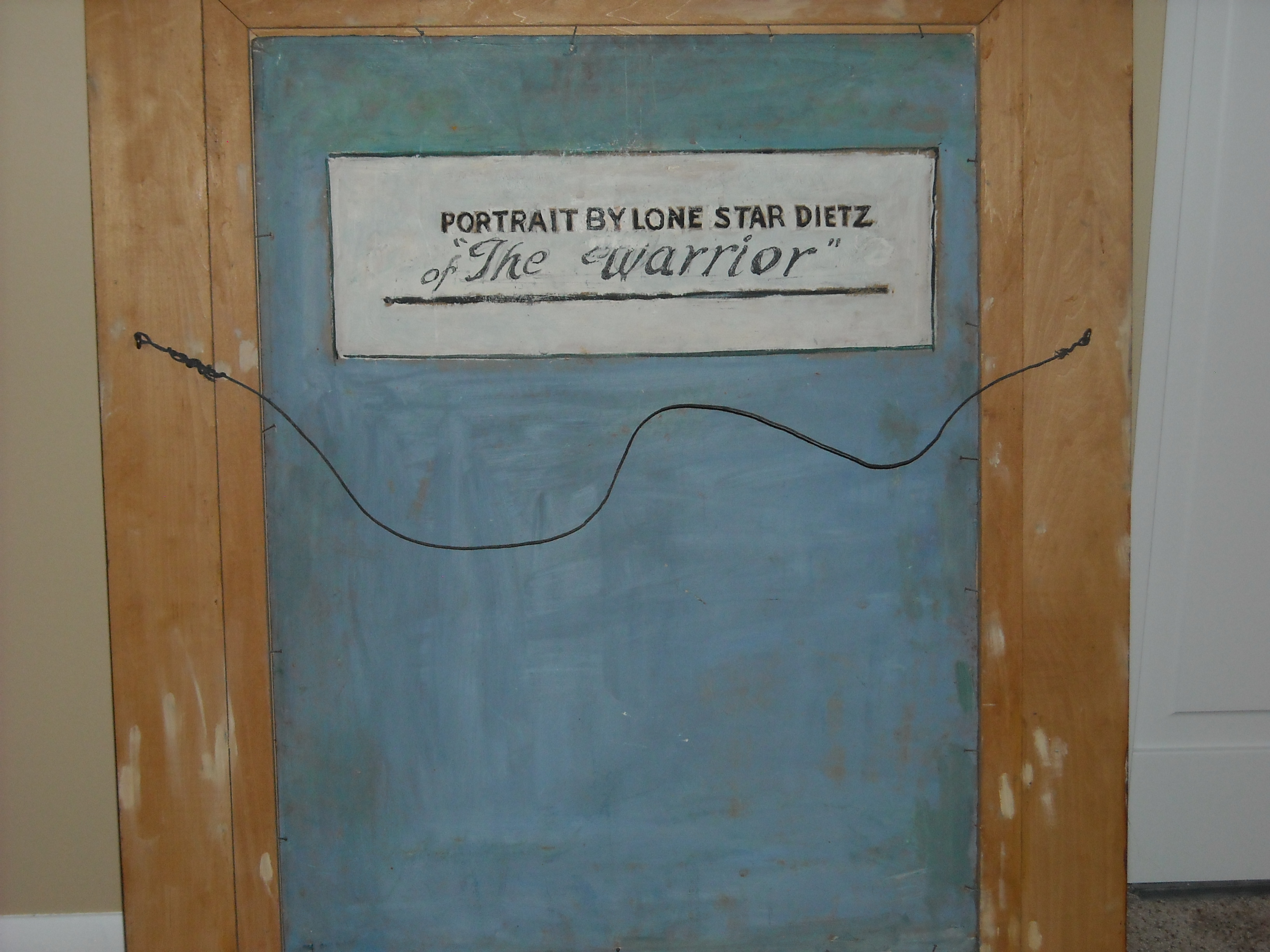
Yesterday, I received n email from the son of Mary Lou Zientek with some photos attached. Mary Lou Zientek was the woman who befriended the Lone Star Dietz and his wife, Doris, in the declining years. Mary Lou managed their estates after Doris died. Mrs. Zientek died on May 7 last year. She distributed artifacts which few valued at that time to places such as Sports Immortals in Boca Raton, Florida (they were in Pittsburgh when Dietz died). She kept a self-portrait Dietz painted in the early 1960s and, one assumes, made a gift to her for her generosity. Previously, I had only seen a black and white photo of the painting See below). Her son sent me color photos. The effect of the painting is much different in color than in black and white. Color photos of both front and back can be seen below. I thank Mr. Zientek for sharing these photos with us.
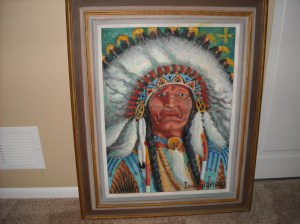
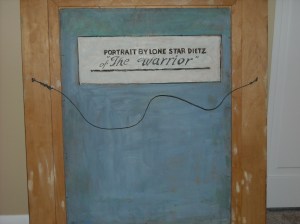
Posted in Carlisle Indian School, Doctors, Lawyers, Indian Chiefs, Football, Lone Star Dietz, Washington Redskins | Leave a Comment »


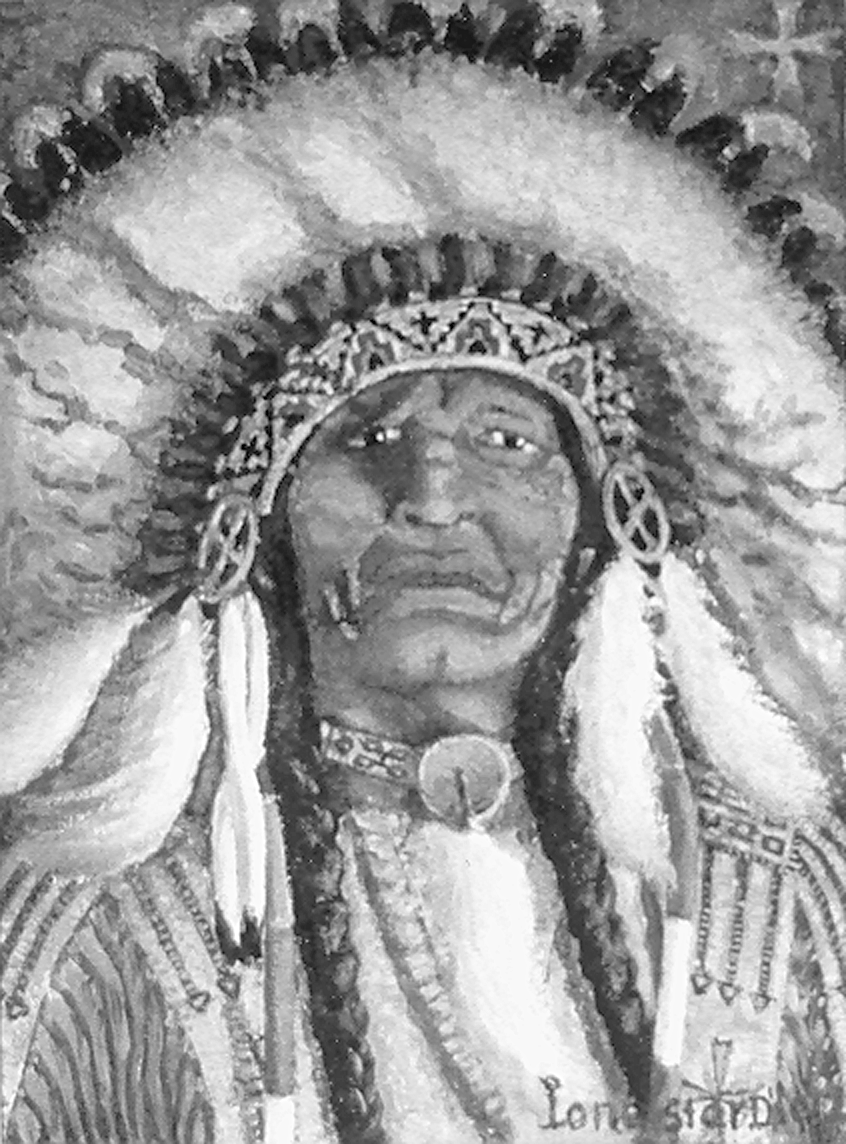
 Tom Benjey's Weblog
