Archive for the ‘Doctors, Lawyers, Indian Chiefs’ Category
June 8, 2012
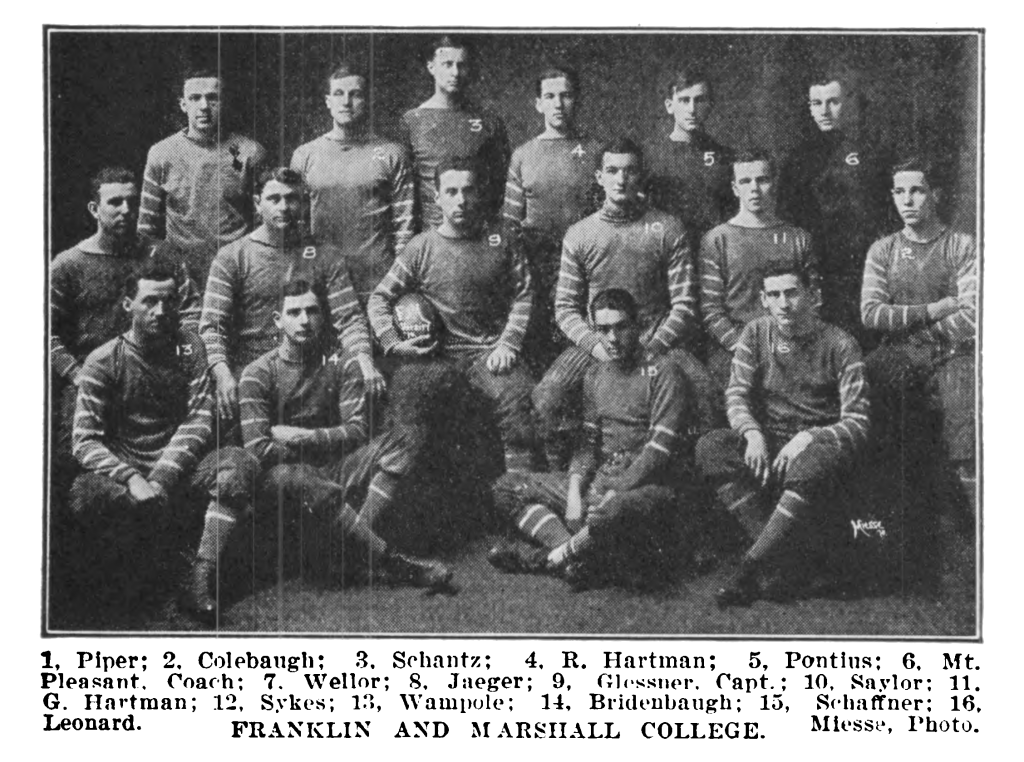
While preparing the 1911 Spalding’s Guide for printing, I noticed that some former Carlisle players could be seen in the numerous 1910 team photos to be found in that volume. That brought to mind an old newspaper article that I can’t lay my hands on now in which the writer opined as to why there were so few football coaches at a time when Carlisle Indian School players were grabbing headlines. I don’t recall his reasoning or conclusions but do remember having read the article.
The truth is that several Carlisle Indian School players tried their hands at coaching with varying success. The names that come quickly to mind are Bemus Pierce, Frank Cayou, Albert Exendine, Caleb Sickles, Lone Star Dietz, James Phillips, Joel Wheelock, Victor “Choc” Kelley, Mike Balenti, and Gus Welch (I keep adding names as they come to me while writing this article). I’m sure there were others. Given enough time to research this issue, I’m sure that I could come up with more. But I don’t have the time right now because I must get the 1901 Spalding’s Guide ready to print.
The lengths of their careers varied, but Exendine, Welch and Dietz all had long coaching careers. Of these, Lone Star Dietz had by far the most success and, as an acknowledgement of that success, was honored by the Helms Foundation many years ago. Next month, the College Football Hall of Fame will honor him. It is highly unlikely that any other Carlisle Indian will receive this honor because only a few had long careers and only Dietz, as far as we know, had a Hall of Fame worthy career as a coach. Also, Exendine and Welch were already inducted as players. My immediate concern is not about the Hall of Fame but with 1910 team photos that include former Carlisle players.
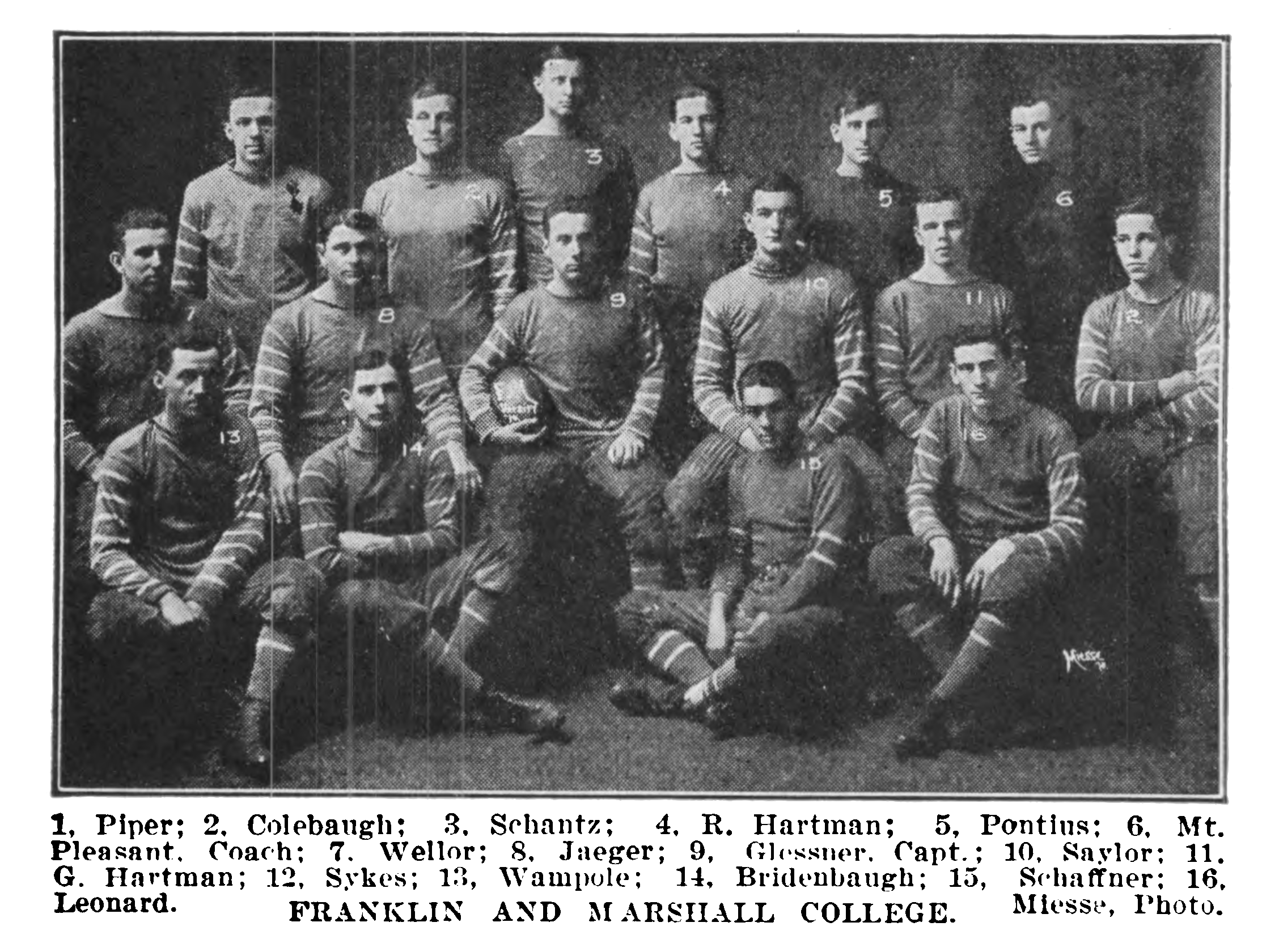
Follows are two of the 1910 team photos. I’ll leave it to the reader to find the Carlisle Indians in them, but here’s a hint: both wore their Carlisle letter sweaters. I take that as an indication of how proud they were of having been part of those great teams.

Tags:Carlisle Indian School Coaches, Franklin and Marshall College, Washington University
Posted in Albert Exendine, Bemus Pierce, Caleb Sickles, Carlisle Indian School, Doctors, Lawyers, Indian Chiefs, Ed Rogers, Football, Frank Cayou, Frank Mt. Pleasant, Gus Welch, James Phillips, Joel Wheelock, Lone Star Dietz, Mike Balenti, Victor Kelly, William Gardner | Leave a Comment »
May 31, 2012
A question that has come up recently is where Lone Star Dietz’s artwork can be purchased, because he is in the news again for being selected for induction into the College Football Hall of Fame, I suppose. I know of no place that his original artwork can be purchased. (I would like to find some myself.) However, some of his works can be seen on public display and others have been reproduced and can be purchased.
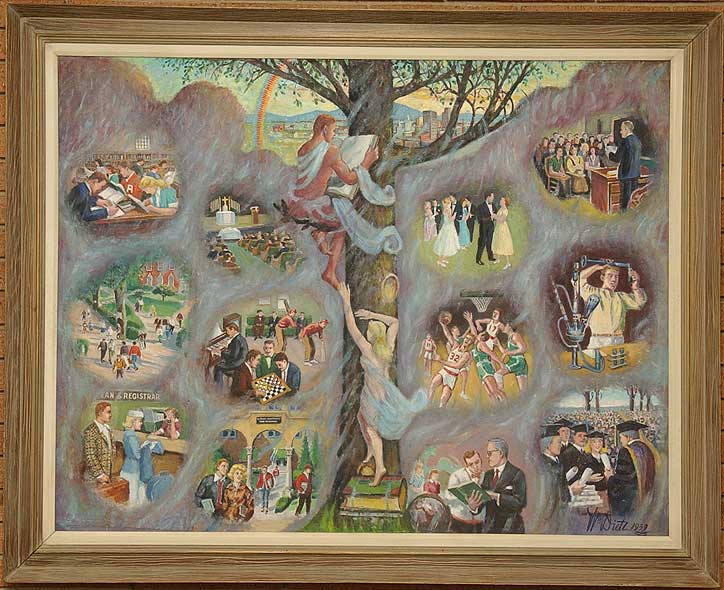
Albright College has four of his paintings on display: the Albright Lion, a portrait of Dick Riffle, a portrait of Lewis Smith, and an unusual collage of the Tree of Learning. Joel Platt has some of Dietz’s artwork in his Sports Immortals museum but they are not generally on display to the public. I was fortunate to find him in when I visited and he showed me a panoramic painting of Pittsburgh he had in his office. The back of the painting contained two titles, “My Pittsburgh” and “Pittsburgh Just Grew.” Apparently, Lone Star changed his mind as to what it should be called.
Most of Dietz’s artwork that I’m aware of is in private collections. A few of those found their way into an article done by Francine Scoboria for Albright College: http://www.albright.edu/reporter/spring2006/lonestar1.html. Occasionally, a reader will send me information on some as I have shared previously in this blog. Hopefully, more will surface in the future.
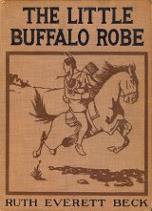
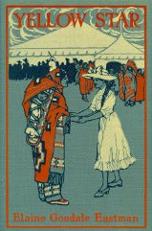
Fortunately, some of Dietz’s smaller pieces have been reproduced on items sold at History on High, Cumberland County Historical Society’s store in Carlisle and Tuxedo Press recently reprinted two books illustrated by Lone Star Dietz and his first wife, Angel DeCora. Yellow Star has four page-sized paintings done jointly by Dietz and DeCora reproduced in grayscale. The Little Buffalo Robe is chockfull of drawings done by Dietz and a few done by DeCora. It also has some full-page artwork done by DeCora. Tuxedo Press also created neckties using Dietz’s unique signature: http://www.tuxedo-press.com/index_files/OrderForm.htm

Tags:Albright College, Cumberland County Historical Society, Dick Riffle, Francine Scoboria, History on High, Joel Platt, Lewis Smith, Sports Immortals
Posted in Doctors, Lawyers, Indian Chiefs, Football, Lone Star Dietz | 8 Comments »
May 24, 2012
Tonight, the National Museum of the American Indian (NMAI) in Washington, DC holds a reception to kick off its new exhibit, “Best in the World: Native Athletes in the Olympics,” to celebrate the athletic achievements of Native Americans on the 100th anniversary of the 1912 Stockholm Games that featured legendary performances by Jim Thorpe and Lewis Tewanima. I am attending because Bob Wheeler, Jim Thorpe’s Boswell, is to speak there. While making preparations for attending this event, I received some unexpected news.
The National Football Foundation (NFF) released its selections for induction in the College Football Hall of Fame Class of 2012 and Lone Star Dietz was finally on the list. As blog followers probably know, Greg and John Witter, first cousins and rabid Washington State football fans, and I campaigned to get Dietz placed on the Hall of Fame ballot some years ago. Getting his won-loss record corrected was the key to getting him nominated but there were larger obstacles yet to come.
Lone Star Dietz died in 1964 and there are few people still alive that knew him. Also, he coached at schools with smaller alumni bases and less clout than the major football factories. Washington State, for example, couldn’t muster the support for him that, say, Ohio State could for John Cooper or Michigan could for Lloyd Carr. While both these recent coaches had very good careers, neither had the impact on the history of the game as did Dietz. It’s one thing to inherit a strong program and be a good steward, but it is quite another to rebuild a floundering program from the ground up, something that Lone Star did multiple times.
The closest he came was in 2006 when the selectors chose Bobby Bowden and Joe Paterno instead of the people who were on the ballot. A couple of years ago, when Lone Star’s name was dropped from the ballot, I gave up all hope of him ever being selected. I didn’t even know that his name was on the Divisional ballot this year, so was shocked when I started receiving phone calls from reporters on Tuesday afternoon.
All I can say is that it’s long overdue. Although he’s being brought in through the back door, so to speak, he will finally be in. He’s the first Carlisle Indian to be inducted as a coach; the rest were as players. Whether this honor is enough to offset the many indignities Dietz suffered and mollify the Lone Star Curse is yet to be seen.
http://seattletimes.nwsource.com/html/cougarfootball/2018262997_dietz23.html
http://www.spokesman.com/stories/2012/may/23/blanchette-wsu-legend-dietz-gets-his-due/

Tags:1912 Olympica, Bobby Bowden, College Football Hall of Fame, Greg Witter, Joe Paterno, John Witter, Lewis Tewanima, Lone Star Curse, National Football Foundation, National Museum of the American Indian
Posted in Carlisle Indian School, Doctors, Lawyers, Indian Chiefs, Football, Jim Thorpe, Lone Star Dietz, Washington Redskins, Washington State University | Leave a Comment »
April 17, 2012
The photo on page 30 of Carlisle Indian School’s starting eleven for 1917, the last team that would represent the school, includes one player who would be heard from later, Nick Lassau. To learn more about Nick, aka Long Time Sleep, read up on the Oorang Indians of 1922 and 1923. Note that Carlisle’s uniforms had changed to include stripes across the midriff and the stripes that had been below the elbow were moved up above the elbow to align with the midriff stripes. Page 35 may contain the last thing written about a Carlisle team in a Spalding’s Guide: “Carlisle showed improvement over the previous year, but until they get a team of first rate caliber they will do well not to schedule so many matches with the big colleges.”
Page 41 begins the section on Foot Ball in West Virginia with the All-West Virginia Elevens selected by H. A. Stansbury, Athletic Director of West Virginia University. It was no surprise that Pete Calac of West Virginia Wesleyan headed the list. No other Carlisle Indians were on it, most likely due to not playing for a West Virginia school.
Page 50, immediately preceding the Foot Ball in the District of Columbia section, contains a photograph of the Georgetown University team on which the players are numbered but no legend is provided. Number 2, front row center in a sweater, is Georgetown’s Head Coach, Al Exendine, star end on the great 1907 Carlisle team. Georgetown was the class of DC college teams as had become the norm under one of Warner’s former assistants.
John Heisman, Head Coach of Georgia Tech, authored the Review of Far Southern Foot Ball. So, it is no surprise that he named Joe Guyon to his All-Southern Team at half-back. About his own team, Heisman wrote, “This team was considered by many as the best of the year anywhere. Whether it was or not need not here be debated. But certain is that in Strupper, Guyon and Hill it possessed three back-field men who were the equal of any other three that could be named the country over.” He said nothing about Guyon’s brother.
<next time—More Carlisle Players in The Great War>
Tags:Golden Tornado, John Heisman, Strupper
Posted in Albert Exendine, Carlisle Indian School, Charles Guyon, Doctors, Lawyers, Indian Chiefs, Football, Joe Guyon, John B. Flinchum, Nick Lassa, Pete Calac, Pop Warner | Leave a Comment »
April 15, 2012
Beginning on page 7, Camp discussed three unbeaten eastern teams, two of which had ties to Carlisle. Carlisle’s former coach, Pop Warner, completed his third consecutive undefeated season at Pittsburgh since leaving Carlisle after the 1914 season. More on Georgia Tech later.
When discussing the state of Pacific Coast football on page 9, Camp gives a Carlisle alum high marks: “Washington State, with seven veterans of the previous season’s team, was again coached by ‘Lone Star’ Dietz, and under his guiding hand established a clear title to the Pacific Coast Championship…She [Washington State] would give many eastern teams a hard battle.”
On page 11, in lieu of his annual All America Team, Camp lists Honorable Mention college players. Ends selected included Pete Calac, formerly of Carlisle, then playing for West Virginia Wesleyan. Backs included Joe Guyon, formerly of Carlisle, then playing on Georgia Tech’s undefeated “Golden Hurricane” team.
Page 13 listed All-America selections made by other pundits. Dick Jemison of the Atlanta Constitution named Guyon to his All-America team as a half-back. Lambert G. Sullivan of the Chicago Daily News placed William Gardner at end on his The Real “All-Western” Eleven on page 17. The All-Southern Eleven picked by seven football writers in the South placed Joe Guyon at half-back. And Fred Digby of the New Orleans Item put Guyon at full-back on his All-Southern Eleven as did Zip Newman of the Birmingham News. “Happy” Barnes of Tulane did the same. Closing out the college all-star teams on page 23 was the All-West Virginia Eleven picked by Greasy Neale, coach of West Virginia Wesleyan. He selected his own player, Pete Calac, as one of the ends.
A photo of the Georgia Tech team appears on page 8 of the 1918 Spalding’s Guide. Figure number 1 is Head Coach John Heisman. That is no surprise. Neither is it that number 13 is Joe Guyon. The last person listed, number 22, is C. Wahoo. From previous research, I know that is Charlie Wahoo, Joe Guyon’s brother Charles Guyon, who also used the fabricated name of Wahoo. That all the other figures in the photo are numbered in order and that Wahoo is positioned out of order is suspicious. So is that his figure is smaller than the others. It’s well known that Heisman didn’t think much of him and that he used recruiting his brother for the team to leverage an assistant coaching position for himself. Could this picture have been “photoshopped” to include him using a primitive tool available at the time?

<next time—More Carlisle Players in The Great War>
Tags:Dick Jemison, Fred Digby, Georgia Tech, Golden Tornado, Greasy Neale, Happy Barnes, John Heisman, Lambert Sullivan, Walter Camp, Xip Newman
Posted in Carlisle Indian School, Charles Guyon, Doctors, Lawyers, Indian Chiefs, Football, Joe Guyon, Lone Star Dietz, Pete Calac, Pop Warner, William Gardner | 2 Comments »
April 12, 2012
This might be considered a senior moment piece as I have no recollection of why I intended to write about errors in ads this time. I suppose that I noticed an error or two in the ads in the back of the 1912 Spalding’s Guide so will start by looking there. Wait a few minutes for me to do a little research….
Perusing the 1912 and 1910 Spalding Guides did not trigger my memory nor did I discover some new error I previously overlooked. So, I will write about something that is fresh in my mind.
Due to problems in scanning the 1918 Spalding’s Guide, I have had to manually clean up many pages, many of which I could not resist reading while working on them. Something that jumped out at me was that, although Carlisle Indian School had a very poor season in 1917, former players’ names and, in some cases, pictures dotted the pages of this volume. And it wasn’t because the pro game was being covered heavily. It was because so many of them played on military teams even though they were not eligible for the draft as being noncitizen Indians.
Page 4 of the 1918 Spalding’ Guide is the first page in that book to mention any player. On that page are the photos of Walter Camp’s All-Service Eleven for 1917. Warner elected to not list an All-America squad for 1917 because so many star players were serving in the military and that many schools discontinued inter-collegiate athletics, played abbreviated schedules, or used inexperienced players. However, the military squads often included several former college stars in their line-ups. The quality of the football played by the military teams was so good that the games often drew large crowds, so large that the annual New Year’s game in Pasadena was played between two military teams.
The photograph on page 4 for player #6 was that of William Gardner, a star end on the great Carlisle Indian School team of 1907. It matters not that Camp misspelled his name as Gardiner because he had Carlisle and Camp Custer right. It is well known that Army Capt. Gardner served at Camp Custer and played on its team. Camp made no mention of Gardner’s play but, on page 5, listed him at end on his ALL-AMERICA SERVICE ELEVEN, First Eleven. Camp also placed him on his ALL-SERVICE SECTIONAL ELEVENS, Middle West Eleven on page 11. At about 34 years of age (ages are uncertain for people of that time), Gardner was long in the tooth for an athlete of that era, having last played at Carlisle in 1907. But he did play some pro ball for Canton in the years leading up to America’s entry into WWI. Perhaps, Walter Camp was making up for his snub of Gardner in 1907 when he left the Indian star off his All America Team.
<next time—More Carlisle Players in The Great War>
Tags:Canton Bulldogs, Walter Camp
Posted in Carlisle Indian School, Doctors, Lawyers, Indian Chiefs, William Gardner | Leave a Comment »
March 6, 2012
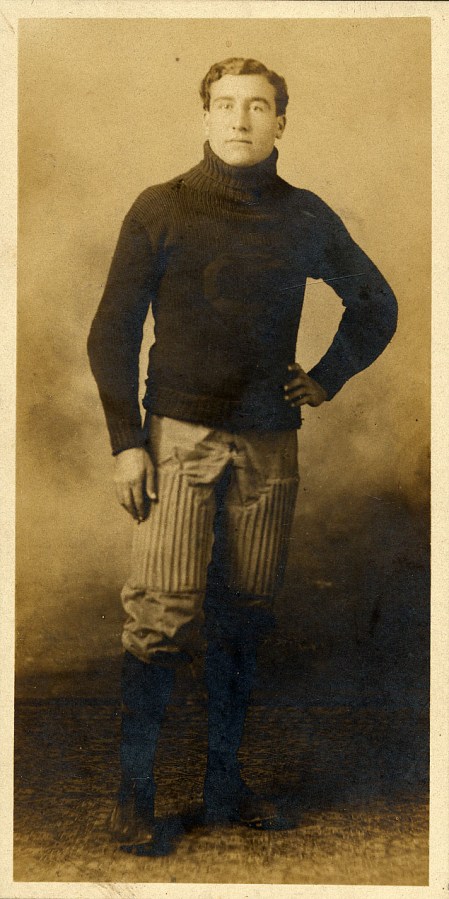
Today, I received an email completely out of the blue from the United States Department of Justice Bureau of Alcohol, Tobacco, Firearms and Explosives (ATF). The message was from an ATF historian wanting to know if I had any photographs of one-time agent William Gardner. What made the request all-the-more surprising was that, when I was researching Gardner’s life, the Department of Justice disavowed having any knowledge of him, even after I appealed their initial decision. Obviously, Justice does know something about the Untouchable who busted up breweries alongside Eliot Ness many decades ago.
While talking with the ATF historian, I learned that the Bureau had undergone several reorganizations over the years and the Untouchables’ files had been thought to be lost somewhere along the way. Recently, eight of the files were found, including Bill Gardner’s. Perhaps the person writing a definitive biography of Eliot Ness uncovered them while doing his research. Now, I must wait for copies to arrive to see what remains in his file and to learn some things I didn’t know about his time with the Justice Department.
Apparently, Eliot Ness, who was a physically small man who played in a very rough game with the likes of Al Capone, recruited Gardner, a large powerful man, for his muscle. Ness may have wanted Gardner for protection both when out on operations and to be with him should the thugs attempt reprisals against him. Ness has written that he initially intended to use Gardner in undercover work but, immediately after seeing him, changed his mind. A six-foot-tall Sioux with a muscular build would not blend in well in Chicago; he would definitely not blend into the background. Gardner’s experience on the football field probably served him as well as his Dickinson law degree when he was raiding those bootleggers. It will be interesting to see what is lurking in his file.
Tags:Al Capone, Alcohol Tobacco & Firearms, Bootleggers, Breweries, Chicago, Eliot Ness, Untouchables
Posted in Carlisle Indian School, Doctors, Lawyers, Indian Chiefs, Football, William Gardner | Leave a Comment »
February 28, 2012
Delaney went on to declare Haskell a better team than his St. Louis U. team: The title of Champions of the Southwest must unquestionably be conceded to the Haskell Indians. Their record is as follows: they defeated Texas, 4 to 0; Kansas, 23 to 6; Missouri, 39 to 0; Washington [of St. Louis], 47 to 0; Nebraska, 14 to 6. They were beaten at the Stadium by the Carlisle Indian team, score 38 to 4.
Next thing of interest to us in Delaney’s column was the selection of his picks for All Southwestern Eleven first and second teams. Haskell players stood out there as they had as a team. He placed DuBois at right tackle, Fallis at quarter, and Pete Hauser at right halfback on his First team. Two more Fighting Indians made his Second Team: John Warren at left guard and Chauncey Archiquette at right halfback. Please note that sports writers of that day took liberties when assigning players to backfield positions on their All Star teams. It wasn’t unusual, for example, to see someone who played halfback put in the fullback position if he thought that halfback was better than any of the fullbacks that year.
Delaney not only selected players but provided some rationale for picking them: Right Tackle should go to DuBois of Haskell Indians for ability and experience. Left Guard—Warren of Haskell seems to be the most likely man for substitute and plays an unusually good game. Center—The best fight seems to be here, for there are three men about equal in Michelson of Kansas, Prugh of Rolla and Felix of Haskell. [He said nothing more about Felix and didn’t put him on either first or second team.] Quarter-backs—this year who have gained considerable notice are Fallis of Haskell Indians and Pooler of Kansas University, they both being very good in a broken field. Fallis seems to have the edge on Pooler in speed and is an expert dodger, good on running back punts and is a sure tackler. His ability to size up a play, his grand leadership and control of his men, combined with his coolness in action, makes him the man to lead the team. Right Half-back—unquestionable belongs to P. Hauser of Haskell with Archiquette of Haskell, his team-mate, substitute, they being so nearly matched that only after some time was P. Hauser selected. Both played hard, brilliant football, and it was their work that won for Haskell Indians the Southwestern championship. Archiquette is better running back punts and on a broken field, while Hauser is very fast running with the ball, a good line bucker and end runner, and plays a harder and more consistent game than his team-mate….
The back-field consists of careful, fast and heavy players, not easily drawn from their positions and unusually good in bracing up a line. All are good punters, excellent dodgers and sure handling punts. Everything considered, this is easily the best team ever representing the All Southwest.

<Next Time—Another missing Carlisle game?>
Tags:1904 All Southwest, DuBois, Fallis, Felix, John Warren
Posted in Carlisle Indian School, Chauncey Archiquette, Doctors, Lawyers, Indian Chiefs, Football, Haskell Institute, Pete Hauser | Leave a Comment »
February 13, 2012
Ed Rogers and James Phillips weren’t the only Carlisle Indians to play for a future Big Ten team in 1903. Player #4 (players on team photos in Spalding’s guides are conveniently numbered for the ease of the reader) on the University of Wisconsin team photo on page 20 is William Baine. He played for the Indians from 1899 to 1900, then returned to Haskell Institute to play before enrolling at Wisconsin in 1903. Prior to coming to Carlisle, Baine had played for Haskell and its cross-town rival, the University of Kansas. While at Carlisle, William was enrolled in Dickinson College Preparatory School.
The photo of the 1903 Macalester College team on page 68 includes Lone Star Dietz as player #11. Dietz played for Friends University part of the 1904 season but a Friends team photo is not to be found in the 1905 Spalding’s Guide. Dietz enrolled at Carlisle in 1907. It isn’t clear what he did during the 1905 and 1906 seasons.
On page 123, Archie Rice, Sporting Editor of the San Francisco Chronicle, named Weller of Stanford as fullback of his 1903 All-Pacific eleven but mitigated that with his next sentence: “There is a possibility that Bemis [sic] Pierce of the Sherman Indians, but formerly of Carlisle, might be more valuable for the team than big Weller….” When Pierce left Carlisle for Sherman Institute in Riverside, California, the Carlisle school newspaper reported that he was to coach that Indian School team, but it appears that he also donned the moleskins to get into the action as a player.
That the 1903 season results and team photos for both Haskell Institute and Sherman Institute were omitted from the 1904 Spalding’s Guide is unfortunate. According the David DeLasses’ www.cfbdatawarehouse.com, Sherman Institute went 4-4 in 1903 with a win over Southern Cal and losses to Stanford and Carlisle. That site has Haskell Institute going 7-4 with wins over Texas, Kansas and Missouri and losses to Nebraska, Chicago and Kansas State. The 1905 Spalding’s Guide has a lot more about Haskell.
Tags:Archie Rice, Friends University, Macalester College, San Francisco Chronicle, Sherman Institute, Spalding's Guide
Posted in Bemus Pierce, Carlisle Indian School, Doctors, Lawyers, Indian Chiefs, Ed Rogers, Football, Haskell Institute, James Johnson, James Phillips, Lone Star Dietz, Pop Warner, William Baine | Leave a Comment »
February 9, 2012
Walter Camp didn’t name any other Carlisle players to All-America team teams that year but James Johnson wasn’t the only Carlisle player to receive an honor. Walter Camp also picked an All-Western Team for 1903 “from the University teams of the Middle West,” essentially the teams that would become the Big Ten plus Notre Dame. “What does this have to do with Carlisle Indian School?” you say. Plenty.
Camp’s All-Western Team included Ed Rogers, Captain of the 1903 University of Minnesota team, at end and James Phillips, Northwestern University guard. Perhaps Camp shed some light on his picks when he wrote, “Rogers is an Indian, experienced, quick, and certain” and “Phillips is another Indian, and as he would not play against Carlisle, Northwestern’s line was correspondingly weakened. That game also showed what a large part Phillips had been in Northwestern’s defense.” Rogers and Phillips had both starred at Carlisle before leaving to embark on careers as lawyers. While at Carlisle, Rogers had taken courses at Dickinson College and Dickinson School of Law while playing football for Carlisle. However, in 1898 as a Dickinson College student, Ed played for Dickinson in their game against Penn State. The college’s school newspaper claimed that he was a bona fide player because Carlisle’s season was already over and he was a legitimate student enrolled in the college. However, his Dickinson College football career was limited to that one game. Later, he starred at Minnesota and captained his teammates to a 6—6 tie with Fielding Yost’s undefeated Point-a-Minute team in the first Little Brown Jug battle.
James Johnson and Ed Rogers were eventually inducted into the College Football Hall of Fame. James Phillips ended his collegiate football career at the end of the 1903 season, married, and migrated west to Aberdeen, Washington where he had an illustrious career, but that is a story for another time.
The story of Carlisle Indians starring for colleges and universities in 1903 is far from complete…
Posted in Carlisle Indian School, Dickinson College, Doctors, Lawyers, Indian Chiefs, Ed Rogers, Football, James Johnson, James Phillips, Pop Warner | 1 Comment »




 Tom Benjey's Weblog
