Two posts ago I opined that, had Jim Thorpe not left Carlisle in 1909 to play summer baseball and instead returned to school, he would have had a good chance of receiving tutelage as a minor league baseball player. I need to revise this conjecture and not just because he had tried out unsuccessfully for the 1908 Olympic games.
Had Thorpe returned to Carlisle for the 1909 fall term, he would have likely had another good season, his third year of eligibility for football, improving the Carlisle team’s 8-3-1 record. He might even have made Walter Camp’s Second Team. If he ran track in spring 1910, he would have used up his four years of eligibility and there were no Olympic tryouts that summer or the next. His track career would probably have come to an end because no economic opportunities existed for track and field at that time. Had he played football in the fall of 1910, he would surely have improved on Carlisle’s 8-6 record and might have made Camp’s All-America First Team, but he wouldn’t have been as dominating as he was in 1911 and 1912 because his body wouldn’t have the extra year of growth it had when he returned in 1911.
Jim would have used up all his college football and track eligibility by the end of 1910. With football not having a professional league yet, only semi-pro teams existed at the time. The irregular and unreliable income from semi-pro football would not have been enough to support him. His only likely professional athletic opportunity at that time would have been minor league baseball. He had already tried that route. While it’s impossible to know if the 1911 baseball season would have worked out better this way than it already did. Perhaps a better team in a more stable league would have picked him up. But, with two summers already under his belt, the team that signed him that summer was in a league that was insolvent, resulting in Jim being out of a job and back in Oklahoma with no good options on the horizon.
Returning to Carlisle would not have been an option because all his eligibility had been used up. Other schools would have been reluctant to enroll him because of the reactions to Frank Mt. Pleasant playing for Dickinson College in 1908 after having played for Carlisle. Some schools refused to play Dickinson if Mt. Pleasant was on the field. The four-years-of-eligibility rule was being enforced.
Had Jim returned to Carlisle after the 1909 summer, he would likely have had fewer options in 1911 than he had after not returning in 1909. Ranching would have been a good outcome for him.
Look forward to seeing Lone Star Dietz’s name in the news soon as the origin of the Washington Redskins name will surely be discussed again. Native American Guardians Association is circulating a petition that had over 67,000 signatures as of Tuesday morning. The group’s president, Eunice Davidson (Sisseton Dakota), sent a letter to the Washington NFL team requesting that the team’s name be changed back to Redskins, citing a poll of Native Americans, 90% of whom did not find the name offensive. She referenced as examples, the Kansas City Chiefs and Chicago Blackhawks, recognizing the names carry “an obligation of honor and respect.” She requested “that the team revitalize its relationship with the American Indian community by (i) changing the name back to ‘The Redskins’ which recognizes America’s original inhabitants and (ii) using the team’s historic name and legacy to encourage Americans to learn about, not cancel, the history of America’s tribes and our role in the founding of this Great Nation.”
She also suggested a boycott similar to the national boycott that lost Anheuser Busch about $27 billion without a single brick being thrown. This may not be successful as many fans have already abandoned the team for it poor play as well as its wretched new name.
Daniel Snyder was long despised as the team’s owner but fans supported him on his pledge to keep the team name. After he caved on that promise, his future as owner was doomed. He is now being pressured to sell the team for something like $4 billion. This brought mind the time the NBA force a racist coot into selling a team for twice its value.
My opinion at the time the name was changed was that Commanders as a name for a pro football team was lame. It hasn’t improved. Perhaps the new owners plan on changing their colors to olive drab and black and attaching visors with scrambled eggs on them to the helmets. Even before this latest news conjectures arose that the new ownership would bring with them a new name. One hopes they do a better job this time. If they must select a Washington-relevant name, they should consider the following: beltway bandits, swamp creatures, budget busters, influence peddlers, and child molesters. Redskins is a far more noble name than those more appropriate ones. More noble than that city deserves.
Will the new owners bring the team back to Carlisle for summer camp in an attempt to win Super Bowls again?
….
One commenter has suggested a return to the team’s original name when it first played in Boston.
While researching the 1899 Christmas Day game between Carlisle Indian School and the University of California for an upcoming article, I learned that the Cal players had voted three times against playing in this post-season game. Initially, they gave fatigue from the season just finished and the need to study for final exams as the reasons for objecting to another game. What turned out to be the real reason was the money. Players complained that the Thanksgiving Day game against archrival Stanford had generated a lot of revenue but athletes received no benefits from it.
A major objection was that Cal’s athletes didn’t have a “clubhouse” in spite of generating lots of money and receiving nothing in return. Only after they’d wrested control of the finances from Manager Irwin J. “Jerry” Muma and transferred it to the athletic committee did the team agree to the tough, but potentially profitable, game with the Indians.
A major difference between then and now is that in the decades before the dawn of the NFL, athletic scholarships were not (officially) allowed. Student players generally paid full tuition and received nothing for their efforts, aside from the adulation of comely co-eds—unless alumni with deep pockets were generous with their money. The Cal players’ case for controlling the finances was considerably different than for today’s gladiators who get athletic scholarships, numerous perks not available to other students, and a shot at turning pro. Why should they have performed risky, unpaid labor for a college unwilling to use some of the profits for facilities that would improve athletes’ performance?
Earlier this summer you read about my ill-fated attempt to see Tim Tebow play minor league baseball against the Harrisburg Senators at City Island. Since that time, I’ve thought about who else played at that island in the Susquehanna River over a century ago.
Called Hargest’s Island in 1902, a crude baseball field there was home turf for Harrisburg Athletic Club for whom Carlisle Indian School grad and Dickinson College student Charles Albert Bender pitched one summer. The future hall-of-famer even hurled a game against the visiting Chicago Cubs. Chief Bender lost but acquitted himself well. So well, that by season’s end he had been signed by Connie Mack to pitch for the Philadelphia Athletics. The rest, as they say, is history.
Baseball wasn’t the only sport in which Carlisle Indians competed on Hargest’s Island. In 1908, 8,000 people attended the first annual statewide track and field meet sponsored by the Pennsylvania Intercollegiate Athletic Association. The Carlisle Indians defeated ten colleges to take first place honors. Several Carlisle athletes performed well. Among them was Jim Thorpe, rounding out his first season of competition. He came in second in the 220-yard hurdles and 16-pound shotput, and first in the high jump. Not bad for someone new to the sport.
Jim Thorpe runs the high hurdles in the Pennsylvania Intercollegiate Meet on Hargest’s Island
The 1912 event was the source of an often-heard legend about the Carlisle Indians. Their team did not run 20 miles to a game, defeat their opponents and run home. Lewis Tewanima and Jim Thorpe were training for the Olympic Games to be held in Stockholm that year and did not compete as members of the team. As part of his training regime, distance running Hopi Tewanima ran from Carlisle to Hargest’s Island, waved to his friends, circled the track, and ran back to Carlisle.
Jim Thorpe returned in 1915 to compete there as a member of the Harrisburg Islanders minor league baseball team. A parallel of Thorpe and Tebow is that that both competed on City Island in baseball, not either’s first sport. Both camein to prominence for their exploits in college football. Tebow was a Heisman Trophy winner and Thorpe would have been had that award existed in 1911 and 1912. His prominent position in the College Football Hall of Fame attests to that.
The ability to search Carlisle Indian School Student Files has given me the ability to identify (however incompletely) the students who worked and lived with the Craighead family on their outing periods away from the school. That Richard Reynolds and Mary Leidigh Craighead were early supports of the school and their location adjacent to the railroad tracks at Craighead Station likely made them favored hosts. After Charles Cooper Craighead married Agnes Miller in 1886, they also had Carlisle students with them on outings.
The files available on-line at Dickinson College include partial outing rosters on which only three students were listed as having stayed with a Craighead family: Henry Morning, Sadie Metoxen and Myrtle Thomas. Student Files proved to be more reliable. A search of them for “Craighead” returned the names of 22 unique students (some were duplicated) who had been with a Craighead family on outings, one of which was Myrtle Thomas. A Student File wasn’t found for Henry Morning and Sadie Metoxen’s file wasn’t returned by the “Craighead” search because it doesn’t include a card for the time period in which she was with the J. B. Craighead family. A search of images not unexpectedly found no photos taken at Craighead Station or of Craighead family members. I would have been surprised if any had been in the school’s files.
A search of Carlisle Indian School publications on “Craighead” found no occurrences. I knew this was misleading because I had previously found references to Craigheads as supporters of the school in the school’s newspapers. I had also read an article in one of the school’s newspapers that mentioned Emma Strong being with Agnes Craighead but her Student File could not be found. A complete manual scan of the Carlisle Indian School newspapers and literary magazines would be necessary to identify the names of all the Carlisle Indian School students who stayed with Craigheads on their outings.
Something not previously mentioned is that people’s names were not always spelled uniformly or correctly. It’s always a good idea to also search on common misspellings of the name. A simple example is Lone Star Dietz whose father spelled the family name Deitz. Something to keep in mind is that some students went by more than one name, such as Charles Guyon aka Wahoo. If you are looking for information on a woman, make sure you also have her maiden name if she was ever married as her records are likely to be under that name. Also search on her married name because some of her items might be associated with that name.
Student files aren’t the only things that can be retrieved. Links to photographs are not uncommon as are inclusions on lists that have been scanned. Mentions of the person in Carlisle Indian School publications, such as The Morning Star, The Red Man, The Carlisle Arrow, etc. are often found but are generally incomplete.
Sometimes information can be found for students whose student files have been lost . Emma Strong is an example. Her name appears in the student file for Frank DeFoe, whom she married after leaving the school. Her name also appears on some lists, however those entries are for other people named Strong or Armstrong or for students not strong (healthy) enough to remain at Carlisle. Emma Strong’s name appears several times in Carlisle Indian School publications but none of those articles are found by this search.
Sometimes, such as in the case of long family names, using just the first five or six letters may return results where spelling it completely won’t. That is because searching on scanned documents is an imperfect process at best.
Walter Camp didn’t name any other Carlisle players to All-America team teams that year but James Johnson wasn’t the only Carlisle player to receive an honor. Walter Camp also picked an All-Western Team for 1903 “from the University teams of the Middle West,” essentially the teams that would become the Big Ten plus Notre Dame. “What does this have to do with Carlisle Indian School?” you say. Plenty.
Camp’s All-Western Team included Ed Rogers, Captain of the 1903 University of Minnesota team, at end and James Phillips, Northwestern University guard. Perhaps Camp shed some light on his picks when he wrote, “Rogers is an Indian, experienced, quick, and certain” and “Phillips is another Indian, and as he would not play against Carlisle, Northwestern’s line was correspondingly weakened. That game also showed what a large part Phillips had been in Northwestern’s defense.” Rogers and Phillips had both starred at Carlisle before leaving to embark on careers as lawyers. While at Carlisle, Rogers had taken courses at Dickinson College and Dickinson School of Law while playing football for Carlisle. However, in 1898 as a Dickinson College student, Ed played for Dickinson in their game against Penn State. The college’s school newspaper claimed that he was a bona fide player because Carlisle’s season was already over and he was a legitimate student enrolled in the college. However, his Dickinson College football career was limited to that one game. Later, he starred at Minnesota and captained his teammates to a 6—6 tie with Fielding Yost’s undefeated Point-a-Minute team in the first Little Brown Jug battle.
James Johnson and Ed Rogers were eventually inducted into the College Football Hall of Fame. James Phillips ended his collegiate football career at the end of the 1903 season, married, and migrated west to Aberdeen, Washington where he had an illustrious career, but that is a story for another time.
The story of Carlisle Indians starring for colleges and universities in 1903 is far from complete…
The on-field influences the government Indian schools, Carlisle mostly but also Haskell to some extent, had on the development of college football are well known. Less well-known are the impacts on the rules under which the game is played. Most football historians are aware that Carlisle Indian School was frequently criticized for not adhering to eligibility rules similar to those agreed to by the major colleges. In 1908, Pop Warner instituted a limit of four years of eligibility on the varsity team for Carlisle’s players. Years spent riding the bench without playing were most likely not counted against the four years. Something that is not known as well is that major colleges routinely ignored the fact that players they recruited from Carlisle had already played for four years prior to enrolling in college. That was about to change in 1905 if some had their way.
A November 29, 1904 article datelined Chicago that was printed in The Boston Globe announced that eligibility rules were about to be enforced more stringently, at least by some schools. “A meeting of representatives of leading western colleges” (read Big Ten) agreed on rule changes to which they were to comply. Two schools were singled out specifically: “Carlisle and Haskell Indian Schools, two formerly unclassified institutions, were raised to the ranks of colleges, and students who have competed for four years from those institutions in the future will not be allowed to compete in events controlled by western colleges.” Since Carlisle and Haskell seldom played more than a total of two games a year against the schools that became the Big Ten, this rule was probably aimed at the schools themselves. Several former Carlisle players had played for these schools after having used up their eligibility at the Indian school. Some that come quickly to mind are: Frank Cayou, Illinois; James Johnson, Northwestern; James Phillips, Northwestern; William Baine, Wisconsin; and Ed Rogers, Minnesota.
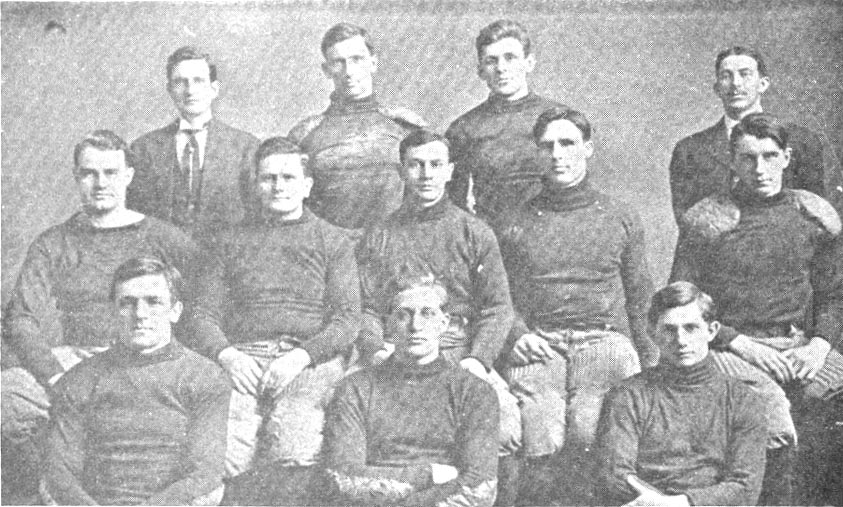
A reader sent me this photo in an attempt to determine if the team in the photo is the 1910 Dickinson College Red Devils and if the player seated at the left in the front row is Frank Mt. Pleasant.
A photo of the 1910 Carlisle Indians-Dickinson College game can be found at this link: http://chronicles.dickinson.edu/studentwork/eyeongame/1910foot.htm. The player at the far left is wearing a Carlisle jersey. The forearm stripes may not have been unique, but were different from most other teams’ uniforms. All the jerseys in the photo are different from the jerseys worn by Dickinson in 1910. Also, Frank Mt. Pleasant graduated in the spring of 1910 and coached Franklin and Marshall that fall.
Follows is a photo of the 1909 Dickinson team of which Mt. Pleasant was captain. Wilbur J. Gobrecht in his history of Dickinson College football reported that in 1903, Dickinson switched to black jerseys and black stockings with half-inch red and white stripes. This uniform design was used for 25 years. As captain, Frank Mt. Pleasant is seated in the middle of the center row in the photograph. I am not very good at identifying people from photographs, so take my opinion with plenty of salt. The player in the first photo looks very different to me than the Captain of the Dickinson squad.
Perhaps someone seeing this photo can identify the team, the year and the players.
I just came across a photo of Frank Mt. Pleasant in his WWI army uniform. Unfortunately, there are a few errors in the associated text. He competed in the 1908 Olympics, placing 6th in both the broad jump and triple jump although injured at the time. In Paris, after healing, he beat the Olympic broad jump champ in a big meet. His name is misspelled in the caption under the dog. He was the first Carlisle Indian to get a degree, a Ph. B., from Dickinson College. However, some others previously got LL B. degrees from Dickinson School of Law.
He has been inducted into the Dickson College and Indiana University of Pennsylvania halls of fame as an athlete and a coach, respectively. He was earlier inducted into the American Indian Athletic Hall of Fame. It is astounding that the Pennsylvania Sports Hall of Fame has not inducted him when you consider that the vast majority of his playing and coaching career was in Pennsylvania and he was a premiere athlete in two sports first at Carlisle Indian School and then at Dockinson College during his playing days.


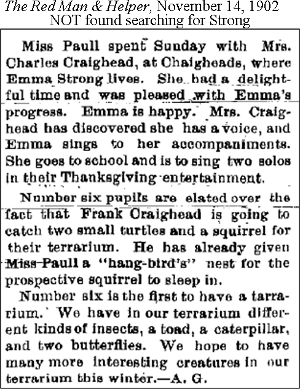 Sometimes information can be found for students whose student files have been lost . Emma Strong is an example. Her name appears in the student file for Frank DeFoe, whom she married after leaving the school. Her name also appears on some lists, however those entries are for other people named Strong or Armstrong or for students not strong (healthy) enough to remain at Carlisle. Emma Strong’s name appears several times in Carlisle Indian School publications but none of those articles are found by this search.



 Tom Benjey's Weblog
