Archive for the ‘Carlisle Indian School’ Category

Frank Mt. Pleasant

August 18, 2008

Perhaps because this is the 100th anniversary of the 1908 Olympics, Ed Farnham, grandnephew of Frank Mt. Pleasant, has been deluged by the media for interviews. Numerous newspaper and television reporters in the Buffalo, NY area, where Ed lived and the Olympic athlete lived, have been calling Ed constantly. Some of the newspaper articles are available on-line. Links to them are provided at the bottom of this piece. So far, none of the TV video has been posted on-line, but if it is in the future, I will provide a link to it.


Although this media attention comes at a cost to Mr. Farnham, he probably views it as a good thing because Frank Mt. Pleasant, viewed at the time as the best all-around athlete of his day, has been largely forgotten. These interviews give Ed the opportunity to better educate the public regarding the Tuscarora people and their contributions. One of the ways he does that is to direct them to the Native American Museum of Art (NAMA) which is located inside Smokin’ Joe’s Trading Post where he is general manager. Frank Mt. Pleasant’s medals are on display amongst the other Native American art and artifacts. The recent publicity should encourage more people to visit the museum and learn more about both the track star and his people.


In my small way I’m trying to correct the slight to Frank Mt. Pleasant a bit. In addition to devoting a chapter in Doctors, Lawyers, Indian Chiefs to him, I have nominated him for induction into the local chapter of the Pennsylvania Sports Hall of Fame, the first step in getting him inducted into the statewide HoF. Dickinson College and Indiana University of Pennsylvania have already inducted him into their halls of fame.


Native American Museum at Smokin’ Joe’s: http://www.nativeamericanmuseumart.com/

Buffalo News article: http://www.buffalonews.com/cityregion/niagaracounty/story/411478.html

More about the museum: http://buffalo.yourhub.com/NiagaraFalls/Stories/Sports/Professional/Story~503924.aspx


1912 Olympics – Part V

August 14, 2008

The team held an exhibition meet on June 13 in New York City at which Thorpe and Tewanima stood out. The diminutive Hopi outran the country’s two best middle-distance men in the 3,500 meters and Jim Thorpe outjumped the world record holder in the high jump by clearing 6’5”. After the event was over, the record holder also cleared 6’5”. The 1912 U.S. Olympic team set sail for Stockholm on a Red Star liner, The Finland, arriving on June 30 to a hearty reception.


In the first day’s events, Jim Thorpe won the pentathlon (Avery Brundage tied for third) and qualified for the high jump finals. Lt. George S. Patton finished 5th in the Modern Pentathlon, an entirely different event designed specifically for military officers. Lewis Tewanima qualified for the finals of the 1,500 meter run. Later that day he placed second and won the silver medal. Tewanima was also entered in the marathon.


Andrew Sockalexis described the conditions for the marathon as, “…the worst I ever saw. The roads were very poor. A thick mud, the color of cement, covered them, and out of this protruded small sized rocks, which made the running anything but comfortable….The morning was cool enough, but how the sun did come out getting near noontime. I think the temperature was between 90 and 95 degreees.” He went on to say that he had never found it so warm in America.


The conditions may have affected the little Hopi as he finished a disappointing 16th. Andrew Sockalexis finished 4th but later kicked himself for losing the race for “failing to use my head at the proper time cost me first place in the great race.” His mistake came at the halfway point of the race when he observed that the two leaders, South Africans McArthur and Gitsham, were clinging tight to each other and that McArthur was frothing at the mouth. Sockalexis planned on starting his spurt when McArthur dropped out of the race. He never did and won the race in record time.


Jim Thorpe did not medal in the high jump due to failing to clear the bar when raised to 189 centimeters, a height he had cleared earlier in the year.  He finished tied for 4th in an event in which six of the top seven finishers were American.


In the decathlon, Jim placed 3rd in the 100-meter dash at 11.2 seconds, 3rd in the broad jump at 6.79 meters, 1st in the shotput at 12.89 meters, 1st in the high jump at 1.87 meters, 4th in the 400-meter dash at 52.2 seconds, 3rd in the discus throw at 36.98 meters, 1st in the 110-meter hurdles at 15.6 seconds, tied for 3rd in the pole vault at 3.25 meters, 4th in the javelin throw at 45.70 meters, and 1st in the 1500-meter run at 4minutes, 40.1 seconds. Avery Brundage finished 16th.


Thorpe’s 1912 Olympic performance is the stuff of legends, even at the time. At the medal ceremony, King Gustav V said, “You, sir, are the greatest athlete in the world.” To which Thorpe famously replied, “Thanks, King.”


Jim Thorpe receiving Olympic gold medal from King Gustav V of Sweden

Jim Thorpe receiving Olympic gold medal from King Gustav V of Sweden

1912 Olympics – Part IV

August 11, 2008

Thorpe received a lot of hype, even before dominating the Pentathlon tryouts. One such example is shown below. As coach of the Carlisle track team, Pop Warner placed himself in charge of Thorpe’s and Tewanima’s training for the Olympics. As part of their training regime he had them sit out most of the school’s spring meets. So, for the first time in several years, a team other than Carlisle won the Pennsylvania Intercollegiate Athletic Association’s track meet held on Hargest’s Island (today’s City Island) at Harrisburg. Thorpe did not attend the meet but Tewanima made an appearance. He ran 18 miles from the Indian School to Hargest’s Island, arrived at the field when the 2-mile run was underway. According to the report in The Carlisle Arrow, “he circled the field amid the cheers and applause of’ nearly everyone on theground. Tewanima made the eighteen-mile run in a little less than one hour and fifty minutes and seemed fresh at the finish and able go many more miles.”


Thorpe’s absence gave others an opportunity to shine. Bruce Goesback placed 1st in the 220 hurdles, 3rd in the 120 hurdles, 4th in broad jump and high jump. Possum Powell finished 2nd in both high jump and shot put. John Squirrel was 3rd in both 440-yd dash and broad jump. Sampson Bird came in 2nd in the hammer throw and 4th in discus. Gus Welch place 2nd in the half-mile and won the 440-yd dash but was disqualified of “alleged interference” with another runner. Arthur Coons placed 3rd in pole vault, Joel Wheelock came in 4th in both hurdle events, and Blackdeer, the only distance man to score points, came in 4th in the 2-mile run.


Carlisle still placed second to Penn State without its Olympians and beat all other colleges in the meet.

Jim Thorpe's Physique

Jim Thorpe's Physique


1912 Olympics – Part III

August 7, 2008

The press was filled with articles about Carlisle’s expected participation in the upcoming games. Various track meets, competitions and races winnowed the field down to those who would eventually participate.


The Boston Marathon, which was run on April 20, was used to select the U.S. long distance team. Prior to the race Pop Warner thought that Mitchell Arquette, St. Regis Mohawk, would do even better than Tewanima. However, Michael J. Ryan, of the Irish American A.C. unexpectedly won the race and in world-record time. Andrew Sockalexis, Penobscot from Maine and not enrolled at Carlisle, came in second in conditions so muddy that runners had to run on sidewalks to get decent footing. After the conclusion of the race, the U.S. Olympic marathon team was set: Ryan and Sockalexis were selected as was Lewis Tewanima, the only Carlisle distance runner on the 1912 U.S. Olympic team. Apparently, the other Carlisle distance men didn’t do well enough in spring meets to qualify.


Jim Thorpe had a good spring. He was running so well that Warner was quoted as saying , “the man who beats him in the 120 yard [hurdle] event at the Pennsylvania relay meet will have to stagger the world’s record.” In May Thorpe competed in a tryout for the Olympic Pentathlon, a new event that consisted of five track and field competitions: 1) Running broad jump, 2) javelin throw with best hand, 3) 200-meters flat race, 4) discus throw with best hand, and 5) 1,500-meters flat race. He had not thrown the javelin previously but was expected to pick that up quickly. Also new to him was the 1,500-meters run in which his stamina was expected to carry him. Thorpe easily qualified for the Olympic team by winning three events: broad jump, discus and 200-meter run. He placed second in the other two, losing to the national champion in the javelin and finishing two yards behind the leader in the 1,500-meters. His prospects for a successful Olympics were good. Also named to the U.S. team to compete against Thorpoe in the pentathlon and decathlon was Avery Brundage.


Tewanima wins race & Arquette comes in 5th

Tewanima wins race & Arquette comes in 5th


1912 Olympics – Part II

August 4, 2008

Carlisle generated much press in the months leading up to the Stockholm games, a good bit of which was focused on the Hopi distance runners. Rather than comment on it, I will present a particular April 1912 newspaper article in its entirety.

April 27, 1912 Sheboygan Journal

1912 Olympics – Part I

July 31, 2008

Some think that 1912 was the year Native American broke onto the Olympic scene but, as shown in the last few blogs, they arrived much earlier. But 1912 was to be better for American Indians in the Olympics than the previous games. But it was not surprising.

As early as New Year’s Day 1912 and as far away as Fairbanks, Alaska, newspapers carried an article with a Carlisle, Pa. byline promoting Jim Thorpe for the upcoming Olympics. That article was surely generated by Pop Warner’s PR machine. An excerpt illustrates the exuberance in which he was promoted:

This youthful redskin hunts, plays lacrosse, tennis, indoor baseball, handball and hockey, all with equal skill, and can fill almost any position on a football team with credit. As halfback he probably is seen at his best, whirling, twisting, dashing and plunging, for one moment bewildering his opponents with lithe, panther like leaps, and the next crushing his way through the mass of would-be tacklers with the ferocity of a mad bull.


The piece ends with what may have been a preemptory defense against claims of professionalism:


Although busy with track work while here, he practiced baseball and played amateur baseball since leaving Carlisle, refusing numerous offers to play on minor league teams.


But Carlisle’s track team was not a one-man operation. Less than two weeks later papers gave Thorpe’s teammate some coverage:


Louis Tewanima of Carlisle Indian School will be a starter in this year’s Boston Athletic Association Marathon race and hopes to make the American Olympic Games team.


Pop Warner announced in early January that he expected Tewanima and Thorpe to make the Olympic team. On March 1st the commentator, who wrote the Diamond Gossip that was distributed widely, opined that the reason so many athletes were deciding against attending the Games was that Thorpe was going to Stockholm. Less than a week later, Warner’s PR machine announced that several other students wanted to make the Olympic team. Warner himself said that he thought five of his Carlisle trackmen might make the cut. He expected that Arquette would “make the foreigners scamper in the 10,000 meters,” but refused to identify the other two. “I don’t care to let any one know as yet who my two new phenoms are. One of them is one quarter-miler of exceptional ability. The other will be entered in the 400 and 500 meters races.”


I have read that Gus Welch made the team but was unable to compete due to injury. Could he have been one of Warner’s mystery men?

Henry Roberts Gets Married

July 28, 2008

While looking up information on Carlisle’s participation in the 1912 Olympics, I stumbled across an article from Carlisle in the Washington Post that had nothing to do with the Olympics. So, we’ll take a day off from our Olympic coverage for a little romance.


GROOM STAR END LAST SEASON


Hurt in Game Against Syracuse, First Thing He Remembers on Regaining Consciousness Is Face of Pretty Indian Maid—Football Eleven Gives Happy Couple Wedding Banquet.


Carlisle, Pa., Jan 17 —As the climax to a four months romance that began when the groom was Injured on the football field, and was nursed in the Carlisle Indian School Hospital here by the bride, Henry Roberts, 23 years old, of Pawnee, Okla and Miss Rose Denomie, 19 years old, of Ashland Wis, were married here at the home of M. Friedman, superintendent of the school, today.

Henry Roberts, Pawnee, played left end on the great Carlisle 1911 team and, before his injury, was Rose Denomie’s football hero. As she nursed him back to health he determined to win the Chippewa maiden’s hand. He studied for a civil service examination and passed with high marks for which he was rewarded with a $900 a year clerical job (not bad for any American in 1911) at Shoshone Indian School in Wyoming. Armed with a good-paying job and restored health, he proposed.


Because Rose was Catholic, they were married by Father Strock in Superintendent Moses Friedman’s residence and were feted by his teammates. Immediately after the celebration they caught a train for Wind River Agency, Wyoming. In November The Red Man reported that they were in Odanah, Wisconsin where he was employed by the government as a stenographer. Jack Newcombe described Roberts as the one who “epitomized the success story Carlisle cared to boast of: a business career with an oil firm in Oklahoma, a home on a hilltop in Pawnee not far from the reserve where he was born, a happy marriage with the girl he had met at Carlisle.” In a 1959 interview Roberts mentioned that before retiring he had helped build the atomic bomb at Los Alamos. From bows and arrows to atom bombs!


Next time it will be back to the Olympics – if nothing interferes.


 Henry Roberts shortly before his wedding

Native Americans in the 1908 Olympics

July 24, 2008

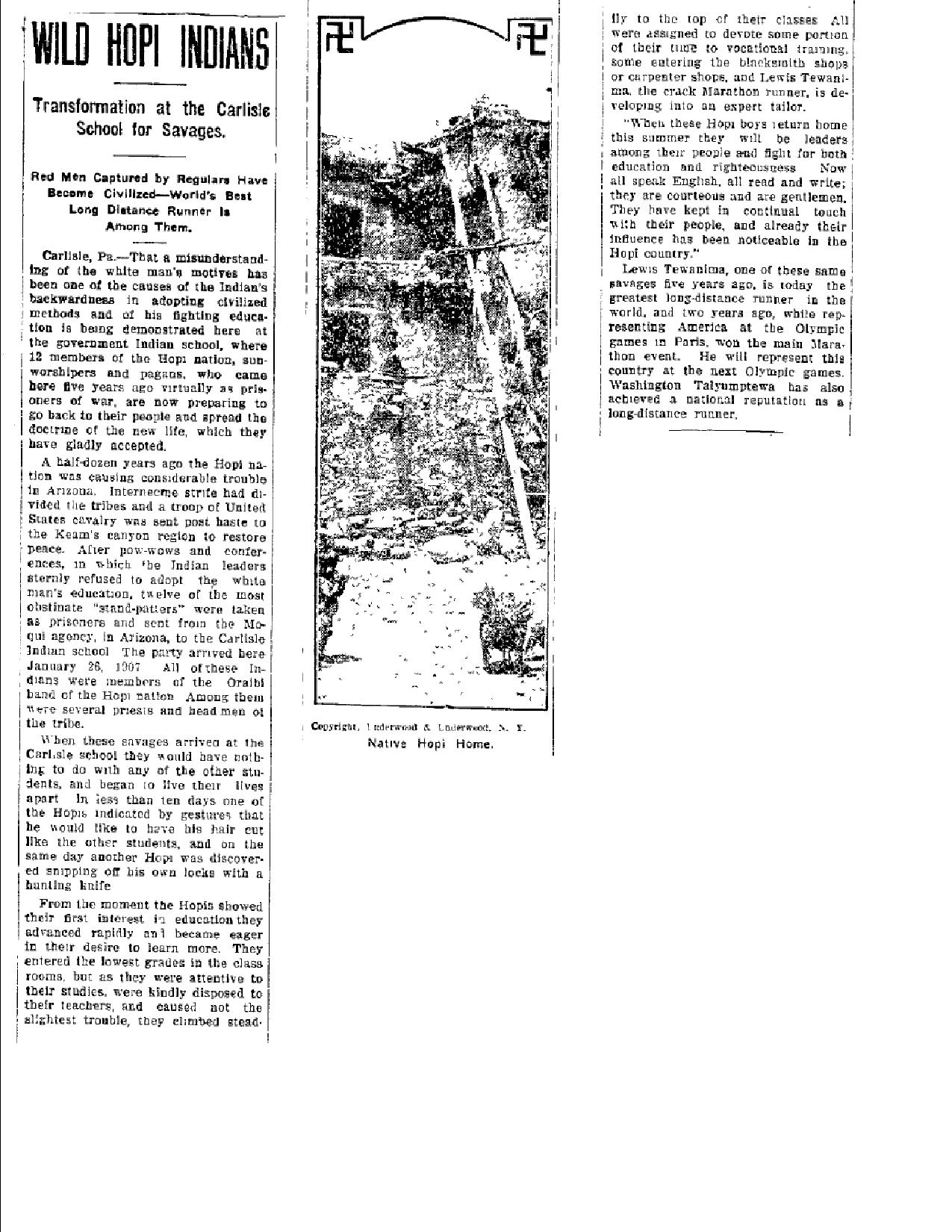
The 1908 Olympic Games were held in London, something that required Carlisle Indian School track stars Frank Mt. Pleasant and Lewis Tewanima to cross the Atlantic with the bulk of the U.S. contingent on the steamer Philadelphia. Neither arrived in the best condition. Mt. Pleasant had an injured ligament in his knee and Tewanima was suffering from sore feet and bad knees. The Hopi’s ninth place finish in the marathon was a great performance for a person who, a year prior to this, had not before worn a running shoe. He finished ahead of all the great British runners and Tom Longboat of Canada. Longboat, an Onondaga from the Six Nations reservation near Brantford, Ontario, was leading the race when he fell ill and withdrew from the race. The year before he had established himself as a world-class marathoner by winning the Boston Marathon in record time.

Frank Mt. Pleasant, Tuscarora, also competed as best he could given his condition and finished sixth in both the broad jump and triple jump. Later that summer in Paris, he and Tewanima got a chance to show their stuff in a competition with some other Olympians. Mt. Pleasant won the broad jump by defeating both Frank Irons, the Olympic champion, and Edwin Cook of Cornell, the American intercollegiate champion. Lewis Tewanima came in second in the 3-mile race.

Upon their return to the U. S. Mt. Pleasant and Tewanima visited President Roosevelt and, in New York, were presented with medals in addition to the ones they won in Europe. New Yorkers paid $3,100 for the medals they gave to the members of the Olympic team.

Frank Pierce did not compete in the 1908 Olympics because he died of pneumonia earlier in the year.

Next time we take a look at the later Olympics.

Lewis Tewanima, Hopi distance runner

Lewis Tewanima, Hopi distance runner

Native Americans in 1904 Olympics – Part III

July 21, 2008

The 1904 Olympics were not the first games to feature football. The 1900 Paris games included two football events neither of which were American football. Soccer and rugby were both played that year but in 1904 American football appeared in the Olympics for the first time. Football (soccer) was a demonstration sport in which three teams played a round-robin tournament between two American teams and a Canadian club. The Canadians won the gold. Several college football games were played on Francis Field at the fair. Washington University and St. Louis University each played a number of their games on the Olympic field. Missouri and Purdue even played there. Prior to the Fair, Washington U’s teams were known as the Purities but due to playing at the Fair were renamed the Pikers in 1905 as a comment on their association with the infamous world fair’s Pike. However, the most important college football game played at the 1904 Olympics wasn’t played by colleges.

President Theodore Roosevelt was to visit the Fair over Thanksgiving weekend making it an ideal time for a major football event (read moneymaker). The Fair organizers’ first choice was to have West Point and Annapolis relocate their annual contest to the fairgrounds but that didn’t happen. Haskell Institute’s Fightin’ Indians were tearing up the Midwest at that time and Carlisle was a top ten program. So, the first ever football game between the two government Indian schools was arranged for the Saturday after Thanksgiving. Carlisle already had a Thanksgiving Day game scheduled against Ohio State in Columbus. Major Mercer, the new Carlisle superintendent, very likely saw the opportunities such a high profile game would create for him and his school and added the game to the schedule. Playing two games in three days may have been taxing for Carlisle’s players, so Head Coach Ed Rogers (Pop Warner was back at Cornell for the 1904-6 seasons) drubbed the Buckeyes with his second team 23-0. Ohio State supporters were unhappy to miss seeing the Carlisle stars they had read so much about.

Rumors of Haskell bringing in ringers, some of them white, were rampant. To balance the scales, Ed Rogers suited up for the game as did Assistant Coach Bemus Pierce and his brother, another former Carlisle and pro star, Hawley Pierce. They needn’t have bothered. Carlisle obliterated Haskell 38 to 4. Seeing the superiority of the Carlisle program, eight Haskell players transferred to the eastern school where many became stars. If there was an Olympic gold medal to have been won Carlisle would have won it, but none was. However, the Carlisle Indians were the closest thing to an Olympic football champion that we’ve had – if you ignore the 1920 and 1924 U.S. rugby teams. But that’s a story for another time.

The Native American game of lacrosse was played at the 1904 Olympics but mostly by non-natives. Three teams, two from Canada and one from the U.S., vied for the championship. The Canadian Shamrocks won the gold, the St. Louis Amateur Athletic Association won silver, and, in a bit of irony, the Mohawk Indians from Canada got the bronze.

Next time we take a look at the 1908 games.

1904 Carlisle-Haskell game program cover

1904 Carlisle-Haskell game program cover


Native Americans in 1904 Olympics – Part II

July 18, 2008

Jerry, Frank and Tom Pierce were Senecas who lived, at least part of the time, in Irving, NY around the turn of the last century and ran distance races, often in the U. S. In those days athletes often trained and competed under the auspices of athletic clubs. They were the younger brothers of Bemus and Hawley Pierce, the famous Carlisle Indian School football players. The boys also claimed to be grandsons of Deerfoot, aka Lewis Bennett, the world champion Seneca runner of the mid-19th century, who ran races in England while clothed in a wolfskin and feathered headband for effect. The Pierce brothers were affiliated with the Pastime Athletic Club out of Syracuse, New York. In 1901 Jerry Pierce led Pastime A C to the national AAU Junior Championship at a meet held in Buffalo by running his opponents off their feet in the five-mile run. The next day he was winded after the four-mile mark in the senior meet and did not win that race. On July 28 Jerry’s teammates carried him on their shoulders after he fought out a victory in the 3-mile run at the Metropolitan Association of the AAU meet which was also held in Buffalo. On Labor Day, he won the 3-mile run by 40 yards at the Knickerbocker Athletic Club meet held in Bayonne, NJ. Later that year he won the national cross country championship.

Jerry’s success continued in 1902. In late August, his younger brother, Frank, paced him in the Metropolitan Association meet held this time at Celtic Park. Jerry won easily, but Frank, exhausted from setting a fast pace in the 3-mile race, finished fourth. Jerry was suspended by the AAU in September for having accepted a suit of clothing for winning a race. He was soon reinstated but his appetite for racing was waning. His brothers’ weren’t though. Frank was improving and some observers thought Tom, the youngest, was the fastest of the lot. Commentators attributed their success to unorthodox training methods. The Pierce brothers reputedly got in shape by hunting moose and deer on their reservation in Canada.

In 1904 Frank qualified to run in the marathon at the Olympics to be held at the St. Louis World’s Fair that year. In the days before the race, he was listed as one of the favorites. On the day of the race, the temperature was in the 90s in the shade, of which there was none, the humidity was high and the race course ran along a dusty road over which race officials drove automobiles immediately ahead of the runners. The runners had nothing but dust to breathe. Frank was forced to drop out of the race before the 20-mile mark as were several others. Thomas Hicks, the eventual winner was given a concoction of strychnine and brandy by his trainer to give him the energy to finish the race. He almost died after finishing the race.

We’re not done with Native American participation in the 1904 Olympics yet. Next time we’ll look at lacrosse and football.