Archive for the ‘Carlisle Indian School’ Category

Return of the Conquering Heroes

September 30, 2022

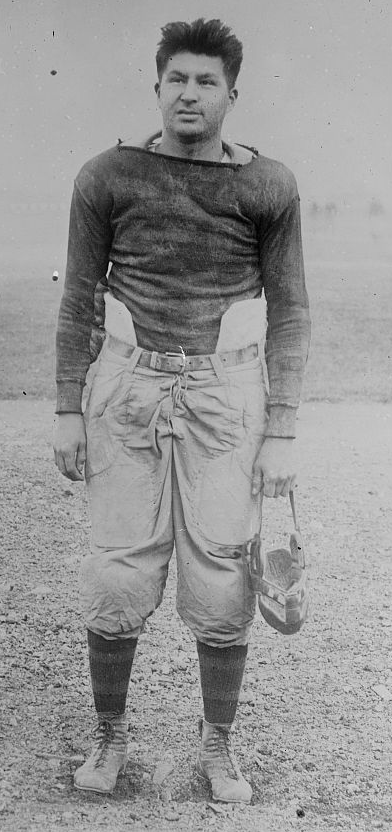
Jim Thorpe’s return to Carlisle after the 1912 Olympics was incorrectly described in at least one newspaper of the day and that description has found its way into current books on Jim Thorpe. Fortunately, The Star-Independent of Harrisburg, PA captured the event in minute detail in its August 16, 1912 edition. However, the article was too detailed to be included in this short piece. There is only room to summarize it here.

A crowd estimated to be between six and seven thousand people congregated at the Cumberland Valley Railroad (CVRR) station across from the James Wilson Hotel a block from the square in Carlisle for Thorpe’s expected arrival at 12:30 p.m.. The crowd-shy hero avoided this multitude by getting off the train at Gettysburg Junction, where the South Mountain Railroad connected with the CVRR, about a mile east of the square. Automobiles waiting there secreted Thorpe, Lewis Tewanima, and Pop Warner to Carlisle Indian School, where they were “greeted informally by students and their closest friends.”

From the Indian school the trio progressed to the parade which was split into three divisions, each of which was formed separately. The honorees were part of the first division which assembled along North Hanover Street, with its head at High Street (colloquially Main Street). Scheduled to start at 2:00 p.m., the parade, led by the first division, progressed east on High Street to Bedford Street, then followed a circuitous route along portions of each of the major streets in the center of town, eventually arriving at Biddle Field on the Dickinson College campus. There the official festivities started. After much speechifying, various events took place in town and on the Indian school campus (Carlisle Barracks). Fireworks were scheduled for 8:30 p.m. (EST probably), which were followed by an invitation-only reception and dance in the school’s gymnasium (present day Thorpe Hall) to close the day’s festivities.

Gus Lookaround – part 6

September 3, 2022

In January 1943, Angus received word that his stepson, Sgt. Conover B. Nichols, age twenty, has been taken prisoner by the Japanese in the Philippines. In September, Phebe received a postcard from her son, who was then interned at the headquarters of Military Prison Camp No. 3. He was reportedly in good health. In October 1944, Phebe was elected president of Wisconsin Women of the Philippine Defenders, formerly known as Wisconsin Women of Bataan.

Phebe’s 1931 book, Sunrise of the Menominees, gets a second printing in November 1944 due to popular interest.

In January 1945, the War Department informed the Lookarounds that Conover had been transferred to Osaka Camp in Japan. In August they received a “captured document” from the War Department which was in Conover’s handwriting. He listed the names of over 20 American prisoners who were hospital patients. In November the Wisconsin Women of the Philippine Defenders hosted a “liberation dinner” which both of Phebe’s sons were able to attend, although Conover had to return to Vaughn Hospital afterward.

Angus died on April 15, 1946 at Wood Veterans’ Hospital in Oshkosh at age 52. Phebe established the Angus F. Lookaround Memorial Museum and Studio in their house on the Menominee Reservation where she continued living. She served as custodian and continued to promote Gus Lookaround’s contributions until shortly before her death in1964 at age 79. The museum’s contents were transferred to University of Wisconsin–Oshkosh in 1966.

<THE END>

Gus Lookaround – part 4

August 28, 2022

In 1929 Gus organized and directed the Keshena Indian School band that was composed of twenty-one boys and one girl. The band won second place in the Wisconsin High School Band Tournament with grade school children after having been organized only four months. That August, he married Miss Alice Hampton (Cherokee) of Bradley, Oklahoma. She was the kindergarten teacher at the school. The following year he was selected to direct the Shawano City Band due to his success at Keshena. When his bride’s health failed in 1932, they relocated to Chickasaw, Oklahoma, to be near her family one assumes. She was buried in the Bradley Cemetery and Gus returned to his home in Wisconsin.

In 1933 he was a member of the Minneapolis Symphony Orchestra. In 1934 Gus was selected for the Indian Achievement Medal to be awarded at the Century of Progress (also known as the Chicago World’s Fair).

Gus remarried in June 1934 to Mrs. Phebe Jewell Nichols, who was nine years his senior. They must have known each other for some time because she was a member of the committee that picked him for the medal. She was an attractive upper-middle-class novelist who had been widowed three years earlier. Gus, who had had no children of his own immediately became stepfather to three: Howard Gardner Nichols Jr. (19), Patricia Nichols (17), and Conover Nichols (12). Phebe’s late husband, a real estate investor and insurance agent a decade, had died after having a nervous breakdown over financial losses incurred during the Great Depression. They had married in 1913 when he was 38 and she 28. They likely became acquainted while she was teaching school in the Oshkosh area. Originally from Wabasha, Minnesota, Phebe had attended Oshkosh Normal School after graduating from Carlton College.

<end of part 4>

Gus Lookaround – part 2

August 22, 2022

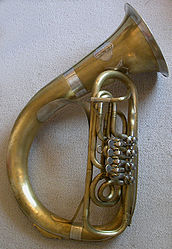
After commencement in the spring 0f 1914, Gus joined another football player, Fred Big Top (Piegan), in operating a horse rental business at Glacier National Park. At summers’ end, Lookaround returned to Carlisle but Joe Guyon didn’t. Just as the season started Gus wrote an article on the 60-piece Indian School band in which he played the helicon bass, a cousin of the sousaphone. In an attempt to shore up the backfield, Pop shifted Gus to fullback for the Lehigh game and quarterback against Dickinson College. A broken leg kept him out of several games but Warner put him in at center against Notre Dame.

Helicon Bass

After the season ended, Gus entered the Ford Motor Company intern program in Detroit, Michigan along with several teammates. They formed a basketball team in their free time. The fall of 1915 found Gus back at Carlisle playing football, making music with the band, and debating as a member of Invincible Debating Society. The Indian coaches, Victor “Choctaw” Kelley and Gus Welch, put him at left end this year. The dismal 3-6-2 season brought Gus’s football career at Carlisle to an end after having played every position except halfback at one time or another. With the spheroid left behind, he headed back to Detroit. He stayed on with Ford until September, 1916 when he returned to his home in Wisconsin.

It’s not clear what Gus did the next eleven months but the Carlisle school newspaper published on November 2, 1917 reported that he had enlisted in the army and was training at Camp Douglas, Wisconsin. Later that month he was reported as being “somewhere in France.” A month later he was on board the battleship U.S.S. New Hampshire. Wisconsin newspapers said he “is going to look around for German U-boats,” probably as a joke. In January, 1918 he visited Carlisle on his way to visit his family in Wisconsin. In February, he wrote that he enjoyed the Navy and “was soon to play in the championship football game of his ship’s league.” No mention was made about how he transferred from the Army to the Navy. The last mention of him in Carlisle publications came in March when he visited Wallace Denny at the school while his ship was in Philadelphia.

<end of part 2>

Gus Lookaround (part 1)

August 19, 2022

Last week a reporter from the local newspaper called asking if I knew anything about August Lookaround for an article he was putting together. About all I knew was that Gus had played on the Carlisle Indian School football team but not much more. Expecting to find enough for a 300-word blog posting I agreed to do a little research and get back to him. 2,000 words later, I have too much for a blog post and don’t have a book in work into it could fit neatly. So, I’ve decided to serialize it on my blog.

August “Gus” Lookaround from Keshena, Wisconsin arrived at Carlisle in April 1912 at twenty years of age. His deceased father was full-blood Menominee and his still alive mother was half-blood. Prior to coming to Carlisle, Gus had attended Keshena Indian School through the fifth grade. After that he attended Tomah Indian School in Tomah, Wisconsin, where he graduated after completing eighth grade. At five feet ten inches tall and weighing one hundred seventy-eight and a half pounds, Gus was a prime candidate for the athletic teams.

He was first mentioned in print in mid-September when head football coach Pop Warner said of the new men trying out for the team, “the most promising of whom are [Joe] Guyon and [Gus] Lookaround, two good-sized fellows who have entered the school since last season.” He got some playing time in the early warm-up games against local small colleges, playing right tackle against Albright College and Lebanon Valley College right guard against Dickinson College. When Sam Burd, the previous year’s captain was called home to Montana, Warner had a vacancy to fill at left end. He tried Lookaround against Villanova and Syracuse. Roy Large eventually got the position but Gus had made a good impression for a first-year man.

At the start of the 1913 season, wags at out-of-town papers had some fun at Gus’s expense. The Meriden Journal said: “Carlisle has a tackle on the football team whose last name is Lookaround. Suppose his first name was Taka.”

He started the 1913 season at right tackle but was shifted the left tackle for the Dickinson game. Last year’s tackles, Guyon and Calac, had been moved to the backfield, leaving both tackle positions open. Gus was back at right tackle the rest of the schedule. Monty placed Gus on his All-American Tenth Team at season’s end.

<end of part 1>

Jim Thorpe’s Records Restored

July 16, 2022

Little did Bob Wheeler know in 1967 that he was starting a lifelong odyssey when he thumbed his first ride to hitchhike across America to interview people who had known Jim Thorpe. His crisscrossing the continent was necessary to meet all of them. Lugging a 30-pound tape recorder of the kind that stooped Howard Cosell’s shoulders, he embarked on a trip to gather information for his master’s thesis. Oral histories were in their infancy and Wheeler’s advisor was no fan of them, but that didn’t discourage the young historian.

Wheeler collected a lot more material than needed for a master’s thesis but he kept going until he had a book. “Jim Thorpe: World’s Greatest Athlete,” is still in print, available from University of Oklahoma Press. Getting published might have been the end of the story but, in many ways, it was just the beginning.

In 1971, Bob married another Syracuse University student, Florence Ridlon, who was working on her Ph.D. in Sociology. Bob was teaching at the time but he soon made a career shift to public relations. Their focus soon changed. In 1975 they formed the Jim Thorpe Foundation, headquartered in a closet at Danker’s Restaurant in Washington, DC. Its purpose was to restore Jim Thorpe’s Olympic honors, including his medals and records.

Little progress was made until Dr. Ridlon discovered a long-forgotten rule book for the 1912 Olympics that had dropped behind a row of books in a Library of Congress stack. The rules clearly stated that all challenges had to be made in 30 days. The revocation of Jim’s medals was illegitimate because the challenge came seven months after the games.

Eventually Thorpe’s medals were restored but there was a problem: no one knew where they were. So, new medals were struck and awarded to his surviving children. Perhaps his original medals may be found but, with two world wars having ravage Europe in the intervening years, it seems unlikely.

Now, after 41 years of trying, Bob and Flo have succeeded in getting Jim Thorpe’s Olympic records restored. Will they retire or is a movie in their future?

Official Announcement

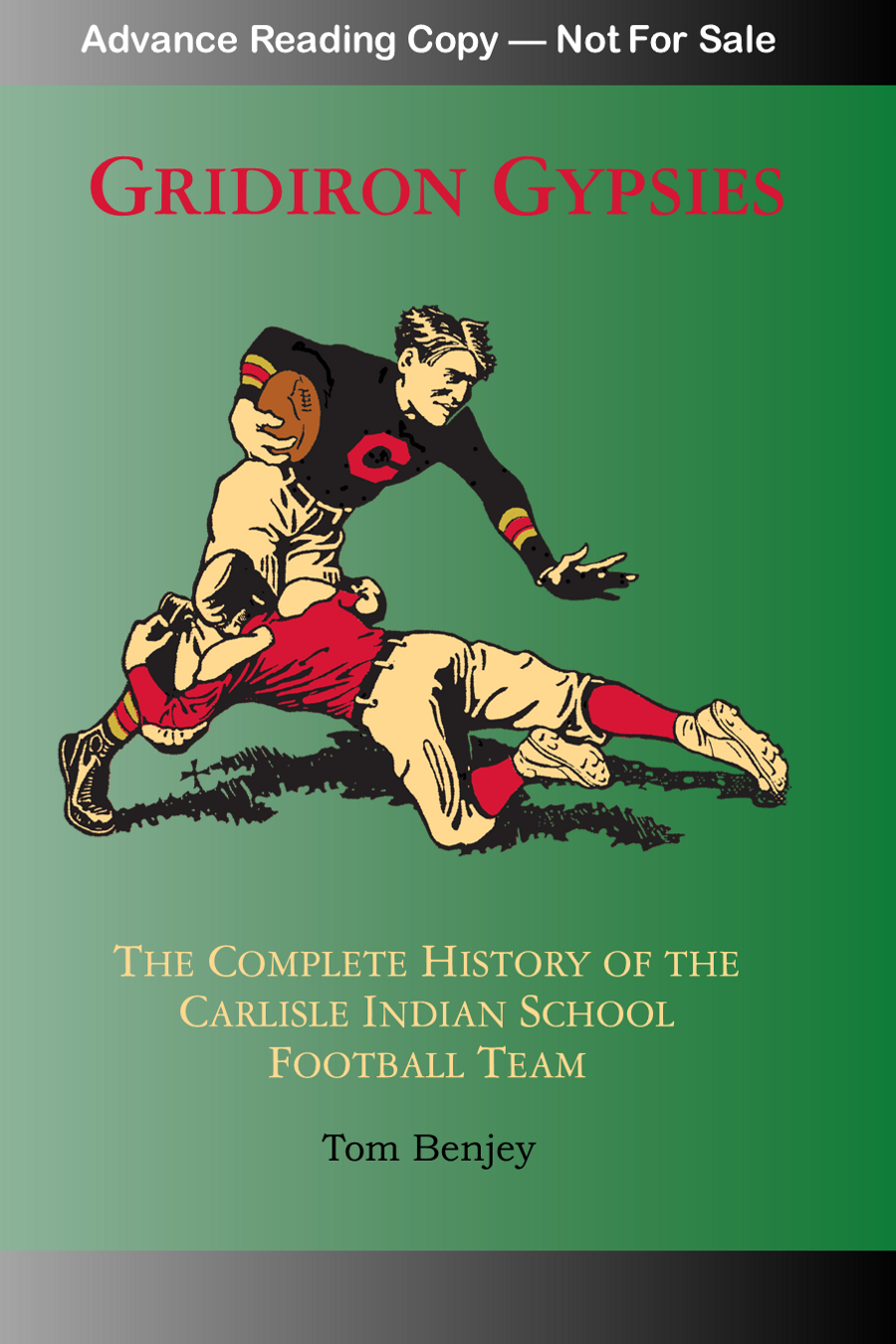
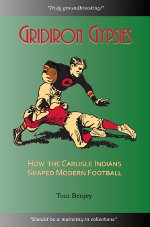
Gridiron Gypsies: The Complete History of the Carlisle Indian School Football Team

June 17, 2022

At long last my latest book, Gridiron Gypsies: The Complete History of the Carlisle Indian School Football Team, is getting close to being published. The text layout, complete with 155 illustrations (period photos and cartoons), a list of players with the years they played, notes, and an index, is complete and a draft cover has been designed. A few softcover copies of the ARC (advance reading copy) will be printed for reviewers that don’t accept digital copies. Since Covid, most reviewers want PDFs but some still want hardcopies. PDFs have been sent to reviewers who accept them and I expect to have print versions in a couple of weeks.

The book will go on sale this fall. Preorders will be accepted after Labor Day. Now I have to design a simple website, GridironGypsies.com, because books are supposed to have websites these days.

New Guardhouse

March 1, 2022
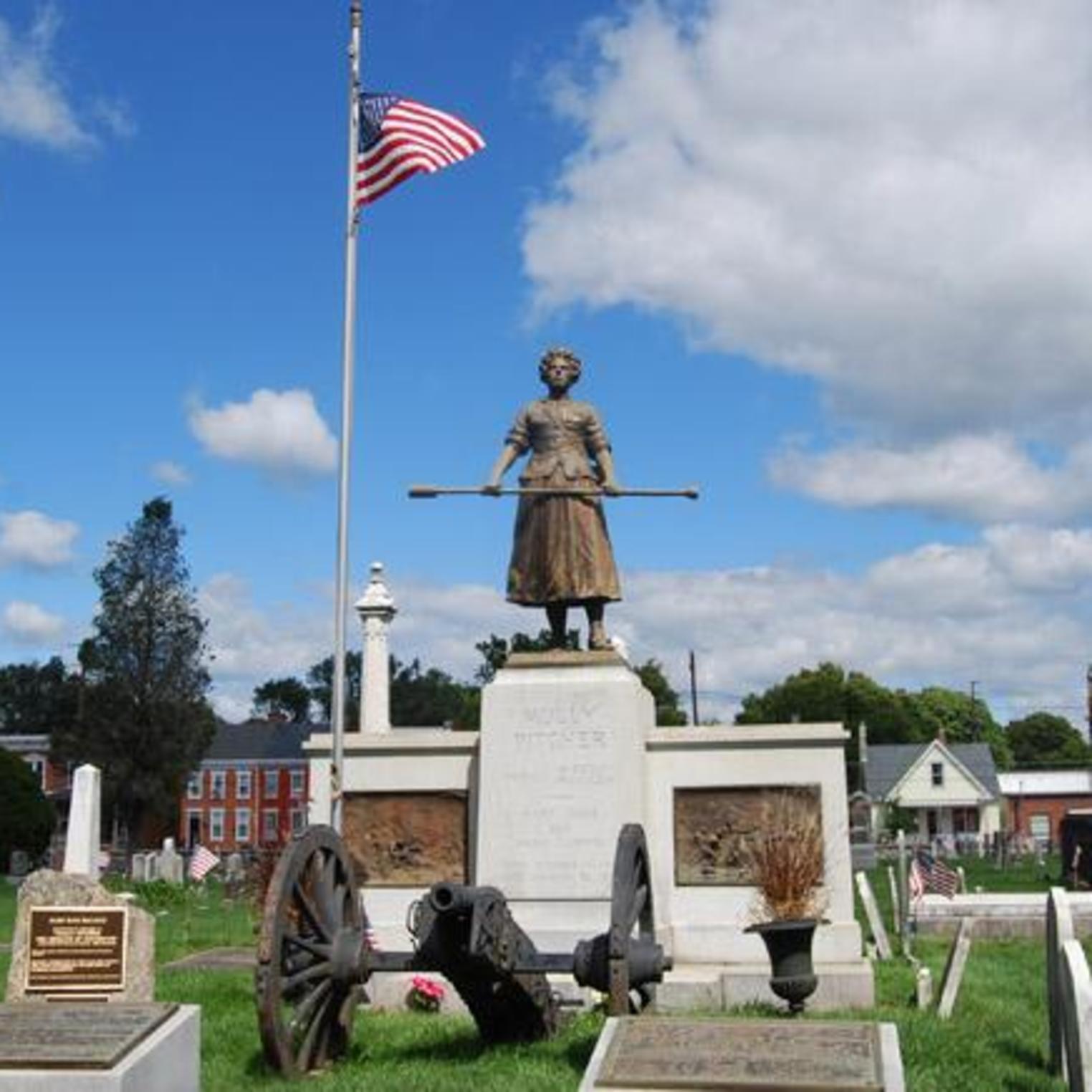
Molly Pitcher’s Grave in Carlisle Cemetery

While reviewing something from the 1911 Carlisle Indian School football season, a pair of sentences on the front page of the November 3rd edition of The Carlisle Arrow caught my eye. The paragraph began with: “The new guard-house is about finished.” That the Hessian powder magazine, built in 1777 by prisoners captured by Washington in the Battle of Trenton, wasn’t always used to incarcerate recalcitrant students. This was news to me. That students and their instructors provided the labor was not surprising because they had build other buildings, including Pop Warner’s house and the Native Arts Building, both of which still stand.

While reviewing something from the 1911 Carlisle Indian School football season, a pair of sentences on the front page of the November 3rd edition of The Carlisle Arrow caught my eye. The paragraph began with: “The new guard-house is about finished.” That the Hessian powder magazine, built in 1777 by prisoners captured by Washington in the Battle of Trenton, wasn’t always used to incarcerate recalcitrant students was news to me. That students and their instructors provided the labor was not surprising because they had build other buildings on campus, including Pop Warner’s house and the Native Arts Building, both of which still stand.

While reviewing something from the 1911 Carlisle Indian School football season, a pair of sentences on the front page of the November 3rd edition of The Carlisle Arrow caught my eye. The paragraph began with: “The new guard-house is about finished.” That the Hessian powder magazine, built in 1777 by prisoners captured by Washington in the Battle of Trenton, wasn’t always used to incarcerate recalcitrant students. This was news to me. That students and their instructors provided the labor was not surprising because they had build other buildings, including Pop Warner’s house and the Native Arts Building, both of which still stand.

The December 15 Arrow included a reprint of an article published by The Patriot of Harrisburg, PA under the heading, “New Guardhouse at Carlisle.” It took up most of a column. Of particular interest was a short paragraph: “Associated with this old structure is one of the early residents of Carlisle—Molly Pitcher, the Heroine of Monmouth. After the war she is credited with spending many a day within the thick walls of the gloomy prison, cooking and washing for the prisoners.”

The new building was of modern concrete and steel construction where the old one was of stone. Little else is known about it except that, starting in late 1911, it replaced the dank, dingy old structure built by Hessian prisoners, and continued in that use until the school was closed in 1918. This means that references to a guardhouse made to the 1914 Joint Congressional Committee investigating the school referred to the new guardhouse not the old one.

Those who read about students being detained after 1911 often incorrectly assume they were incarcerated in the Hessian powder magazine when they were actually in the new guardhouse .

A Coaching Mystery

February 25, 2022

The current edition of the College Football Historical Association’s newsletter includes and article titled “Mystery Solved.” The author, Timothy Hudak, was researching the life of Hall of Fame coach Frank “Iron Major” Cavanaugh when he unexpectedly came across a reference to Cavanaugh coaching the University of Nebraska at Omaha football team in 1919. Knowing that the war hero was with Boston College at that time created a mystery to be solved. He wondered, “How could a man fresh from recovering from serious wounds suffered in the closing stages of the war, with a wife and six kids, coach at two schools at the same time located in opposite parts of the country?”

Hudak’s further investigation revealed that they were two different men. The Omaha coach was Frank P. Cavanaugh; the Iron Major was Frank W. Cavanaugh. Case closed. However, a similar case but not involving war injuries and a wife and six kids actually happened decades earlier.

From 1895 through 1899, Glenn S. “Pop” Warner coached teams at two different teams quite distant from each other. He coached Iowa State all five years while leading Georgia (1895-6), Cornell (1897-8), and Carlisle Indian School (1899). The question is: How did he do it?

A year after graduating from Cornell with a law degree, Warner had passed the bar but hadn’t yet developed  a substantial practice. So, when the Iowa State graduate football manager offered him twenty-five dollars a week plus expenses to coach their team, he seriously considered the offer. Curious about other possibilities, he contacted some southern and western schools. The University of Georgia offered him thirty-five dollars a week plus expenses for the ten-week period starting September 15.

He then told Iowa State he was willing to coach their team for four weeks beginning in early August. Unable to find a better coach, they offered him one hundred fifty dollars plus expenses for thirty days. An alumni player would assist him while he was there and would take charge after he left.

Warner had no losing seasons with Iowa State, one losing (3-4-0) and one undefeated (4-0-0) season with Georgia, two winning seasons (5-3-1 and 10-2-0) with Cornell, and a strong season (9-2-0) with Carlisle. Warner’s promotion to athletic director at Carlisle in 1900 ended his double-coaching career.

Pop Warner with Jim Thorpe

Pratt: The Red Man’s Moses

January 23, 2022

While finishing Elaine Goodale Eastman’s 1935 book about Richard Henry Pratt, founder and superintendent of Carlisle Indian School for its first 25 years of operation, I came across the the passage below. Under it is a photograph of Pratt’s grave marker in Arlington Cemetery.