Archive for the ‘Carlisle Indian School’ Category

1908 Carlisle-Denver Game Canceled

May 31, 2009

Like most of the interesting things I find, I unexpectedly stumbled across a November 19, 1908 Nebraska State Journal article that said the upcoming game between the Carlisle Indians and the University of Denver had been canceled. Post-season (about anything after Thanksgiving in those days) road trips were not unusual for the Indians. As early as 1896, they played a night game in the Chicago Coliseum on December 19 against that year’s Champions of the West, Wisconsin. And 1908’s trip wasn’t as long or as elaborate as some. It started early with a November 21 game against Minnesota in Minneapolis. Five days later, the opponent was St. Louis University in St. Louis. Six days after that it was Nebraska in Lincoln. Three days after that was to be the Denver game in Denver. According to the article, Denver officials were informed by Carlisle officials that the game was called off because, “…that leave of absence could not be secured for so long a journey.” The article didn’t say if it was Superintendent Friedman, who was new at his post, Commissioner of Indian Affairs Francis Leupp, or someone else. There had been recent communications with Pop Warner and he had said nothing about a cancelation. Denver didn’t take it lying down.

According to the paper, they went straight to the top: “President Roosevelt has been asked to use his influence in having a contract between representatives of Denver University and the Carlisle Indian school for a football game between the elevens of the two schools lived up to.…they at once asked the president through former United States Senator  Patterson, to request that the Indians be given the leave necessary. A portion of Senator Patterson’s message reads: ‘The Denver boys want a square deal and turn to you to get It for them.’ Governor Buchtel, who is chancellor of Denver University, also wired Congressman Bonynge and Senator Teller to secure, if possible, the Intervention of Commissioner of Indian Affairs Leupp.”

I don’t know what happened next but do know that the Indians won three and lost one on the road trip. The loss was to Minnesota. The wins were over St. Louis, Nebraska and Denver.


Carlisle Quarterback Mike Balenti

Carlisle Quarterback Mike Balenti

1895 Carlisle-Army Game?

May 28, 2009

The other day, Frank Loney asked me to look at two 1895 letters written by W. G. Thompson, Carlisle Indian School Disciplinarian. It’s always a treat doing things like that because you never know what you will find. The letters were from July and October 1895. The first letter, the typed one, attempted to arrange a football game for the upcoming season. However, the party to whom the letter was addressed was not mentioned in the letter. That the second letter, the handwritten one, was written to a Chas. L. Poor in Annapolis, Md. This letter was written after the October 26, 1895 game with Navy and mentioned the previous year’s game. The first letter also mentioned the previous year’s game.

Carlisle first fielded a football team in 1893. Due to the late start, they played two November games against high schools. To the Disciplinarian fell many tasks and managing the football team was one of them, at least before Pop Warner arrived in 1899. The task of coaching the team fell to Vance McCormick in 1894 but Thompson was still responsible for arranging the games. Thompson arranged a complete schedule of games for 1894 for the Indians’ first real season. These letters document part of the process for arranging the 1895 schedule and managing the financial details of the game.

The only teams Carlisle played in both 1894 and 1895 were Navy, Bucknell and York YMCA. All the clues in the letters point to Navy; None point to Bucknell or York YMCA.

The next-to-last sentence was the prize in this package. It read, “I am holding decisions on dates with several universities that you and West Point may have preference of dates.” I interpret the “you” to mean the Naval Academy and West Point to be the Military Academy – Army. This means that Carlisle attempted to schedule Army a decade before the historic 1905 game. One need little imagination to think of reasons why Thompson was unsuccessful in scheduling a game with Army.

Jenkins and Anderson Omit 1905 Army Game

May 26, 2009

The May 2009 College Football Historical Society newsletter includes an article that debunks the basic premise for the 2007 books by Sally Jenkins and Lars Anderson, The Real All Americans: the team that changed a game, a people, a nation and Carlisle vs. Army: Jim Thorpe, Dwight Eisenhower, Pop Warner, and the forgotten story of football’s greatest battle, respectively. In “Jude and the Prince,” James G. Sweeney, a lawyer, former prosecutor and, most importantly, an Army fan for 50+ years, describes the epic Carlisle-Army game in detail. The difference between his article and their books is that Sweeney writes about the first time Carlisle met Army on a football field where Jenkins and Sweeney write about the second meeting – without acknowledging the first game. Their omission could be overlooked if the 1905 meeting was played by scrubs or special rules or something of the kind. In fact, the November 11, 1905 Carlisle-Army game was, as Sweeney put it, “was ‘the’ game of the day.” Sweeney also quoted The New York Tribune: “Never before has a football game at West Point been witnessed by a more distinguished gathering. Seated on the grandstand was Prince Louis of Brattenberg, surrounded by army officers, both British and American. The gold lace and trappings of military men, mingled with the gay dresses and flags of pretty girls, made a sight worth seeing.”

By the way, Carlisle won the game 6-5 to settle the score with the “long knives” seven years before the meeting Jenkins and Anderson touted in their books. In Anderson’s case, it may be a matter of ignorance. At the talk he gave in Carlisle, Lars Anderson mentioned that, in order to get his book in print at the same time as Jenkins, he employed a researcher. The researcher probably didn’t look at anything outside the narrow scope he was given. Sally Jenkins, on the other hand, appears to have been aware of the 1905 game. About the 1905 season, she wrote, “The Indians were a predictable disappointment under [Advisory Coach George] Woodruff….They were 10-5 and lost every significant game, and more important, they lost their uniqueness. Their only real fun came in a 36-0 defeat of crosstown rival Dickinson.” John S. Steckbeck, The Arrow and CFbDatawarehouse.com all reported a 10-4 record for the 1905 Indians, with losses to Penn, Harvard, Massillon A. C. and Canton A. C. Jenkins ends what game coverage she had for the 1905 season with the loss to Harvard on a soft field. She apparently doesn’t consider the wins over Penn State, Virginia, Army, Cincinnati, Washington and Jefferson, and Georgetown as significant. Nor does she consider beating Army, thumping Cincinnati 34-5, beating Washington and Jefferson 11-0, or embarrassing Georgetown 76-0 to be fun.

On page two of her book, Jenkins implies that she knew the 1905 game had taken place without mentioning the game or sport when she wrote, “…this was only the second time government authorities had allowed the two parties to meet on an athletic field.” Perhaps Ms. Jenkins will explain why Carlisle’s 1905 victory over Army was neither significant nor worthy of mention.

Prince Louis Battenberg, 1905

Prince Louis Battenberg, 1905

A Bitter Night – NOT

May 15, 2009

“On Sacred Ground: commemorating survival and loss at the Carlisle Indian School,” an article written by the then Managing Editor of Central PA, the monthly magazine for PBS affiliate WITF, begins, “In the middle of a bitter night in October 1879….” Knowing that the train arrived in Carlisle at 12:30 a.m. on Monday, October 6, 1879 and living in the Carlisle area for more than three decades, I am well aware of the fact that the weather in the first week of October tends to be mild here. She cited no sources to support her assertion that the weather was bitter, so I did a little research.

I quickly found out that the National Weather Service wasn’t collecting meteorological data for Carlisle or even Harrisburg at that time. The NWS does consider data collected in Philadelphia from as far back as 1872 as reliable enough for its record keeping. Daily highs for October 5 and 6, 1879 were both a balmy 79 degrees. Lows for these dates were 56 and 62, respectively. But Philadelphia is not Carlisle. Neither is Wellsboro, a town about 150 miles north of Carlisle (less as the crow flies). Wellsboro resident H. D. Deming recorded temperatures three times each day at his home. The Agitator reported that Deming’s temperatures were 84 at 2 p.m. on the 5th, 64 at 9 p.m., 50 at 7 a.m. on the 6th, and 86 at 2 p.m. This was unseasonably warm weather in a place that is normally cooler than Carlisle.

Although local newspapers provided no weather data, they did provide some anecdotes that, when coupled with the above data, show that Carlisle’s weather was anything but bitter when the first group of students arrived. The Carlisle Herald wrote, “For a wonder the weather was not only all that could be desired, but a trifle too much so, if we are permitted to judge from the extremely warm weather, which would have done credit to midsummer.” A week later, Gettysburg’s The Star and Sentinel declared, “The weather continues phenomenally warm, dry and dusty.” One wonders who does the fact checking for WITF.

Film Footage of Jim Thorpe

May 12, 2009

Recently, a friend and I bemoaned the lack of film footage of Jim Thorpe. We conjectured that footage of the 1912 Stockholm Olympics must exist somewhere. Then I stumbled across an article about an auction of articles related to the great Thorpe. In an article titled “Jim Thorpe Mementoes in Demand at Sports Immortals Sale,” Rosemary McKittrick wrote about an auction conducted jointly by Guernsey and Hunt. Apparently, the auction was held last October in Atlantic, NJ. The source of the memorabilia wasn’t clear from the article. However, she used “Sports Immortals” in the article’s title, so these items may have come from their collection. The item that caught my eye was “Film and footage; Thorpe playing for the Canton Bulldogs; rare, early glimpse of Thorpe in action on football field; $1,155.” I don’t know if these items sold for the amounts listed or if they were just the auctioneer’s projections. As pleased as I was to discover that footage of Jim Thorpe still exists, it wasn’t of the Olympics. Oh well.

IMDB.com list a 1996 made-for-TV documentary, “100 Years of Olympic Glory,” directed by Bud Greenspan. The film includes archive footage of Jim Thorpe with King Gustav at the 1912 Olympics. Now to find a copy of that video.

A further look at IMDB.com uncovered a listing titled “The Giants-White Sox Tour.” The 1913 World Series was filmed. Perhaps that action prompted Jim Thorpe to sell the movie rights to his marriage to Iva Miller in Carlisle. Immediately after their wedding, the Thorpes joined the New York Giants for their around-the-world-tour with the Chicago White Sox. This film documented that tour. Perhaps it includes footage of the wedding. I can hope. Now to find a copy of it this, the first full-length documentary.

IMDB.com also lists archival footage of Jim Thorpe appearing in “Idols of the Game,” a 1995 video hosted by Dabney Coleman. That gives me three films to look for.

Jim Thorpe

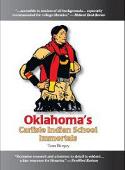
Oklahoma’s Carlisle Indian School Immortals

May 7, 2009

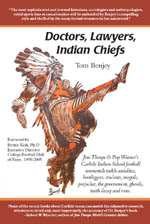
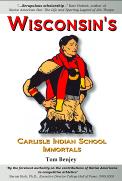
Galleys for Oklahoma’s Carlisle Indian School Immortals, the first book in my upcoming series on Native American Sports Heroes, have arrived. At about 160,000 words, Doctors, Lawyers, Indian Chiefs is too long for most middle school and many high school students to read. So, I am splitting it up into a series by state, the first of which is Oklahoma because it has the largest Indian population of any state. It also was home to many of the Carlisle stars. Splitting up the book into smaller volumes has another advantage; it makes room for some more players. Doctors, Lawyers, Indian Chiefs got to be so long that I had to stop adding players, but now I have places to tell their stories. For example, Henry Roberts and Mike Balenti  are in Oklahoma’s Carlisle Indian School Immortals but aren’t in Doctors, Lawyers, Indian Chiefs.

The new book will be in hardback so that it is attractive to libraries and is under 200 pages long, including the index and appendices. My hope is that school and public libraries across Oklahoma, and elsewhere, add this book to their collections. A book reviewer suggested that grandparents may be interested in giving this book to their grandchildren as gifts. I would like that because my readers to date tend to be over 40. Young people should know about the lives and achievements of Carlisle Indian School students.

Like my other books, Oklahoma’s Carlisle Indian School Immortals is heavily illustrated with rarely seen period photos and cartoons. Bob Carroll of the Professional Football Researchers Association even drew portraits of all the players for the book. This book will be released in September.

09774486812

Researching the 1909 Aggies

April 29, 2009

I’m writing an article about the 1909 Texas A & M football team for the College Football Historical Society August newsletter and am making some interesting discoveries. Now you may be asking how this article relates to Carlisle Indian School. After being on the Carlisle team in 1908, Victor Kelley (backup quarterback) and Charlie Moran (assistant coach) left for College Station after a year in Carlisle bringing Mike Balenti (starting quarterback) with them. The three led the Aggies to an undefeated season and won the Southwest Championship. The article is the story of that team’s season, but writing it isn’t as easy as it first seemed.

That a fire destroyed many of A & M’s old records is unfortunately not an unusual circumstance that researchers encounter. The library does have a copy of the yearbook – always a good place to get an overview but often not as accurate as one would expect – and a librarian graciously scanned the section on the championship team into a PDF for me. The A & M library has incomplete sets of school and local newspapers on microfilms that aren’t available for inter-library loan, something else that is not uncommon.

Everything I previously read credited Charlie Moran with being the team’s head coach, but the yearbook stated that someone else started the season in that position and quit after the second game, at which time Moran was elevated into the position. The mystery is: why did the first coach quit. CFbDataWarehouse.com listed one more game – a game with Dallas University – that the yearbook didn’t include. One Wiki site listed this game but another listed a game on the same date with the same score with Trinity. David DeLassus of CFbDataWarehouse.com bailed me out. The Aggies beat Holy Trinity College 47-0 on 11-13-1909 at College Station. His source? The 1910 Spalding Football Guide. He also explained that Trinity changed its name to the University of Dallas in 1910.

Membership in the College Football Historical Society is a modest $17.00 a year. Send a check to: Ray Schmidt, PO Box 6460, Ventura, CA 93006 Subscriptions also make great gifts.

cfhs-masthead-cropped

Iva Miller’s Parents Objected to Jim Thorpe

April 24, 2009

I was surprised to read “He was in love with a Carlisle student named Iva Miller, but her parents forbade the marriage and she went home to California” on page 287 of The Real All Americans: The Team That Changed a Game, a People, a Nation by Sally Jenkins. The reason for my reaction was that it was my understanding that Iva’s parents died when she was quite young, a fact that made forbidding their daughter to marry Jim Thorpe over a decade later quite difficult. I wondered if Ms. Jenkins discovered that they had faked their deaths or found that they had risen from the dead. However, her book mentioned nothing of the sort. That earlier books on Thorpe reflected something considerably different from what Jenkins claimed prompted me to do some research. Jenkins sources for this discovery would provide a good starting point. However, unlike for many other points in her book, she provided no reference for this statement.

Iva Miller’s Carlisle Indian School records seemed to be a good place to start. They arrived this week and provided some interesting information. Her parents did not sign her enrollment papers; Grace Gray-Morris, who likely was her older sister or aunt, signed the papers and swore that Iva’s dead mother was half-blood Cherokee from North Carolina. Iva’s Physical Record indicated that her father was living and in good health as were three brothers and a sister. Another brother had died of pneumonia and consumption had taken her mother. Iva had attended Chilocco Indian School before coming to Carlisle and Ms. Gray-Morris probably assisted with her enrollment at that facility due to her geographic proximity in Arkansas City, Kansas, the town closest to Chilocco.

I haven’t found Iva’s father on censuses after 1900 but that doesn’t mean he wasn’t still alive and living in California in 1912 when Iva graduated from Carlisle and supposedly returned home to her parents. She may have visited family members in California for a bit but wasn’t held there because she was soon in Oklahoma. Her letters to Carlisle that were published in the school newspaper indicated that she spent the summer in Oklahoma and the fall working at the Otoe Agency. My findings differ significantly from what Jenkins published.

Iva Miller Thorpe's Wedding Photo

Iva Miller Thorpe's Wedding Photo

Carlisle Presaged Professionalism Issue

April 20, 2009

A major thrust of the 1914 Joint Congressional Inquiry into Carlisle Indian School concerned the funding of the athletic program. The training table provided special food for athletes and was eliminated as a result of the investigation. Providing athletes special diets was not all that unusual at colleges at that time but was frowned upon by those who wanted college athletics to be purely amateur, or at least give that outward appearance.

A little over a decade later, in December 1926, Penn State hired a new president, Ralph Hertzl, with the aim of upgrading the institution’s academic standing. Shortly after his inauguration, the alumni committee recommended that financial aid to athletes be eliminated, a Board of Athletic Control be formed, and the Director of Physical Education (Athletic Director in modern parlance) be disallowed from coaching any teams. These recommendations were also aimed at loosening Hugo Bezdek’s tyrannical grip over the Athletic Department and were eventually successful.

Fast forward to the October 1935 Homecoming. Bezdek was still athletic director but hadn’t coached for years. Penn State hadn’t beaten Pitt since 1919 and wouldn’t that year either. The Penn State Collegian editor, Harry B. Henderson, was not amused with the condition of Penn State athletics and wrote an editorial titled “Wake up Alumni” in which he wrote that he was “attempting to place clearly in the minds of the alumni of Penn State the true conditions of athletics here and the hypocrisy and rotten unfairness of Hugo Bezdek’s plan for the non-subsidization of athletics. What started out to be a system of decency and progress in all athletics has been converted into an intolerable and unjust exploitation of athletes, coaches, and alumni…Candidly and frankly the football players here are being exploited by an Athletic Association that pays them nothing for four hard hours a day and yet takes in gates which approach former magnificence.”

Henderson wrote that Penn State was “scheduling for box office appeal” by competing against “professionals” to line the coffers of the Athletic Association at the expense of players who received just one meal a day and were “forced to hunt for jobs, room and board.” Four days later The Collegian claimed victory in its headline, “Athletic Board of Control Grants 2 Meals Daily to Members of Varsity Grid Squad.” It claimed that, “No longer will players be forced to leave school because they are not eating well enough.”

Issues of professionalism that were raised at Carlisle Indian School a century ago continued for decades and are still debated today. More on Penn State football history can be found on Black Shoe Diaries.

Old Sioux Chiefs Didn’t March In 1905 Inauguration

April 17, 2009

Previously, I wrote about the Carlisle Indian School contingent that marched in the 1905 Inauguration Parade to celebrate Theodore Roosevelt’s election as President. Six great chiefs, led by Geronimo, rode on horseback in front of the Carlisle Indian School Band. I didn’t write about the others who wanted to participate in the festivities.

Over a dozen old Sioux chiefs paid their own way to travel to Washington from the Rosebud and Standing Rock Reservations “…to march in their eagle feathers and war bonnets and paint down the avenue after the great Father who once lived out in their country.” Indian Commissioner Leupp would have none of it. He would not let the inauguration be a Wild West Show, that there was no place for these red men. He said, “The Indians will be represented by the chiefs of six famous nations at one time hostile to this country. …Directly behind these old chieftains, each of whom represents a nation once at war with this country and subdued only at great loss of life, will be 350 students of the Carlisle Indian School. My object is to contrast the old Indians of the warpath and the educated, manly Indians of today.”

Leupp would not budge and the old chiefs returned to Dakota without marching in the parade. They were not greeted by President Roosevelt who clapped his hands with delight and, like the others in his box, rose to his feet when the six chiefs passed.