Archive for the ‘Carlisle Indian School’ Category

Jim Thorpe’s Eye Disease

May 27, 2010

While looking through some 1911 newspapers about the 1911 Carlisle-Syracuse game for an article Ray Schmidt is doing for the College Football Historical Society, I came across a piece about Jim Thorpe having eye surgery. The December 12, 1911 edition of The Washington Post included a special from Carlisle, Pa. dated Dec. 6 titled, “Thorpe Under Knife” and subtitled “Great Indian Athlete Is Operated On for Eye Trouble.” This was news to me. I was completely unaware that Jim Thorpe had had eye trouble when he was young.

A quick scan of Thorpe biographies revealed nothing nor did the Carlisle Indian School newspaper and literary magazine. Apparently, wire services didn’t pick up this article and Thorpe biographers didn’t stumble across it. A reason for that may be that trachoma was so prevalent among Indians at that time that it was not surprising that Jim would have had it. Richard Henry Pratt devoted several pages to eye disease among the Indians in his autobiography because it was a large problem with which he dealt.

Dr. Cornelius R. Agnew of New York City visited Fort Marion and became interested in improving conditions for the Indians. Agnew was a frequent visitor at Carlisle and a significant benefactor. On each visit, he would examine ill students and recommend treatments for them. He also treated students with trachoma at his office in New York. After his demise, his protégé, Dr. L. Webster Fox, of Philadelphia stepped up and treated students for free, charging the school only a dollar a day for room and board in his hospital. Fox treated Carlisle students for 20 years and, during this time, trained the school’s physicians in performing certain treatments. So, by the time Jim Thorpe developed trachoma, the school’s physician was probably able to do the surgery himself.

The article pointed out that Thorpe was unable to read Walter Camp’s article in which he named Thorpe to his All America first team, but was able to listen to someone read it to him. Apparently, the surgery was successful because good vision is necessary to hit a major league fastball.
Jim Thorpe 1912 Olympics Postcard

May 24, 2010

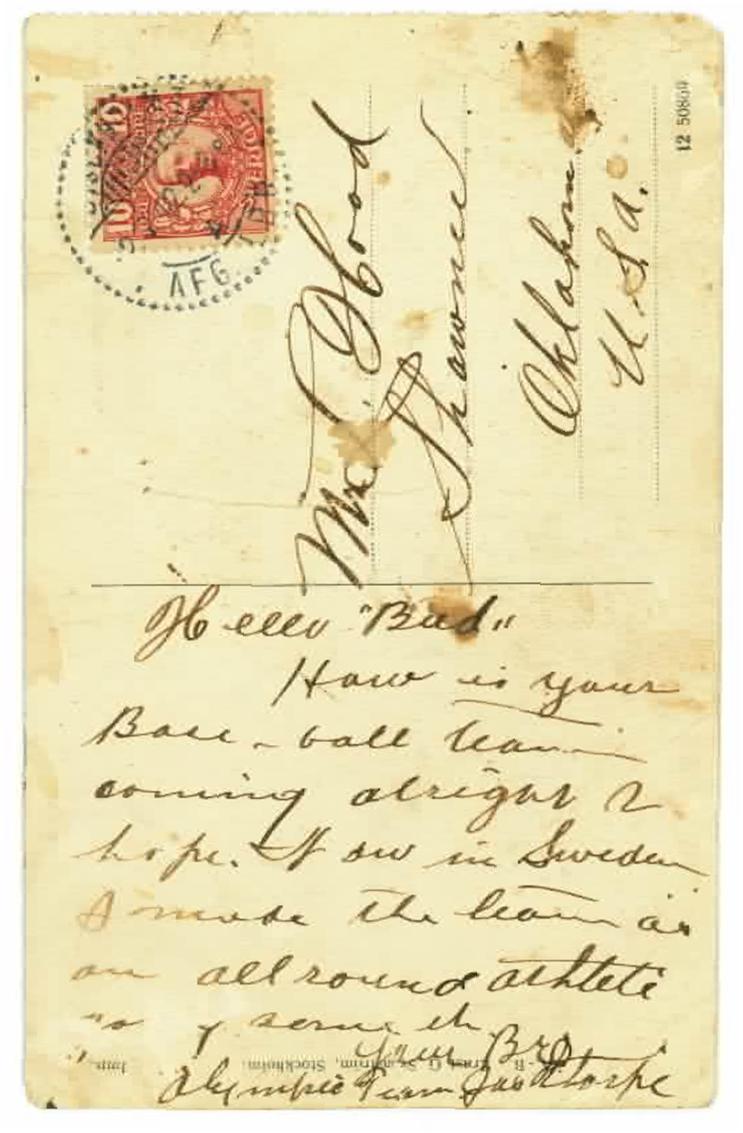
A postcard that Jim Thorpe sent to a childhood friend from the 1912 Stockholm Olympics is being offered for sale. Front and back views of the postcard are provided below.

Luther Hood, recipient of the card, was an Absentee Shawnee and a good friend of the Thorpe family. The families continue a strong friendship today. In tribal culture when a relative dies the family adopts someone to take that person’s place. It seems that Luther may have been an adopted brother to Jim Thorpe, who lost several very close family members, including his twin brother, when he was young. That is why he would have used the terms “Bud” and “Bro.”

The stamp on the card is from Sweden. Closer inspection is required to determine the postmark. The U. S. Olympic team, other than the distance runners and Thorpe, used the ship they traveled over on, the SS Finland, as their hotel during the Olympics. Perhaps the postcard was sent from the Finland.

Bob Wheeler is assisting the owner of what is surely an expensive item in selling it. If you are interested, contact Bob at bobwheelerwrc@aol.com


Shop Team Photos

May 19, 2010

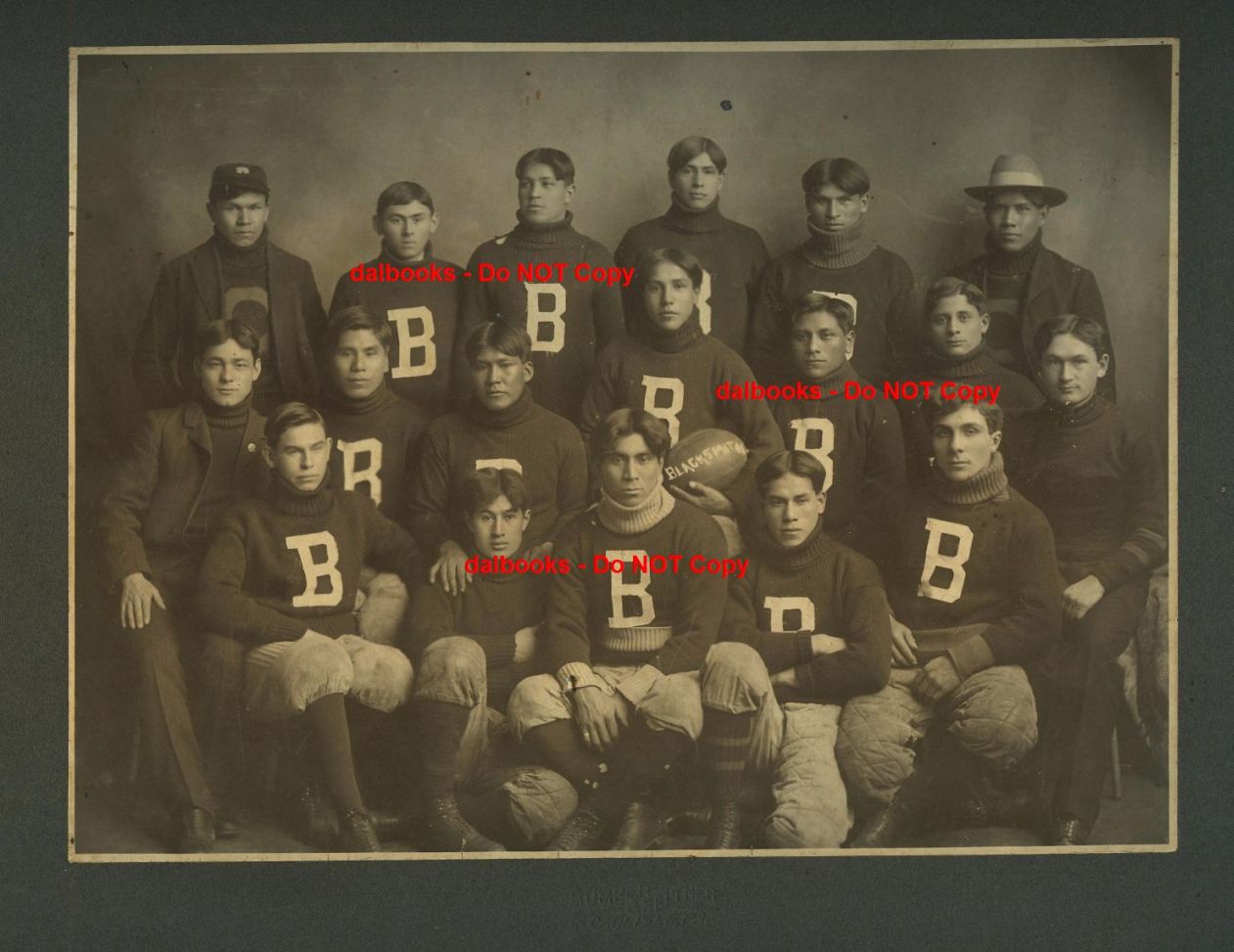
A couple of days ago, I got an email from a local collector of Carlisle Indian School artifacts enquiring about the legitimacy of a photo currently offered for sale on ebay. I looked at the item and noticed that the seller claims it is either a 1903 or, more likely in his estimation, a 1913 photo of the Shoemakers football team from Carlisle Indian School. I had never seen a photo of a shop team before but was well aware that such teams existed. Large shops had their own teams while smaller shops would have joint teams. Debating societies had teams. The band even had a team! When he was superintendent, Major Mercer claimed to have 14 teams to outfit. Each year the varsity would get new uniforms. Their old ones would be passed down to another team. Besides the varsity, the second team played a schedule of games as did the junior varsity. Selling athletic equipment to Carlisle was a lucrative business.

The seller said that he bought the photo from an enrolled member of the White Earth reservation in Minnesota. On the rear of the photo is written “Joe Libby Dec. 19, 1903.” Joe Libby was from the White Earth reservation and didn’t make the varsity until a few years later. I would say that this photo is real.


The very next day, I came across a collection of items that appear to have come from Mitchell Pierce’s estate. One of the items was a photograph of the Blacksmiths team. I think this photo is also real. Note the two lettermen on either end of the back row. They were probably experienced players who were coaching the Blacksmiths, most probably because that was their trade.


Both the Shoemakers photo and the collection that includes the Blacksmiths photo are still up for sale as of this writing, but the Shoemakers won’t be up much longer.

More Misinformation from a Journalist

May 17, 2010

While wrangling grandchildren in Bethesda, MD this weekend, my wife took the impressionable young minds into a bookstore. 12-year-old Joey, a bookie if there ever was one, picked up a copy of The Redskins Encyclopedia by Michael Richman. When he showed it to my wife, she immediately noticed several errors in a paragraph that deals with Lone Star Dietz. The offending paragraph can be found on page 3:

The hands-on Marshall fired Wray, too, and replaced him with William “Lone Star” Dietz, a part-blood Native American. Dietz recruited six football stars from the Haskell Indian School in Kansas, where he had once played with the great Jim Thorpe and later coached for four years. The recruits included “Chief” Larry Johnson, Louis “Rabbit” Weller, and John Orien Crow. The charismatic coach told his players to pose with war paint, feathers, and full headdresses before the 1933 home opener against the Giants.

Where to start? Let’s do them in the order they appear:

1. Dietz recruited six football stars from Haskell

I’ve read this elsewhere but can only verify that he brought four former Haskell students with him—the three Richman listed plus David Ward.

2. …from Haskell Indian School in Kansas…

They came from Haskell Institute (today’s Haskell Indian Nations University) in Lawrence, KS not Haskell Indian School.

3. …where he [Dietz] once played

There is no record of Dietz ever enrolling at Haskell Institute or playing on their football team. He did coach there from 1929 to 1932.

4. …where he [Dietz] once played with the great Jim Thorpe

Lone Star Dietz played with Jim Thorpe at Carlisle not Haskell.

Jim Thorpe attended Haskell Institute before attending Carlisle but did not play on the school’s football team.

What is discouraging is that the author is a veteran journalist and should know that he should have checked his facts. It would have taken him little time to find these errors had he just consulted my biography of Lone Star Dietz and Bob Wheeler’s biography of Jim Thorpe. It is no surprise that yet another journalist has made less than accurate statements about Jim Thorpe and Carlisle Indian School, but it is unfortunate because most readers accept that the author has his facts right and don’t check for themselves.

Wisconsin’s Carlisle Indian School Immortals

May 13, 2010

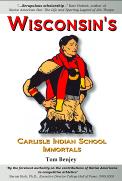
Yesterday, a reader asked about Wisconsin’s Carlisle Indian School Immortals, wondering if it would be a series of blogs or a book. That tells me it’s time to talk about it a bit. Last year I wrote Oklahoma’s Carlisle Indian School Immortals, Volume I of the Native American Sports Heroes Series. I have now completed Volume II of that series. Wisconsin’s Carlisle Indian School Immortals will be released on September 1. Like the earlier book, it follows 17 football stars with ties to a particular state, Wisconsin in this case, from their childhoods on the reservation, generally, to their time at Carlisle, and through their later lives. Background chapters on Carlisle Indian School, its legendary football teams, and coach “Pop” Warner set the stage for the individual biographies.

Not included are busts of the players drawn by Bob Carroll. Bob graciously drew those for Oklahoma’s Carlisle Indian School Immortals just before the end of his life. In their place, is a map that shows all the Indian Reservations in the state of Wisconsin which is intended to assist the reader in knowing where these people spent their early childhoods and, in some cases, returned to after finishing at Carlisle.

Chapters are included for:

Chauncey Archiquette

Wilson Charles

Wallace Denny

Lone Star Dietz

Louis Island

James Johnson

Frank Lone Star

Jonas Metoxen

Thomas St. Germain

Caleb Sickles

George Vedernack

Gus Welch

Joel & Hugh Wheelock

Martin Wheelock

Charles Williams

William Winneshiek

It is my hope that historians, teachers and librarians review this book and make it more available to students who would learn a lot about how disadvantaged people overcame obstacles to excel.

Copies of the softcover version of Oklahoma’s Carlisle Indian School Immortals are now in stock for June 1st release.

Mystery Photograph

May 11, 2010

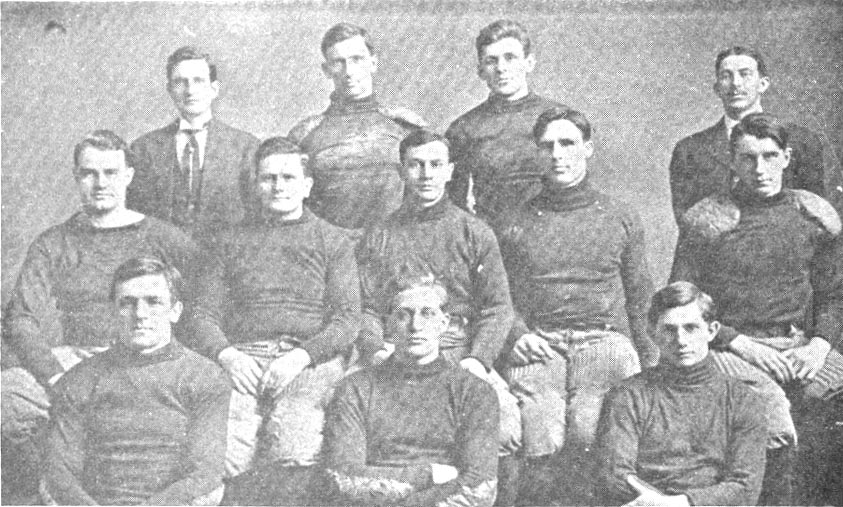
A reader sent me this photo in an attempt to determine if the team in the photo is the 1910 Dickinson College Red Devils and if the player seated at the left in the front row is Frank Mt. Pleasant.


A photo of the 1910 Carlisle Indians-Dickinson College game can be found at this link: http://chronicles.dickinson.edu/studentwork/eyeongame/1910foot.htm. The player at the far left is wearing a Carlisle jersey. The forearm stripes may not have been unique, but were different from most other teams’ uniforms. All the jerseys in the photo are different from the jerseys worn by Dickinson in 1910. Also, Frank Mt. Pleasant graduated in the spring of 1910 and coached Franklin and Marshall that fall.


Follows is a photo of the 1909 Dickinson team of which Mt. Pleasant was captain. Wilbur J. Gobrecht in his history of Dickinson College football reported that in 1903, Dickinson switched to black jerseys and black stockings with half-inch red and white stripes. This uniform design was used for 25 years. As captain, Frank Mt. Pleasant is seated in the middle of the center row in the photograph. I am not very good at identifying people from photographs, so take my opinion with plenty of salt. The player in the first photo looks very different to me than the Captain of the Dickinson squad.

Perhaps someone seeing this photo can identify the team, the year and the players.

Hang Time for a Watermelon

May 6, 2010

Today’s mail brought a new article by Jim Sweeney entitled, “Hang Time for a Watermelon: Did Thorpe Really Do It?” Jim first read about Thorpe’s celebrated feat in Bill Crawford’s 2005 biography, All American: the rise and fall of Jim Thorpe. Later, he read Steckbeck’s matter-of-fact recounting that implied superhuman feats were routine for the world’s greatest athlete.

The day was October 21, 1911; the place was Pittsburgh, Pennsylvania; and the opponent was the University of Pittsburgh. In the middle of Carlisle’s greatest season, Thorpe put on an exhibition that is still being talked about 99 years later. The Carlisle Arrow carried several accounts of the game from Pittsburgh newspapers, but the Dispatch told the story in the most detail:

“So fast were the Carlisle players that only twice during the many punting duels engaged in were Pittsburg players able to bring out the ball after it had been booted into their territory. Indeed, on two occasions, Thorpe, who kicked wonderfully well for Car lisle, got down the field under his own bootings, capturing the ball each time. Once he kicked a beautiful long spiral almost into the midst of five Pitt players and got down the field in time to grab the Pigskin, shake off three or four would-be tacklers and dart 20 yards across the line for a touchdown.”

Sweeney doubted that it was humanly possible to do what the reporter said Thorpe did. No one today could punt the ball from deep behind his line, recover from the awkward position a punter is in after kicking the ball, race downfield through his teammates and the opposition, position himself under the ball, and outjump others for it. Jim analyzed each aspect of the alleged feat to determine if it was even possible. When his article is published, I’ll inform you as to where it can be found so you can learn of his conclusions.

Harvard Law School Game Recap

April 28, 2010

Today we talk about what actually happened in the game played on November 16, 1910 between Carlisle Indian School and the Harvard Law. The game against the Indians was the second game for Hamilton Fish’s all stars. On October 19, Harvard Law played the Harvard varsity and lost 6 to 0 due to fumbling the ball. Their defense was strong as they allowed only two field goals. The varsity only allowed one team to score against them in their 8-0-1 season that ended with a scoreless tie with arch-rival Yale.

Captain Pete Hauser had not recovered sufficiently from the injuries he received in the Navy game to play against Harvard Law. In his place was his brother, Emil Hauser, who was listed in the line-up as Wauseka. Wauseka normally played at tackle but returned from the injured list to fill in for his brother in the backfield. He spent most of the season coaching the second team because he wasn’t able to play.

In spite of their injuries and the quality of the opposition, Carlisle played a strong game. Probably because there was little scoring, news accounts of the game were very short. The Boston Morning Globe reported:

The All-star vs. Carlisle game was the talk of the town yesterday. “By jove, I wish I had been out there; I am sorry I missed it,” was the constant refrain all day. Those who saw the game maintained that it “was the best ever,” and that it was a splendid thing for the sport.

A wire account of the game summarized the lawyers’ 3 to 0 victory:

It was a one-man contest, however, for F. B. Philbin, the fleet Yale half back, ran the team front quarter back’s position, where he took direct passes either for a dash around the end on his own account or to hurl a forward pass. The Indians played entirely on the defensive except for a brief spurt in the fourth period.

The only scoring in the game was a 15-yard field goal Steve Philbin kicked in the first quarter. The first half was all Harvard Law as they had the ball inside Carlisle’s 25-yard line twice and on their 8-yard line once in the second quarter, but the Indian defense held.

Jim Thorpe Sports Days

April 24, 2010

We interrupt the discussion of the 1910 Harvard Law School team to report on the annual Jim Thorpe Sports Days that kicked off yesterday with a flyby of two F-16 fighter jets from the Vermont Air Guard. Students from the war colleges of the various branches of the military compete in races and games each year on Indian Field at Carlisle Barracks, PA to continue a tradition that began in 1974. Indian Field is no stranger to athletic competitions; it is the field on which the Carlisle Indian School football teams played their home games. Jim Thorpe, Frank Mt. Pleasant and most of the others played their home games here. However, the Indians’ earliest games weren’t played on this field because it didn’t yet exist.

Superintendent Pratt reported on the football field in the September 1898 edition of The Red Man, the school’s newspaper at that time:

“The football team has not only continued to hold the high record it made, but through the earnings of the game a large and fine athletic field has been added to the school advantages. Ground adjoining the school was bought, leveled off, and a large, oval turf field, with a quarter mile running track, is now near completion.”

The field today is different from its 1898 configuration. The topsoil and its base were replaced over a century ago; a sprinkling system was added not many years after Indian Field was put into service; the track was upgraded a few times; and bleachers were eventually installed. Those wooden bleachers were replaced by the limestone-clad concrete grandstand years ago.

John Thorpe, grandson of Jim Thorpe, and George Yuda, son of Montreville Yuda, descendents of Carlisle Indian School students were present at the festivities.

The Sentinel’s coverage of Jim Thorpe Sports Days can be found at http://www.cumberlink.com/articles/2010/04/24/news/local/doc4bd25f2f21aa0440783186.txt

Carlisle Sentinel photo

Harvard Law School All Stars

April 22, 2010

A little research has unearthed a few more facts about the 1910 Harvard Law School football team. After two years as a Walter Camp first team All American at Harvard, Hamilton Fish wasn’t quite ready to put aside his cleats and what passed for a helmet in those days even though he had graduated and had entered Harvard Law School. The term wasn’t underway long when he organized a team from his classmates who had played football in their undergraduate days. He apparently challenged the Crimson varsity to a game because, on Thursday, October 20, the Daily Kennebec Journal reported on a game played the day before at the Harvard horseshoe:

The Harvard Varsity football eleven played this afternoon at the Stadium with a team made up of former Harvard Yale and Princeton football players styling themselves All Stars and won by the narrow margin of 6 to 0. The members of the All Stars team are all now Harvard Law School students and aside from their fumbling they put up so strong a game that the Crimson men were unable to get across the goal, the only points being made on two goals from the field by Lewis.

On November 3, The Post-Standard of Syracuse questioned the likelihood of a game between Carlisle and Harvard Law School: Glenn Warner’s Men Are Sadly Crippled: But Few of the First Team Are in Physical Shape to Be Used in Practice. “The few regulars that were out were put on the second team, which was given a short scrimmage against the third eleven.” It also reported that Carlisle management would likely reach a decision the next day.  

The November 14 issue of The Washington Post A PIECE titled INDIANS BADLY BATTERED confirmed that the Indians would be playing the Harvard Law School All Stars the following Wednesday. Warner felt that his injured players, or at least most of them, would be recovered enough to play against Fish’s squad.

 Next time—the game.