Archive for the ‘Carlisle Indian School’ Category
November 29, 2010
Pop Warner is viewed by most historians as the great football innovator and especially for his work at Carlisle Indian School. However, not all the innovations at Carlisle were Warner’s brainchildren. In 1906, the Indians were coached by former players Frank Hudson and Bemus Pierce who Warner helped prepare for the revolutionary rule changes that were implemented that year. After Warner departed for Cornell to start his season, Hudson and Pierce were pretty much on their own. But that wasn’t much of a problem. The Carlisle Indians were called a lot of things but witless wasn’t one of them.
One of the major rule changes was the legalization of the forward pass. Completing a pass wasn’t the easiest thing to do, particularly when both teams wore similar brown or black leather helmets. Passers needed a way to identify the eligible receivers. So, during the very first season in which the forward pass was legal, the Indians experimented with special helmets to help the passer find his target. The November 21, 1906 edition of The Lake County News described this early attempt at receiver identification. Five players wore snow white helmets and one wore a blazing red one. The article used the term headgear rather than helmet which, given the early state of helmet development, is probably more accurate. Given that the four backs and two ends are eligible to receive passes, the total of six special helmets makes sense. It seems fair to surmise that the red one would be worn by the player who does most of the passing and that the white ones are worn by those who can go out for passes.
In 1933, Michigan State started using a winged helmet for all its players to differentiate their men from the defenders. Less than a decade later, Lone Star Dietz’s Albright College team painted crosses on the tops of the receivers’ helmets but didn’t invent that idea as it had been used before, possibly even at Carlisle.
Tags:Forward pass, Painted helmets, Winged helmets
Posted in Bemus Pierce, Carlisle Indian School, Football, Frank Hudson, Lone Star Dietz, Pop Warner | Leave a Comment »
November 25, 2010
While doing a little research at the Pro Football Hall of Fame in Canton, Ohio recently, I came across a photocopy of a newspaper article titled “Backfield of Indians—Plan of Jim Thorpe.” The article began by saying that Thorpe planned on fielding an Indian backfield for the Canton Bulldogs during the 1919 season. The name of the newspaper and date were not on the copy but the paper must have been local to Canton or nearby Massillon because the third paragraph began, “Guyon’s presence here…” which implies that the paper is local to the team’s location. Discussing the possible line-up for the 1919 season suggests that the article was written after the end of the 1918 season, definitely after Armistice in November 1918. Sometime in 1919 is more likely because the article stated, “…will reach shores not later than September.”
The writer discusses how Thorpe plans to reunite with three of his former Carlisle teammates all in Canton’s backfield. Gus Welch would play quarterback (blocking back in the single-wing, wingback in the double-wing), Joe Guyon and Thorpe would be the halfbacks, and Pete Calac would be the fullback. All had played together on the 1912 Indian team but Guyon and Calac were needed on the line to replace Lone Star Dietz and Bill Newashe at the tackle positions because they were no longer playing on the team. Welch, Guyon and Calac were all in the backfield on the 1913 edition but Thorpe had departed by then.
Thorpe’s dream of being reunited fell through because Gus Welch took the head coaching position that had opened up with Lone Star Dietz’s dismissal. Thorpe, Calac and Guyon played pro ball together for several years and won championships in 1919 and 1920. Thorpe tried to field the same all-Indian backfield in 1917 but Joe Guyon elected to play college ball for National Champions Georgia Tech, was named to Walter Camp’s All America Second team at halfback, the same honor he received in 1913, his last year at Carlisle.
Tags:Canton Bulldogs
Posted in Carlisle Indian School, Football, Gus Welch, Jim Thorpe, Joe Guyon, Lone Star Dietz, Pete Calac, William Newashe | Leave a Comment »
November 18, 2010
I was recently sent an article on a particular topic on the history of football—it doesn’t matter which article because this is a common error—that attributed or blamed, depending on one’s perspective on Pop Warner that he did not do. That Warner had a split tenure at Carlisle Indian School is either not widely known or is forgotten by many when they write about Carlisle football. In this instance, the matter has to do with the 1904 Carlisle-Haskell game and the mass transfer of football talent from Haskell to Carlisle that happened after that game.
For a little background, President Theodore Roosevelt was to spend a few days around Thanksgiving at the 1904 St. Louis World’s Fair. Promoters saw an opportunity to attract greater attendance by staging a football game for Teddy to attend. Their first choice was to host the Army-Navy game that year. That idea was turned down immediately. The next thing that came to mind was to have the two prominent government Indian boarding school teams play each other as both were running roughshod over the competition in their respective parts of the country. Carlisle was already scheduled to play Ohio State on Thanksgiving, so the game with Haskell Institute of Lawrence, Kansas, was set for the Saturday following the holiday.
Why did Warner have nothing to do with this game, one asks? Well, Pop Warner left Carlisle after the 1903 season to return to coaching his alma mater, Cornell. The reason for that move, according to his critics, was that he was paid more money. They are probably correct. Warner coached Cornell through the 1904, 1905 and 1906 seasons and, other than teaching his new formations to Carlisle’s Indian coaches in 1906, probably had little to do with the operation of that program. He had no reason to recruit Haskell players for Carlisle. He might have tried to entice the best ones to enroll at Cornell, but that seems improbable.
Superintendent Richard Henry Pratt had been relieved of command of Carlisle Indian School in the summer of 1904 and replaced by then Captain William A. Mercer. With no athletic director in place and the coaches hired just for the season, Mercer filled the void left by Warner’s departure and became involved with the football program. The next year, he arranged the first Carlisle-Army game but that is a separate story.
Tags:Haskell Institute, Major Mercer, Ohio State, St. Louis World's Fair, Theodore Roosevelt, William A. Mercer
Posted in Carlisle Indian School, Football, Pop Warner, Richard Henry Pratt | Leave a Comment »
November 9, 2010
Readers of this blog are probably well familiar with trick plays that the Carlisle Indians ran. There’s a new one that they didn’t run but would have if they had thought of it. The Penalty Play has aspects of the Dead Indian Play and the Hidden Ball Play with some more deception thrown in.
Driscoll Middle School of Corpus Christi, Texas was trailing rival Wynn Seale 6-0 late in the third quarter when the Wynn Seale defense was penalized five yards. It was then that Driscoll’s quarterback saw his chance to call the trick play the team had been working on prior to the game. Immediately after the officials respotted the ball, Driscoll quarterback Jason Garza told his center, in a voice everyone could hear, that the refs were going to mark off five more yards and to give him the ball. The center then handed the ball to the Garza who then casually stepped off several yards straight through the defense. When he cleared the secondary, Garza took off running for the goal line and outraced the defenders who belatedly figured out it was a trick.
While Garza did a great job of acting, his coach, Art Rodriguez, served as his foil on the sideline by barking commands to him and making animated gestures to help confuse the defense. The coach’s part in this ruse is visible on the bottom of the screen at the beginning of the clip. This play was picked up by the Today show and The New York Daily News. Rodriguez revealed that the play was the brainchild of assistant coach John Delosantos.
The play can be viewed without a commercial at http://www.youtube.com/watch?v=-KM7XeMj_zA
Tags:Art Rodriguez, Dead-Indian Play, Driscoll Middle School, Hidden Ball Play, Hunchback Play, Jason Garza, John Delosantos, The Penalty Play, Wynn Seale
Posted in Carlisle Indian School, Football | 1 Comment »
November 4, 2010
This blog deals with some miscellaneous research findings and issues that aren’t closely related to each other.
An event that helped trigger my interest in researching the Craighead naturalists was mentioned in this blog some time ago when I noticed that Frank Craighead, age 12, agreed to stock a terrarium for Miss Paull’s classroom at the Carlisle Indian Industrial School. Later, I noticed that Frank’s older sister, Rebecca, visited Miss Paull at the Indian School. Now, I learn that Rebecca graduated from Carlisle High School and gave an oration at her graduation ceremony in 1906 entitled “Nature Is God’s Mirror.” Frank graduated from CHS two years later. At his ceremony, Carlisle Indian School Superintendent Moses Friedman conferred the diplomas. This was yet another example of the Indian School’s involvement with the local community.
Today, I visit the Professional Football Hall of Fame in Canton, Ohio with multiple objectives. First, I want to photograph Leon Boutwell’s Oorang Indians uniform. I have seen several black and white photos of these maroon and orange outfits but haven’t encountered any that are in color. I read where Boutwell’s descendents donated his suit to the HoF and would love to see it. Who knows, it might make a great cover photo for “Carlisle Indians in the NFL.”
Also while at the HoF, I want to do a little research on players about whom I need more information. Chief among them is Joe Little Twig, another Oorang Indian. He played in the NFL for a few years after the Oorang franchise folded and eventually settled in Canton, Ohio. His early life is unclear. Little Twig is reputed to have attended Carlisle Indian School but I have not found any evidence of that. Perhaps, he was enrolled under a different name but I don’t know what that was. Here’s hoping that I find more information on him today.
Tags:Frank Craighead, Joe Little Twig, Moses Friedman, Oorang Indians, Pro Football Hall of Fame, Rebecca Craighead
Posted in Carlisle Indian School, Football, Leon Boutwell | Leave a Comment »
November 2, 2010
Now that we’ve dealt with some obvious errors in Rich Manning’s article, let’s get to the original issue: formations. The single-wing section in the Carlisle Indian School article in LeatherHelmetIllus.com starts this way:
In 1907, ‘Pop’ Warner returned to Carlisle. Together he and the Indians developed a new formation that would revolutionize football. The single wing shifted the halfback out wide, to outflank the opposing tackle. The new offense formed a shape that look like a wing. It opened up options and disguised intentions. The ability to show one thing and do another combined with the new rules made it possible to run, throw or kick at any time. ‘Pop’ Warner unveiled the new formation against the University of Pennsylvania, on Oct. 26, 1907.
I have read that the single-wing was unleashed in several different years due to Pop Warner’s inconsistent memory and writers’ imaginations. After researching this topic a bit, I came to believe that the single-wing did not arrive fully formed as the unbalanced-line, direct snap version depicted as Formation A in Warner’s 1927 book. I have concluded that the formation evolved over time as Warner implied on page 136 of his 1927 classic where he stated that it was first used by the Carlisle Indians and that he had used it or variations of it since the rules change of 1906. That he spent a week in Carlisle before the start of the season preparing coaches Bemus Pierce and Frank Hudson for the rule changes gives credibility for it having been first used by the Indians in 1906 when he wasn’t their coach. Fortunately, some documentation exists.
Warner began marketing a correspondence course on football in 1908 for which I have located and have reprinted the Offense pamphlet along with its annual updates. The 1908 pamphlet includes a number of offensive formations, which is not surprising as Warner was noted for tinkering with them. That newspaper coverage of the 1907 Penn game mentioned that multiple formations were used is not surprising. However, it is far from clear that end-back formation, the earliest documented version of Warner’s single-wing, was the formation being described for many of the plays as it didn’t feature a direct snap to a running back. That would come later. However, the punt formation did allow direct snaps to the backs and Warner had devised a set of running and passing plays from this formation.
He even described Play No. 17 thusly, “This is the long forward pass play used so successfully last season.” Last season would have been 1907, so this is likely the formation from which Frank Mt. Pleasant and Pete Hauser completed all those passes, not an early incarnation of the single-wing.
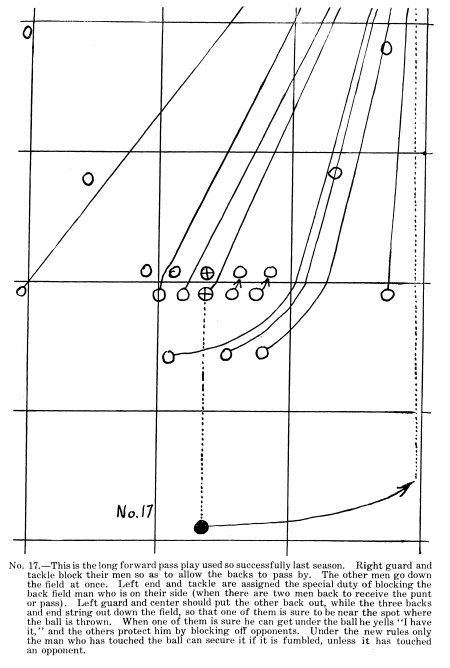
Play No. 17 from 1908 correspondence course Offense pamphlet
Tags:LeatherHelmetIllus.com, Rich Manning
Posted in Albert Exendine, Bemus Pierce, Carlisle Indian School, Football, Frank Hudson, Frank Mt. Pleasant, Jim Thorpe, Pete Hauser, Pop Warner, Single-Wing | Leave a Comment »
October 29, 2010
Let’s now look at Rich Manning’s statement regarding Jim Thorpe:
The [Pennsylvania] game also marked the debut of Jim Thorpe. He broke free for 45 yards the second time he touched the ball.
This statement didn’t ring true because Pop Warner wouldn’t likely put an untested player like the young Thorpe into the pressure of a big game. He was more likely to have given him some playing time in the warm up games to better prepare him for game situations. One of the purposes of the warm up games at the beginning of the season was to give new players playing time in game situations with little pressure. However, the 1907 schedule didn’t provide Warner much opportunity to try untested players. Lebanon Valley College and Susquehanna University were the only games with lopsided scores. Unfortunately, the reports for those games in the Carlisle school newspaper didn’t list the names of all the players who got into those games. One assumes that Jim Thorpe got significant playing time in the 91-0 blow out of Susquehanna. Although we don’t know that for sure, it wasn’t necessary to research that point because the write up of the Bucknell game provides all the information we need to show that Warner didn’t debut Thorpe against Penn.
The Indian School newspaper reprinted coverage from The Evening Sentinel about the Bucknell game, including, “After the next kick-off [Jim] Thorpe made a long run, but dropped the ball,” and in the second half, “Thorpe did most of the work carrying the ball, and proved an excellent ground gainer. He followed his interference well and held the ball.”
So, Warner debutted Jim Thorpe a week earlier than Manning stated, assuming that he didn’t play in the early blow outs or that they didn’t count because they were warm up games.
The next blog will deal with the errors in the article related to formations .
Tags:Bucknell University, Rich Manning, University of Pennsylvania
Posted in Carlisle Indian School, Football, Jim Thorpe, Pop Warner, Single-Wing | Leave a Comment »
October 27, 2010
I was recently asked if Pop Warner unveiled the single-wing against Penn in the Carlisle Indians’ fifth game of the 1907 season. Penn was actually Carlisle’s 7th opponent that year but that was probably just a typo made by the person asking the question. This was the first time I had heard (or read) that the single-wing was first used in that particular game. I have seen it attributed to several other times but not that one. A little research found a source for this claim but quite possibly not the only person to make it. Follows is an extract from an article on the Carlisle Indians in LeatherHelmetIllus.com:
‘Pop’ Warner unveiled the new [single-wing] formation against the University of Pennsylvania, on Oct. 26, 1907. So far that season no team had crossed the Quaker’s goal line. Carlisle was undefeated. A large crowd of 22,800 fans looked on. They were expecting a good game but they got more than they bargained for. Carlisle scored on the second play: a 40 yard pass from Hauser to Gardner, caught on the run. The diversified offense racked up 402 yards, to 76 yards for Penn., Carlisle went 8 of 16 passing. The game also marked the debut of Jim Thorpe. He broke free for 45 yards the second time he touched the ball. The Indians won 26 – 6.
After finding this, I set about locating game accounts in period newspapers. Before resolving the issue of the single-wing, I noticed a significant error—or the sports writers of the day had it all wrong. Nowhere did I find mention of (William) Gardner scoring a touchdown or anything else in that game. What I did find in the coverage by The Washington Post, The New York Times, United Press and other wire service accounts was that the Indians’ first score came on a field goal kicked by Pete Hauser early in the game. That score was followed by Fritz Hendricks’ 100-yard touchdown run after picking up Hollenbach’s fumble. Payne closed out the first-half scoring with a touchdown of his own around Penn’s end from the 4-yard line. Penn played better in the second half and didn’t allow Carlisle an offensive touchdown. However, Little Boy scored his touchdown by diving on a Penn punt that Albert Exendine had blocked and fell behind their goal line. Hauser closed out Carlisle’s scoring with a second field goal. Frank Mt. Pleasant kick the extra points after each touchdown. Although Mt. Pleasant and Hauser received much praise for their passing in this game, none of their tosses went for a touchdown to Gardner or anyone else.
The next blog will deal with the errors related to Jim Thorpe and the single-wing.
Tags:Albert Payne, Fritz hendricks, LeatherHelmetIllus.com, Little Boy, Rich Manning
Posted in Albert Exendine, Carlisle Indian School, Doctors, Lawyers, Indian Chiefs, Football, Frank Mt. Pleasant, Jim Thorpe, Pete Hauser, Pop Warner, Single-Wing, William Gardner | Leave a Comment »
October 20, 2010
Although several books written have been written about Jim Thorpe in recent years, little new information has been uncovered about him. The reason for that is that Robert W. Wheeler plowed so deeply when he researched everyone’s All American that little ground remained untouched. Bob spent seven years researching what began as an oral history of the great athlete for his master’s thesis. Most of the people he interviewed who knew or interacted with Thorpe are no longer alive and, thus, not available for other’s to interview. Bob has graciously allowed others to use his interview tapes. Some artifacts, such as scrapbooks, that Wheeler was able to study are now out of the Thorpe family’s hands and, in some cases, held by private collectors who do not make them available to researchers.
So, Big Jim’s recent biographers have stood on Wheeler’s shoulders in more than one way. Put another, perhaps better, way by Freddie Wardecker, there has been little point to anyone else writing a Thorpe biography since Wheeler’s. Dick Schaap put it succinctly when he said, “Robert W. Wheeler is Jim Thorpe’s Boswell.”
Recent Thorpe biographers have been invited to speak in Carlisle, but not Bob Wheeler—until now. He will be speaking at the inaugural Celebrate the Book festival at the Expo Center on Saturday at 2:00 p.m. And I have been given the honor to introduce him. Of course, I was far from the first choice, but due to other people having schedule conflicts and that I was going to be at the festival anyway, I get to do this. I may be doing this because the better choices were busy but that’s OK with me. Bob Wheeler’s odyssey across the country and his experiences along the way could make a separate book. If you’re within a couple of hours of Carlisle, it’s an easy drive. His is a talk not to be missed.
Tags:Robert W. Wheeler
Posted in Carlisle Indian School, Jim Thorpe | Leave a Comment »
October 5, 2010
The October 30, 1903 weekly edition of the Narka Kansas News included an article title, “The Plan a Good One.” The plan being referred to was on concocted by the faculty of the University of Chicago which would have eliminated paid admissions to contests in which the school’s athletes participated. The plan wasn’t as simple as it sounds at first glance because not all of Chicago’s games, meets, matches and tournaments were played at facilities controlled by the University. Many of them were played at facilities located on the campuses, mostly those of members of the same athletic conference as Chicago. So, meetings were set up with faculty representatives of the Universities of Wisconsin and Michigan to discuss dropping admission fees for athletic contests held at those schools.
Dropping admission fees is not something that can be done easily because athletic programs cost money to operate, even a century ago. Ticket sales help cover those costs and, in some places like Yale and Carlisle Indian School, generated a tidy profit. So, the trustees of the University of Chicago were going to create an endowment from which the earnings were to pay for the operation of the University’s athletic program and had taken preliminary steps to create an endowment for physical culture and athletics.
It is highly unlikely that this plan ever got off the ground because Michigan and Wisconsin were probably making so much money off their respective football programs that it couldn’t be replaced easily with earnings from an endowment unless the endowment was very large.
Also, this move was in sharp contrast with the announcement made by the Athletic Association of the University of Pennsylvania ten days earlier when it announced that approximately 6,000 tickets were to be sold at $2 each. Previously, 21,000 tickets were to be divided equally among the academies and Penn. This year, the tickets allocated to Penn were to be put up for sale. In earlier years, no admission was charged.
Tags:University of Chicago
Posted in Carlisle Indian School, Football | Leave a Comment »


 Tom Benjey's Weblog
