A month ago, I posted an article to Facebook that was nearly identical to the last one I posted here. By lunch I was canceled. No explanation. No appeal. No nothing. I am now banned from Facebook for life.
It isn’t all bad because I’ll save money. Promoting my books on Facebook didn’t increase sales. I will save the time I spent reading useless things but I will miss reading what friends, acquaintances, and schoolmates are up to these days.
Why exactly did they ban me? I can only guess. At the end of the article, I included a quote from a former Carlisle Indian School student who wrote in positive terms about his experience at the school. It is against wokester ideology to mention the good Carlisle did. That is not allowed. Earlier postings about the Native American Guardians Association’s (NAGA) attempts to have the Washington NFL team revert to calling themselves Redskins surely didn’t endear me to the activists and guilty white liberals who demanded the team to drop that name in the first place.
In respond to a 1912 letter requesting information about his life after leaving the school, George responded in part:
The likely offending passage follows.
“ I feel as that my learning while at Carlisle Indian Industrial School was the foundation of my success in life so far. Does it pay to educate the Indians? Certainly it does. Today there are white people that don’t live far from me that can’t write their own names. Does it pay to educate white children?”
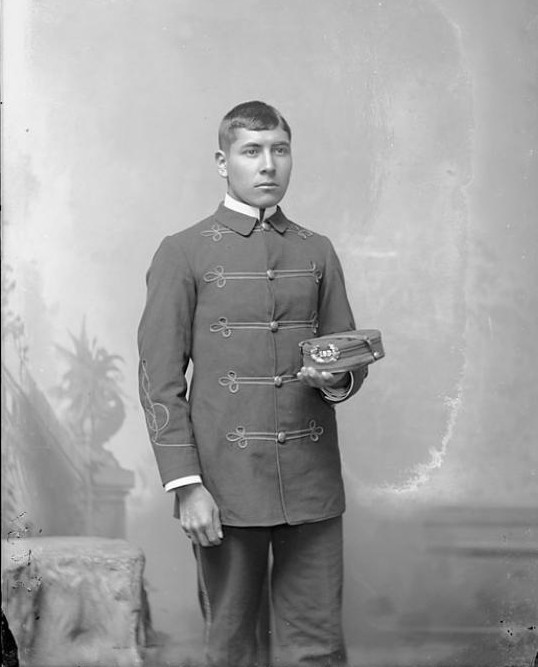
Some family members doubt this is a photo of George although it is labeled as such in the archives.
An interesting article from 2012 unexpectedly came over my virtual transom today. It was about an Osage Indian selling his grandfather’s Carlisle Indian School uniform to the National Museum of the American Indian (NMAI). No, it wasn’t a football uniform. It was his student uniform which was similar to those worn by the cavalry. That may seem strange to those not familiar with the school but it really isn’t. The school’s founder and superintendent for 25 years, Richard Henry Pratt, was a cavalry officer as was his successor. Pratt’s adult life had almost all been spent in the army, either fighting in the Civil War or in the Indian wars later. The military life was what he knew so he dressed the students in military uniforms, assigned them military ranks, arranged them in units, and drilled them in marching.
What was a little surprising was that the man was Osage. Since few of them were football players, I didn’t know much about them. According to his grandson, George Conner was an orphan who arrived at Carlisle in 1885 and stayed until 1890. He returned for a second enrollment at Carlisle, during which he assisted with the physical education program. He finished his schooling in 1899 at age 29 and returned to Oklahoma (Indian Territory at that time). There he put his training in harness making and saddle repair to work when he opened his own shop in Pawhuska, the Osage capitol.
George married Lillian House, who was a matron at St. Louis School (often referred to as Osage girls School), a Catholic institution funded by Mother Mary Katherine Drexel. After George’s stepfather was murdered, the couple considered Pawhuska too dangerous a place to raise a family and moved to Grainola. He took up farming and remained there the rest of his life.
He became involved in the resistance to the Dawes Act and worked with fellow Osages for two decades in an attempt to prevent the division of the reservation into allotments. He also served as the Osage National Council Secretary for a number of years.
In responding to a 1912 letter from Carlisle requesting information about his life after leaving the school, George said in part:
“I feel as that my learning while at Carlisle Indian Industrial School was the foundation of my success in life so far. Does it pay to educate the Indians? Certainly it does. Today there are white people that don’t live far from me that can’t write their own names. Does it pay to educate white children?”
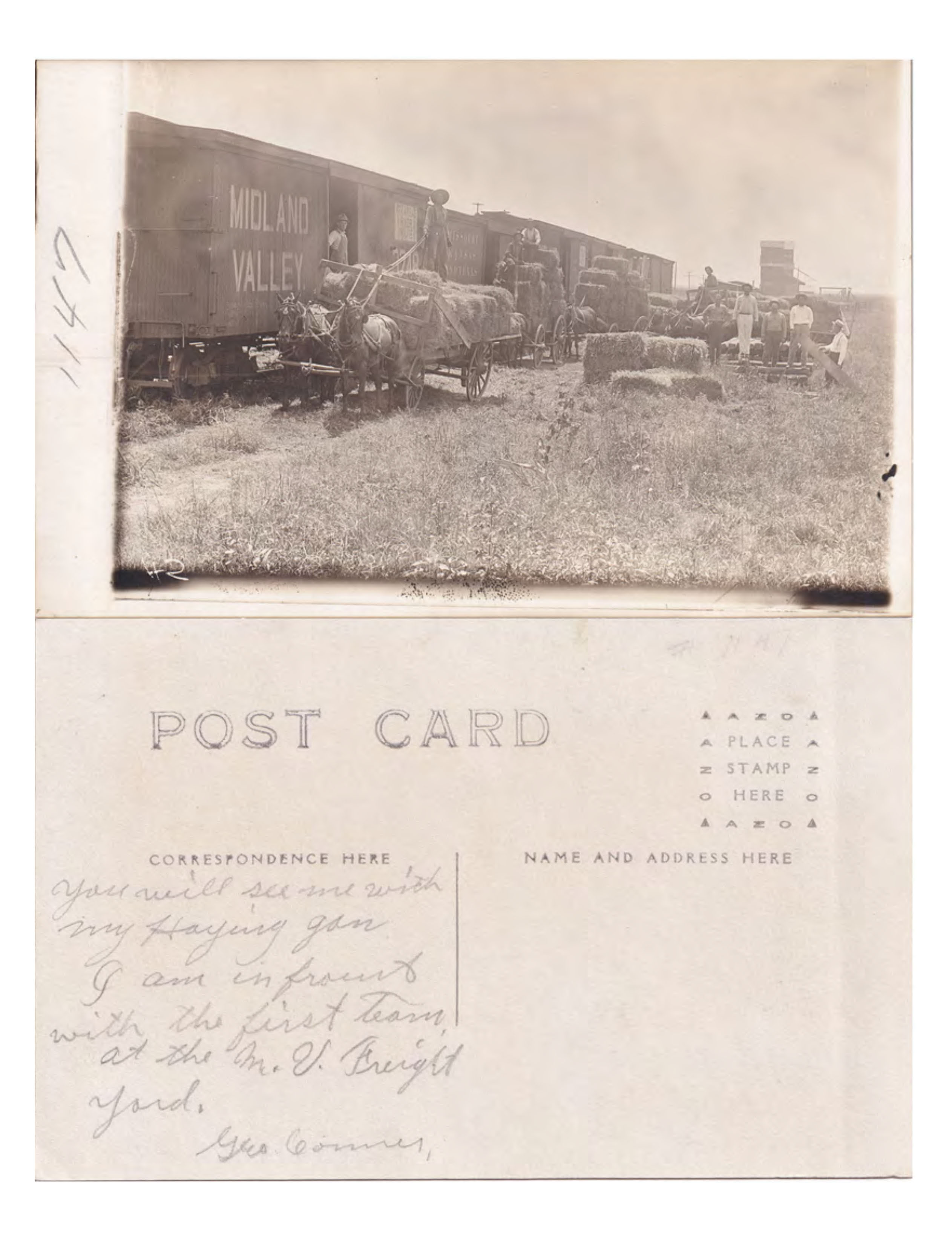
Joe Conner’s wife commented that the photo at the top is definitely not George Conner. Below is a photo that surely is him. However, he was too far from the camera for his face to be seen clearly.
The famous biographer of Robert Moses and LBJ, Robert Caro, tells of an admonition the cigar-chewing editor on his first job as a reporter told him, “You’ve got to turn every page, kid.” In another land-use battle into which I’d gotten myself embroiled, Caro’s admonition proved true once more. A neighbor uncovered an important detail I had missed. I had gone through all of the township’s ordinances I thought pertinent at the conditional-use phase but the neighbor went a step further and perused the ordinances for a later phase, subdivision and land development (SALDO). In them was a tiny nugget crucial to our case. Some might consider this akin to finding a needle in a haystack, a very sharp needle.
The ordinance he found dealt with the maximum impervious coverage allowed in a wellhead protection zone. The limit varied depending on the underlying zone. The land on which the commercial soccer complex was to be built was zoned agricultural conservation (AC), which normally allowed 25% impervious coverage. However, when a wellhead protection zone overlays an AC zone, the maximum allowable impervious coverage is only 15%.
When our attorney informed the soccer club that their plan, which called for 25% impervious coverage, would fail getting approval, the club withdrew their plan and investigated another, more suitable location. To conform to the ordinance at the original site, the plan would had to be scaled down to fewer artificial turf fields than the soccer club wanted. Turning every page saved the community from an ill-designed facility.
Caro also recommended visiting the important places in a subject’s life. He used sticking his fingers in the thin layer of topsoil at LBJ Ranch to discover the reason LBJ’s father went broke trying to farm that land. Last year I was asked to comment on the most recent book on Jim Thorpe because of my work researching the Carlisle Indian School football program and its players. This book got a lot of hype because it was written by a Pulitzer Prize winner, but that didn’t mean it didn’t have serious errors of the type Caro admonished writers to avoid. Two of the most egregious errors in the book have to do with Carlisle itself and the parade held in Thorpe’s honor after the 1912 Olympics.
During a Q & A session at a talk he gave at the local library, I asked Mr. Maraniss about Caro’s recommendation to visit the site. He claimed that, because he conducted his research during COVID, he didn’t visit Carlisle. That excuse seemed lame to me because the COVID lockdown was over months before his book was released. Had he visited Carlisle, one assumes he would not have described Carlisle Barracks as being on a hill outside the city of Carlisle. Locals laugh when they hear this because Carlisle Barracks is not on a hill and no one ever considered Carlisle to be a city.
His second egregious error, regurgitating an erroneous newspaper account of the parade following the 1912 Olympics, may not have been made had he actually driven around the center of town. That article placed the train station at the square opposite the James Wilson Hotel. The station was across from the Jimmy Wilson, as locals call it, but neither were at the square. The routing of the parade as described in that article made no sense. Anyone familiar with the town’s layout spots that immediately. Had Maraniss turned every page, he would have found an article in a different newspaper that described the event in such detail that he must have known Thorpe was going to get off the train at the junction at the eastern edge of town to avoid the crush at the square and to give him time to visit with friends and officials at the Indian School before joining the parade.
I doubt if Caro’s recommendations would have stopped Maraniss of claiming that Carlisle had beaten Princeton because they never did. In six tries against the Tigers, Carlisle scored only once and that was in the 1896 game. Warner complained that certain teams stopped playing the Indians after they became a good team. However, Princeton gave Carlisle its only loss in 1907, Thorpe’s first year on the squad, and stopped playing them after 1910, just in time to avoid Thorpe’s return and the return of strong teams.
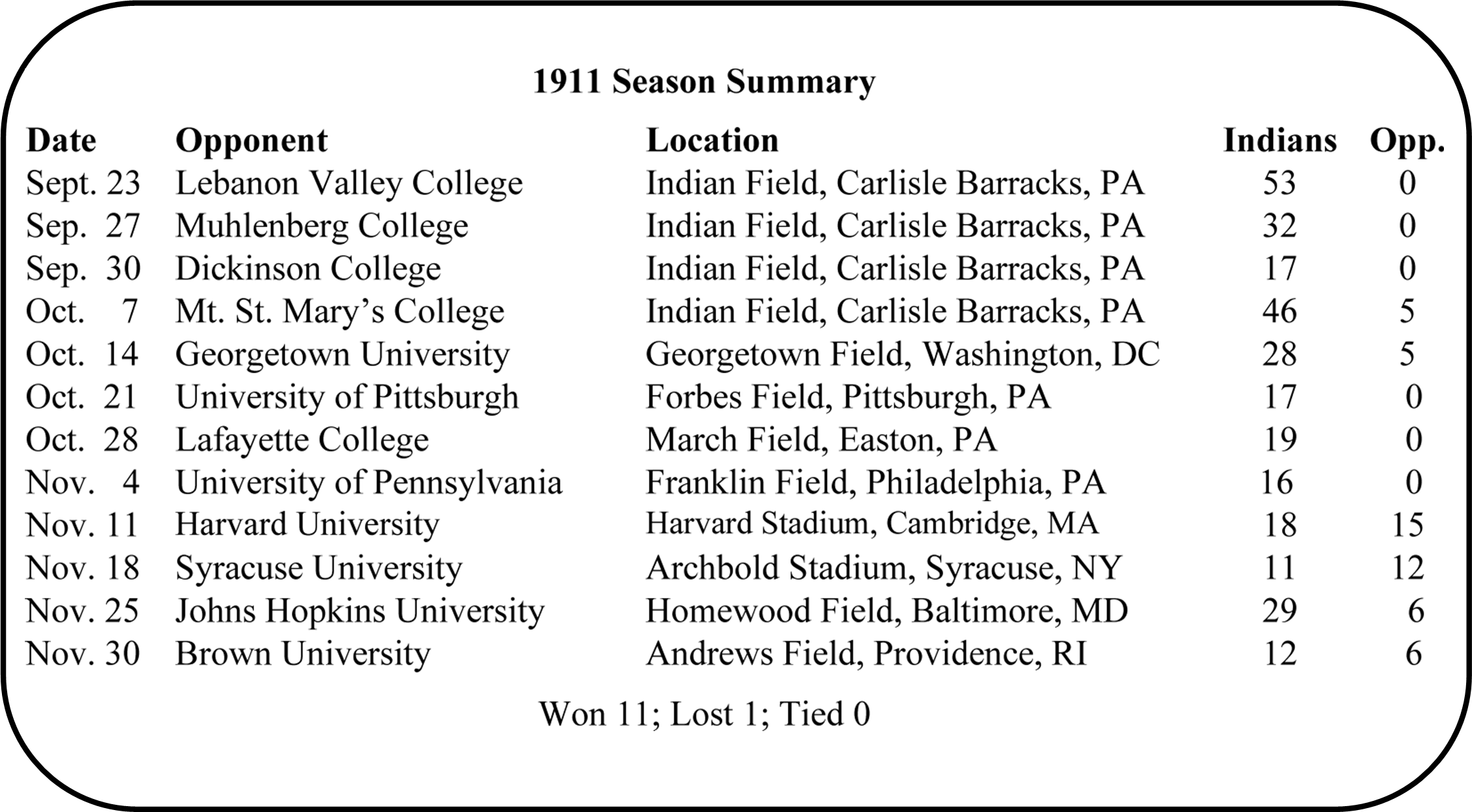
I was recently asked what I thought was the stronger Carlisle team, 1911 or 1912. That is a question that has been raised several times. Let’s start by looking at schedules and results first. The 1911 team went 11-1-0, missing an unbeaten season by a single-point loss to what Warner considered an inferior Syracuse team. They beat two of the Big Four, Penn and Harvard, for only the second time in the team’s history. The Indians scored 298 points while giving up 49. Six teams were shut out, including Pitt, Penn, and Lafayette.
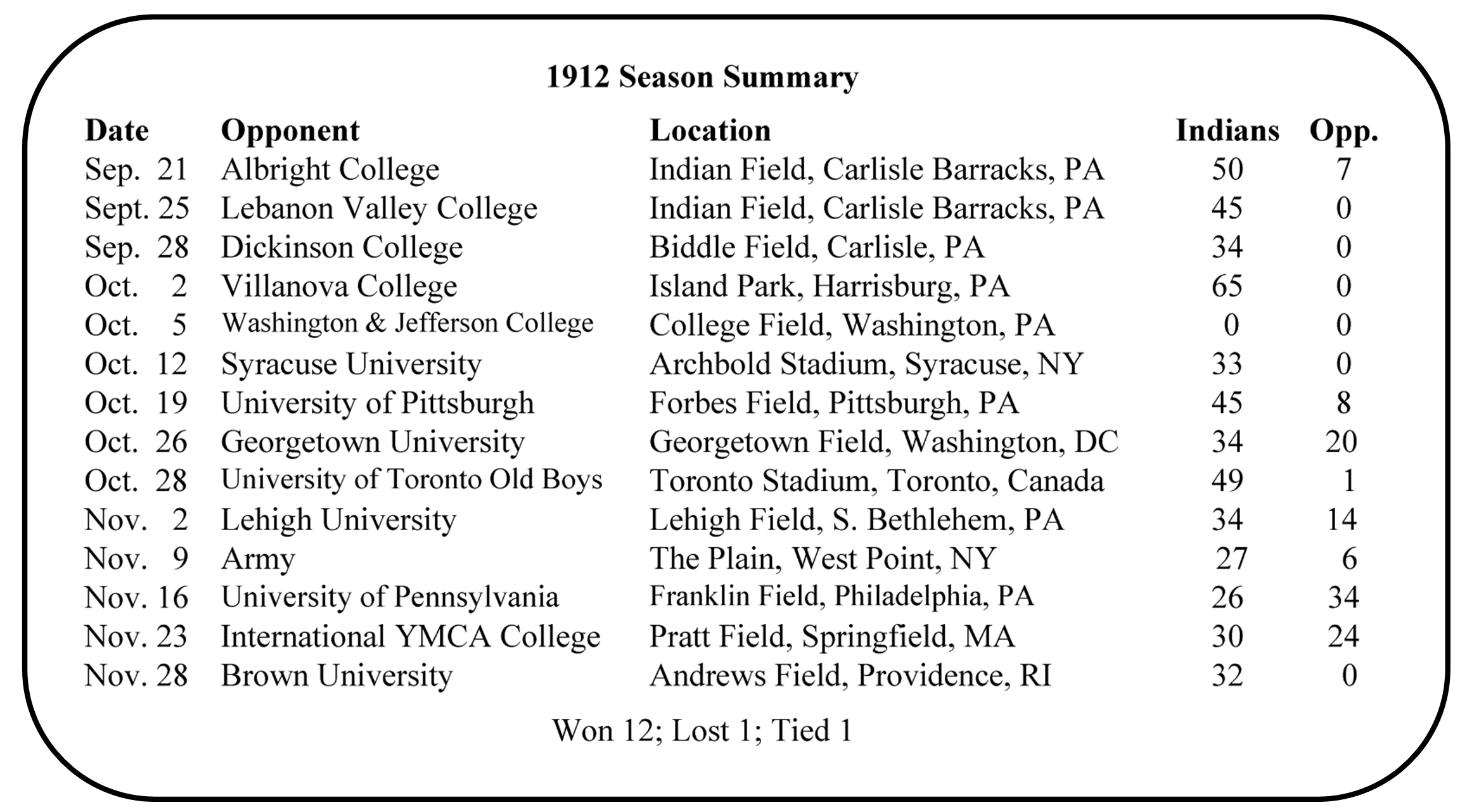
For 1912, like Steckbeck before me, I credited Carlisle with a 12-1-1 record. They shut out five teams where the 1911 version blanked six opponents. They only played one of the Big Four, Penn, and lost to the Quakers. For comparison purposes, I would eliminate the 49-1 game with the University of Toronto Old Boys because the opponent was a rugby team whose players had never played American football. Other Carlisle opponents, even the weakest, knew the rules and had played the game for some years. Dropping the Toronto game reduces Carlisle’s 1912 results to 11-1-1. Eliminating points from the Toronto game from Carlisle’s record leaves the 1912 team with 455 points scored and 113 points given up for the season.
Computing the ratio between points scored over points allowed gives the 1912 team 4.03 points scored for each point given up. The 1911 team’s ratio was 6.08 points scored per point allowed. While the 1912 version was a scoring machine, its defense gave up more than twice as many points, 113 as the 1911 squad did, 49.
In the 1912 Spalding’s Guide, George Orton of Penn wrote of the 1911 Indians, “…whatever inferiority they may have shown in defensive work, they more than made up by the much greater brilliancy, variety, and power of their offense.”
When evaluating the 1912 team Orton wrote, “…defensively they were not strictly first class.”
Something to keep in mind when reading about eastern teams in the Spalding’s Guides is that articles discussing those teams were written by representatives of IVY League schools who were biased toward those institutions’ teams. They never considered strength of schedule or the fact Carlisle played all its major games away from home.
The 1912 tie, which 1911 didn’t have, was a scoreless affair with Washington & Jefferson. This would be a mark against the 1912 squad. Now, let’s compare the teams’ losses. Warner, through the school newspaper, blamed the one-point loss to Syracuse on a sloppy field to “Poor generalship, poor kicking, and numerous penalties for offside play and holding” and “Thorpe’s kicking and playing in general was disappointing.” Thorpe missed an extra point that would have tied the game.
The 34-26 1912 loss to Penn was due to “the careless work of Carlisle’s backfield, their mistakes on signals, their fumbles, and their failure to intercept forward passes over the goal line, together with a fumbled punt, practically gave their opponents every score they made and enabled Pennsylvania to score 34 points with very little effort on their part.”
Both losses were bad but the one to Penn was worse. Carlisle couldn’t blame its poor play on a muddy field this time.
While researching this article, I discovered an error in Gridiron Gypsies. The season summary table for 1912 did not include the 33-0 victory over Syracuse. It was covered in the text but not in the table. A correction has been sent to the printer but who knows when corrected books will be printed. The corrected table follows.
Andre Billeaudeaux, historian and co-founder of Native American Guardians Association (NAGA), thinks opponents of the Redskins name don’t know what they’re talking about. “These people are just ignorant. It’s toxic ignorance. It’s group think. It’s the psychology of a group that has no idea what they’re doing, but they won’t listen to us [NAGA], either.”
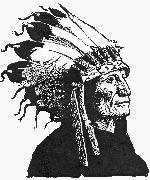
The origin of the Redskins name and logos go back to 1912 when James Gaffney, of New York’s Tammany Hall, purchased the Boston Rustlers National League baseball team. He renamed the team as the Braves and used an image inspired by Saint Tammany for the team’s logo. That image is prominent on the left sleeve of Babe Ruth in a photo taken in 1935.
When a group including Washington laundry magnate George Preston Marshall purchased an idle NFL franchise and established a team in Boston, they named the team the Braves. It was common for upstart NFL teams to name themselves after established baseball teams, particularly when they shared the same field. The new Braves’ uniforms didn’t include an Indian motif. Instead they wore jerseys of a simple design in Marshall’s company’s colors: blue and gold.
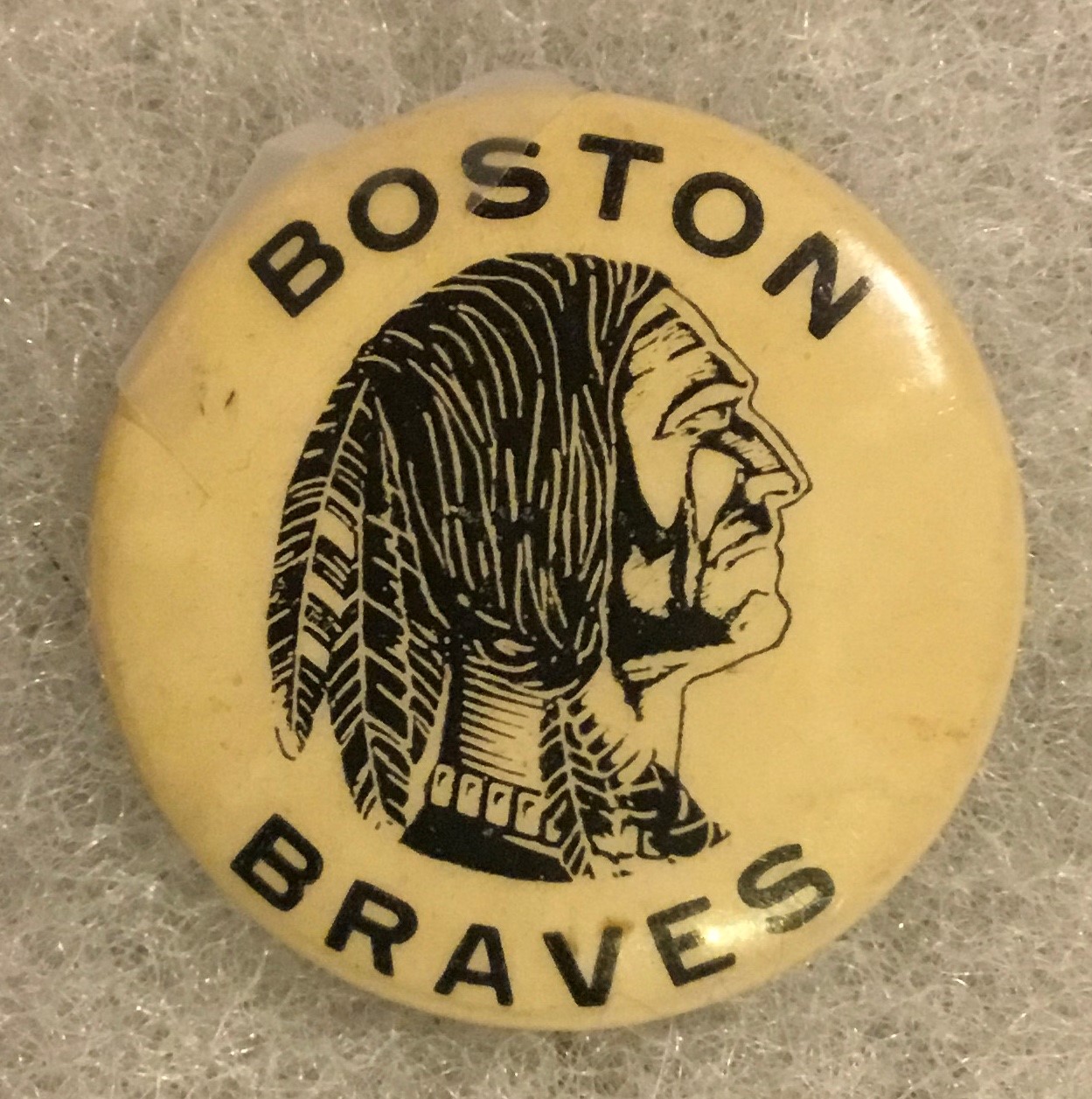
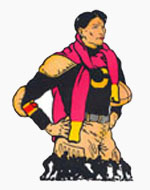
As a .500 first season, Marshall’s cohorts left, leaving him as sole owner of the team. He fired the coach, Lud Wray, and hired Lone Star Dietz, a Carlisle Indian School alum who had had success coaching at the college level. Dietz brought four of his Haskell Institute (today’s Haskell Indian Nations University) Fighting Indians star with him. The figure on the Braves’ letterhead and pin is different than the one used by the baseball team. On the baseball team logo, the man wore a headdress where the football logo image only had three feathers. I’m not qualified to determine if the football team used Saint Tammany’s profile or not. Having red on the letterhead suggests that the team’s colors changed shortly after Dietz became their head coach. The existence of the pin argues against Dietz changing the logo because he was only with the team a short amount of time before the team name was changed and it was during the off season. So, the logo on the button was probably created for the 1932 season.
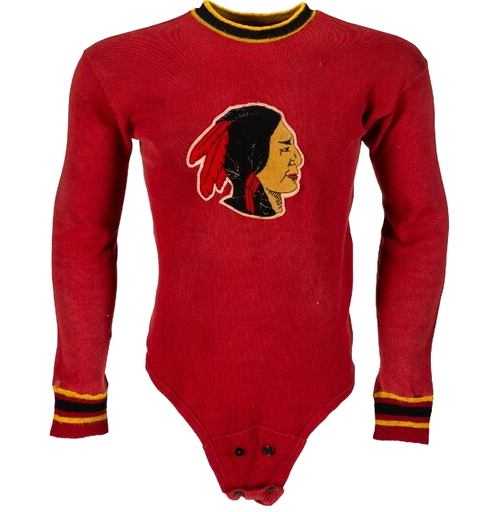
One question never asked is: Why did Marshall change the team’s colors? A 1933 jersey shown below has red as the primary color and is trimmed with gold and black bands. These colors are similar to Carlisle’s colors and the stripes on the cuffs are reminiscent of the below-the-elbow stripes on the Indians’ jerseys. Some have attributed the design of the Redskins’ logo to Lone Star Dietz. The image may have preceded him; it’s not clear when the team adopted it. Dietz likely borrowed the concept from the NHL Blackhawks’ design and placed the logo on the front of the jersey.
Probably to save money, Marshall moved the team from Braves Field to Fenway Park. To eliminate confusion with the baseball team, he felt he had to change the name. Some think red was chosen because they were then based on the Red Sox home field. A Boston newspaper writer claimed that Marshall chose the name to save money by not having to buy new uniforms. As shown in this piece, both colors and design of the team’s uniforms changed when the team’s name changed. However, the team had to wear the old uniforms in the first game of the 1933 season because the new ones hadn’t arrived yet.
Billeaudeaux thinks otherwise. “Redskins is not about race. It’s a warrior who’s gone through the bloodroot ceremony. “They shave their heads and surrender their souls to their Creator. They paint themselves red as if they were born new into the world.”
“The Redskins were the only minority representation in the entire NFL and it was a real person, not a mascot,” said Billeaudeaux. “The name Redskins is a national treasure and for that reason it should be protected. It’s a cultural treasure and deserves to be protected and understood. It’s not just about the football team. It’s about the DNA of the nation.”
NAGA members aren’t the only people who prefer Redskins for the team name. As of this writing, 130,790 people had signed NAGA’s petition demanding the team name be changed back to Redskins. “Redskins Fans Forever,” a Facebook group with 61,600 members, refers to the team only by its historic name.
Ninety percent of Native Americans around the country supported the Redskins name in a Washington Post poll in 2016, as the woke assault on the traditional name grew stronger.
Red Mesa High School on a Navajo reservation in Arizona recently installed a new football field with the Washington Redskins logo on the 50-yard line.
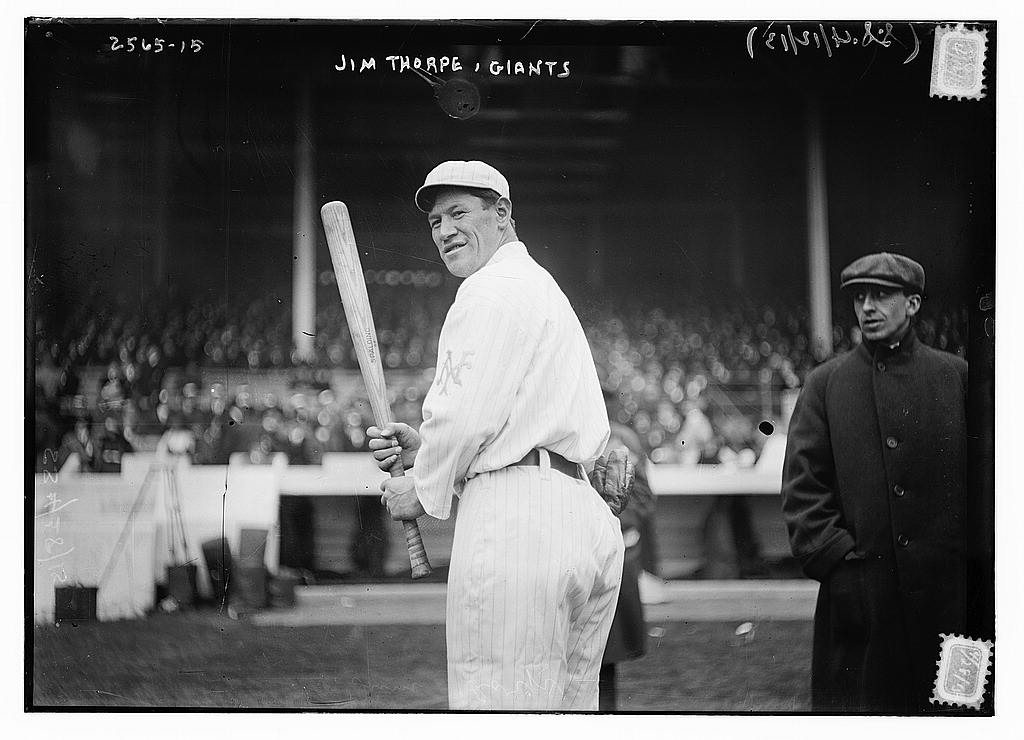
Two posts ago I opined that, had Jim Thorpe not left Carlisle in 1909 to play summer baseball and instead returned to school, he would have had a good chance of receiving tutelage as a minor league baseball player. I need to revise this conjecture and not just because he had tried out unsuccessfully for the 1908 Olympic games.
Had Thorpe returned to Carlisle for the 1909 fall term, he would have likely had another good season, his third year of eligibility for football, improving the Carlisle team’s 8-3-1 record. He might even have made Walter Camp’s Second Team. If he ran track in spring 1910, he would have used up his four years of eligibility and there were no Olympic tryouts that summer or the next. His track career would probably have come to an end because no economic opportunities existed for track and field at that time. Had he played football in the fall of 1910, he would surely have improved on Carlisle’s 8-6 record and might have made Camp’s All-America First Team, but he wouldn’t have been as dominating as he was in 1911 and 1912 because his body wouldn’t have the extra year of growth it had when he returned in 1911.
Jim would have used up all his college football and track eligibility by the end of 1910. With football not having a professional league yet, only semi-pro teams existed at the time. The irregular and unreliable income from semi-pro football would not have been enough to support him. His only likely professional athletic opportunity at that time would have been minor league baseball. He had already tried that route. While it’s impossible to know if the 1911 baseball season would have worked out better this way than it already did. Perhaps a better team in a more stable league would have picked him up. But, with two summers already under his belt, the team that signed him that summer was in a league that was insolvent, resulting in Jim being out of a job and back in Oklahoma with no good options on the horizon.
Returning to Carlisle would not have been an option because all his eligibility had been used up. Other schools would have been reluctant to enroll him because of the reactions to Frank Mt. Pleasant playing for Dickinson College in 1908 after having played for Carlisle. Some schools refused to play Dickinson if Mt. Pleasant was on the field. The four-years-of-eligibility rule was being enforced.
Had Jim returned to Carlisle after the 1909 summer, he would likely have had fewer options in 1911 than he had after not returning in 1909. Ranching would have been a good outcome for him.
Everyone knows what happens when one assumes something, so I don’t need to repeat the rest of that saying. In my last blog post I assumed Jim Thorpe had not tried out for the 1908 Olympic team and was quickly corrected by a couple of readers. Since I hadn’t bothered to look into Thorpe’s possible competing in the 1908 games, it was a good time to do a little research.
Carlisle’s 1908 track competitions started on April 25 with Penn’s Relay Carnival, as it was referred to at that time. The best track and field men across the country competed at this event. Pop Warner sent several members of his squad but the relay team and Thorpe was the only ones to medal. The relay team came in third in “Event No. 22” and Jim tied for first in the high jump with “Long John” Miller of Indiana University by clearing 6’1”. Thorpe was awarded first place by winning the coin toss.
The May 9 dual meet with State College must not have taken place. Both schools’ newspapers announced it preceding the event, but neither published the results. And no coverage was found in regular newspapers. Perhaps weather conditions caused it to be canceled. Next up was a May 14 dual meet with Syracuse at Elmira, New York. Steady rain and chilling temperatures prevented record times from being posted. Frank Mt. Pleasant, who was training for the Olympic tryouts, didn’t participate but Jim Thorpe did well scoring 21 of the winning team’s points. He won the 120-yard hurdles, 220-yard hurdles, and running high jump, while place second in the shot put and broad jump.
On May 23, Carlisle hosted a three-way meet against Swarthmore College and Dickinson College, producing a resounding victory for the Indians. Thorpe broke school records while coming in second in the shot put and winning the 220-yard hurdles. He also won the high jump and broad jump but came in third in the 120-yard high hurdles.
Carlisle last meet of the season was for the 1st Annual State Intercollegiate Championship in front of 8,000 spectators at Harrisburg on May 30. The Indians won the meet with a 17 ½ point margin over second-place finisher Lafayette. Pitt, Penn State, Swarthmore, Dickinson, Lehigh, Washington & Jefferson, and Gettysburg each scored at least one point in the meet. Jim won the high jump with a jump of 6’0”. He came in second in the 220-yard hurdles and the 16-pound shotput. Carlisle’s season was over but Thorpe’s wasn’t.
Pop Warner brought Jim Thorpe, Frank Mt. Pleasant, Lewis Tewanima, John Corn, and Walter Hunt back to Franklin Field, the site of the Penn Relays, for the Olympic tryouts. Mt. Pleasant came in second, ¼ inch behind the first place finisher in the broad jump. Thorpe didn’t place in either the high jump or broad jump. Tewanima came in third in the 5-mile run but Corn and Hunt didn’t place in that event. Only Mt. Pleasant was initially selected for the team. Tewanima was added to the supplemental list later. Thorpe reputedly spent the summer in Oklahoma.
While discussing an article I had written about the 1908 Carlisle Indian School football team, the editor of the journal that is going to publish it in the spring asked about Jim Thorpe’s contributions. 1908 was Thorpe’s second year on the football team, the first as a starter. He played well and Walter Camp selected him for his All-America Third Team. The 1908 team wasn’t nearly as good as the 1907 squad, the best Carlisle had fielded to that point, having defeated both Harvard and Penn.
Jim Thorpe left Carlisle after the spring 1909 track season to play summer baseball in the Carolinas. He didn’t return to Carlisle as a student or athlete the next two school years. When Albert Exendine ran into Thorpe in Anadarko, Oklahoma during the summer of 1911, he saw a different person than the skinny kid he had tutored for track events. Jim had left as a boy but would return with the muscular physique of an adult man.
What Thorpe accomplished in 1911 and 1912 on the football field, in track and field, and in the Olympics is well known. When thinking about this, it dawned on me that had Thorpe returned to Carlisle at the end of summer 1909 and continued competing for Carlisle, he would not likely have accomplished what he did when he returned two years later. The additional size and strength he had gained helped him immensely in both football and track.
The 1908 Olympics were held after the end of a successful 1908 track season but Jim wasn’t encouraged to try out for the team. Two other Carlislians were on America’s 1908 squad, Lewis Tewanima and Frank Mt. Pleasant. So, Warner was well aware a team representing the country was being assembled but, as much as he valued Thorpe on his team, he apparently didn’t consider Jim ready to compete internationally.
Thorpe would have likely had another good year playing football in 1909, maybe even making Walter Camp’s Second Team. He would have used up his four years of eligibility in track in spring 1910 and for football in that fall. He might have even made Camp’s First Team but he wouldn’t likely have been as dominating as he was in 1911 and 1912, years he wouldn’t have competed in had he not taken the two-year hiatus. His only likely professional athletic opportunity would have been minor league baseball. Had he taken that route, he could have received the tutelage he needed to develop into a complete major league player.
Filled out, Warner encouraged Jim to try out for the 1912 Olympics and trained him for the games. The adult Jim Thorpe had the size and strength to run roughshod over the best football players in the country and to top the best cindermen in a grueling variety of events. Had he returned to Carlisle after playing summer baseball in 1909, he would not likely have been a two-time Walter Camp First Team All-American or gold medal winner in either the pentathlon or decathlon at the 1912 Summer Games. He may not have even tried out for the team.
Rather than harming Jim, playing summer baseball ultimately led to him achieving things few others have been able to do. He is still considered the finest all-around athlete the world has ever produced. The skinny kid could not have won the gold medals but he might have ultimately had a long, successful baseball career.
I had not heard of the Native American Guardian’s Association (NAGA) prior to Google informing me that they were fighting to have the Washington NFL team reinstate the Redskins name. Perusing their website, https://www.nagaeducation.org/, I found their motto, “Educate Not Eradicate,” and their mission statement:
“The Native American Guardian’s Association (NAGA) is a 501c3 non-profit organization advocating for increased education about Native Americans, especially in public educational institutions, and greater recognition of Native American Heritage through the high profile venues of sports and other public platforms.”
Also on the front page was a large photo of the Red Mesa Redskins’ new football field. Red Mesa is a high school on the Navajo reservation.
The History tab states, “NAGA celebrates and promotes the rich history, legacies, and many national contributions of First Nation’s people which have historically been woven into the fabric of American identity.” It is a statement of inclusion and being part of what has been called “The American Experiment.” It is accompanied by a photo of men wearing red garrison caps reminiscent of the ones one often sees American Legion members wear. There’s a good chance many of these men are veterans because American Indians serve in the armed forces at a higher rate than the population at large, particularly during wartime.
This website is information rich, containing a lot more information than I can mention in a blog message. I urge you to peruse the site to see for yourself. Of particular interest is the Top Misconceptions tab. It has links to ten pages, starting with “Redskins is Racist.” Another link discusses polls that show vast numbers of American Indians do not consider Redskins or Redmen to be racist. One link shows that leaders who oppose the name speak only for themselves. The link on the 90% polls explains that the polls were conducted using normal polling methods and have, at least, a 95% confidence level. Some are as high as 98%.
Check out this site to learn more about how people in Indian Country think about things.
On June 1, 2020 I posted a photograph taken at Union Station in St. Louis in 1908. Five Carlisle Indian School football players posed in a Thomas automobile used as a prop by a photographer who operated in the train station. Cecilia Balenti-Moddelmog, grandaughter of Carlisle star quarterback Mike Balenti, identified four of the five young men in the photo but could not identify the person on the far right.
The others are l-to-r Little Boy (Scott Porter), Wauseka (Emil Hauser), Mike Balenti and Fritz Hendricks.
Now Dennis Parrish has identified the player on the far right as John Balenti, Mike’s brother. In the team photo below, he is in the back row fourth person from the left. At least that is what the Pittsburgh Press said.
Why Mike’s granddaughter didn’t recognize her great uncle is a reasonable question. However, I had an uncle I never met even though he was alive decades into my adult life. I am so bad at picking people from old photos that I’m little help sorting out this one.







 Tom Benjey's Weblog
