Archive for the ‘Albert Exendine’ Category
December 15, 2008
Recently a question was raised on this blog about American Indian leadership in athletics. Saturday’s action by the Downtown Athletic Club to award the Heisman Trophy to Sam Bradford may spread this discussion to a broader audience. The Oklahoma University quarterback, being 1/16th Cherokee, is enrolled in the tribe. Last year an ESPN announcer was unintentionally humorous when he stated that Bradford was “certified Cherokee.” The announcer was cut some slack because the enrollment process is very complicated.
Sam’s great-great-grandmother, Susie Walkingstick, was full-blood Cherokee. His father, former OU lineman Kent Bradford, is 1/8th blood Cherokee. It is appropriate that this Heisman winner plays for Oklahoma University because Oklahoma has the largest American Indian population of any state. Fellow Oklahoman Sac & Fox Jim Thorpe did not win the Heisman because that award wasn’t initiated until 1935 when the University of Chicago’s Jay Berwanger became the first recipient of the trophy with the famous pose. Jim Plunkett, being Mexican-American, was probably the first person with significant quantities of Indian blood to win the Heisman when he was named in 1970. Since then, it hasn’t been close. Not even fellow Cherokee Sonny Sixkiller who played quarterback for the Washington Huskies two decades later contended seriously.
A USA Today cover story http://www.usatoday.com/sports/college/football/big12/2008-12-09-bradford-cover_N.htm discusses the impact Bradford’s candidacy has already had on Indian children. Like Sixkiller, Bradford did not live on a reservation and grew up with little exposure to his Cherokee heritage. Anadarko, OK was home for College Football Hall of Famer Albert Exendine, star end at Carlisle. Anadarko is also the town in which Exendine, in the summer of 1911, encouraged Jim Thorpe to return to Carlisle. Alongside this history exists Riverside Indian School, a place where one would expect football to thrive. But that hasn’t been the case. Riverside dropped football a few years ago but, due to Bradford’s inspiration, fielded a team this year. Forty boys came out for the team – not bad for a school that has only 400 students who range in age from 4th grade to high school. The Braves only won one game but this was their inaugural season. The important question is: Are they running the single-wing?

USA Today photo of Sam Bradford with his Heisman Trophy
Tags:Cherokee, Heisman Trophy, Kent Bradford, Riverside Indian School, Sam Bradford, Susie Walkingstick
Posted in Albert Exendine, Carlisle Indian School, Jim Thorpe, Single-Wing | Leave a Comment »
December 2, 2008
The December 1 issue of Sports Illustrated has an article on the single-wing. The writer, Tim Layden, first discusses the formation’s current use at Apopka High 15 miles northwest of Orlando and in the NFL by the Dolphins in their unexpected victory over the unsuspecting New England Patriots. Also mentioned is Todd Bross, organizer of the annual spring conclave at Kings College in Wilkes-Barre, PA. (It was Todd Bross and Ted Seay who urged me to research Pop Warner’s correspondence course in football that was first published in 1908). Layden discussed the renaissance the single-wing is undergoing but was apparently unaware that little Windber Area High School is running it as he was probably unaware of my documentary in which they were featured.
The article talks about viewing old films over Ed Racely’s garage on Cape Cod. Racely, now 80, has been studying the single-wing longer than anyone. Layden then goes into the single-wing’s history beginning with President Theodore Roosevelt’s 1905 threat to ban the game unless rule changes weren’t made to clean up the game. He goes on the mention that Pop Warner coached Carlisle Indian School from 1907 to 1914 and quotes Warner as having first used early incarnations of the single wing by the Carlisle Indians in response to the 1906 rule changes. He is apparently unaware of Pop’s earlier tenure at Carlisle (1899-1903) and of my research that uncovered Warner’s weeklong visit with the Carlisle coaches shortly before the start of the 1906 season. He made no mention of the revisions to Warner’s correspondence course between 1909 and 1911, nor did he mention my publication of the offense pamphlets from the correspondence course. The diagrams found those pamphlets represent the earliest known documentation of the single-wing. A 1924 newspaper interview of Warner was accompanied by a diagram of a formation that “The Old Fox” designed in 1902 to protect injured linemen Antonio Lubo, Martin Wheelock and Albert Exendine and to adjust for injured first-string center, Nikifer Schouchuk. It’s too bad that wingback diagram wasn’t made public a couple of decades earlier. The Sports Illustrated article can be found at:
http://vault.sportsillustrated.cnn.com/vault/article/magazine/MAG1149161/index.htm
Tags:Bill Belichick, Ed Racely, Miami Dolphins, New England Patriots, Nikifer Schouchuk, Sports Illustrated, Ted Seay, Tim Layden, Todd Bross, Wildcat formation, Windber
Posted in Albert Exendine, Antonio Lubo, Carlisle Indian School, Football, Martin Wheelock, Pop Warner, Single-Wing | 5 Comments »
November 27, 2008
These days authors are supposed to have video previews of their books posted on the web for all to see. I was also instructed to make a video of me reading from my new book. Knowing full well that few would want to look at me reading for any period of time, I took a different approach. I read the words Pop Warner said in a 1924 interview in which he told of an episode that clearly shows what kind of stuff the Carlisle Indians were made of. After getting the thing started, I mostly disappear from view and am replaced by other footage and still photographs. Warner’s story is fascinating and, as best I can tell, is true. Because he told it over twenty years after it happened, he may have had some details confused. But the major things check out.
The story is a bit long but, when I’ve read it in book talks, audiences enjoy it because it is such a good story and, to my knowledge, hasn’t been told since the 1920s. YouTube.com enforces a strict time limit on videos that may be posted on their site, so it was necessary to split the story into two pieces. The first, and longer, part has been created and posted. The second and more interesting conclusion will be posted next week. “Carlisle Indians Had The Right Stuff” can be found at www.YouTube.com/TomBenjey. This is a chance to learn more about people such as Albert Exendine, Nikifer Schouchuk, Antonio Lubo, Martin Wheelock, James Johnson, Charles Williams and Richard Henry Pratt.
Feel free to make comments, either positive or negative.
Tags:Carlisle vs. Cornell 1902, Nikifer Schouchuk
Posted in Albert Exendine, Antonio Lubo, Carlisle Indian School, Charles Williams, Doctors, Lawyers, Indian Chiefs, James Johnson, Martin Wheelock, Pop Warner, Richard Henry Pratt | Leave a Comment »
September 5, 2008
Yesterday’s email brought a curious announcement. I am going to receive a free, signed copy of a new book to be released soon. The Toilet Paper Entrepreneur by Mike Michalowicz, about which I know nothing, was looking for humorous bathroom graffiti. I sent in my all-time favorite from the back of the men’s room door at The Blessed Oliver Plunket, a bar/restaurant featuring live entertainment located across the street from the Cumberland County Historical Society. The Plunket, as it was better known, has numerous stories to tell but I’m not the one to tell them. In the late 70s, as I was leaving the men’s room, I noticed a scribble on the door:
No sign of intelligent life…Kirk Out
Apparently that witticism has found its way into a book.
Back to Donna Newashe McAllister’s question…
I expected that more people would comment on this and would like to see more myself. So, I’ll share some of my thoughts.
My wife and I have discussed this issue to some degree and I think it is an issue with multiple facets. First, I’m not so sure that American Indian athletes have necessarily declined. Judging today’s athletes with those who were at the Carlisle Indian School may not be fair. Those guys were world-class athletes coached by one of the most innovative coaches of all time. Pop Warner is criticized much today but few question his knowledge or his ability to coach football. During its heyday, Haskell had fine athletes and was led by Dick Hanley, Lone Star Dietz and Gus Welch, all of whom were excellent coaches. Dietz belongs in the College Football Hall of Fame. Neither Haskell nor the tribal colleges can afford to hire coaches of their caliber today.
Bob Wheeler tells me that Bill Thorpe shoots better than his age, 80, in golf. To compare anyone with Jim Thorpe is unfair. He was the greatest athlete of all time and could do anything well. I can’t imagine how he could be competitive in the pole vault, but he was. Sam Bird’s grandchildren and great-grandchildren are big in the rodeo. Some of the others didn’t have children and many settled off the reservation. For example, Joe Guyon was a big star at Carlisle, Georgia Tech and in the NFL where Joe Guyon, Jr. played for Catholic University.
But you seem to be focused more on leadership than on athletic ability. It appears to me that many of the better leaders did not return to the reservation after finishing at Carlisle or Haskell. Several were officers in WWI and were leaders in the service but didn’t return to lead their tribes. Some kept one foot in each world and their children found more opportunity in white society. For example, Thomas St. Germain’s son, grandson and great-grandson were/are renowned research physicians at Tulane University School of Medicine.
It may be that Indians are playing leadership roles individually but not together as a group. MANY of the Carlisle players went into coaching but Dietz, Exendine and Welch were about the only ones who made it their life’s work. Coaching was an even more precarious occupation then than now and only the best schools paid well. So, most devoted their considerable talents to other occupations. Even Exendine and Welch practiced law in the off-season.
Surely, other people have some insight into this issue.
Tags:Bill Thorpe, Blessed Oliver Plunket, Bob Wheeler, Dick Hanley, Mike Michalowicz, The Toilet Paper Entrepreneur
Posted in Albert Exendine, Carlisle Indian School, Football, Gus Welch, Jim Thorpe, Joe Guyon, Lone Star Dietz, Pop Warner, Sampson Bird, Thomas St. Germain, William Newashe | 2 Comments »
July 21, 2008
The 1904 Olympics were not the first games to feature football. The 1900 Paris games included two football events neither of which were American football. Soccer and rugby were both played that year but in 1904 American football appeared in the Olympics for the first time. Football (soccer) was a demonstration sport in which three teams played a round-robin tournament between two American teams and a Canadian club. The Canadians won the gold. Several college football games were played on Francis Field at the fair. Washington University and St. Louis University each played a number of their games on the Olympic field. Missouri and Purdue even played there. Prior to the Fair, Washington U’s teams were known as the Purities but due to playing at the Fair were renamed the Pikers in 1905 as a comment on their association with the infamous world fair’s Pike. However, the most important college football game played at the 1904 Olympics wasn’t played by colleges.
President Theodore Roosevelt was to visit the Fair over Thanksgiving weekend making it an ideal time for a major football event (read moneymaker). The Fair organizers’ first choice was to have West Point and Annapolis relocate their annual contest to the fairgrounds but that didn’t happen. Haskell Institute’s Fightin’ Indians were tearing up the Midwest at that time and Carlisle was a top ten program. So, the first ever football game between the two government Indian schools was arranged for the Saturday after Thanksgiving. Carlisle already had a Thanksgiving Day game scheduled against Ohio State in Columbus. Major Mercer, the new Carlisle superintendent, very likely saw the opportunities such a high profile game would create for him and his school and added the game to the schedule. Playing two games in three days may have been taxing for Carlisle’s players, so Head Coach Ed Rogers (Pop Warner was back at Cornell for the 1904-6 seasons) drubbed the Buckeyes with his second team 23-0. Ohio State supporters were unhappy to miss seeing the Carlisle stars they had read so much about.
Rumors of Haskell bringing in ringers, some of them white, were rampant. To balance the scales, Ed Rogers suited up for the game as did Assistant Coach Bemus Pierce and his brother, another former Carlisle and pro star, Hawley Pierce. They needn’t have bothered. Carlisle obliterated Haskell 38 to 4. Seeing the superiority of the Carlisle program, eight Haskell players transferred to the eastern school where many became stars. If there was an Olympic gold medal to have been won Carlisle would have won it, but none was. However, the Carlisle Indians were the closest thing to an Olympic football champion that we’ve had – if you ignore the 1920 and 1924 U.S. rugby teams. But that’s a story for another time.
The Native American game of lacrosse was played at the 1904 Olympics but mostly by non-natives. Three teams, two from Canada and one from the U.S., vied for the championship. The Canadian Shamrocks won the gold, the St. Louis Amateur Athletic Association won silver, and, in a bit of irony, the Mohawk Indians from Canada got the bronze.
Next time we take a look at the 1908 games.
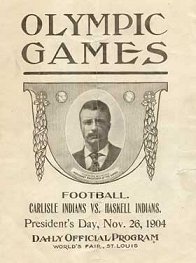
1904 Carlisle-Haskell game program cover
Tags:1904 Olympics, Haskell Institute, lacrosse, St. Louis World's Fair, Theodore Roosevelt
Posted in Albert Exendine, Carlisle Indian School, Charles Guyon, Ed Rogers, Emil Hauser, Football, Frank Mt. Pleasant, Hawley Pierce, Joe Guyon, Wauseka | Leave a Comment »
May 27, 2008
The advance reading copies (called ARCs in the trade) arrived for my new book and are being sent out to reviewers. This is a big moment in a writer’s life: seeing thousands of hours of hard work turned into something tangible. In the old days (pre-computer), ARCs were called galleys, bound galleys or galley proofs. Authors, editors and publishers go over these babies with a fine-tooth comb looking for errors, typos or things that have changed since writing was complete. It is an impossible task because, after all this scrutiny, some typos escape and find their way into the final book. But we try.
Another important use of ARCs is to see how the photos and artwork come out in print. Overall they came out very well, better than expected. But a cartoon about the Oorang Indians from a 1922 Baltimore newspaper is too dim. The challenge now is to figure out how to darken it without losing the detail.
This weekend I received some additional information and a correction regarding Louis Island from a family member who happened to see a previous blog. That was fortuitous because I want the book to be as accurate as possible. This blog is already proving to be of some value. That encourages me to continue with it.
Having these ARCs provides local booksellers the opportunity to provide their customers something extra. People can look at an ARC and pre-order the book if they choose. The bonus, besides being sure of getting a copy of the book as soon as it comes out, is to receive an inscription of his or her choice signed by the author. On-line booksellers also take pre-orders but personalized inscriptions are impractical.

Tags:Add new tag, ARC, biography, book, galleys, Louis Island
Posted in Albert Exendine, Alex Arcasa, Antonio Lubo, Archie Libby, Arthur Sheldon, Bemus Pierce, Benjamin Caswell, Caleb Sickles, Carlisle Indian School, Charles Guyon, Charles Williams, Dickinson College, Doctors, Lawyers, Indian Chiefs, Ed Rogers, Elmer Busch, Emil Hauser, Football, Frank Cayou, Frank Hudson, Frank Mt. Pleasant, Fred Broker, George May, George Tibbits, George Vedernack, Gus Welch, Hawley Pierce, Henry Broker, Hugh Wheelock, Isaac Seneca, James Johnson, James Phillips, Jim Thorpe, Joe Bergie, Joe Guyon, Joe Libby, Joel Wheelock, John B. Flinchum, Leon Boutwell, Lone Star Dietz, Louis Island, Martin Wheelock, Nicholas Bowen, Nick Lassa, Pete Calac, Pete Hauser, Pop Warner, Sampson Bird, Single-Wing, Stacy Matlock, Stancil Powell, Thomas St. Germain, Victor Kelly, Washington Redskins, Washington State University, Wauseka, William Baine, William Gardner, William Garlow, William Newashe | Leave a Comment »
March 28, 2008
Yesterday I came across a December 8, 2007 article in The News Tribune out of Tacoma, Washington. In it reporter Todd Miles wrote, “Not since 1917 have the Washington State Cougars had a minority head coach in football.” Putting aside the fact that Washington State’s teams weren’t called the Cougars in 1917, the statement is still incorrect. Yes, Lone Star Dietz coached the 1918 Mare Island Marine team that was featured in WSC’s yearbook because ten players were from WSC. And, although Dietz considered it Washington State’s second Rose Bowl team, it didn’t wear crimson and gray. The major error is that not one but two minority coaches were overlooked. This is why we study history.
When Dietz was unceremoniously dumped in early 1919, WSC wanted another coach who was steeped in the Warner system because Dietz had been wildly successful with it. So, the administration looked for someone with experience, not just with the single and double-wing formations but with the whole system. Recall that Ace Clark thought that the way Lone Star conditioned his players and reduced the amount of scrimmaging left them in better shape for the games. Albert Exendine was a logical choice but he was under contract at Georgetown. Eventually Gus Welch was tracked down on a former battlefield in France and recruited for the job.
Gus Welch was Chippewa from Wisconsin and Al Exendine was Delaware and Cherokee from Oklahoma, but they have a lot of similarities. Both attended Carlisle Indian School and starred on its teams, Exendine at end and Welch at quarterback (blocking back in Warner’s single-wing). Both got their law degrees from Dickinson School of Law (now part of Penn State) across town from the Indian school. Both had long careers of coaching football in the fall and practicing law the rest of the year. Both were inducted into the College Football Hall of Fame as players. And both coached Washington State. Welch led the team from 1919 through 1922 and Exendine took over in 1923, lasting through the 1925 season. Each has a chapter devoted to him in Doctors, Lawyers, Indian Chiefs.
So, Washington State has a history of hiring minority head football coaches, just not lately.
Tags:Ace Clark, Dickinson School of Law, Mare Island Marines, Penn State, Rose Bowl
Posted in Albert Exendine, Carlisle Indian School, Football, Gus Welch, Lone Star Dietz, Pop Warner, Single-Wing, Washington State University | Leave a Comment »



 Tom Benjey's Weblog
