Posts Tagged ‘Olympics’

A Likely Outcome

August 29, 2023

Two posts ago I opined that, had Jim Thorpe not left Carlisle in 1909 to play summer baseball and instead returned to school, he would have had a good chance of receiving tutelage as a minor league baseball player. I need to revise this conjecture and not just because he had tried out unsuccessfully for the 1908 Olympic games.

Had Thorpe returned to Carlisle for the 1909 fall term, he would have likely had another good season, his third year of eligibility for football, improving the Carlisle team’s 8-3-1 record. He might even have made Walter Camp’s Second Team. If he ran track in spring 1910, he would have used up his four years of eligibility and there were no Olympic tryouts that summer or the next. His track career would probably have come to an end because no economic opportunities existed for track and field at that time. Had he played football in the fall of 1910, he would surely have improved on Carlisle’s 8-6 record and might have made Camp’s All-America First Team, but he wouldn’t have been as dominating as he was in 1911 and 1912 because his body wouldn’t have the extra year of growth it had when he returned in 1911.

Jim would have used up all his college football and track eligibility by the end of 1910. With football not having a professional league yet, only semi-pro teams existed at the time. The irregular and unreliable income from semi-pro football would not have been enough to support him. His only likely professional athletic opportunity at that time would have been minor league baseball. He had already tried that route. While it’s impossible to know if the 1911 baseball season would have worked out better this way than it already did. Perhaps a better team in a more stable league would have picked him up. But, with two summers already under his belt, the team that signed him that summer was in a league that was insolvent, resulting in Jim being out of a job and back in Oklahoma with no good options on the horizon.

Returning to Carlisle would not have been an option because all his eligibility had been used up. Other schools would have been reluctant to enroll him because of the reactions to Frank Mt. Pleasant playing for Dickinson College in 1908 after having played for Carlisle. Some schools refused to play Dickinson if Mt. Pleasant was on the field. The four-years-of-eligibility rule was being enforced.

Had Jim returned to Carlisle after the 1909 summer, he would likely have had fewer options in 1911 than he had after not returning in 1909. Ranching would have been a good outcome for him.
What Might Have Been

August 19, 2023

While discussing an article I had written about the 1908 Carlisle Indian School football team, the editor of the journal that is going to publish it in the spring asked about Jim Thorpe’s contributions. 1908 was Thorpe’s second year on the football team, the first as a starter. He played well and Walter Camp selected him for his All-America Third Team. The 1908 team wasn’t nearly as good as the 1907 squad, the best Carlisle had fielded to that point, having defeated both Harvard and Penn.

Jim Thorpe left Carlisle after the spring 1909 track season to play summer baseball in the Carolinas. He didn’t return to Carlisle as a student or athlete the next two school years. When Albert Exendine ran into Thorpe in Anadarko, Oklahoma during the summer of 1911, he saw a different person than the skinny kid he had tutored for track events. Jim had left as a boy but would return with the muscular physique of an adult man.

What Thorpe accomplished in 1911 and 1912 on the football field, in track and field, and in the Olympics is well known. When thinking about this, it dawned on me that had Thorpe returned to Carlisle at the end of summer 1909 and continued competing for Carlisle, he would not likely have accomplished what he did when he returned two years later. The additional size and strength he had gained helped him immensely in both football and track.

The 1908 Olympics were held after the end of a successful 1908 track season but Jim wasn’t encouraged to try out for the team. Two other Carlislians were on America’s 1908 squad, Lewis Tewanima and Frank Mt. Pleasant. So, Warner was well aware a team representing the country was being assembled but, as much as he valued Thorpe on his team, he apparently didn’t consider Jim ready to compete internationally.

Thorpe would have likely had another good year playing football in 1909, maybe even making Walter Camp’s Second Team. He would have used up his four years of eligibility in track in spring 1910 and for football in that fall. He might have even made Camp’s First Team but he wouldn’t likely have been as dominating as he was in 1911 and 1912, years he wouldn’t have competed in had he not taken the two-year hiatus. His only likely professional athletic opportunity would have been minor league baseball. Had he taken that route, he could have received the tutelage he needed to develop into a complete major league player.

Filled out, Warner encouraged Jim to try out for the 1912 Olympics and trained him for the games. The adult Jim Thorpe had the size and strength to run roughshod over the best football players in the country and to top the best cindermen in a grueling variety of events. Had he returned to Carlisle after playing summer baseball in 1909, he would not likely have been a two-time Walter Camp First Team All-American or gold medal winner in either the pentathlon or decathlon at the 1912 Summer Games. He may not have even tried out for the team.

Rather than harming Jim, playing summer baseball ultimately led to him achieving things few others have been able to do. He is still considered the finest all-around athlete the world has ever produced. The skinny kid could not have won the gold medals but he might have ultimately had a long, successful baseball career.

Return of the Conquering Heroes

September 30, 2022

Jim Thorpe’s return to Carlisle after the 1912 Olympics was incorrectly described in at least one newspaper of the day and that description has found its way into current books on Jim Thorpe. Fortunately, The Star-Independent of Harrisburg, PA captured the event in minute detail in its August 16, 1912 edition. However, the article was too detailed to be included in this short piece. There is only room to summarize it here.

A crowd estimated to be between six and seven thousand people congregated at the Cumberland Valley Railroad (CVRR) station across from the James Wilson Hotel a block from the square in Carlisle for Thorpe’s expected arrival at 12:30 p.m.. The crowd-shy hero avoided this multitude by getting off the train at Gettysburg Junction, where the South Mountain Railroad connected with the CVRR, about a mile east of the square. Automobiles waiting there secreted Thorpe, Lewis Tewanima, and Pop Warner to Carlisle Indian School, where they were “greeted informally by students and their closest friends.”

From the Indian school the trio progressed to the parade which was split into three divisions, each of which was formed separately. The honorees were part of the first division which assembled along North Hanover Street, with its head at High Street (colloquially Main Street). Scheduled to start at 2:00 p.m., the parade, led by the first division, progressed east on High Street to Bedford Street, then followed a circuitous route along portions of each of the major streets in the center of town, eventually arriving at Biddle Field on the Dickinson College campus. There the official festivities started. After much speechifying, various events took place in town and on the Indian school campus (Carlisle Barracks). Fireworks were scheduled for 8:30 p.m. (EST probably), which were followed by an invitation-only reception and dance in the school’s gymnasium (present day Thorpe Hall) to close the day’s festivities.

Abel Kiviat, Olympian

September 1, 2020
Abel Kiviat

Last week I had the pleasure of meeting Jeff Benjamin and his father Jack at Wardecker’s Menswear and Jim Thorpe Museum in Carlisle. Jeff is a high school history teacher, a runner, and Senior Writer For The Running Network. His research topic is Abel Kiviat (6/23/1892-8/24/1991), the Hebrew runner as he was referred to in his day. Why might you ask was someone interested in a person with no direct ties to Carlisle, the Indian School, Dickinson College, the US Army War College or Carlisle Barracks come to Wardecker’s? Kiviat was Jim Thorpe’s roommate aboard the SS Finland on the voyage to Stockholm to compete in the 1912 Olympics.

 Kiviat was a distance runner, as was his teammate on the ship, Carlisle’s Lewis Tewanima but they didn’t compete against each other in the Olympics. Kiviat came in second in the 1500 meter race to Britain’s Arnold Jackson, who broke Kiviat’s world record to win the gold medal. Kiviat also competed in the 3000 meter team event in which each country competing entered five runners as a team. Kiviat, coming in second overall, led the American contingent to a gold medal in the event.

Abel Kiviat had another tie to Carlisle. He trained with and competed for the Irish-American Athletic Club out of New York City. While preparing for the 1908 Olympics, Carlisle’s Frank Mt. Pleasant, who had no Irish ancestry either, had also trained with the Irish-American Athletic Club.

L-to-R. Jack Benjamin, Freddie Wardecker, Jeff Benjamin

Restore Jim Thorpe’s Records

July 16, 2020

Thanks in great part to Florence Ridlon’s and Bob Wheeler’s tireless efforts, Jim Thorpe’s Olympic medals were restored in 1983. That isn’t entirely accurate. Thorpe’s original medals were supposed to be kept secure in a museum but were stolen. So, the medals his children were given were commemorative ones, not their father’s actual medals. The IOC may have restored his medals, sort of, but only listed him as co-champion of the 1912 decathlon and pentathlon, the two multi-event competitions he won but his times, distances and points were not restored. The IOC records still list the second-place finishers as the winning marks. Now, people are trying to do something about that injustice.

BrightPathStrong.com is circulating a petition with the goal of restoring Jim Thorpe’s records. For those who might not be aware, Bright Path is the Anglicized version of Jim’s Sac and Fox name. Here is a link to their site:

https://brightpathstrong.com/petition

Thorpe Lost Olympic Medals 100 Years Ago

January 29, 2013

Last Thursday, Carlisle Sentinel reporter Joe Cress called to remind me that the 100th anniversary of the discovery of Jim Thorpe’s professionalism was imminent. Joe was essentially right. In late-January 1913, Roy Johnson of the Worcester Telegram, wrote an article challenging Jim Thorpe’s amateur status, based on a conversation he had with Charles C. A. Clancy, manager of the Winston-Salem baseball team of the Carolina League. According to Johnson’s article, Clancy claimed that he paid Thorpe to pitch and play first base for his team during the 1910 season. On January 19, 1913, charges claiming Thorpe was not an amateur were filed with the AAU. On January 23, an interview of Clancy was published in which he denied that Thorpe played for his team or on any other team in the Carolina Association. On January 25, Pop Warner restated Clancy’s position that Thorpe had not played for his team. That same day, the AP reported that Thorpe was negotiating a contract with the Tecumseh professional hockey team to play for them the next season.

An International News Service article dated January 25, 1913 included a claim by Peter Boyle stating that he played with Jim Thorpe in the Eastern Carolina Association. He also claimed that he was traded to the Rocky Mountain team in 1910 for Thorpe who was then playing for Fayetteville. On January 27, the AAU informed newspapers via telegram that “All doubt as to the truth of the charges has vanished and the members of the American Olympic Committee are prepared to make their apologies to the Swedes for having used Thorpe in the Olympic games.” Shortly after that, Thorpe sent the AAU a letter (probably written by Warner) admitting his “professionalism” and returned his gold medals and other trophies.

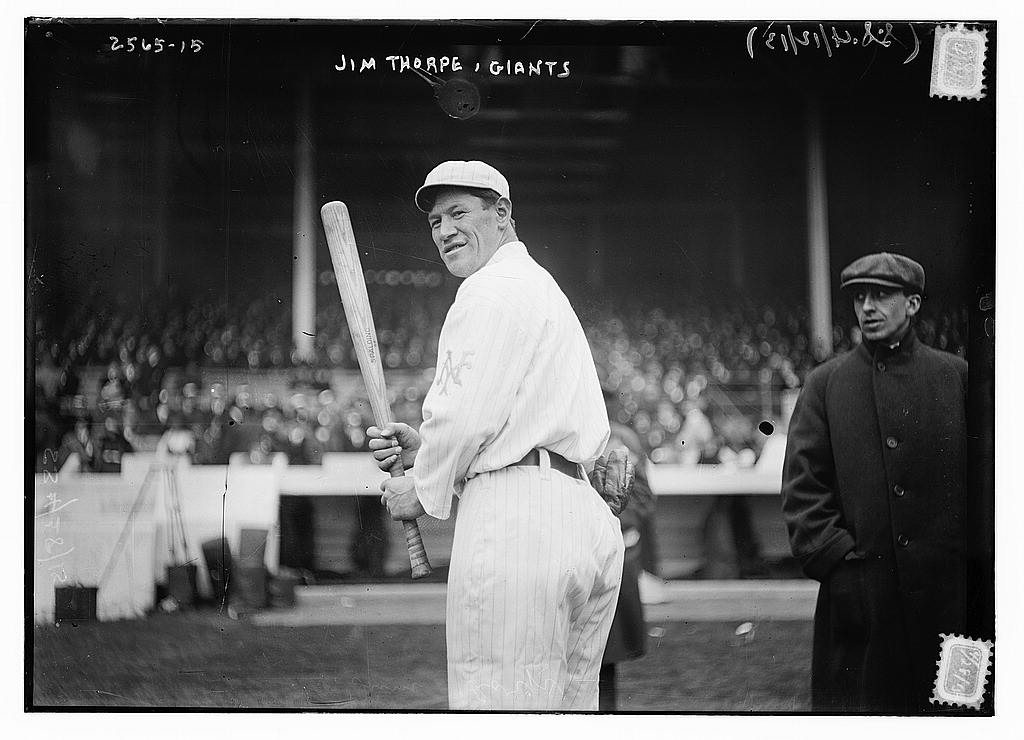
Soon after this, Thorpe signed with the New York Giants but that is a story in itself.

http://cumberlink.com/news/local/history/thorpe-admitted-to-professionalism-years-ago/article_22e2ec04-6903-11e2-a4b1-0019bb2963f4.html

Today’s Event at the National Museum of the American Indian

August 17, 2012

Several decades ago, Robert W. Wheeler then a grad student at Syracuse hitchhiked coast to coast carrying an incredibly heavy reel-to-reel tape recorder to interview acquaintances of Jim Thorpe for his master’s thesis. The project grew as the miles rolled on. His budget, however, didn’t grow. But Bob persevered.

Years—it probably felt like decades—later, he had not just a master’s thesis but a full length biography of the world’s greatest athlete. After reading the book, Dick Schaap referred to Bob as Jim Thorpe’s Boswell, drawing an analogy to the thoroughness of his research in comparison to that done by James Boswell in documenting the life of Samuel Johnson. Since Wheeler’s book was first published, several other biographies of Thorpe have been written but they all draw on the painstaking work done by Wheeler.

The National Museum of the American Indian (NMAI) is celebrating of the 100th anniversary of Jim Thorpe’s triumphs in the Stockholm Games along with other Native Americans’ participation, many for medals, in the Olympics. The entrance to the exhibit features a blown up photograph of Carlisle Indian Frank Mt. Pleasant broad jumping in his Dickinson College track uniform. Here is a link to information about the exhibit: http://nmai.si.edu/explore/exhibitions/item/504/

Today, Bob Wheeler is giving a talk at the NMAI that I will be attending. Those unable to attend can hear Bob speak on the NMAI’s webcast of the event. Here is a link to the webcast: http://nmai.si.edu/calendar/?trumbaEmbed=date%3D20120817 Also speaking will be Flo Ridlon, Bob’s wife, who played a crucial role in getting Thorpe’s Olympic medals restored. Both are spellbinding speakers. This is an event not to miss.

Native Americans in 1904 Olympics – Part I

July 16, 2008

News outlets are now getting interested in Native Americans’ participation in past Olympics, so I should share a little of that history in case the media should overlook important contributions. Everyone knows about the incomparable Jim Thorpe’s triumphs in the 1912 Stockholm Olympics, but Native Americans were involved much earlier than that. There was too much earlier involvement to cover in one message, so I’ll break this topic into installments beginning with the 1904 games held in St. Louis as part of the World’s Fair (more properly called the Louisiana Purchase Centennial Exposition). Pairing the Olympic Games with a world’s fair was not unusual at the time because the 1900 games were co-located with the Paris World’s Fair. Including events that we moderns wouldn’t consider appropriate as Olympic events wasn’t unusual either.

The 1904 Summer Olympics, officially known as the Games of the III Olympiad, conducted what must have been the most bizarre athletic contest ever. Some 3,000 native people from around the globe were brought to the fair for the Anthropology Exhibit. These people lived on the fair’s ground in traditional dwellings and wore traditional attire. Finding appropriate food for them presented a bit of a problem. Legend has it that the neighborhood known as Dogtown got its name as being the place Igorots captured a favorite meat. Included in the Anthropology Exhibit were a number of Native Americans who represented several tribes. Adjacent to their tipis was the Model Government Indian School which was populated by Chilocco Indian School students and faculty. Having all these different “primitive” ethnic groups at their disposal was just too tempting for Fair and Olympic organizers.

On August 12 and 13 Ethnology Days were held. The Indian School Journal, which was printed in the Model School, had this to say about those games:

Our Indians Easy Winners

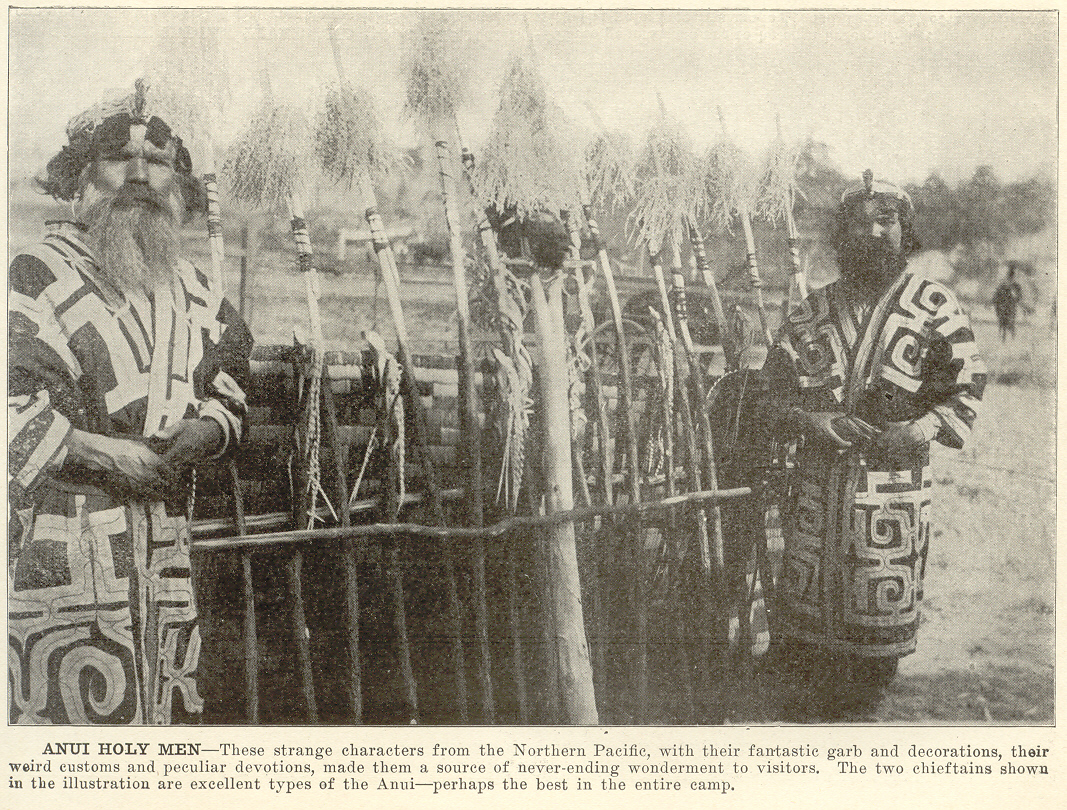
 The athletic games held yesterday for members of the various races in the Anthropology Exhibit furnished one of the most unique entertainments imaginable. A remarkable collection of peoples were gathered together in the Stadium to vie with one another in contests of speed and endurance. There were wild-eyed Ainus, heavy-bearded and gorgeously clad; great, tall lumbering Patagonians; stockily built Moros; slender, tawny-skinned Syrians; long-haired Cocopas, wild and savage of aspect; and last but by no means least, pupils of the Indian School, clad in the conventional athletic habiliments of the white man.

And the winners were:

100-yd dash – 1. George Mentz (Sioux)

120-yd low hurdles – 1. Leon Poitre (Chippewa), 2. George mentz

High jump – 1. George Ments, 2. Black Whitebear

440-yd run – 1. George Mentz, 2. Simon Marques (Pueblo)

Mile run – 1. Black Whitebear

Baseball throw – 2. Frank Moore (Pawnee)

Lone Star Dietz qualified for the finals in the shot put, but apparently did not win the event.

Prizes of $50 or more were given to the winners. Apparently, the Indians did not participate in the mud-throwing and pole climbing events. From the results of these events, AAU Secretary James E. Sullivan, concluded that the results “prove conclusively that the savage is not the natural athlete we have been led to believe.”

The distance-running Pierce brothers and the 1904 Olympics next time.

Ainu at 1904 St. Louis World's Fair

Ainu at 1904 St. Louis World's Fair