Posts Tagged ‘history’

Parlaying a Life Off the Reservation

February 5, 2025

While researching information for an article about Keewatin Academy, I came across a July 2010 blog posting by the late, great Bob Lemke. In it he stated:

“Like Thorpe, Guyon was a two-sport star who parlayed awesome athletic abilities into a life away from the White Earth Indian reservation near Brainerd, Minn.”

Joe Guyon was an incredible teammate of Jim Thorpe, both at Carlisle Indian School and in the pros. In between, he attended Keewatin Academy to prepare himself academically for college and to play on the Georgia Tech “Golden Tornado” football team. Few others have played on two legendary teams but that isn’t the reason Lemke’s statement jumped out at me. Parlayedinto a life away from thereservation is what caught my eye.

Carlisle Indian School is being criticized relentlessly these days and critics often conflate it with other schools, even some in Canada. Carlisle was unique; it reflected  founder Richard Henry Pratt’s philosophy and prepared students to farm their allotments on the reservation, if staying on the reservation was their desire, and for the others to be able to prosper off the reservation.

To my knowledge, no one has studied the difference in results for Carlisle students who didn’t permanently return to the reservation with those who parlayed their Carlisle educations into lives away from the reservation. Such a study would be difficult to make but could be enlightening.

Something simpler to look at would be deaths. Something that is ongoing at Carlisle Barracks, formerly the home of Carlisle Indian School, is the return of the remains of deceased students to the reservations from which the students came. It is sad so many children died. It is also sad so many children in the general population died during the period of time Carlisle operated (1879-1918). As an example, a prosperous local family, Richard Reynolds Craighead and his wife Mary, had nine children but only three survived early childhood. Children dying was a sad fact of life at the time. Another example of people able to obtain the best medical care available were the parents of two Keewatin Academy students, renowned structural engineer Joachim Giaver and his wife Louise, who lost three of their eight children in their infancy.

It might be that fewer children died at Carlisle than did on the reservations because Pratt provided better healthcare for the students than the government did for reservation residents. Studies have been conducted of deaths at the school. Now would be a good time to conduct a more comprehensive study. A control group already exists: the young people who stayed on the reservation and didn’t go to Carlisle or any other off-reservation boarding school. The results could be enlightening.

Listen to Carlisle Indian School March

December 16, 2024

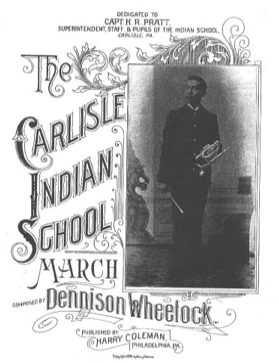
A month ago, I wrote that Carlisle Town Band member Dr. David M. Kammerer had taken the piano score for “Carlisle Indian School March” and scored parts for the various instruments in the band and they would be playing it at their concert the following Sunday. I had the pleasure of attending the concert and enjoyed hearing the march played with full instrumentation. Here is a link to a recording made of that portion of the concert: https://www.youtube.com/watch?v=2OjPSdnaFmM

Before we could hear the march played, we had to listen to an introduction given by an archivist from the local college that scanned the Carlisle Indian School records from the National Archives files. She gave a fair recital of composer Dennison Wheelock’s history up to 1900. He was an Oneida from Wisconsin who enrolled at Carlisle in 1885, in part to improve his musical skills. A cornet player, he excelled at Carlisle, both in music and academics. After graduating in 1890, he returned to the school in 1891 as an employee and to attend cross-town Dickinson College’s prep school. There, he also sang with the College’s glee club. He soon became the Carlisle Indian School  bandmaster and married former student Louisa LaChapelle (Chippewa from Minnesota). They had a son, Edmund, in 1896, the same year Dennison wrote the march. They had a second son, Dennison Paull Wheelock, in 1899. A reason for the unusual spelling of the child’s middle name may have been friendship with or admiration of Carlisle teacher Fanny Paull. On March 28, 1900, Dennison and the Carlisle Indian School Band performed at Carnegie Hall. The first piece on their program was “Suite Aboriginal,” composed by Wheelock. He and the band toured, playing concerts at several venues in preparation for traveling to the Paris Exposition to perform. In late April, he was reported as saying the trip was not a certainty. In May, tragedy struck when their infant son died. After services at 2nd Presbyterian Church, the child was buried in the Carlisle Barracks cemetery. In June, Dennison resigned and left for a vacation in Minnesota.

The young archivist claimed that he returned to Wisconsin to work as a real estate agent and practice law. I knew that to be a false statement due to having researched the government Indian school exhibit at the 1904 St. Louis World Fair twenty years ago. What he actually did after leaving Carlisle will be covered in future postings.

Carlisle Indian School March

November 13, 2024

I was just informed that the Carlisle Town Band will be playing “Carlisle Indian School March” at their concert on Sunday. Several years ago, I found the sheet music for it in the National Archives. Unfortunately, Dennison Wheelock only provided a score for piano. Some years ago, I gave the sheet music to the band so their arranger could write the parts for the various band instruments. At long last the scoring has been finished and the Carlisle Town Band will be playing Wheelock’s march in a concert for the public.

Prior to this, all unmusical me was able to do was to input the piano score into MuseScore and get a synthesized piano output. You can play it by clicking on here. You may have to skip over an ad or two before it plays.

Earlier, I was able to get the Second Presbyterian Church choir to sing the Carlisle School Song, written by Pop Warner. To hear it click here.

I hope to get a recording of the fully instrumented version of Carlisle Indian School March.

Bob & Flo Finally Get Their Due

November 3, 2024

Robert “Bob” Wheeler and his wife, Florence “Flo” Ridlon received the AAU Gussie Crawford Lifetime Achievement Award for their several-decades-long work in championing Jim Thorpe and getting his Olympic medals and records reinstated by the International Olympic Committee (IOC).

“The award is intended to recognize those whose efforts, both on and off the playing field, have paved the way for great change in amateur sports. First awarded in 2016, this is the seventh time the AAU Crawford Award has been given out.”

Bob is best known for his definitive biography Jim Thorpe. Dr. Ridlon received her Ph.D. in sociology from Syracuse University and has written two published works: A Black Physician’s Struggle for Civil Rights: Edward C. Mazique and A Fallen Angel: The Status Insularity of the Female Alcoholic.

It was Flo’s research in the Library of Congress that found the written copy of the 1912 Olympic Rules that had fallen behind other books on the shelf. Jim’s disqualification was disqualified by those rules, which set the challenge date as no longer than a month after the Olympics were played. Thorpe’s challenge was placed months later, making it invalid according to the rules.

Bob and Flo have worked decades in getting Thorpe’s medals and records returned and reinstated, making recognition of their work long overdue.

I heard rumors of the Jim Thorpe Memorial at Jim Thorpe, PA being refreshed. Let’s hope they’re true.
 

Jean Craighead George Was a Kentucky Colonel

April 13, 2024

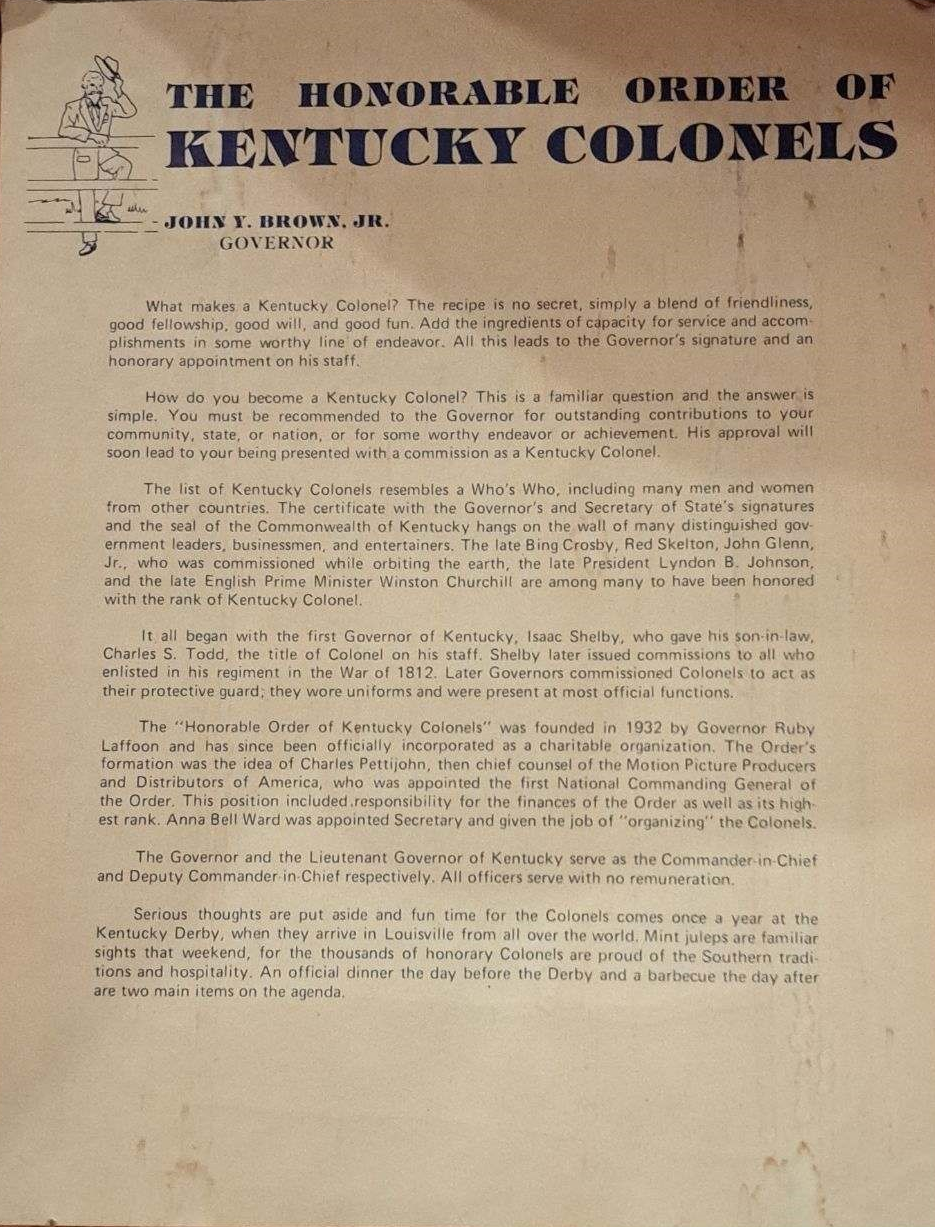
One of the artifacts Craighead House holds is a framed certificate complete with official seal and ribbon from then governor of Kentucky, John Y. Brown Jr., commissioning Jean Craighead George as a Kentucky Colonel. It was dated 9 September 1983, the 92nd year of the Commonwealth. Like Pennsylvania, Kentucky is also a commonwealth, whatever that means.

Research into Indiana’s Sagamore of the Wabash honorific found that the Bluegrass State’s Kentucky Colonel program had existed long before Indiana’s. Kentucky’s goes all the way back to its first governor, Isaac Shelby, who put his son-in-law, Charles Todd, on his staff with the title of Colonel, and not to the Civil War as many suspect. Shelby, who had fought in battles against the Indians in colonial times and against the British during the Revolutionary War, as governor raised a force of 3,500 volunteers and led them in the Battle of Thames during the War of 1812 against the British. After the war, he commissioned all who had enlisted in his regiment as Colonels. Later on, other governors commissioned Colonels to act as their protectors. They even wore uniforms and were present at most official functions.

In 1932, the chief counsel of the Motion Picture Producers and Distributors of America, Charles Pettijohn, convinced then Governor Ruby Laffoon to found The Honorable Order of Kentucky Colonels. He then appointed Pettijohn  as the National Commanding General of the Order, a position that was responsible for the finances of the Order. Anna Bell Ward was appointed Secretary and was given the task of organizing the Order. Later on it was made a charitable organization.

The Governor and Lieutenant Governor serve as the unpaid Commander-in-Chief and Deputy Commander-in-Chief, respectively. The Order continues to this day. Commissions are for the recipients’ lifetimes but membership in the Order requires annual donations to the Good Works Program. The Order also sells memorabilia to raise money and holds a major event over the Kentucky Derby weekend each year. Active members are also expected to help out during the Annual Day of Service.

Numerous famous people, including movie actors, Presidents, and star athletes. Winston Churchill was a Kentucky Colonel. The most unusual commissioning was that of John Glenn while he was orbiting the earth in a Mercury capsule.

Someone must have considered Jean’s works important enough to nominate her commission.

Below is what was mounted on the backside of her commission.

Sagamore of the Wabash

April 10, 2024

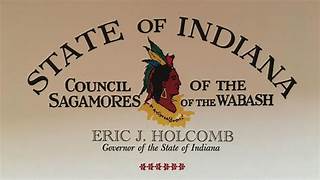
Last week the wife of one of my grad school professors called to tell me that he had died. I won’t dwell here on the tremendous loss his demise is to me but will explore something new I learned. This Indiana University professor was a leader in his field for decades and received many honors, one of which may sound unusual. He was made a Sagamore of the Wabash, the state’s highest civilian honor, by the Governor of Indiana. Unfamiliar with this name, I looked up its meaning. As defined by Merriam-Webster, a sagamore is a subordinate Algonquin chief or sachem. In practice, a sagamore was a person the head chief relied on for advice due to his experience and wisdom. My old professor definitely was a source of wisdom and he didn’t hold a high political office. The Wabash part is self-explanatory to anyone familiar with the geography of Indiana or is aware of songs about that river, including the popular song recorded by The Mills Brothers among others, “On the Banks of the Wabash, Far Away,” which was established as the Indiana State Song by the Indiana Code in 1913. But how did this honorific come into being?

Indiana Governor Ralph Gates (1945-1949) was about to attend a tri-state conference with officials of Ohio and Kentucky in Cincinnati when he was informed that the governor of Kentucky was planning on naming him a Kentucky Colonel, the Bluegrass State’s highest honor. Something had to be done because Indiana had no such honor. The Life and Times of Little Turtle, First Sagamore of the Wabash provided more details on the honorific’s conception: “In 1946 Indiana governor Ralph F. Gates created the Council of the Sagamores of the Wabash in response to a suggestion made by Samuel R. Harrell, who had been named a Kentucky Colonel and felt that Indiana needed a similar reciprocal honorary organization. Kurt Pantzer joined with Harrell in devising the details.”  Business executive (and World War I pilot) Samuel R. Harrell and attorney Kurt Pantzer were both good Hoosiers, Wabash College alums, and friends of Governor Gates. Harrell suggested “Honorary Citizen of Indiana” for the name of the award. Attorney General James Emmert proposed “Hoosier Schoolmaster.” Patzer’s idea “‘Sagamore of the Wabash’ was deemed to be more deeply steeped in the history of Indiana.”

Governor Gates made Simeon S. Willis, Governor of Kentucky, the first Sagamore of the Wabash and Ohio Senator Robert Taft the second. Kentucky wags suggested that Willis’s naming the Indiana governor a “Kentucky Colonel” as “a long step forward toward getting Indiana cooks to stop putting sugar in cornbread.”

After reading up on this topic I recalled that Jean Craighead George had been named a “Kentucky Colonel.” More on that next time.

Hunka Tin

March 14, 2024

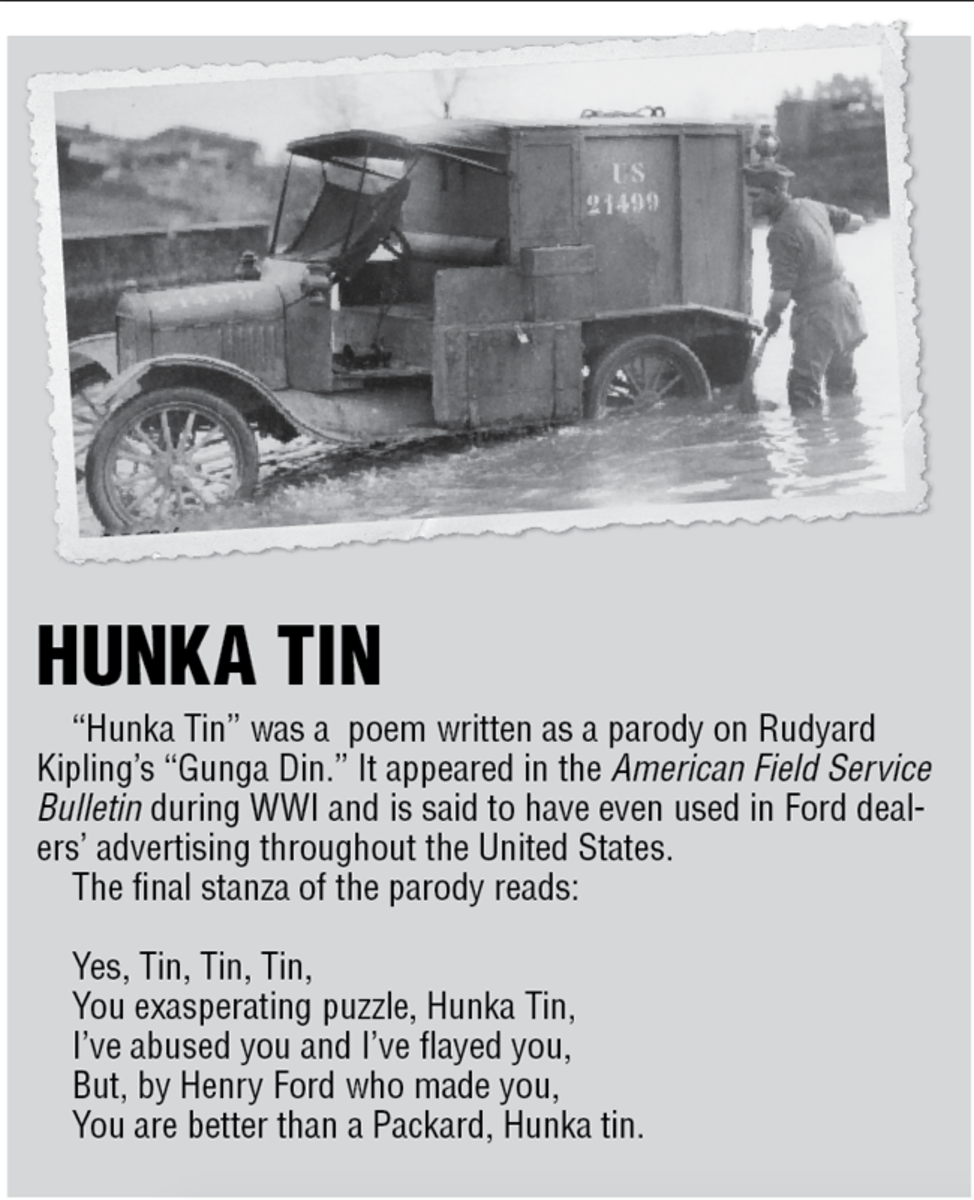
A scene in the 1927 Motion Picture Academy Best Picture Winner Wings brought something to mind that James McGrath Morris wrote in or about (I forget which) The Ambulance Drivers, a book about how writers Ernest Hemingway and John Dos Passos became friends while driving ambulances in WWI. What caught my eye several years ago was Morris’s assertion that ambulance drivers had to be from economically advantaged families because poor people wouldn’t know how to drive. That conflicted with what my father had said about growing up poor on a farm at that time.

Dad was too young to go to war but he recalled having some sort of car or truck on the farm even though they didn’t own any land. Used Model T Fords, which were released almost a decade before America’s entrance into WWI, were always on the market at heavily depreciated prices. I remember taking Dad and his older brother to an auction in 1976. The deceased farmer had been a tinkerer who attached Model T drive trains to horse-drawn implements to create useful machines before they were available from major manufacturers. Also at the sale were some complete Model Ts that hadn’t been adapted for other use. My uncle said, “I can remember when that car could be bought for ten dollars.” Dad piped in, “If it ran.”

The point to this is that even poor people had access to automobiles before WWI, although they weren’t Duesenbergs or Packards. Generally, they were Fords because the Model T was the least expensive automobile and it accounted for half of the automobile market at the time.

Clara Bow’s character saw an advertisement for volunteers, with the stipulation that they must be able to drive Fords. To the unfamiliar, that might sound odd. The reasons for it were that Ford built 5,745 ambulances for the Allied Powers and 107 for the Red Cross during WWI. These vehicles used the same Model T drivetrain that was used in passenger cars so many people owned. Other companies also supplied ambulances but Fords were the most common. But why did she need experience driving Fords?

Model T Fords drive like no other automobile. They have no accelerator pedal. Instead they have a throttle level attached to the steering column. Ts employ the handbrake as part of the gear shifting mechanism along with the three pedals on the floor. And they have no clutch pedal. Considerable practice is required to master driving a Model T. The Red Cross probably didn’t have the time for volunteers to learn how to drive the ambulances and couldn’t afford the damage that was sure to result while they were learning.