Posts Tagged ‘Haskell Institute’

Pete and Emil Hauser in the News

November 20, 2008

Last week Doctors, Lawyers, Indian Chiefs got a plug in The Kansan out of Newton, KS in an article covering a presentation by Carolyn Williams at the Halstead Historical Society. She explained that Halstead was more than the home of Adolph Rupp, Conrad Nightingale and Dennis Latimore. It was also the home of the Krehbiel Farm Indian School that the Hauser brothers, Pete and Emil, aka Wauseka, attended in the 1890s. I was aware that they had connections with Halstead, KS but didn’t know about the Krehbiel school. Constantly learning new things is one of the benefits of my job.

Christian Krehbiel emigrated from Germany in the mid-1800s and eventually settled on a farm near Halstead. He was also very active in the Mennonite Church. As part of his religious activity, he became involved with the missionary work among the Indians. In 1885 the Industrial School, Halstead, Kansas was formed by the Mission Board of the General Conference Mennonite Church and Halstead Seminary with 15 Indian children from Oklahoma for students. In 1887 the Indian School was moved to Krehbiel’s farm. Students lived on the farm with the Kriehbiels as a large family.Students studied academic subjects during the school year worked on the farm in summer. For the 1892-93 school year Krehbiel contracted with the government to take 30 students for $125 each. After the government ended its contract policy for Indian students in 1896, he organized the Orphan and Children’s Aid Society and started an orphanage on his farm. It’s likely that the Hausers were attending the school in its latter years.


The article about Carolyn Williams’ talk can be found at http://www.thekansan.com/sports/x1772948257/Hausers-a-lost-part-of-Halstead-history. More on Christian Krehbiel can be found at http://www.gameo.org/encyclopedia/encyclopedia/contents/krehbiel_christian_1832_1909. More can be found on the school at http://www.gameo.org/encyclopedia/contents/I533.html.


Returning Indians to Prominence in Football

October 6, 2008

Coming across a 1937 newspaper article in which Gus Welch launched a movement to return Indians to prominence in football. He was quoted as saying:


“The Indian is disappearing from football just like he disappeared from the forests. There used to be a lot of good Indian athletes—Thorpe, Guyon Mount Pleasant, Sweet Corn, Jim Levi, Tiny Roebuck and Mayes McLain. Pop Warner developed a dozen great ones at Carlisle and Haskell Institute produced a number. But they are fast dwindling. Most of the Indians we see in athletics today are impostors, or at best half-breeds. And they might as well be cigar store Indians in so far as I’m concerned.”


The article went on to say that Gus and his wife had recently adopted a baby girl. He insisted that the next child would be a boy adopted from one of what he considered the two fiercest tribes.


“I’m going to visit the Sioux reservation first and look over their crop of babies. If they don’t have anything to my liking, I’m going to pay the Cheyennes a call. I’m determined to find a real all-American and restore the Indian to his proper place in football.”


You already know that didn’t work out, but did you know that Bacone College attempted to revive Indian football after it was de-emphasized at Haskell Institute during the Great Depression? It was a natural thing for the little Muskogee, OK college to do because the school’s original name when it was founded in 1880 at the Cherokee Baptist Mission in Tahlequah by Almon C. Bacone was Indian University. Oklahoma’s longest-running institution of higher education was renamed Bacone Indian University in 1910. Later, its board of trustees gave it its current name. An irony is that Bacone and Haskell, both now four-year schools, play each other.

Gus Welch between Possum Powell and Jim Thorpe

Radio Tour Kicks off in Lawrence, Kansas

August 21, 2008

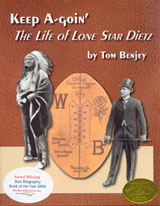
With the release of a new book starts another adventure – radio interviews. The first one I’m doing for Doctors, Lawyers, Indian Chiefs is with Warner Lewis on his Lewis at Large Smart Talk Radio show out of Lawrence, Kansas. The interview is being taped and will be aired the week of August 25 to 31 on KLWN Lawrence, KFRM Clay Center, KLKC Parsons and possibly other stations in eastern Kansas. Warner interviewed me two years ago on his sports talk show after Keep A-goin’: the life of Lone Star Dietz was released. It was a great experience. There are strong ties between Carlisle, PA and Lawrence, KS beside the fact that Lone Star Dietz played for Carlisle Indian School and coached Haskell Institute (now Haskell Indian Nations University) in Lawrence. When athletics were deemphasized at Carlisle, the leadership mantle was passed to Haskell where, during the 1920s and very early 1930s, the Fightin’ Indians were, as Ray Schmidt described, the lords of the prairie.


But more than the mantle passed from Carlisle to Haskell. Students also transferred to Haskell as well, Nick Lassaw for one. Nick was perhaps better known by the moniker given to him when he played for the Oorang Indians: Long Time Sleep. However, transferring between the two government Indian schools did not start at that time; it had a long tradition. The most notable example was after the 1904 Carlisle-Haskell game held at the St. Louis World’s Fair, the only time the schools played each other, when eight football players including the Guyon and Hauser brothers and several others came east to play for the stronger team.


There are other reasons that make Lawrence an appropriate to kick off my radio tour. Bernie Kish, Executive Director of the College Football Hall of Fame, 1995-2005, now lives in Lawrence. Bernie wrote a forward for Doctors, Lawyers, Indian Chiefs and I’m waiting for him to write a history of Haskell.


Native Americans in 1904 Olympics – Part III

July 21, 2008

The 1904 Olympics were not the first games to feature football. The 1900 Paris games included two football events neither of which were American football. Soccer and rugby were both played that year but in 1904 American football appeared in the Olympics for the first time. Football (soccer) was a demonstration sport in which three teams played a round-robin tournament between two American teams and a Canadian club. The Canadians won the gold. Several college football games were played on Francis Field at the fair. Washington University and St. Louis University each played a number of their games on the Olympic field. Missouri and Purdue even played there. Prior to the Fair, Washington U’s teams were known as the Purities but due to playing at the Fair were renamed the Pikers in 1905 as a comment on their association with the infamous world fair’s Pike. However, the most important college football game played at the 1904 Olympics wasn’t played by colleges.

President Theodore Roosevelt was to visit the Fair over Thanksgiving weekend making it an ideal time for a major football event (read moneymaker). The Fair organizers’ first choice was to have West Point and Annapolis relocate their annual contest to the fairgrounds but that didn’t happen. Haskell Institute’s Fightin’ Indians were tearing up the Midwest at that time and Carlisle was a top ten program. So, the first ever football game between the two government Indian schools was arranged for the Saturday after Thanksgiving. Carlisle already had a Thanksgiving Day game scheduled against Ohio State in Columbus. Major Mercer, the new Carlisle superintendent, very likely saw the opportunities such a high profile game would create for him and his school and added the game to the schedule. Playing two games in three days may have been taxing for Carlisle’s players, so Head Coach Ed Rogers (Pop Warner was back at Cornell for the 1904-6 seasons) drubbed the Buckeyes with his second team 23-0. Ohio State supporters were unhappy to miss seeing the Carlisle stars they had read so much about.

Rumors of Haskell bringing in ringers, some of them white, were rampant. To balance the scales, Ed Rogers suited up for the game as did Assistant Coach Bemus Pierce and his brother, another former Carlisle and pro star, Hawley Pierce. They needn’t have bothered. Carlisle obliterated Haskell 38 to 4. Seeing the superiority of the Carlisle program, eight Haskell players transferred to the eastern school where many became stars. If there was an Olympic gold medal to have been won Carlisle would have won it, but none was. However, the Carlisle Indians were the closest thing to an Olympic football champion that we’ve had – if you ignore the 1920 and 1924 U.S. rugby teams. But that’s a story for another time.

The Native American game of lacrosse was played at the 1904 Olympics but mostly by non-natives. Three teams, two from Canada and one from the U.S., vied for the championship. The Canadian Shamrocks won the gold, the St. Louis Amateur Athletic Association won silver, and, in a bit of irony, the Mohawk Indians from Canada got the bronze.

Next time we take a look at the 1908 games.

1904 Carlisle-Haskell game program cover

1904 Carlisle-Haskell game program cover


You meet the nicest people

May 5, 2008

The best part of doing this research is the people you meet. The most recent are Iris Davis and Dick Boganwright. Driving back from a wedding in Madison, Wisconsin brought us near Mentone, Indiana where Iris and Dick live. Iris has a photo of their uncle, Louis Island, in his WWI uniform. The photo is mounted in an oval frame with curved glass, something that makes scanning difficult. Taking a photo of a photo that is under glass presents problems of its own, but they were dealt with. By now you may be wondering why I’m babbling on about this.

Louis Island played quarterback, mostly backup, at Carlisle and eventually became a star in the early pro game. He eventually settled in Fort Wayne, Indiana and married Phebe Harsh, who was raised on a farm near Mentone, which is not far from Fort Wayne. Iris Davis and Dick Boganwright’s mother was one of Phebe’s sisters. Iris and Dick remember Dr. Island from family gatherings when they were children. They also remember when he contracted tuberculosis and died. They also remember when his son died from what they thought might have been muscular dystrophy. Dick and Iris recalled that Louis had a grandson who was left the area with his mother when he was a child.

Meeting relatives of Carlisle players is always a pleasure. Sometimes people are surprised to learn that their grandfather or uncle was famous at one time or was a great athlete because their memories of him are often of an old man. The telephone conversations that preceded the visit got them thinking about their uncle and they later remembered things about him that they had forgotten long ago. The visit gave me the opportunity to share with them what I had learned about their uncle.