Posts Tagged ‘F-102’

Operation Thirsty Camel

July 24, 2024

I stumbled across a video about Operation Thirsty Camel the other day. My first assignment in the Air Force after tech school was to the 405th Armament and Electronics Maintenance Squadron (405th A&E) at Clark AFB in The Philippines. I was trained to maintain MG-13 and MG-10 Automatic Weapons Control Systems on F-101B and F-102A aircraft, respectively because these systems were almost identical. At Clark there were two squadrons of Deuces (F-102s) and no F-101s. The MG-10 system used radar and infrared to track enemy bombers and shoot them down with the missiles and rockets kept inside the aircraft.

One of the squadrons we maintained, the 64th FIS, was relatively new to the base, arriving in 1966. When I arrived in early 1967, all of the Deuces were camouflaged but did not have the large squadron codes on their tails yet. Some of the 64th birds had unusual brackets. Oldtimers told me that the brackets were from the in-flight refueling systems that had been installed on the 64th planes to get them from Paine Field, Washington to the P.I. during operation Thirsty Camel.

Century Series fighter planes were not usually equipped for in-flight refueling, but the Vietnam War heating up necessitated getting more interceptors across the Pacific in a hurry. I was told that two planes were assigned to each tanker, a KC-135, for the flight. Fighters suck up so much fuel that one or the other of the pair was always getting refueled. The fuel usage may not have necessitated that, but it was advisable to keep as much fuel in each plane as possible in case an emergency erupted.

Follows is a link to the video about Operation Thirsty Camel. It’s hokey in places but is a fun watch. The first planes to go weren’t from the 64th. They were from a squadron that was sent to Okinawa. The 64th pilots and birds went a few months later.

UPDATE

Two things happened last week related (in my mind) to this post. First, American interceptors were scrambled to confront Chines and Russian planes over the Bering Sea, and second, The Russians Are Coming, The Russians Are Coming was shown on Turner Classic Movies.

First things first. A pair of intruding bombers, a Russian TU-95 Bear and a Chinese H-6 flew over the Bering Sea, close to American airspace. Three interceptors were scrambled to deter the bogies: an American F-16 and an F-35 plus a Canadian CF-18. The intruders departed without incident. In my day, a pair of F-102s from the 317th FIS at Elmendorf AFB near Anchorage, Alaska would have made the intercept as they did numerous times back then.

Second. The Russians Are Coming, The Russians Are Coming was set in 1966 on the fictitious Massachusetts island named Gloucester but was filmed in California. The story started with a Soviet (it was the height of the Cold War at that time) submarine running aground by an incompetent crew. Eventually, the Air Defense Command dispatched two interceptors to investigate. A pair of F-101Bs flew across the screen. Since this movie came out while I was in tech school for the MG-13 weapons control system that was used on that model aircraft, it was especially interesting to me. Before that, I hadn’t even seen a photo of an F-101. An odd coincidence occurred because, had it been real life, the Air Force would have sent two planes from Otis AFB in Massachusetts. Based at Otis was a squadron of F-101Bs. With the film being made in California, the nearest interceptors were the F-101Bs stationed at Hamilton AFB.

When I my tour in the Far East was up, which included TDYs to Vietnam and Thailand, I received orders for the 49th FIS at Griffiss AFB in Rome, New York. I looked forward to working on F-101s, the planes the 49th had at that time. However, during my transit from halfway around the world, the 49th’s F-101s were replaced with F-106s from Kincheloe AFB, Michigan. The F-106 started out as an F-102B but so many changes were made, including the weapons control system, I was then working on the MA-1 system, also manufactured by Hughes Aircraft. It used transistors where the MG-10/MG-13 systems used vacuum tubes, the functions were similar. I was discharged on December 26, 1969 without ever touching an F-101.
Shooting Down Balloons

February 14, 2023
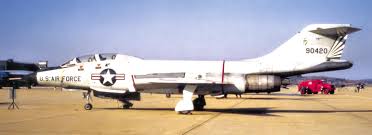
Two of the planes I worked on in the Far East

An unexpected article popped up on my phone this afternoon possibly because fighter planes have recently been shooting down airborne “items.” A little background is needed as to why this got my attention. From February 1967 through mid-August 1968 I maintained the FCS of F-102 aircraft in The Philippines, Vietnam, and Thailand. The Deuce, as F-102s were often called, wasn’t a sexy airplane at that time. The F-106 was faster and the F-4 carried a much larger variety of weapons. Being an old plane, half of the F-102s, maybe more, were then flown by National Guard units. In spite of its age, the Delta Dagger, the plane’s official nickname, was chosen for overseas duty because it was more reliable and more easily supported logistically than the newer interceptor, the F-106.

The article linked to below tells of one pilot’s experiences flying the plane against a very fast target, the B-58 bomber. In order to better understand the article some abbreviations and acronyms need to be defined.

FCS stands for Fire Control System. This has nothing to do with putting out fires. It has to do with aiming and firing the plane’s weapons. The F-102 used the MG-10 weapons control system built by Hughes Aircraft. It used radar and infrared to seek and track targets. Most of its circuits used vacuum tubes. Only a few functions utilized solid-state components.

ECM stands for Electronic Counter Measures, devices used to defeat or confuse the interceptor’s radar.

IRST stands for Infra Red Search & Track (or sighting & tracking). An IR seeker head resembling a chrome ball was located just forward of the cockpit. Targets could be located and tracked using either radar or IR or both together. Follows is an anecdote of both methods being used together:

One day at Bien Hoa Air Base in South Vietnam we had the radome off to do some work on the radar antenna . About the time we needed to test the system after finishing making the adjustment the adjustment an Air Policeman guarding the revetments in which our planes were stationed walked by smoking a cigarette (it was 1967). I locked the infrared onto his cigarette and shifted the mode to IR/Radar Slaved. Normally there is no external indication as to what the system is doing but, with the radome removed, the antenna is visible. With IR locked on to his cigarette and radar slaved to it, the radar antenna followed him as he walked past. He, not surprising, was unnerved by this.

If the Chinese balloon/items had floated by back in the day, F-102s very likely would have been assigned the job of shooting them down.

50 Years Ago Today

May 10, 2016

My blogs are almost always about some person or thing other than myself. This one is intentionally different. This morning’s Facebook post generated some interest in my life I hadn’t expected:

50 years ago today, I was inducted into the U.S. Air Force. I didn’t want to be there but I was about to be drafted and my dad suggested I’d have better conditions than in the Army and might learn something useful. He was right but it was a very long 3 years, 7 months and 16 days, including 18 months in The Philippines, Vietnam and Thailand.

Besides receiving well wishes from several people, I was asked about what was it I did when in the Air Force and responded with the following:

I was an Automatic Weapons Control System Technician on MG-10 and MA-1 systems. In English, I worked on the fire control radar on F-102 & F-106 interceptors.

To make sure I remembered some of the terminology correctly, I Googled the terms to unexpectedly find this written by Tim White:

PACAFUSAFETAC An Extraordinary Bunch

In the middle and late 1960s, the sophistication of high-tech electronic systems began to grow at a phenomenal rate. Fortunately, the USAF (and a few other nations) had a small number of technicians – rarely exceeding 600, worldwide–who had the ability to maintain, upgrade, and even improve upon these state-of-the-art systems. Sustained, at first, by the compelling “equality” of the Vietnam draft (a rich source of competent and intelligent recruits who otherwise would have excelled in civilian life) the switch to an all-volunteer military resulted in a slow decline in the “quality” of personnel available for this challenging task.

They were farm boys and ghetto punks; college drop-outs and those who barely passed in high school. Scoring in the top 5 percent of the population in spatial perception, electronic/mechanical aptitude, and command of language, they were some of the best and the brightest the nation had to offer.

Eventually, basically-analog systems (containing digital components) were completely replaced by digital; in many cases, the software writers had no idea how the electronics worked, and never considered the hardware to be a maintainable, alignable system. In a binary world of on/off, there was no room for a concept other than pass/fail. Maintenance mock-ups became “test stations” in a “smart machine/dumb technician” form of maintenance–and the WCS troops were no longer required. Failing components were trashed instead of repaired (because no one knew how anymore), and dependence upon “spares” grew, along with depot and manufacturer-level repair. WCS troops, as a species, started to become extinct. It was the end of an era.

I assumed the newer aircraft used digital systems but was unaware that the newer equipment does not require alignments—which were a significant part of my job—and of the shift to a “smart machine/dumb technician” approach to maintenance. Thank you for the kind words about my generation, Mr. White.

F-102-37

Two F-102s I worked on overseas. PK on the tails indicates that they are 509th FIS birds.