Posts Tagged ‘Dennison Wheelock’

Dennison Wheelock cont’d

December 22, 2024

A September 8, 1900 Australian paper, reported that Dennison and a 60-piece band sailed out of Boston for a “tour of the principal European cities.” The newspaper hadn’t gotten the word that the trip, and the tour of the eastern U. S. to raise funds for it, had been called off in May by school authorities. They gave the reason for the cancellation as the estimated cost of $15,000 “…was not feasible from a financial perspective.”

The June 15 edition of The Indian Helper reported, “The band has given up its trip to Paris and has disbanded. Many of the boys have gone to their homes in the west and some to the schools whence they came. Storekeeper Kensler has taken charge of the instruments and there will be no band music for some time.” Included in those dispersing were Dennison’s younger brother clarinetist James Riley Wheelock (often referred to as James or J. Riley) and noted violinist Zitkala-Sa (Yankton Dakota). In late-June, friends and coworkers gave Louisa and Dennison silver spoons, forks, and knives as going-away presents. Mrs. Cook recited a poem she had written in their honor. They left to visit with her family and rest in Minnesota.

 In October, Dennison, who was then living in DePere, Wisconsin, took a position as a reporter with a Green Bay, Wisconsin newspaper. Later, he told a Lawrence Daily World reporter “..he would rather be a newspaper reporter than anything else he had ever known.” No article under his byline has been located to date but he may have had pieces published without attribution. He must have had some abilities as a writer because he won second prize in a writing contest at Carlisle in 1887. Although not eligible to vote yet, he  campaigned for Republicans throughout Brown County.

The next month, he obtained the “contract for getting out a large quantity of popular from the Oneida Reservation for the Pulpwood company of this city [Appleton Papers?].” How he intended to accomplish this work wasn’t mentioned.

In February 1901, he gave a talk to the Epworth League’s annual state convention in Marinette, Wisconsin. The League was a Methodist organization of young adults from 18 to 35. Newspapers sometimes confused Dennison with his football-playing cousin Martin Wheelock.

 In March, De Pere News announced:

“Dennison Wheelock has been given the contract to organize an Indian band for the Pan-American exposition at Buffalo. He will recruit a band of sixty pieces and will have his headquarters in New York.”

In July, he served as Assistant Conductor and cornet soloist for the Carlisle Indian School Band at the Pan-American Exposition in Buffalo, New York. Carlisle Bandmaster Lt. Joel B. Ettinger conducted the forty-five musicians. Moses Shongo (Seneca from New York) was the solo cornetist. Prior to going to Buffalo the band played two concerts at Reservoir Park in Harrisburg, Pennsylvania, a short train ride from the Indian school. The afternoon concert opened with a march titled “Carlisle Indian Band” by Wheelock. This might have been his “Carlisle Indian School March.” The band played entirely different pieces for the evening program.

In March 1902, Dennison took the job as bandmaster for Flandreau Indian School in South Dakota. He also served as disciplinarian and choir instructor. In November, Professor Wheelock, as he was often referred to, resigned to take the musical director position at Haskell Institute in Lawrence, Kansas, the largest Indian school in the west. His major task was to organize and prepare an Indian band for the 1904 St. Louis World’s Fair. At Haskell, he was also in charge of the orchestra and mandolin club. In early January, his new band gave a concert in the chapel. In late January 1903, the Wheelocks suffered another tragedy, the death of their baby boy Leland shortly before his first birthday. He was buried in the Haskell cemetery. A baby girl, Louise Frances, arrived in April to brighten their lives.

That month a listing of Haskell Institute band members included four familiar names because they later became Carlisle football stars. A fifth, Robert Bruce, aka Nagiyanpe, had played in the Carlisle Indian School band and led the town band. After getting the Haskell band in shape, Wheelock scheduled a tour from June 1 to December 24 of the following year. According to The Daily Gazette, over a million people heard them play in a five-week summer tour of Colorado resorts.

In April 1904, Dennison closed a contract with the World’s Fair to have a two-week engagement instead of the expected one week. His band was to play in connection with another band for three of the concerts. Lawrence Daily World reported:

“There is great rivalry for this contest, which it virtually is, and each band will play its best. Mr. Wheelock does not know what band he will have to play with. There is trouble in band circles over the playing there of Sousa and Innes, just before Mr. Wheelock’s band comes. These men are great rivals and personal enemies and trouble is expected when either one attempts to direct the other band. Under the rules when the two bands play together the bandmasters take alternate turns at leading. This is where the trouble is expected to start.” No such altercations were reported as having happened.

It went on to say that Wheelock had closed a contract for touring the country for five years, for which he would receive $23,000 a year plus railroad fares. Because of the band’s reputation, the lyceum bureau believed it would make good wherever it went.

The Haskell Band was an instant success at the St. Louis World’s Fair in June, reputedly drawing larger crowds than Sousa had drawn. After finishing their two-week engagement, the band toured the country, playing at Philadelphia, Cleveland, Indianapolis, Chicago and other musical centers, returning later in the season for another World’s Fair engagement. It even gave two concerts at Mt. Holly Park, near Carlisle, Pennsylvania during the tour.

The Carlisle band did not appear in St. Louis, likely because Superintendent was being retired around this time as punishment for statements he had made about the Bureau of Indian Affairs during a speech he gave at the Baptist convention. The fair’s resident band was from Chilocco Indian School, home of the model government Indian school exhibit’s director.

In late September, Dennison signed a four-year contract with Slayton Lyceum Bureau to make tours of the United States and Europe. Wheelock’s United States Indian Band, as it was then called, toured much of the country until mid-December when Wheelock disbanded his band for the winter and returned to his home in Lawrence, Kansas. Within days he was organizing a new band at Haskell. His plan was to build another all-Indian band, drill it until he left on tour, and hand it over to another instructor at the school.

In mid-March, he brought his family back to De Pere, where he intended to make it his future headquarters. By late April, band members were gathering at Steinway Hall in Chicago and doing “…some unusually hard work for a few weeks before going out on their concert tour.”

While in Fort Wayne, Indiana on the tour, Dennison shared this nugget with a reporter:

“The writing of music is one of the most uncertain occupations in which one can engage. Like the prospector who digs the soil in the hope of discovering hidden gold, the composer of music writes and writes and endeavors, in some instances, for years in the hope of striking a chord that will meet with popular approval.” He continued opining on the topic for several minutes more.

In late July, Louisa wrote a friend that, although she was still in Wisconsin, she intended on joining Dennison while he was on tour in the east. She related that her little daughter Louise had learned to speak the Oneida language and insisted on speaking it to everyone, including her Chippewa mother.

Dennison became ill with consumption (tuberculosis) in August and sold his interest in the band to his brother James. A Chicago specialist treated him for a few weeks and told him to spend the winter in Arizona. If he went, he didn’t stay long because he was back in Wisconsin by spring. He was apparently not idle during his convalescence because he was working as an attorney in November 1906. He had reputedly been studying under Pennsylvania lawyer John R. Miller.

So, Dennison Wheelock did not leave Carlisle in 1900 to practice law and invest in real estate. So, that all started nearly seven years later.

Listen to Carlisle Indian School March

December 16, 2024

A month ago, I wrote that Carlisle Town Band member Dr. David M. Kammerer had taken the piano score for “Carlisle Indian School March” and scored parts for the various instruments in the band and they would be playing it at their concert the following Sunday. I had the pleasure of attending the concert and enjoyed hearing the march played with full instrumentation. Here is a link to a recording made of that portion of the concert: https://www.youtube.com/watch?v=2OjPSdnaFmM

Before we could hear the march played, we had to listen to an introduction given by an archivist from the local college that scanned the Carlisle Indian School records from the National Archives files. She gave a fair recital of composer Dennison Wheelock’s history up to 1900. He was an Oneida from Wisconsin who enrolled at Carlisle in 1885, in part to improve his musical skills. A cornet player, he excelled at Carlisle, both in music and academics. After graduating in 1890, he returned to the school in 1891 as an employee and to attend cross-town Dickinson College’s prep school. There, he also sang with the College’s glee club. He soon became the Carlisle Indian School  bandmaster and married former student Louisa LaChapelle (Chippewa from Minnesota). They had a son, Edmund, in 1896, the same year Dennison wrote the march. They had a second son, Dennison Paull Wheelock, in 1899. A reason for the unusual spelling of the child’s middle name may have been friendship with or admiration of Carlisle teacher Fanny Paull. On March 28, 1900, Dennison and the Carlisle Indian School Band performed at Carnegie Hall. The first piece on their program was “Suite Aboriginal,” composed by Wheelock. He and the band toured, playing concerts at several venues in preparation for traveling to the Paris Exposition to perform. In late April, he was reported as saying the trip was not a certainty. In May, tragedy struck when their infant son died. After services at 2nd Presbyterian Church, the child was buried in the Carlisle Barracks cemetery. In June, Dennison resigned and left for a vacation in Minnesota.

The young archivist claimed that he returned to Wisconsin to work as a real estate agent and practice law. I knew that to be a false statement due to having researched the government Indian school exhibit at the 1904 St. Louis World Fair twenty years ago. What he actually did after leaving Carlisle will be covered in future postings.

The Carlisle Indian School March

August 5, 2010

Some time ago, I found the sheet music for “Carlisle Indian School March” at the Library of Congress and ordered a copy. What arrived was a piano score with no arrangement for band instruments. Not being able to play the piano or find someone willing to take the time to learn the tune, I was out of luck. I feared that I would never hear it played. But last week I discovered something that could make it possible to hear it. MuseScore is free software that allows you to key in music scores, print sheet music for them and, most important to me, play it back.

The software downloaded easily onto my computer, but not after having a scare. Because my machine was running short of disk space, I attempted to download it onto my wife’s laptop which has ample space available. Very early into the process, her computer uttered a brief whimper and emitted some smoke. That was followed by the all-too-familiar smell of burnt electronics. People on the MuseScore support forum assured me that it was a coincidence. Logically, I knew that but my wife’s computer had just died while I was using it. So, I intrepidly ventured forward and installed the software from www.MuseScore.org without a hitch.

Entering all the notes, etc. wasn’t easy, especially given that I don’t play the piano and my music education ended with playing the bass clarinet in the jr. high band very early in the Kennedy administration. But it was completed over the weekend. It can be heard at Carlisle Indian School March.

Now, the challenge is to get it arranged for the various instruments in a marching band. Since I know nothing about arranging music, I must rely on the kindness of others. A Dickinson College professor has expressed interest in the project. It would be great to hear this historic music played by a real band.

Dennison Wheelock Sent His Son to Carlisle

April 1, 2010

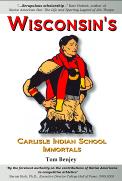
While working on Wisconsin’s Carlisle Indian School Immortals, the idea came to me that some tidbits of information may be in Dennison and James Wheelocks’ files at the National Archives that may also pertain to their younger brothers, Joel and Hugh. The copies of their files arrived this afternoon. Dennison’s file opened to an August 1914 letter from him to Oscar Lipps, Acting Superintendent of Carlisle Indian School. Dennison graduated from Carlisle and was later bandmaster at Haskell Institute and Carlisle. After touring with his own band, he returned to West DePere, Wisconsin where he practiced law and participating as an officer of the Society of American Indians. His letter began:

“My sister, Martha Wheelock, aged twenty years, whose term expired at Flandreau, South Dakota last June, and is now with me in West DePere, desires to be admitted to the Carlisle Indian School as a pupil. I am very anxious that she shall go if possible. She is in eighth grade. My son, Edmund, who was born at the Carlisle Indian School, in1896, is also very anxious to have the benefit of a diploma from Carlisle on account of the prestige it carries with it throughout the West….”

Both were admitted and were attending Carlisle within a month. Both were active in school life and joined literary societies shortly after enrolling, Martha in the Susans and Edmund in the Standards.

Edmund had been attending public school in Wisconsin and doing well but his father was concerned about the environment. “Unfortunately, however, DePere is a city of less than five thousand inhabitants, yet has in the neighborhood of twenty-two, or twenty-four saloons, and on account of what is falsely termed liberal sentiment, the saloon keepers do not hold strictly to the law of the land, and as a result we see young boys very frequently under the influence of liquor.”

Dennison Wheelock was pragmatic about where Indian children should be educated. He preferred that they be enrolled in the public schools unless there was good reason to send them elsewhere. His experience at Carlisle evidently convinced him that it was a better environment for his son than his home town.

The Wheelock Family Tree

February 19, 2010

Researching the lives of Martin, Joel and Hugh Wheelock was made more difficult because their relationships to each other and to other Wheelocks at Carlisle Indian School, of which there were many, are not entirely clear. It wasn’t hard to determine who their fathers were. Censuses reflected that James A. Wheelock was the father of Joel and Hugh and Abram Wheelock fathered Martin Wheelock. James and Abram were surely related to each other and could have been brothers or cousins. The fun begins.

On the 1885 census, the earliest on I found that had Martin listed, no mother was mentioned. Eventually, I found the Powless Diary, which contained an entry for 1879 that stated, “Sunday, wife of Abram Wheelock, Mary Ann, age 26, died May 4.” Martin’s parentage was established—or so I thought. Then I encountered another entry that might be relevant: “Wife of Abram Wheelock, Lucy died August 29.” I then noticed that the entry was for 1869. Because Martin was born about five years later, Lucy couldn’t have been his mother. It must have been Mary Ann.

The 1891 Oneida census is the first one on which I found Joel (2 years) and Hugh (3/4 year) listed. Their father was James A. Wheelock and his wife was Sophia. The James Wheelocks’ had 10 children listed. The oldest was Dennison, 19, and the youngest was Hugh. However, they couldn’t have all been Sophia’s children because she was only 27 at that time. I noticed two gaps in the ages of the children: one between James R., 14, and Wilson, 11; the other between Josephine, 8, and Louisa, 3. Sophia was very likely the mother of Hugh and Joel. She could have been the mother of Wilson, Ida, Eliza and Josephine, but that’s not a mystery I have to solve—at least not yet. She surely isn’t the mother of Dennison and James Riley, as I have seen stated elsewhere, but that isn’t my problem, either.

Later, Sophia died and James A. Wheelock married Lena Webster and had children with her. The 1905 census lists her, then a widow, as the stepmother of Joel and Hugh and the mother of children she had with James. To complicate matters further, Lena soon married Martin Wheelock and had children with him.