Posts Tagged ‘College Football Historical Society’

A New Review of My Latest Book

February 8, 2023

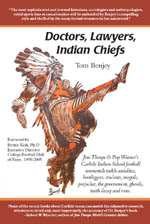
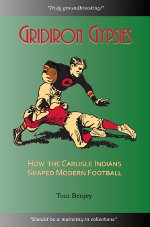
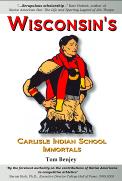
In all of the years that I have been reading and studying about college football, the team representing the Carlisle Indian School has always taken on somewhat legendary proportions. Much of this probably came from reading about Jim Thorpe and his association with the school, or in reading about other schools that had to play the dreaded Carlisle Indians. Over the years I have read several books that deal at least in part with the Carlisle football team. However, I have never come across any publication that tells the entire story of that team, until now.  Therefore, when I was asked to review this significant new book I leapt at the opportunity.

The active time for the Carlisle team was from 1893-1917, with 1894 being the first year to feature a complete schedule of about 10 games. When you consider that this was well over 100 years ago, and that for at least it’s first few years the Carlisle team was hardly known around Pennsylvania, much less the rest of the country, the amount of material that the author has uncovered from this time period is truly amazing. There is no bibliography included in the book; but, the notes listed for each chapter (no less than 25 pages of them) in essence serve as the book’s bibliography. If anyone cares to research a game or a season further, the references are right there.

Although the author acknowledges many people for their help with this project, the story could have used some better editing in two areas. The first is to clear up the player identification ambiguities that are often encountered in the game accounts. Virtually every game that Carlisle ever played is covered in detail based on the available newspaper accounts. With all of this material to decipher and organize, the telling of the story of each season’s games at times suffers. The names of the players from both teams in a game are often used without clearly identifying the team to which they belong; especially confusing when the Carlisle players have non-Indian names. This leads to some confusion for the reader and the need to reread the account to make sure of each player’s team affiliation.

Secondly, the author does a great job in trying to recreate the game action based on what the newspapers reported. However, these recreations stick too closely to the often dry reporting of an early 20th century newspaper sports reporter, a reporter from an era before the reporting of football really took off. Using more exciting prose, without changing any of the facts of the play or the game, would have definitely livened up these accounts and resulted in a more exciting read.

There are two sections of the book which I also feel are placed incorrectly. Appendix A, Origin of the School, tells the story of the Carlisle Indian School from its founding to just before the organizing of the school’s first football team. When I was first perusing the book and came across this Appendix, I decided to read it first. I was correct in doing so, as it is a natural introduction to the rest of the book and should have been used as either Chapter 1 or as the Introduction.

The other section that appears to be misplaced is Chapter 8, Captain Leadership, which relates in great detail something that took place during the 1902 season. Instead of including this material in Chapter 6, which covers the 1902 season, or making it Chapter 7, it is placed after the material covering 1903, which seems out of place to me.

Despite the imperfections mentioned above, they are minor when compared to the total amount of material presented and the research done, i.e., the overall excellence of this work. This is an incredibly detailed story of one of the most legendary of college football teams, one whose reputation is still strong more than 100 years after its final game was played. Few programs have been covered in such detail. If you are a student of college football, this book is a must for your football library.

Since this is a brand new book, there are no copies currently available from any of the used book sources. My suggestion would be to order directly from the source, www.Tuxedo-Press.com (See ad in this issue), or Amazon.

                                                                                                                                         Timothy Hudak

                                                                                                     Sports Heritage Specialty Publications

A Coaching Mystery

February 25, 2022

The current edition of the College Football Historical Association’s newsletter includes and article titled “Mystery Solved.” The author, Timothy Hudak, was researching the life of Hall of Fame coach Frank “Iron Major” Cavanaugh when he unexpectedly came across a reference to Cavanaugh coaching the University of Nebraska at Omaha football team in 1919. Knowing that the war hero was with Boston College at that time created a mystery to be solved. He wondered, “How could a man fresh from recovering from serious wounds suffered in the closing stages of the war, with a wife and six kids, coach at two schools at the same time located in opposite parts of the country?”

Hudak’s further investigation revealed that they were two different men. The Omaha coach was Frank P. Cavanaugh; the Iron Major was Frank W. Cavanaugh. Case closed. However, a similar case but not involving war injuries and a wife and six kids actually happened decades earlier.

From 1895 through 1899, Glenn S. “Pop” Warner coached teams at two different teams quite distant from each other. He coached Iowa State all five years while leading Georgia (1895-6), Cornell (1897-8), and Carlisle Indian School (1899). The question is: How did he do it?

A year after graduating from Cornell with a law degree, Warner had passed the bar but hadn’t yet developed  a substantial practice. So, when the Iowa State graduate football manager offered him twenty-five dollars a week plus expenses to coach their team, he seriously considered the offer. Curious about other possibilities, he contacted some southern and western schools. The University of Georgia offered him thirty-five dollars a week plus expenses for the ten-week period starting September 15.

He then told Iowa State he was willing to coach their team for four weeks beginning in early August. Unable to find a better coach, they offered him one hundred fifty dollars plus expenses for thirty days. An alumni player would assist him while he was there and would take charge after he left.

Warner had no losing seasons with Iowa State, one losing (3-4-0) and one undefeated (4-0-0) season with Georgia, two winning seasons (5-3-1 and 10-2-0) with Cornell, and a strong season (9-2-0) with Carlisle. Warner’s promotion to athletic director at Carlisle in 1900 ended his double-coaching career.

Pop Warner with Jim Thorpe

George Woodruff’s Record

December 7, 2011

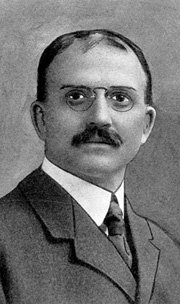
An article by Bob Barton in the November 2011 issue of the CFHS newsletter, among other things, discusses the elevation of Penn’s football program under George Woodruff’s leadership. Given the treatment that Woodruff received from Sally Jenkins, it seems necessary to present a more balanced view of his career. George Washington Woodruff (1864-1934) attended Yale University in the late 1880s, graduating in 1889. While at Yale, he played on the football team, rowed crew and ran track.

In 1892, he enrolled in law school at the University of Pennsylvania and took on the duties of coaching football and rowing crews. (One assumes that he initially took on these jobs to support himself while in law school.) Yale supporters did not take Woodruff’s shift of allegiance well as Woodruff had been a guard for the Eli. They also didn’t like the change in competiveness. The eleven games played between Yale and Penn between 1879 and 1892 all ended in victories for the Eli, often in a rout. Scores in Yale’s favor of 60-0 and 48-0 were quickly reduced by Woodruff to 28-0 and 14-6 in 1893. Claiming that Woodruff had recruited ineligible players although the rules weren’t in place before the 1893 season started, Yale broke with Penn and didn’t play them for 32 years. That didn’t seem to bother George much as his 1894 team went undefeated with victories over Princeton and Harvard and was retrospectively named National Champions. He repeated the feat in 1895 without Princeton, who remained off the schedule until 1935. Not only did George Woodruff bring the quality of Penn’s football to the highest level, he maintained it at that level, going 124-15-2 for the ten years he coached the Quakers. After dropping out of coaching following the 1901 season, he returned to the arena twice: first in 1903 to lead the Illini to an 8-6 season and again in 1905 to go 7-2 with the Carlisle Indians. His charges beat Army, Penn State and Virginia but lost to Harvard and Penn.

Woodruff’s .885366 winning percentage was far above the minimum required for induction into the College Football Hall of Fame.

Carlisle’s Most Important Game

October 30, 2009

The following question was posed to me this week:

I have to do a college speech on an event in the 20th century. I decided to do it on a Carlisle Indian School football game and how that particular game brought attention to the school, the players, and the whole story behind it. If you had to pick ONE game that, in your opinion, put the Carlisle Indian School and their football team on the map what game would you pick.

This is a very difficult question to answer because there are several possibilities:

1. In just their third full season of football, the Indians played The Big Four (Princeton, Yale, Harvard and Penn) in successive weeks and were competitive in all four games. A bad call cost them the Yale game and they held Harvard to just four points. National Champions 10-0-1 Princeton beat all of their opponents except Lehigh, Army and Harvard worse than they beat the 5-5 Indians. The Tigers were held to a scoreless tie by Lafayette. Carlisle smashed Penn State 48-5 and beat the previously unbeaten Champions of the West Wisconsin 18-8.

2. In Pop Warner’s first year at Carlisle, the Indians notched their first win over a BIG FOUR team, Penn, 16-5. They also beat California 2-0 in a game played on Christmas Day in San Francisco. Halfback Isaac Seneca was named to Walter Camp’s All America First Team, the first Carlisle player to be so honored.

3. The 10-1 1907 Indians beat a BIG THREE team for the first time when they took Harvard 23-15. They also beat Penn 26-6, Minnesota and Chicago. Their only loss was to Princeton. Warner considered the set of players on this team to be Carlisle’s best and Jim Thorpe was on the bench! The win over Amos Alonzo Stagg gave him much personal satisfaction.

4. The 11-1 1911 team also beat both Harvard and Penn. Warner considered this team to be Carlisle’s best but it lost to Syracuse by one point due to overconfidence and listless play. Clark Shaugnessy ranked the 1911 Carlisle-Harvard game as one of the twelve best games of all time. Jim Thorpe described it as his most favorite game of his long career.

5. The importance of the 1912 Carlisle-Army was debunked in “Jude and the Prince,” an article written by James G. Sweeney and published in the May 2009 journal of the College Football Historical Society.

I’d appreciate reading your opinions regarding Carlisle’s most important game.

Researching the 1909 Aggies

April 29, 2009

I’m writing an article about the 1909 Texas A & M football team for the College Football Historical Society August newsletter and am making some interesting discoveries. Now you may be asking how this article relates to Carlisle Indian School. After being on the Carlisle team in 1908, Victor Kelley (backup quarterback) and Charlie Moran (assistant coach) left for College Station after a year in Carlisle bringing Mike Balenti (starting quarterback) with them. The three led the Aggies to an undefeated season and won the Southwest Championship. The article is the story of that team’s season, but writing it isn’t as easy as it first seemed.

That a fire destroyed many of A & M’s old records is unfortunately not an unusual circumstance that researchers encounter. The library does have a copy of the yearbook – always a good place to get an overview but often not as accurate as one would expect – and a librarian graciously scanned the section on the championship team into a PDF for me. The A & M library has incomplete sets of school and local newspapers on microfilms that aren’t available for inter-library loan, something else that is not uncommon.

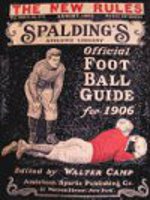
Everything I previously read credited Charlie Moran with being the team’s head coach, but the yearbook stated that someone else started the season in that position and quit after the second game, at which time Moran was elevated into the position. The mystery is: why did the first coach quit. CFbDataWarehouse.com listed one more game – a game with Dallas University – that the yearbook didn’t include. One Wiki site listed this game but another listed a game on the same date with the same score with Trinity. David DeLassus of CFbDataWarehouse.com bailed me out. The Aggies beat Holy Trinity College 47-0 on 11-13-1909 at College Station. His source? The 1910 Spalding Football Guide. He also explained that Trinity changed its name to the University of Dallas in 1910.

Membership in the College Football Historical Society is a modest $17.00 a year. Send a check to: Ray Schmidt, PO Box 6460, Ventura, CA 93006 Subscriptions also make great gifts.

cfhs-masthead-cropped