Posts Tagged ‘Carlisle’

Listen to Carlisle Indian School March

December 16, 2024

A month ago, I wrote that Carlisle Town Band member Dr. David M. Kammerer had taken the piano score for “Carlisle Indian School March” and scored parts for the various instruments in the band and they would be playing it at their concert the following Sunday. I had the pleasure of attending the concert and enjoyed hearing the march played with full instrumentation. Here is a link to a recording made of that portion of the concert: https://www.youtube.com/watch?v=2OjPSdnaFmM

Before we could hear the march played, we had to listen to an introduction given by an archivist from the local college that scanned the Carlisle Indian School records from the National Archives files. She gave a fair recital of composer Dennison Wheelock’s history up to 1900. He was an Oneida from Wisconsin who enrolled at Carlisle in 1885, in part to improve his musical skills. A cornet player, he excelled at Carlisle, both in music and academics. After graduating in 1890, he returned to the school in 1891 as an employee and to attend cross-town Dickinson College’s prep school. There, he also sang with the College’s glee club. He soon became the Carlisle Indian School  bandmaster and married former student Louisa LaChapelle (Chippewa from Minnesota). They had a son, Edmund, in 1896, the same year Dennison wrote the march. They had a second son, Dennison Paull Wheelock, in 1899. A reason for the unusual spelling of the child’s middle name may have been friendship with or admiration of Carlisle teacher Fanny Paull. On March 28, 1900, Dennison and the Carlisle Indian School Band performed at Carnegie Hall. The first piece on their program was “Suite Aboriginal,” composed by Wheelock. He and the band toured, playing concerts at several venues in preparation for traveling to the Paris Exposition to perform. In late April, he was reported as saying the trip was not a certainty. In May, tragedy struck when their infant son died. After services at 2nd Presbyterian Church, the child was buried in the Carlisle Barracks cemetery. In June, Dennison resigned and left for a vacation in Minnesota.

The young archivist claimed that he returned to Wisconsin to work as a real estate agent and practice law. I knew that to be a false statement due to having researched the government Indian school exhibit at the 1904 St. Louis World Fair twenty years ago. What he actually did after leaving Carlisle will be covered in future postings.
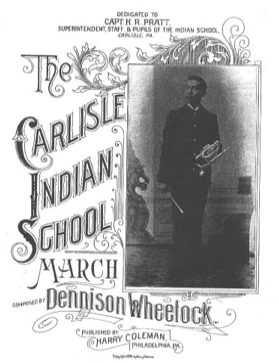
Carlisle Indian School March

November 13, 2024

I was just informed that the Carlisle Town Band will be playing “Carlisle Indian School March” at their concert on Sunday. Several years ago, I found the sheet music for it in the National Archives. Unfortunately, Dennison Wheelock only provided a score for piano. Some years ago, I gave the sheet music to the band so their arranger could write the parts for the various band instruments. At long last the scoring has been finished and the Carlisle Town Band will be playing Wheelock’s march in a concert for the public.

Prior to this, all unmusical me was able to do was to input the piano score into MuseScore and get a synthesized piano output. You can play it by clicking on here. You may have to skip over an ad or two before it plays.

Earlier, I was able to get the Second Presbyterian Church choir to sing the Carlisle School Song, written by Pop Warner. To hear it click here.

I hope to get a recording of the fully instrumented version of Carlisle Indian School March.

George Woodruff

March 8, 2024

Even those who have read Gridiron Gypsies: How the Carlisle Indians Shaped Modern Football may wonder why I’m writing about George Woodruff because I’ve already taken Sally Jenkins to task for her deceitful treatment of him. The reason I’m writing about him now is because a person who is writing Woodruff’s biography contacted me about information concerning his hiring by Carlisle in 1905. This request caught me cold because I hadn’t given it much thought. Woodruff, a future hall-of-fame coach, was available and Carlisle management thought they could use him because Pop Warner had returned to Cornell.

George Washington Woodruff had elevated Penn to make it the fourth member of The Big Four alongside Harvard, Yale, and Princeton but undergrads were dissatisfied with recent results. Although he won three national championships while going 124-15-2 over his 10-year career at Penn (1892-1901), the 5-loss 1901 season was unacceptable, causing him to be let go. He led Illinois to a pitiful 8-6 1903 season (only one win was against a college team – Purdue).

Having political connections to President Roosevelt and Gifford Pinchot, he took a government position in Washington, DC. There, he officiated the Bucknell-Georgetown game played on November 12, 1904. This suggests that he was still keeping his hand in the game.

On August 14, 1905 Penn announced that Woodruff was to be on its “advisory coaching board,” whatever that means, along with Carl Williams, George McFadden, and George Brooke. On September 2, 1905, datelined Carlisle, Pa, “The management of the Carlisle Indian School’s football eleven today announced that they had secured the services of George Woodruff…The Indian School authorities have had him for some time, but did not announce having secured him until his arrival today.” How long “for some time” is debatable because less than three weeks earlier, he was associated with Penn.

The details of exactly he came to be employed by Carlisle have yet to be uncovered. Any information regarding that would be most appreciated.

Woodruff went 7-2 at Carlisle in 1905 before leaving for Washington after the victory over West Point. Some credit him with the three wins and two losses in games that were played after he left but he was not involved with those games.

Forbes Road

June 23, 2008

This year marks the 250th anniversary of the building (perhaps hewing may be more accurate) of Forbes Road. The Seven Years War between France and Britain was raging around the globe. Pennsylvania found itself at the epicenter of the North American theater of what Americans generally call the French and Indian War. General Forbes set out from Carlisle in 1758 to take Fort Duquesne (present-day Pittsburgh) from the French. He followed Indian paths from Carlisle south along what is today Route 11 to Chambersburg and headed west along what later became Route 30. He widened and improved the crude existing roads and, beginning at Bedford hacked his way west to Pittsburgh. 157 years later, in 1915, Pop Warner likely followed the same route when he left Carlisle to take the reins at the University of Pittsburgh.

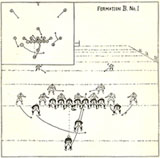
Warner took more than his belongings to Pitt; he also took his single- and double-wing offenses. But before football season started, he held a summer camp for his players at Camp Hamilton, a facility Pitt owned just outside the town of Windber. To get to Windber, Warner would have backtracked on Forbes Road past Ft. Ligonier and halfway to Bedford before heading north to Camp Hamilton. It was at Camp Hamilton that Pop schooled his new players in the intricacies of the single- and double-wing. Many Carlisle players headed west to Altoona and Pittsburgh to play for independent teams, but they would not have followed Forbes Road because they most likely traveled by train.

Camp Hamilton became an expensive luxury for Pitt during the Depression, so ownership of it passed to Windber Area School District. In 2003, after posting Windber’s 500th win, Coach Phil DeMarco was looking for something new. That something new turned out to be the single-wing. So, the single-wing returned to Camp Hamilton after a long absence, not so long, however, as Pop Warner’s absence from Pittsburgh. Windber ran the single-wing at Camp Hamilton back in the 1930s when they won two state championships with it by beating John Harris one year and Steelton another.

The 250th anniversary of Forbes Road celebrates more history than the victory of the British over the French, it also honors the opening of the Northwest Territory to settlement and other things that traveled along the road, wanted or not.