Posts Tagged ‘Boston Redskins’

Historian Demands Redskins Name Be reinstated

September 7, 2023
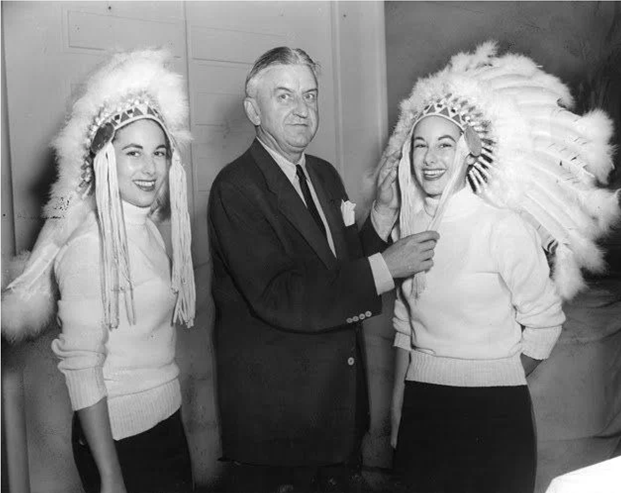
George Preston Marshall (center)

Andre Billeaudeaux, historian and co-founder of Native American Guardians Association (NAGA), thinks opponents of the Redskins name don’t know what they’re talking about. “These people are just ignorant. It’s toxic ignorance. It’s group think. It’s the psychology of a group that has no idea what they’re doing, but they won’t listen to us [NAGA], either.”

The origin of the Redskins name and logos go back to 1912 when James Gaffney, of New York’s Tammany Hall, purchased the Boston Rustlers National League baseball team. He renamed the team as the Braves and used an image inspired by Saint Tammany for the team’s logo. That image is prominent on the left sleeve of Babe Ruth in a photo taken in 1935.

When a group including Washington laundry magnate George Preston Marshall purchased an idle NFL franchise and established a team in Boston, they named the team the Braves. It was common for upstart NFL teams to name themselves after established baseball teams, particularly when they shared the same field. The new Braves’ uniforms didn’t include an Indian motif. Instead they wore jerseys of a simple design in Marshall’s company’s colors: blue and gold.

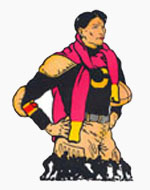
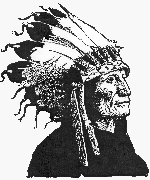
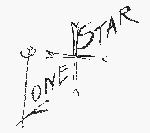
As a .500 first season, Marshall’s cohorts left, leaving him as sole owner of the team. He fired the coach, Lud Wray, and hired Lone Star Dietz, a Carlisle Indian School alum who had had success coaching at the college level. Dietz brought four of his Haskell Institute (today’s Haskell Indian Nations University) Fighting Indians star with him. The figure on the Braves’ letterhead and pin is different than the one used by the baseball team. On the baseball team logo, the man wore a headdress where the football logo image only had three feathers. I’m not qualified to determine if the football team used Saint Tammany’s profile or not. Having red on the letterhead suggests that the team’s colors changed shortly after Dietz became their head coach. The existence of the pin argues against Dietz changing the logo because he was only with the team a short amount of time before the team name was changed and it was during the off season. So, the logo on the button was probably created for the 1932 season.
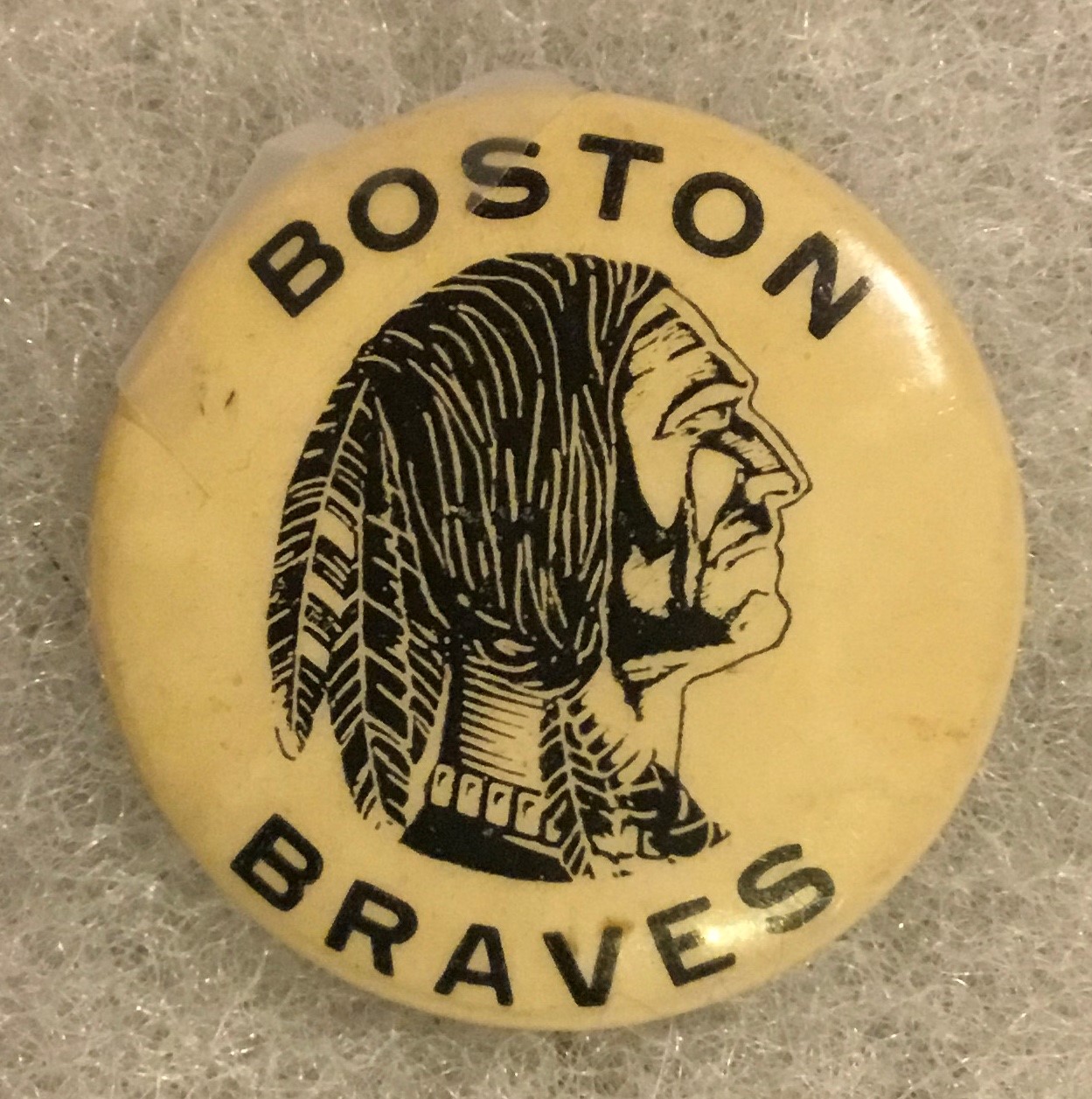
One question never asked is: Why did Marshall change the team’s colors? A 1933 jersey shown below has red as the primary color and is trimmed with gold and black bands. These colors are similar to Carlisle’s colors and the stripes on the cuffs are reminiscent of the below-the-elbow stripes on the Indians’ jerseys. Some have attributed the design of the Redskins’ logo to Lone Star Dietz. The image may have preceded him; it’s not clear when the team adopted it. Dietz likely borrowed the concept from the NHL Blackhawks’ design and placed the logo on the front of the jersey.
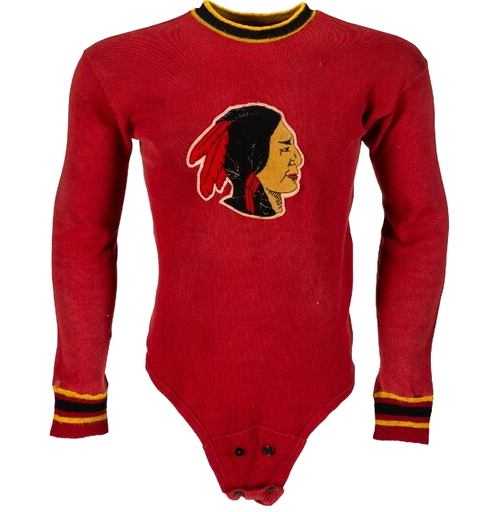
Probably to save money, Marshall moved the team from Braves Field to Fenway Park. To eliminate confusion with the baseball team, he felt he had to change the name. Some think red was chosen because they were then based on the Red Sox home field. A Boston newspaper writer claimed that Marshall chose the name to save money by not having to buy new uniforms. As shown in this piece, both colors and design of the team’s uniforms changed when the team’s name changed. However, the team had to wear the old uniforms in the first game of the 1933 season because the new ones hadn’t arrived yet.

Billeaudeaux thinks otherwise. “Redskins is not about race. It’s a warrior who’s gone through the bloodroot ceremony. “They shave their heads and surrender their souls to their Creator. They paint themselves red as if they were born new into the world.”

“The Redskins were the only minority representation in the entire NFL and it was a real person, not a mascot,” said Billeaudeaux. “The name Redskins is a national treasure and for that reason it should be protected. It’s a cultural treasure and deserves to be protected and understood. It’s not just about the football team. It’s about the DNA of the nation.”

NAGA members aren’t the only people who prefer Redskins for the team name. As of this writing, 130,790 people had signed NAGA’s petition demanding the team name be changed back to Redskins. “Redskins Fans Forever,” a Facebook group with 61,600 members, refers to the team only by its historic name. 

Ninety percent of Native Americans around the country supported the Redskins name in a Washington Post poll in 2016, as the woke assault on the traditional name grew stronger.

Red Mesa High School on a Navajo reservation in Arizona recently installed a new football field with the Washington Redskins logo on the 50-yard line.

Lone Star Dietz Designed Redskins’ Uniforms

January 8, 2014

A little bit of research made crystal clear that The Boston Globe writer hadn’t bothered to research the 1932-1933 Braves-Redskins uniform issue at all when he wrote, “It appears the name change was nothing other than a cheap, pragmatic way for the Redskins to play under a new name at a new venue with uniforms that were but a year old.”

The Boston Herald coverage for the 1933 Redskins first home game announced, “Furthermore, they have a new coach, Lone Star Dietz; have new uniforms and some new players.” Grainy black and white period newspaper photos don’t show off the new uniforms very well, so football trading cards will have to suffice. Turk Edwards’ card shows the front pretty well where Cliff Battles gives a side view. The colors are similar to those of Carlisle Indian School, which were red and old gold. A multi-color Indian head adorns the front of the jersey and stripes are placed at the wrists. (Carlisle’s stripes were just below the elbow.) Now that we know what the Redskins wore in 1933 and later, let’s find out what the Braves wore in 1932.

The September 19, 1932 edition of The Boston Herald reported that the Braves didn’t look like a well-polished professional team when they easily defeated the Quincy Trojans in a practice game at Fore River Field on September 18, 1932. One reason was the long off-season lay-off. The other was sartorial. Because their new uniforms hadn’t arrived, they wore plain blue jerseys without numbers. Fortunately, their dark blue jerseys with gold numerals arrived before their first home game. Although the black and white photos that accompany the article aren’t in color, they clearly show numerals on the front of the 1932 jerseys in the place where the Indian heads appear in 1933. This is further evidence, again easily found, that George Preston Marshall didn’t select Redskins for the team name as an economy move.

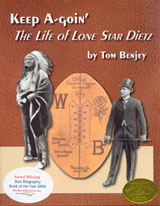
This uniform information brought to mind something that came up when researching Lone Star Dietz’s life. A Lafayette, Louisiana attorney I interviewed had represented the One Star family pro bono some years earlier in an attempt to receive compensation from a previous owner for the artwork Dietz created for the team in 1933. The statute of limitations had expired decades earlier so the family got nothing. Unable to find physical evidence that Dietz had designed the uniforms, such as sketches he had made, I didn’t include the topic in his biography. Now, I think it’s quite likely that Lone Star designed the 1933 Redskins uniforms. The team name changed months after he was hired. The Redskins’ new colors were similar to Carlisle’s. Dietz clearly had the artistic ability to design the Indian head for the jerseys. He had a long history of making art for teams and schools and participating in artistic endeavors seldom done by football coaches. And it wouldn’t have cost Marshall anything.

1932 Boston Braves

1932 Boston Braves

Cliff Battles chicklet Turk Edwards national chicle card

Redskins Named in Dietz’s Honor

May 6, 2013

Professor Joseph Gordon Hylton posed some opinions and asked a question with regard to the naming of the Redskins NFL team yesterday. He stated that George Preston Marshall, owner of the Boston NFL franchise, had a life-long fascination with Indians. That is believable because another NFL owner, Walter Lingo, believed there existed a mystical connection between Indians and the Airedales he raised and sold. His team was formed a decade before Marshall’s and was named the Oorang Indians. Now to Dr. Hylton’s question:

“Has anyone pinpointed the day that the name change was announced?”

I previously located letterhead for the Boston Braves that listed Lone Star Dietz as the head coach (see p. 278 of Keep A-goin’: the life of Lone Star Dietz) but hadn’t tried to pinpoint the exact date of the name change. A little research turned up the date Dietz was named head coach in a March 8, 1933 issue of The Boston Herald. The team was referred to as the Redskins on the sports page by the end of August, so it had to renamed before that. A little more research located the announcement of the team’s name change. The July 6, 1933 issue of The Boston Herald included a short article titled Braves Pro Gridmen to be Called Redskins (see below). This article establishes the fact that the Redskins were renamed well after Dietz’s hiring and includes the team’s published reason, “…the change was made to avoid confusion with the Braves baseball team and that the team is to be coached by an Indian, Lone Star Dietz, with several Indian players.”

This article supports the contention made by George Preston Marshall’s granddaughter several decades later.

1933-07-06 Redskins renamed

More Misinformation from a Journalist

May 17, 2010

While wrangling grandchildren in Bethesda, MD this weekend, my wife took the impressionable young minds into a bookstore. 12-year-old Joey, a bookie if there ever was one, picked up a copy of The Redskins Encyclopedia by Michael Richman. When he showed it to my wife, she immediately noticed several errors in a paragraph that deals with Lone Star Dietz. The offending paragraph can be found on page 3:

The hands-on Marshall fired Wray, too, and replaced him with William “Lone Star” Dietz, a part-blood Native American. Dietz recruited six football stars from the Haskell Indian School in Kansas, where he had once played with the great Jim Thorpe and later coached for four years. The recruits included “Chief” Larry Johnson, Louis “Rabbit” Weller, and John Orien Crow. The charismatic coach told his players to pose with war paint, feathers, and full headdresses before the 1933 home opener against the Giants.

Where to start? Let’s do them in the order they appear:

1. Dietz recruited six football stars from Haskell

I’ve read this elsewhere but can only verify that he brought four former Haskell students with him—the three Richman listed plus David Ward.

2. …from Haskell Indian School in Kansas…

They came from Haskell Institute (today’s Haskell Indian Nations University) in Lawrence, KS not Haskell Indian School.

3. …where he [Dietz] once played

There is no record of Dietz ever enrolling at Haskell Institute or playing on their football team. He did coach there from 1929 to 1932.

4. …where he [Dietz] once played with the great Jim Thorpe

Lone Star Dietz played with Jim Thorpe at Carlisle not Haskell.

Jim Thorpe attended Haskell Institute before attending Carlisle but did not play on the school’s football team.

What is discouraging is that the author is a veteran journalist and should know that he should have checked his facts. It would have taken him little time to find these errors had he just consulted my biography of Lone Star Dietz and Bob Wheeler’s biography of Jim Thorpe. It is no surprise that yet another journalist has made less than accurate statements about Jim Thorpe and Carlisle Indian School, but it is unfortunate because most readers accept that the author has his facts right and don’t check for themselves.