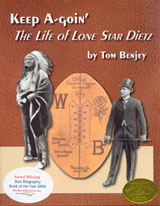
It was almost two years ago that I gave my first booktalk on Keep A-goin’: the life of Lone Star Dietz. Things went smoothly until the question and answer session when a gentleman informed me that a photo in my book had an incorrect caption. The caption below a photo on page 290 of two men in business suits flanking a smaller young man in his Albright College football uniform read, “Jim Thorpe shows Leo Disend some tricks as Lone Star looks on.” There can’t be anything wrong with that, I thought, because it came straight from an Albright College yearbook. Also, I knew what Jim Thorpe and Lone Star Dietz looked like, so it couldn’t be wrong. Or so I thought.
The gentleman then informed me that the player in the photo was not Leo Disend. He didn’t know who it was but he was sure it wasn’t Moose, as Leo was better known as. The man identified himself as Sid Disend, Leo’s bother. Well, I couldn’t argue with him because he surely knew what his brother looked like. He also said that the layer in the photo was not wearing Leo’s number. I then had to find out who the mysterious number 31 in the photo was.
The next day I emailed Francine Scoboria, Manager of Advancement Communications at Albright College, to inform her of this long-standing error. She researched the issue and found that the mystery man was John Killiany, class of 1946, varsity quarterback.
The lesson in this was that errors made decades earlier, this time over 60 years before, often are assumed to be correct years later. So, when you’re researching the past, don’t be surprised when you encounter conflicting information. Either or both source may be wrong.
Now I’m off to research the great Dickinson College crockery riot of 1912.
April 8, 2008
It is with sadness I report seeing the following in today’s Harrisburg Patriot-News:
Sidney DisendSid Disend, 86, of Harrisburg, died Sunday April 6, 2008 at the Carolyn Croxton Slane Hospice Residence on Linglestown Road.
Born in Roselle, NJ, he was the son of Samuel and Sarah Disend. Sid graduated from Albright College in Reading, PA with a degree in Education then served his country in World War II at the Battle of the Bulge in the U.S. Army as a sergeant in the 95th Division, Field Artillery.
He was the owner/operator of Ess & Dee Venetian Blind Company then retired as Regional Sales Manager for the R.W. Norman Company of Salisbury, NC, responsible for the entire Northeast territory.
He was a member of Temple Ohev Sholom, a member of the Brotherhood, and Principal of the Religious School. He was the Past President of the Harrisburg Jaycees, and the recipient of their first Honorary Life Membership. He was the Founder and Past President of the Wilson Park Civic Association, Founder and Past President of the Latshmere Crime Watch, a charter member of the Susquehanna Rovers Volksport Association, and a founding member of the Capital Area Greenbelt Association.
Sid was also an active volunteer at the Harrisburg State Hospital, the Jewish Home of Greater Harrisburg, a Dispatcher for the Susquehanna Township’s Indian Wheels, an Instructor with the Literacy Council, and, with his wife Shirley, was responsible for the development of the “Five Senses Gardens, on the Greenbelt.
Sid is survived by his wife of 64 years, Shirley, son Jeff and his wife Kay of Atlanta, son Randy of Harrisburg, and several nieces and nephews.
A memorial service will be held on Wednesday, April 9, 2008 at 11:00 a.m. in the Bookstaber Chapel of Mount Moriah Cemetery. An additional memorial service will be held in the Manor at Oakridge, 4500 Oakhurst Blvd., Harrisburg, PA on Thursday, April 10, 2008 at 2:00 p.m.
Arrangements by Fackler-Wiedeman Funeral Home, Harrisburg. There will be no viewing or visitation.
Memorial contributions may be made to the Five Senses Gardens, c/o Capital Area Greenbelt Association, P.O. Box 15404, Harrisburg, PA 17105 or Hospice of Central Pennsylvania, P.O. Box 206, Enola, PA 17025.
Sid has donated his body to science through the Humanity Gifts Registry at the Hershey Medical Center. wiedemanfuneralhome.com







 Tom Benjey's Weblog
