Correct Information Is Hard to Find

January 8, 2010

A November 27, 1949 newspaper article by Deke Houlgate discussed the problems Warner Brothers were having with a screenplay for Jim Thorpe’s biopic. Several scripts had been written and discarded but a new one, titled “All-American,” was expected from the screenwriters soon. However, he questioned how good it would be given the problems the writers faced. He wrote, “One of the present problems at the Burbank studio seems to be that the records for this famous team–records that must reach back prior to World War I—no longer exists or are easily obtainable. The Army of the United States took over the school or campus, without asking, for the use of its fledgling doctors in 1917 and scattered students plus pertinent data all the way from Lawrence, Kansas, to Riverside, California.”

Like most newspaper reporters, Houlgate had some details wrong but he did better than most. First, the Army took Carlisle Barracks back in 1918, not 1917. Second, the facility wasn’t used for “fledgling doctors” as that came later. In 1918 it was used as a hospital to treat soldiers wounded in WWI. Houlgate went on to attempt to set the record straight on some legends that unfortunately still persist:

First off, Carlisle never had an undefeated, untied season. The Indians came close to a perfect record many times but always managed to lose at least one game. Next Jim Thorpe was not the first or only All-American. Third, Pop Warner did not bring Carlisle from obscurity to fame because Bemus Pierce and Metoxen were recognized as All-Americans by Walter Camp in 1896 or years before Glenn Scobie ever coached there.

Houlgate is correct about everything in the last paragraph except that Walter Camp first recognized a Carlisle player as a first team All-American in 1899 when he selected Isaac Seneca as a halfback. He may have named Pierce and Metoxen to his second or third teams but I don’t have a reference at hand to verify that. Whether or not Camp named Carlisle Indians to his All-America teams does not mean that Houlgate’s point is incorrect. The team and its star players were indeed famous before Warner was hired to coach them.

Be Careful What You Read

January 5, 2010

While reading a December 1928 newspaper, I came across an article by the great sportswriter Grantland Rice in which he credited the Carlisle Indians with doing more to popularize the game of football than anyone else:

“It was Pop Warner and his Carlisle Indians who did more to spread the gospel of football to crowds around the country than anything else. Wherever the Indians roved and roamed the multitude flocked. Those were the days of Bemus Pierce, Metoxen, Hudson, Mount Pleasant, and later such stars as Thorpe, Guyon and Calac. Old Boy Jim, meaning Thorpe, was the king of the lot, a great football player for 20 years….Warner’s teams are always interesting to watch. As a rule, they have something unexpected ready to reach for in case they need it. Even a rival lead of two touchdowns can be wiped out in one period if the other side isn’t abnormally cagy.”

Because of the Indian School’s fame, reporters often created links where they didn’t exist. Included in Jonas Metoxen’s death notice in a 1942 newspaper was the statement that he “…won fame as a blocking halfback for Jim Thorpe….” Little research is needed to determine that this statement is incorrect. Metoxen and Thorpe were not at Carlisle at the same time. Metoxen played in the late 1890s where Thorpe played dome, but not all, the years between 1907 and 1912. A smaller error is that Jonas generally played fullback.

One needs to be very careful when reading books and articles about the Carlisle Indians because many are loaded with errors. Relating a former player with Jim Thorpe is probably the most common of all. The school operated from 1879 to 1918 and Thorpe but Jim Thorpe was a student for only a small portion of those years. Also, very few of the boys were good enough to play on the varsity squad, so very few that were at Carlisle when Jim was played alongside him. Many, if not most, played on shop teams or the like, but only the very best played on the varsity. Newspaper clippings often list the starting line-ups and the substitutes that got into the games. If a person can’t be found in one of those, he probably didn’t play for Carlisle.

Ringing in the New Year 100 Years Ago

December 31, 2009

“A Happy New Year” wrought in red electric lights, and suspended across the gymnasium, welcomed the guests to the annual reception of the Standard Debating Society in the gymnasium last Friday night, and suggested the general theme of the evening’s entertainment. The event took the form of a farewell party to 1909 and a welcome to 1910, an idea which was carried out in the menu cards and souvenirs which each represented a dainty 1910 calendar. The Standard colors, orange and black, were attractively used in the decorations, and the music was good. The address of welcome was given by the president of the Society, Francis Coleman. A novel and very enjoyable feature of the program was the singing of “By the Light of the Silvery Moon” with all the lights extinguished except the tiny red ones in the Happy New Year sign. Just before midnight a seated supper was served in the Y. M. C. A. Hall. The menu consisted of chicken salad, wafers, maple nut ice cream, cake, fruit, mints and coffee. Mr. Whitwell, the Standards’ advisory member, as toastmaster, cal1ed for the following toasts: What standards have accomplished, Ray Hitchcock; Our sister and brother societies, R. Charles; Once a Standard, always a Standard, Mr. Nori. The cakes for the prize dances were awarded by the judges, Mrs. Foster, Mrs. Stauffer and Mr. Dietz, as follows: Twostep, lst, Ruth Lydick, Albert Lorentz; 2nd, Emma Newashe, John Farr; Waltz, lst, Rose Hood, Reno Rowland, 2nd, Inez Brown, Harry Woodbury. After the presentation of the prize cakes by Mr. Whitwell, a solo by Montreville Yuda, “I’m Going to Do as I Please,” set the merry feasters in an uproar of applause which lasted until the ringing of bells and the blowing of whistles proclaimed the arrival of 1910, Then a great wave of Happy New Year wishes swept over the hall, and all returned to the gymnasium to welcome in the New Year with dancing. This number was danced with the lights lowered and with only the red welcome to the New Year shining on the dancers. The home waltz ended the program.

Carlisle Student Returns to Reservation

December 28, 2009

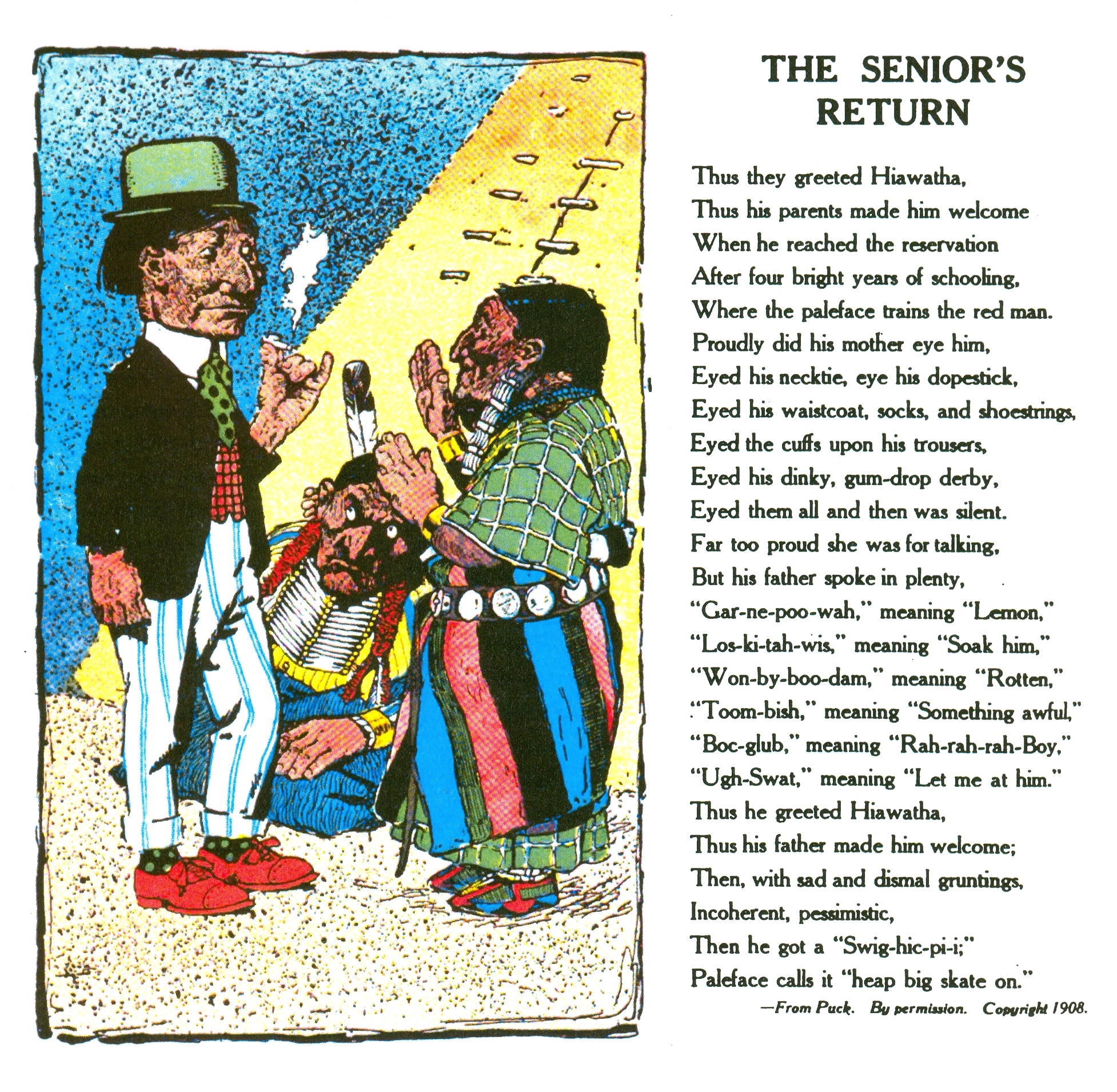
On more than one occasion, Puck Magazine parodied the return of a son from Carlisle Indian School to the reservation. The cartoon below is from a 1908 issue.  That Carlisle did not prepare students for the lives previous generations lived is true. They weren’t taught to hunt or tan hides. They weren’t taught how to make bows and arrows. And they weren’t taught how to use weapons. However, many rose to positions of authority in their tribes because they could read and write English and had a better understanding of the white man’s culture. Those who did not return to the tribe tended to fare better because they could put the skills they learned at skill to use to support themselves.

Christmas at Carlisle 100 Years Ago

December 24, 2009

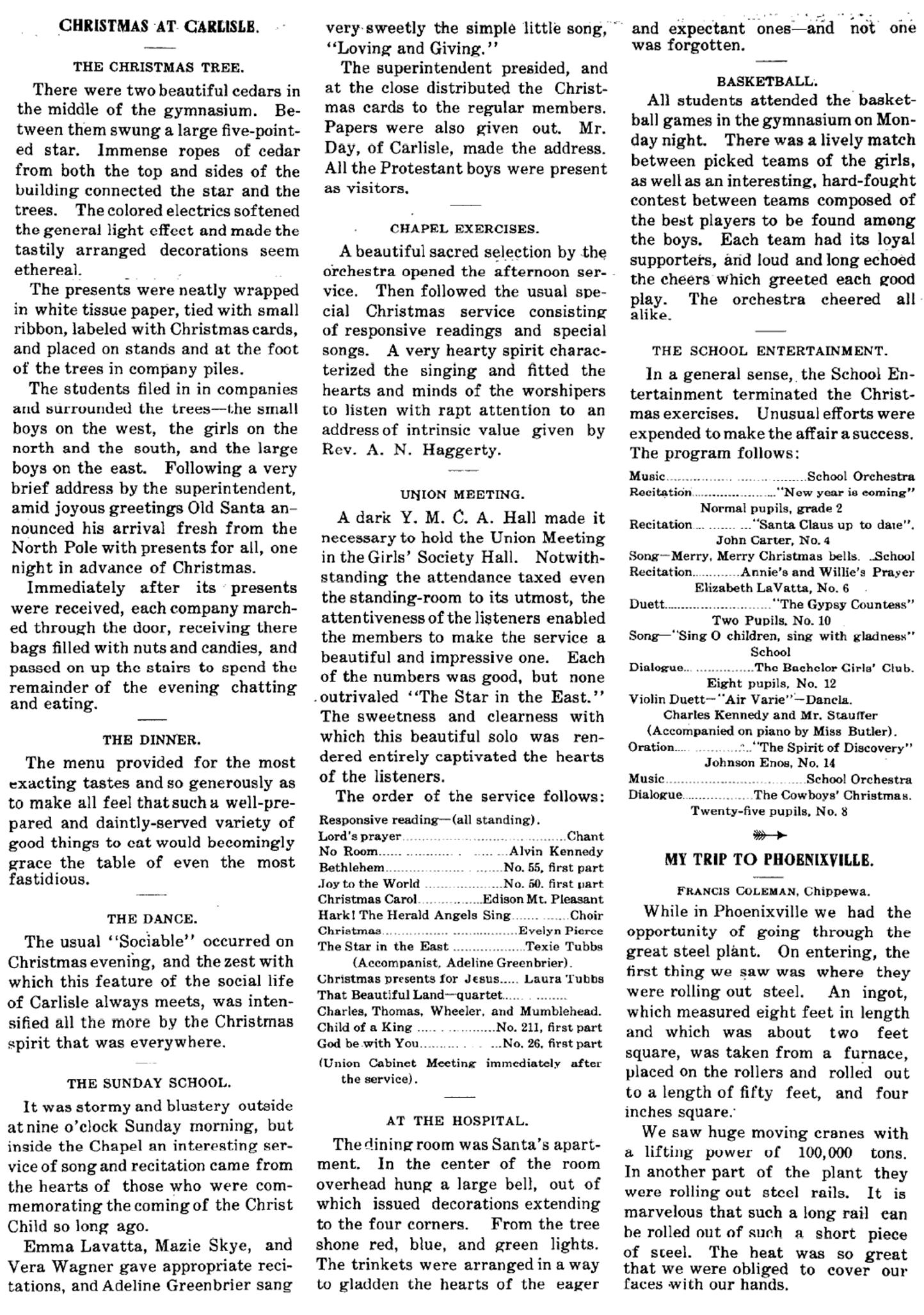
Christmas 1909 was the second under the command of Superintendent Moses Friedman. Although Jewish himself, the school’s observance of the Christian holiday did not change significantly from earlier years. Follows is a page from the school’s newspaper in which that year’s activities are described:

Lt. Frank Mt. Pleasant

December 22, 2009

 I just came across a photo of Frank Mt. Pleasant in his WWI army uniform. Unfortunately, there are a few errors in the associated text. He competed in the 1908 Olympics, placing 6th in both the broad jump and triple jump although injured at the time. In Paris, after healing, he beat the Olympic broad jump champ in a big meet. His name is misspelled in the caption under the dog. He was the first Carlisle Indian to get a degree, a Ph. B., from Dickinson College. However, some others previously got LL B. degrees from Dickinson School of Law.

He has been inducted into the Dickson College and Indiana University of Pennsylvania halls of fame as an athlete and a coach, respectively. He was earlier inducted into the American Indian Athletic Hall of Fame. It is astounding that the Pennsylvania Sports Hall of Fame has not inducted him when you consider that the vast majority of his playing and coaching career was in Pennsylvania and he was a premiere athlete in two sports first at Carlisle Indian School and then at Dockinson College during his playing days.

Joe Gilman Last Installment

December 17, 2009

Joe Gilman was still in Minneapolis in 1917 when he registered for the draft on June 5. He and his family lived at 3218 Bryant Street and he worked as a salesman for Minneapolis Auto Laundry Company. He gave his date and place of birth as February 8, 1892 in Emily, Minnesota. He registered as an Indian but claimed no exemptions from the draft. Under prior military service, he claimed 4 years as an infantry 1st Sergeant at Carlysle [sic]. It may be that he was trying to get drafted. It seems unlikely that he did because his second child, Isabelle, was born in 1918 in Minnesota.

Although Minneapolis Auto Laundry Company is an odd name for a company that sells automobiles, it might have been who Joe was working for when he wrote Carlisle in November 1916.

The 1920 census listed Joe Gilman as working for Ford Motor Company in Minneapolis as a salesman. It might be that his work ended when the 300-car contract was finished, causing him to return to the Ford branch. Family lore has it that he owned a Ford dealership, Gilman Motors Company, in Minneapolis that went bankrupt in 1922. He could have started that right after the 1920 census.

According to family lore, after his bankruptcy Joe Gilman moved his family back to Detroit where he again worked for Ford as a salesman. At least for a time. The 1930 federal census listed him as living in Detroit but working for an unnamed soap company. His position was illegible but might have been salesman but probably wasn’t. The 1937 tribal role listed him as still living in Detroit.

He left his family in 1943 and his daughter, Roberta, never saw him again after her wedding day. Needless to say, his grandchildren never saw him. He died in 1960 while in an Addicted Adult Program, which probably meant that he suffered from alcoholism.

Joe Gilman Part V

December 14, 2009

Joe Gilman was apparently transferred to Minneapolis by Ford because his daughter, Roberta Carlysle, was born there and his wife, Lydia, was from Michigan. The November 3, 1916 issue of The Carlisle Arrow contained this item about Joe:

End of Part V

Joe Gilman Part IV

December 10, 2009

In July, The Carlisle Arrow announced that Joe Gilman and 18 other boys were receiving excellent reports for their work at Ford. On Sept 11 1915, Joe married Lydia Douglas 1 week before Lydia’s 17th birthday. In November the school reported on his marriage, stating the young couple, “..is getting on very well. Joseph has an excellent record at Carlisle, and great success is wished him by his friends.” The fact that this item appeared in the Alumni Department Notes column implied that Joe was no longer a Carlisle student. Lydia was a white girl who was born in Michigan to a father from Canada and a mother from Michigan.

The December 3 edition told of Joe’s promotion and transfer:

Joseph Gilman, Everett Ranco, and Norman Thompson, who went to Detroit last January, were promoted in July and are now receiving $5.00 a day.…Joseph Gilman expects to be transferred to Minneapolis, Minn., before long to do the same kind of work in the Ford plant there.

In January 1916, The Arrow reprinted an article from the Philadelphia Public Ledger titled “Indian Youths Set Records in Factory.” The lead paragraph featured Joe:

Out of the score of nations represented in an automobile factory in Detroit it remained for an Indian, Joseph Gilman, a Chippewa, whose home is in Minnesota and who is at present enrolled at the Carlisle Indian School, to set the world’s record for assembling a car of that make. He had the machine ready for the road in two hours and fifty minutes after beginning work. The previous record was three hours.

Roberta Carlisle Gilman was born on March 3, 1916 in Minnesota.

End of Part IV

Joe Gilman Part III

December 7, 2009

The January 1, 1915 edition of The Carlisle Arrow announced that Joe Gilman and Pete Calac, both Freshmen, would be leaving soon to work for Ford Automobile Company in Detroit. By the time he left, less than a week later, four more boys: Gus Lookaround, Norman Thompson, Everett Ranco and Charles Pratt, were added to the list. The Freshmen class held a reception in their honor in the Mercer’s Hall to celebrate their leaving. Joe and some of the others were called upon to say some words at the event. Later in the month, in an article entitled “What Carlisle Means to Her Graduates,” lauded Joe’s initiative:

Last summer when work was scarce and hard times had struck our country, Joseph Gilman, without any other credentials than his honest face and the fact that he was a Carlisle Indian, applied for a job at the Bethlehem Steel Works. He was one in a long line of men waiting for work. Hundreds had been laid off, but Joe was given a job and was told by the superintendent when he left that if at any time he wanted work he could find it there.

On February 5, the first report on the boys’ progress at Ford. Joseph Gilman and Gus Lookaround are in rear axle department. They have been through the rear axle operations and are now on transmission, but Lookaround still has the repair job on rear axle to learn, as there was no room for him there. Their foreman says they are good and willing workmen, Gilman being especially apt. At school they have taken up work in English, arithmetic, and penmanship, and will later take up spelling and drawing. Gilman and Ranco have attended regularly, the others having missed some sessions. At their boarding place they are behaving themselves admirably and are general favorites. They are much interested in basketball, and their instructor says they show the best form for a winning team of any group he ever saw. They never seem to lose their tempers, even when the other team is purposely rough, simply laughing it off. They have the reputation for conducting themselves as gentlemen wherever they appear.

End of Part III