Asa Sweetcorn, Carlisle’s Wild Man

March 26, 2010

As so often happens, I came across an interesting article when looking for something else. This time it was a 1933 interview of Gus Welch by Alan Gould of the Associated Press. By this time Gus Welch had gained a reputation as a great storyteller, having won the coveted Brown Derby Award at annual coaches conferences. For whatever reason, no award was made in 1933 but Welch told an interesting story about, as were many of his stories, a teammate at Carlisle. He recalled a headstrong player named Asa Sweetcorn who, as a running guard [probably a pulling guard in modern parlance], felt that his contributions were being disregarded in Warner’s newspaper columns. He reacted by drawing attention to himself. Instead of running plays as his coach diagrammed, Sweetcorn “…would go ripping around an end, legs and arms flying, making gestures at everybody but taking out nobody. I took him aside to find out what was going on. Slyly he wispered to me: `Gus, that’s psychology. I keep `em all worried and guessing and then they say, My what a great running guard this Sweetcorn is.’”

 Reporters rewarded him with positive mention in their columns and opposing teams started to take notice of him. Navy concentrated much of their effort against Sweetcorn to his detriment. Soon he was groggy and bloody. At half-time, Pop suggested that a substitute be sent in for him. Welch responded, “No, this Sweetcorn is just faking. Let him stay in.” After taking terrible beatings game after game, Asa began to wise up a bit but not completely. Lying on the field badly beaten in a game, he had about reached the limit of punishment he could withstand, he said something to Welch about needing a “medicine man” but Welch disagreed, “Never Mind medicine man; send for a priest.”  

 Next time, find out how Sweetcorn fooled Sally Jenkins.

More on the Writer’s Digest review

March 24, 2010

This time we’ll discuss other parts of the Writer’s Digest review of Oklahoma’s Carlisle Indian School Immortals, beginning with “The U. S. tendency to treat Native Americans like animals means that their biographies reflect the glory of sports—and the sorrow of poverty and bigotry.”

For starters, biographies of these men must “reflect the glory of sports” because, in their youth, these men were famous across the country as a result of their athletic abilities. Sure, newspaper coverage was often racist but it was respectful of their abilities and accomplishments. Sports opened doors to them that were not open to most young whites of that period. College was largely reserved for the elite. Few from the working class darkened the doors of these hallowed institutions. However, several Carlisle Indians were enrolled in major universities. These same schools complained about Carlisle not conforming to the same eligibility rules that they gave lip service to while recruiting the Indians to leave Carlisle and come play for them.

Others leveraged their Carlisle fame into jobs away from the reservations where opportunities were few. Not many of them became rich, but sports were not a route to wealth for all but a few in those days. Amos Alonzo Stagg was probably the highest paid man in sports because he was making $6,000 a year as a tenured professor with the University of Chicago. Jim Thorpe’s contract with the New York Giants paid him as much but only for five years. It wasn’t until Red Grange and Babe Ruth arrived on the scene that athletes became rich. By then, the Carlisle Indians who hadn’t retired from competition were in the twilight of their athletic careers.

Most of the Carlisle football players I have researched rose from poverty into the middle class. Many of them worked with their hands in occupations that some consider menial today. But most Americans worked in “menial” jobs those days and very few went to college. The grandchildren of these men who have contacted me have gone to college and living middle-class lives. Ironically, their family histories parallel those of immigrant groups given that Indians are the only non-immigrants in the country.

Review of Oklahoma’s Carlisle Indian School Immortals

March 19, 2010

Writer’s Digest just sent me a review of Oklahoma’s Carlisle Indian School Immortals that included something interesting. Before we get to that, you can read the short review in its entirety:

I knew Jim Thorpe would be in this book, and he is; but I didn’t know how many honors he had earned. Didn’t the Olympic Committee restore his medals, also? Well, besides Thorpe and his athletic prowess, this fine little book offers stories about a number of other fine students, All-Americans and later coaches. The U. S. tendency to treat Native Americans like animals means that their biographies reflect the glory of sports—and the sorrow of poverty and bigotry. If those students had cried all the tears they earned, Oklahoma would be a swamp. I wish the author had had time to write a book about each of the men.

I take the comments that “this fine little book” and the wish that I had “time to write a book about each of the men” as compliments. However, I feel that I should address some of what was said in the review lest the reader be misled. Of course the reviewer is correct in stating that I don’t have time to write book-length biographies for all these men. But time isn’t the reason I didn’t and don’t expect to be able to do that. Availability of information is the determining factor. The men about whom I write typically left few papers behind and none wrote memoirs. Occasionally, I locate one of their children but most of them are now deceased. Grandchildren are often interested in their grandfathers’ lives but most have little information about them. It is wonderful when they do.

These men, like most Americans of all races, generally worked at their jobs, paid their taxes, supported their families, survived the depression as best they could and sent sons off to fight in WWII. After being famous in their youths, they lived quiet, productive lives typical of their generation. Unfortunately, that usually doesn’t create enough material for a book.

A grandchild of one such man wrote me recently to inform me that she had read the chapter about her grandfather and told me that she was amazed at the amount of material I had found about him. Granted, his name found its way into his local newspapers much more than most but he left far too little information behind for a book.

Some of the reviewer’s other statements deserve comment and will be addressed next time.

Cause of Oscar Hunt’s Death

March 16, 2010

I spent some time researching the cause of Oscar Hunt’s death. First, I thought if I could locate his death certificate, I would find out what caused his death. I quickly learned that death certificates were not issued in Oklahoma till later that year and were not required then. It was some time that death certificates were routinely issued in Oklahoma.

Next, I thought if I could locate the court records, they might contain something about his death. Because newspaper articles stated that his case was in Federal Court at Afton, Oklahoma, I contacted the Northern District Court in Tulsa. Their clerk informed me that the court did not exist until 1922 and referred me to the Eastern District Court in Muskogee. Their records don’t start until later in 1907 and a quick check of their card file found nothing. The clerk suggested that I contact the county court. Since Afton is split between two counties, Jay and Ottawa, it was necessary to contact both of them. Unfortunately, they had no records prior to statehood. A clerk did recommend that I contact the Muskogee Court House because that court was older than many others. Muskogee had nothing prior to statehood, either.

No one seems to know if records for trials that took place in Indian Territory still exist and, if they do, where they are preserved. My next stop is at the National Archives in Fort Worth. I fear that finding Hunt’s legal records will be like looking for a needle in a haystack.

Lone Star Dietz on 2010 Hall of Fame Ballot

March 13, 2010

We are celebrating Dietz’s listing by giving 20% off his biography at www.Tuxedo-Press.com. To learn more about Lone Star Dietz, check out www.LoneStarDietz.com.

The National Football Foundation released this year’s ballot of candidates for induction into the College Football Hall of Fame. Lone Star Dietz is on the ballot again.  This year, he is joined by:

  • Barry Alverez of Wisconsin
  • Jim Carlen of South Carolina, Texas Tech and West Virginia
  • Wayne Hardin of Temple and Navy
  • Bill McCartney of Colorado
  • Billy Jack Murphy of Memphis
  • Darryl Rogers of Arizona State, Michigan State, San Jose State, Fresno State and Cal State-Hayward

It will be interesting to see if the injustice done to Lone Star will be corrected this year. It also remains to be seen if the Lone Star Curse over Washington State will ever be lifted. WSU’s last undefeated season was in 1917, Dietz’s last year in Pullman. Their last, and only, Rose Bowl victory was in 1916 when Dietz’s undefeated warriors upset Fritz Pollard and Brown to put West Coast football on the map and to establish the Rose Bowl and all the other bowl games that followed.

The End of Oscar Hunt

March 6, 2010

Steve Hawkins and a volunteer researcher at Oklahoma Historical Society located some 1907 newspaper articles related to Oscar Hunt’s untimely demise and sent copies of them to me. What a treasure trove of information that package included! They found some pieces from the Miami, Oklahoma Record-Herald and the Afton Climax from March and April of 1907. These short news reports help shed light on what happened.

The first one, dated March 1, 1907, in its entirety said, “Oscar Hunt is under arrest for the killing of Joe Wolfenberger in the Seneca nation last Saturday night.” Now we know that Hunt had indeed been arrested for murder as well as when and where it took place.

Two weeks later, the Afton Climax reported on Oscar’s preliminary hearing after which he was released on $1,000 bond, which he furnished. None of the witnesses, who had apparently been with Hunt and Wolfenberger on a drinking binge, could remember none of the details of the drunken fight on the way home from Tiff City that left Wolfenberger dead.

That day’s Record-Herald provided more detail. The farmers were returning to the Seneca Nation from Tiff City, Missouri “…in inebriated condition when they and “stopped in a hollow to camp and complete their carousal.” Oscar Hunt was bound over to the next federal grand jury and “…in the meantime Hunt will have time to look over his situation in the innermost depths of the Vinita jail.”

Two weeks after that, the Afton Climax blared, “Oscar Hunt Gone Insane.” Perhaps he had probed his innermost depths of his being, reflected upon what he may have done and couldn’t handle having killed someone while drunk. So distraught was he that “It is reported that it takes several men to hold him and it is probable that he will be taken to some asylum soon, should his condition not improve.” He was released on bail to go to his home near Cayuga.

The final episode came two weeks later when the Record-Herald reported that Oscar Hunt had died. More research will be needed to find out the cause of death.

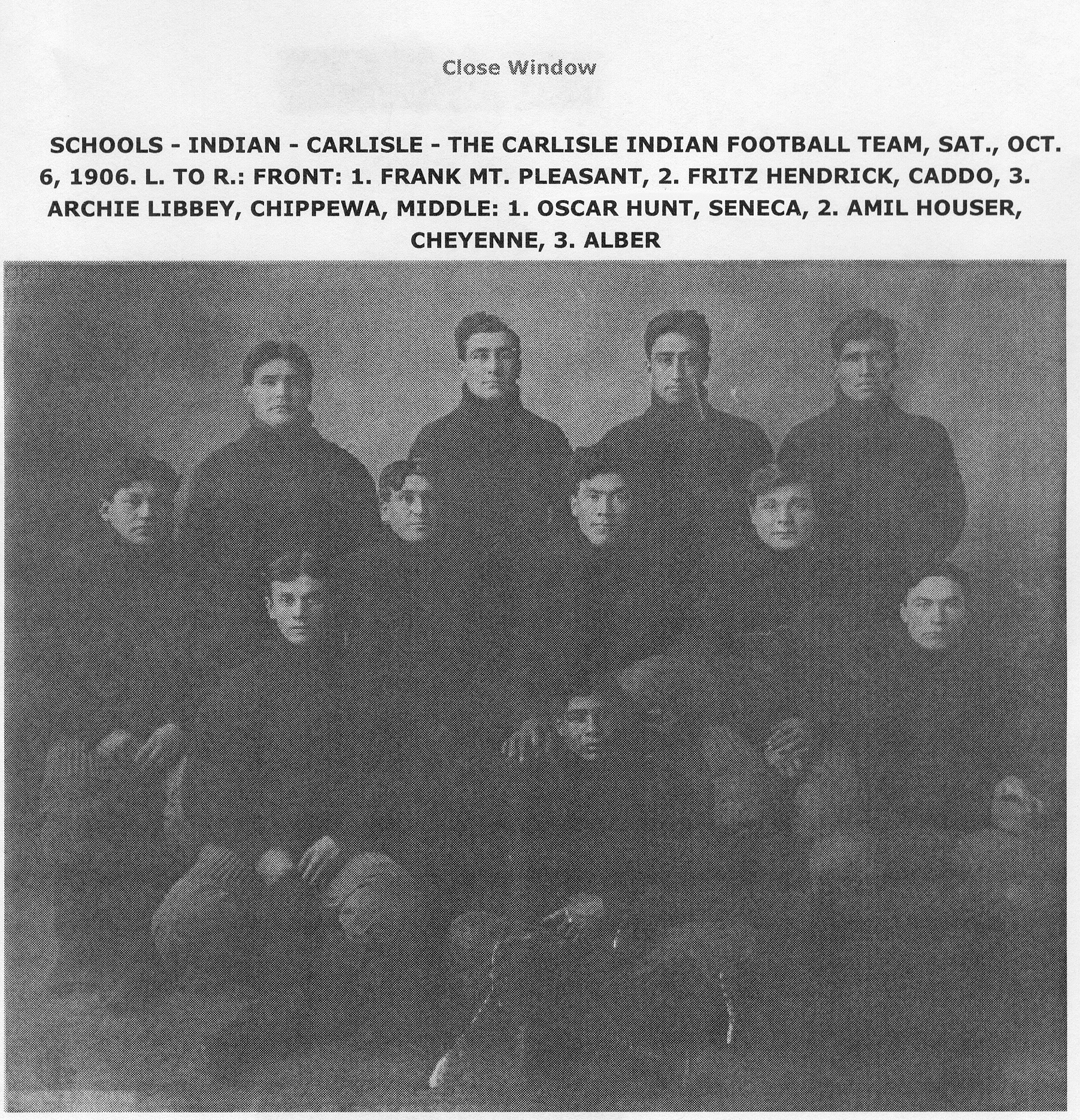
1906 Carlisle Indians. Oscar Hunt second row, far left.

More About Rush Roberts

March 3, 2010

The commenter who raised the issue about Rush Roberts’s heritage found his obituary and forwarded it. The March 11, 1958 issue of The Lawton Constitution included the following extract:

 Roberts on Sept. 3, 1876 was the youngest of 100 Pawnees chosen as scouts for soldiers assigned the job of avenging Gen. George A. Custer’s death In the battle of Little Bighorn. He enlisted under his boyhood name of Ahrekahrard.

 Roberts was born in Nebraska and came to Oklahoma on a long trek with his tribe in 1874-75 when the government established a Pawnee reservation.

 Roberts was first married in 1882 to an Indian girl whose name translated into English as Captive Princess. She died a year later. Polygamy was then customary in the tribe and he next married three daughters of Kaheeka, principal chief of the Skedee band of Shawnees.

 On Sept. 18, 1876 Roberts and his fellow recruits were formally mustered into the army at Sidney, Neb. In a little over a month after his enlistment, Roberts, then 17, was in battle….

 Roberts won high praise from white troop leaders he served, one officer recalling: “Ahrekahrard, the youngest Pawnee scout in Gen. Crook’s fall and winter campaign of 1876-77, was with us on every occasion, he was quiet, but brave as any man could be and be charged with us into the villages as fearlessly as a warrior should.”

 Roberts subsequently traveled with the William F. (Buffalo Bill) Cody’s Wild West Show in 1884-85….

 The commenter wrote, “shortly after his return took Lou Howell as his wife. She shows up in 1888-1896 annual Indian censuses as his wife. These same censuses have Lou’s younger sister Rose listed as ‘Living by Herself’ next after Rush & Lou[Howell]. Rose then shows up in the annual census’ as Rush’s wife from 1888 until her death in 1928.”

Was Rose his sister by blood? Was she really his wife, or just living in his house? Perhaps future research will find the answers to these questions.

Pawnee Adoption Customs

February 26, 2010

Reader comments that prompted Tuesday’s blog and those that came afterward contained some interesting information regarding Pawnee customs. Not being Indian, I know nothing about the customs of the various tribes and nations other than what I happen to read about them. Some customs are relatively standard for a geographic area whereas others are unique to certain peoples. It appears that the Pawnee have many customs that are their own and differ from their historic neighbors.

I first learned a bit about Pawnee customs while researching Stacy Matlock. After his first wife died, he returned to Carlisle where he worked at the Indian school for a year. During that time he may have courted Blanche Bill, younger sister of his late wife, because they soon married and returned to Oklahoma. His student file found in the National Archives included this handwritten note: “Married Blanche Bill who was next in relative line when his wife died.” Stacy’s granddaughter, who was unaware of his first marriage, wrote a volunteer at the Pawnee County Historical Society that it was a Pawnee custom for a sister or brother to marry the widow or widower.

Frances Kotal, granddaughter of Rush Roberts, Jr., commented about another Pawnee custom—adoption of children by childless family members. Her grandfather’s daughter, Wynema, with his first wife, Sally, was adopted by his sister, Vivian and her husband, Walter Archambault, after Sally’s death. Alexandra Kay, one of Rush Jr.’s five children with his second wife, Gertrude, was adopted at an early age by Harold and Emma CurleyChief. Frances’s mother, Richenda Irene, remained with her parents and three other siblings.

These customs were very practical and helped solve problems that arose when parents died when their children were still young. One wonders if they are still practiced.

Rush Roberts May Have Been White

February 23, 2010

As I sat down to write today’s blog on an entirely different topic, a comment came in from a relative of Henry Roberts. Henry played football for Carlisle for just one year, in 1911. Prior to coming to Carlisle, he had attended Haskell Institute. The commenter, who wants others related to, or knowledgeable about, Rush Roberts to get in touch with him. In his comment, he mentioned that Henry Roberts wrote a story when in fourth grade that can be found on the web. With a little googling, I found what I think is that article: http://www.roger-echo-hawk.com/resources/TheIndianStoryByHenryRoberts.html. An annotation by Henry’s brother, George, that was later attached to the story, gives some background information about Rush Roberts that even he may not have known. George wrote that Rush Roberts was not born a Pawnee, that he was a white, perhaps German or of German descent, whose parents had been killed by Sioux. Later, some Skidi happened along to find the orphaned boy. Sitting Eagle and Roaming Princess took him in and raised him as their own.

George opined that the reason Rush’s adopted Skidi mother sent him to the new Pawnee Reservation School was because orphans were often sent there. Hampton Institute records indicate that Rush attended that school for a time as well. This is the first time I have read someone acknowledge that Indian orphans were often sent to government schools. In my research of Carlisle Indian School football players, I have observed that many, probably the majority, had lost at least one parent before coming to the school.

The commenter also mentioned that a photo can be found on the Internet of Rush Roberts with seven other surviving Pawnee scouts. In his opinion, Rush had Caucasian features. Here is a link to a site that has a number of photos including one that may be the one the commenter referred to: http://images.google.com/imgres?imgurl=http://www.cowanauctions.com/images/cc0501.jpg&imgrefurl=http://thunderdreamers.com/forum/YaBB.pl%3Fnum%3D1247083964&usg=__m-HAUemWgAkHFjEtmEOYllwhw3I=&h=331&w=600&sz=95&hl=en&start=2&um=1&itbs=1&tbnid=iMAi08AtuIHTvM:&tbnh=74&tbnw=135&prev=/images%3Fq%3Drush%2Broberts%26um%3D1%26hl%3Den%26sa%3DN%26tbs%3Disch:1 I’ll leave to the reader to determine if Rush had Caucasian features.

The Wheelock Family Tree

February 19, 2010

Researching the lives of Martin, Joel and Hugh Wheelock was made more difficult because their relationships to each other and to other Wheelocks at Carlisle Indian School, of which there were many, are not entirely clear. It wasn’t hard to determine who their fathers were. Censuses reflected that James A. Wheelock was the father of Joel and Hugh and Abram Wheelock fathered Martin Wheelock. James and Abram were surely related to each other and could have been brothers or cousins. The fun begins.

On the 1885 census, the earliest on I found that had Martin listed, no mother was mentioned. Eventually, I found the Powless Diary, which contained an entry for 1879 that stated, “Sunday, wife of Abram Wheelock, Mary Ann, age 26, died May 4.” Martin’s parentage was established—or so I thought. Then I encountered another entry that might be relevant: “Wife of Abram Wheelock, Lucy died August 29.” I then noticed that the entry was for 1869. Because Martin was born about five years later, Lucy couldn’t have been his mother. It must have been Mary Ann.

The 1891 Oneida census is the first one on which I found Joel (2 years) and Hugh (3/4 year) listed. Their father was James A. Wheelock and his wife was Sophia. The James Wheelocks’ had 10 children listed. The oldest was Dennison, 19, and the youngest was Hugh. However, they couldn’t have all been Sophia’s children because she was only 27 at that time. I noticed two gaps in the ages of the children: one between James R., 14, and Wilson, 11; the other between Josephine, 8, and Louisa, 3. Sophia was very likely the mother of Hugh and Joel. She could have been the mother of Wilson, Ida, Eliza and Josephine, but that’s not a mystery I have to solve—at least not yet. She surely isn’t the mother of Dennison and James Riley, as I have seen stated elsewhere, but that isn’t my problem, either.

Later, Sophia died and James A. Wheelock married Lena Webster and had children with her. The 1905 census lists her, then a widow, as the stepmother of Joel and Hugh and the mother of children she had with James. To complicate matters further, Lena soon married Martin Wheelock and had children with him.