June 21, 2010
I have wondered for some time where John S. Steckbeck found some of the the anecdotes he used in Fabulous Redmen. The other day while searching for something else—the usual situation—I came across a Project Gutenberg file for Football Days: Memories of the Game and of the Men Behind the Ball, a 1916 book by William H. Edwards, Princeton 1900, with an introduction by Walter Camp. In one section of the book, Edwards retells some of stories told by former Yale star Carl Flanders, who helped coach the Indians in 1906.
Because Flanders related these stories within a decade of them happening, they stand a better chance of being accurate than those that were told a half century, or longer, after that. Of particular interest was the topic of nicknames:
“The nicknames with which the Indians labeled each other were mostly those of animals or a weapon of defense. Mount Pleasant and Libby always called each other Knife. Bill Gardner was crowned Chicken Legs, Charles, one of the halfbacks, and a regular little tiger, was called Bird Legs. Other names fastened to the different players were Whale Bone, Shoe String, Tommyhawk and Wolf.”
I do wonder if Edwards got a couple of the names reversed or if Flanders remembered them incorrectly. During WWI, Bill Gardner was referred to in newspaper columns as “Birdie,” something that leads me to suspect that his nickname was Bird Legs not Chicken Legs. If that is so, then Wilson Charles was probably called Chicken Legs. Perhaps a descendent of his will let us know which was his correct nickname.
Tags: Carl Flanders, Fabulous Redmen, John S. Steckbeck, nicknames, Walter Camp, William H. Edwards, Wilson Charles
Posted in Archie Libby, Carlisle Indian School, Football, Frank Mt. Pleasant, Joe Libby, William Gardner | Leave a Comment »
June 17, 2010
Right now, for sale on eBay is a letter dated October 26, 1896 on Essex County Park Commission stationery to “My Dear Mr. Church” from a person whose signature I can’t make out. From the tone of the letter, the writer was apparently a Princeton alum who was thanking Church for his hospitality by allowing him to stay in his room at the Cannon Club on a Princeton football Saturday. The recipient of the letter was probably one of the football-playing Church brothers, J. Robb “Bob” Church, class of 1888, or Bill Church, class of 1897. The seller states that the letter is from the estate of Bill Church. This makes sense because the Cannon Club was first opened during Bill’s time at Princeton. Bob was awarded a Medal of Honor for his valor in the Spanish-American War. Bill was named to the All America first team at tackle that year. After graduation, coached and played football for a few years after leaving Princeton.
A second purpose of the letter was to provide Church with some intelligence for the upcoming Princeton-Yale game. Two days earlier, the writer had attended the Carlisle-Yale game that was played on Manhattan Field in New York City. That was the infamous game in which the Indians were robbed of a touchdown. This Princetonian thought it was worse than that. He wrote, “The score should have been about Carlisle 18 – Yale 12, in order to represent the facts – and the relative merits of the teams. I wish you would say to yourself and to the rest of the Princeton boys that there is no reason now in sight why they should not win this year.”
And win they did. Princeton beat Yale 24-6. They beat Carlisle 22-6. These 12 points were all that were scored against that year’s national champions. Yale ended its season at 13-1. It should have been 12-2.
Tags: 1896 National Champions, Bill Church, H. Robb Church, Princeton, Yale
Posted in Carlisle Indian School, Football | Leave a Comment »
June 15, 2010
Apparently, Pop Warner added three post-season games to the 1914 schedule very late in the season, quickly or while on the road or all three. The first mention of the post-season games came in the December 4 issue of The Carlisle Arrow, after the first two of these games had been played. The team likely did not return home after the Thanksgiving game with Brown because the first pot-season game was played two days later in Boston. On December 6, the Indians met Alabama Polytechnic Institute (Auburn) in a game played in Atlanta that figures prominently in Auburn folklore. It was Pop Warner’s last at Carlisle’s helm and Lone Star Dietz’s last before embarking on a career as a head coach.
Some research into student files uncovered the fact that former Carlisle end Charles Guyon, aka Wahoo, was instrumental in setting up that game. At that time, he was th Atlanta branch manager for Spalding Sporting Goods and, as such, was closely involved in athletics in that city. Unfortunately for him, the game had been set up too quickly to generate much publicity and, due to having a bad season, the Indians weren’t a big draw at that time. Guyon fronted the money for the game and lost it. Attempts to have the government refund part of it were fruitless.
The game itself was a defensive struggle. The Indians had the ball in Auburn territory much of the first quarter but failed to score. Auburn stiffened. The second and third quarters were fought to a standstill with neither team able to generate much offense, let alone score. In the final period, Auburn moved the ball with a series of line plunges followed by pass from quarterback Hairston to left end Kearly, who carried the ball to the Carlisle six-yard line. “On the next play Hairston catapulted through the Indian line for the touchdown.” Louiselle kicked the extra point. Carlisle moved the ball with a series of lateral and pass plays but fell short when a pass was intercepted.
The game lives on in Auburn folklore, not for the victory so much as for the play of a Carlisle substitute named Hawkeagle.
Tags: Alabama Polytechnic Institute, Auburn University, Hairston, Hawkeagle, Kearly, Louiselle, Pretty Boy, Wahoo, War Eagle
Posted in Carlisle Indian School, Charles Guyon, Football, Louis Island, Pop Warner | Leave a Comment »
June 10, 2010
A person interested in writing a biography of Pop Warner contacted me last night with some questions that got me thinking about what is not commonly known about Warner. One thing I uncovered is his last game as head coach of the Carlisle Indians. Steckbeck didn’t cover it, most likely because the school paper didn’t say anything about it.
Warner considered the 1914 season to be a disaster and made it his last. Up through the end of November, Carlisle’s season was to end with the annual Thanksgiving game with Brown University. When writing about the Brown game in the December 4, 1915 issue of The Carlisle Arrow, Assistant Coach John McGillis announced three postseason games: 1. Former Harvard All Stars in Boston, 2. University of Georgia at Atlanta, and 3. University of Alabama at Birmingham. The Boston game, in which Carlisle lost 13-6, had already been played by that time. Then the Indians beat Alabama 20-3. It should be noted that Bama still plays some of its big games in Birmingham rather than on-campus in Tuscaloosa.
The Georgia game was never played or had been confused with Auburn because the Indians played the unscored-up Auburn team four days later. However, nothing was written about it in the Carlisle school newspaper, even after it was played. That was probably because Pop Warner had decided to take the Pitt job and leave. Later, Warner wrote that he had been approached by Pitt officials after the Carlisle-Pitt game on October 17 about the head coaching job and he decided to take it.
After the joint congressional investigation earlier in 1914, Warner’s publicity machine appears to have been shutdown, leaving the writing of articles to the coaches. Already mentally in Pittsburgh, Warner didn’t bother to write up anything about the Auburn game. More on that game next time.
Tags: Auburn University, John Steckbeck, University of Pittsburgh
Posted in Carlisle Indian School, Elmer Busch, Football, Pop Warner | Leave a Comment »
June 8, 2010
Recently, biographer David O. Stewart asked “Who’s Checking the Facts?” in his blog at: http://207.56.179.67/david_stewart/2010/05/whos-checking-the-facts.html. In that blog, Stewart pointed out a gross error in a book that “just received a respectful review from NPR.” The book in question described Aaron Burr as “tall, elegantly dressed…” when it is widely known that Burr was short and that he was called “little Burr.” Stewart wonders “Why don’t book reviewers catch such howlers? Laziness? Ignorance? You tell me…” I have asked myself similar questions with regard to the 2007 books on Jim Thorpe by Sally Jenkins and Lars Anderson. Stewart’s question caused me to revisit Jenkins’s glaring omission of the 1905 Carlisle-Army game.
While trying to determine where Jenkins came up with a 10-5 record for the Carlisle Indians (she apparently included the Second Team’s loss to Susquehanna University on the same day the Varsity lost to Harvard), I noticed that Advisory Coach George Woodruff is generally credited by usually accurate sources, such as the College Football Hall of Fame and cfbdatawarehouse.com, with Carlisle’s 10 wins and 4 losses that year. This error is understandable because head coaches normally lead their teams for the entire season. That was not the case for George Woodruff and the 1905 Carlisle Indians.
After the Indians beat the Cadets at West Point on November 11, 1905 (the first time the Indians played Army), Woodruff left the team and headed to Washington, DC for a government job. Thus, his record for 1905 was 7-2. The remaining 5 games should have been awarded to Woodruff’s assistant, Ralph Kinney. Woodruff’s old friend, Gifford Pinchot, had taken the helm of the newly formed U. S. Forest Service and needed legal counsel. Woodruff accepted the position as the first Chief Legal Officer for the Forest Service.
Eliminating the 3 wins and 2 losses for games played after he was no longer coaching Carlisle does not dilute Woodruff’s worthiness for induction in the College Football Hall of Fame in the least. It’s just that records should be accurate.
Tags: 1905 Carlisle Army game, 1912 Carlise-Army game, Aaron Burr, College Football Hall of Fame, David O. Stewart, Forest Service, George Woodruff, Lars Anderson, Little Burr, Sally Jenkins, University of Pennsylvania, West Point
Posted in Carlisle Indian School, Football, Jim Thorpe | Leave a Comment »
June 4, 2010
A collector contacted me about two cabinet cards he had purchased from what was purported to be the estate of John B. Warren in an attempt to verify that they were in fact photographs of Carlisle Indian School students. The collector wasn’t familiar with Warren and I only knew that he played on the Carlisle Indian School football team at some point. Identifying the first one was easy. The collector was correct in that it was a photo of Martin Wheelock. He was a star on the teams from 1894 to 1902, serving as captain of the 1899 and 1901 teams. In 1899 and again in 1901, Walter Camp named Martin Wheelock as a tackle on his All America second team. Thus, his face was well known and readily identifiable. This was not the case for Warren.
Steckbeck, the first place to look for information on Carlisle Indian School football, listed a Warren as being a member of the 1899 team. The photo of the 1899 team in Steckbeck’s book identified him as being the person second from right in the middle row, next to Jonas Metoxen. He was not mentioned in the book’s text, so more research was required.
Newspaper coverage of the 1899 games had Warren as playing right guard and tackle in parts of some games. Although not a starter, Warren got some playing time that year. That was probably the extent of John’s varsity play because he graduated in March of 1900 and is included in his class photo in the commencement issue of the school newspaper.
The June 26, 1903 issue of The Red Man and Helper mentioned that “John Warren, class 1900 Carlisle, who has been attending the Minnesota State University is home.” The October 3, 1902 edition reported that his sister, “Grace Warren married a white man and is disappointed.” More research is clearly required.
Tags: Grace Warren, John B. Warren, John Steckbeck, Jonas Metoxen
Posted in Carlisle Indian School, Football, Martin Wheelock | Leave a Comment »
May 31, 2010
Not long ago, I wrote about a 1910 game that had received little coverage. Now, Adam Miller has written about a 1903 game that received even less attention. In 1903, Pop Warner put together a post-season road trip to the West Coast on which the Indians were to play Reliance Athletic Association, a team of the best former college players from the state of California, on Christmas Day in San Francisco. Perhaps Warner thought his team would need a scrimmage to break up the trip, or he saw an opportunity to make a little money along the way. Regardless of the reason, he booked a game with the University of Utah to a game to be played on December 19 in Salt Lake City. Miller’s piece covers that game: http://utahfootballcountdown.blogspot.com/p/december-19-1903-utah-vs-carlisle.html. It also includes one of those great period newspaper cartoons.
Pre-game hype heaped hyperbolic praise on James Johnson, who Walter Camp had recently named as quarterback of his All America First Team. Whether Johnson’s head had inflated after reading his newspaper clippings or if Warner was feeling threatened is not known. Warner wrote in what became his autobiography that he benched Johnson the morning of the game over a rule infraction. Because this happened before the game, the rule Johnson had broken was likely a team rule. Warner wrote that he played Joe Baker in his place and that Baker “did an admirable job that afternoon” in the 22-0 victory on a snowpacked field. Newspaper coverage of this game varies from Warner’s recollection.
The Salt Lake Herald’s play-by-play had Johnson playing the entire first half plus kicking a point after touchdown and missing a field goal. Baker replaced Johnson for the second half and led the Indians to three more touchdowns by using the then-new wing-shift play to good advantage.
It may be that Warner’s memory failed him as to when he benched Johnson, but he does appear to have done just that. Johnson’s reaction is the subject of another story.
Tags: Adam Miller, Joe Baker, Reliance A. A., University of Utah, Wing-Shift play
Posted in Carlisle Indian School, Football, James Johnson, Pop Warner | Leave a Comment »
May 27, 2010
While looking through some 1911 newspapers about the 1911 Carlisle-Syracuse game for an article Ray Schmidt is doing for the College Football Historical Society, I came across a piece about Jim Thorpe having eye surgery. The December 12, 1911 edition of The Washington Post included a special from Carlisle, Pa. dated Dec. 6 titled, “Thorpe Under Knife” and subtitled “Great Indian Athlete Is Operated On for Eye Trouble.” This was news to me. I was completely unaware that Jim Thorpe had had eye trouble when he was young.
A quick scan of Thorpe biographies revealed nothing nor did the Carlisle Indian School newspaper and literary magazine. Apparently, wire services didn’t pick up this article and Thorpe biographers didn’t stumble across it. A reason for that may be that trachoma was so prevalent among Indians at that time that it was not surprising that Jim would have had it. Richard Henry Pratt devoted several pages to eye disease among the Indians in his autobiography because it was a large problem with which he dealt.
Dr. Cornelius R. Agnew of New York City visited Fort Marion and became interested in improving conditions for the Indians. Agnew was a frequent visitor at Carlisle and a significant benefactor. On each visit, he would examine ill students and recommend treatments for them. He also treated students with trachoma at his office in New York. After his demise, his protégé, Dr. L. Webster Fox, of Philadelphia stepped up and treated students for free, charging the school only a dollar a day for room and board in his hospital. Fox treated Carlisle students for 20 years and, during this time, trained the school’s physicians in performing certain treatments. So, by the time Jim Thorpe developed trachoma, the school’s physician was probably able to do the surgery himself.
The article pointed out that Thorpe was unable to read Walter Camp’s article in which he named Thorpe to his All America first team, but was able to listen to someone read it to him. Apparently, the surgery was successful because good vision is necessary to hit a major league fastball.
Tags: All America, Cornelius Agnew, eye surgery, L. Webster Fox, Richard Henry Pratt, trachoma, Walter Camp, Washington Post
Posted in Carlisle Indian School, Football, Jim Thorpe | 2 Comments »
May 24, 2010
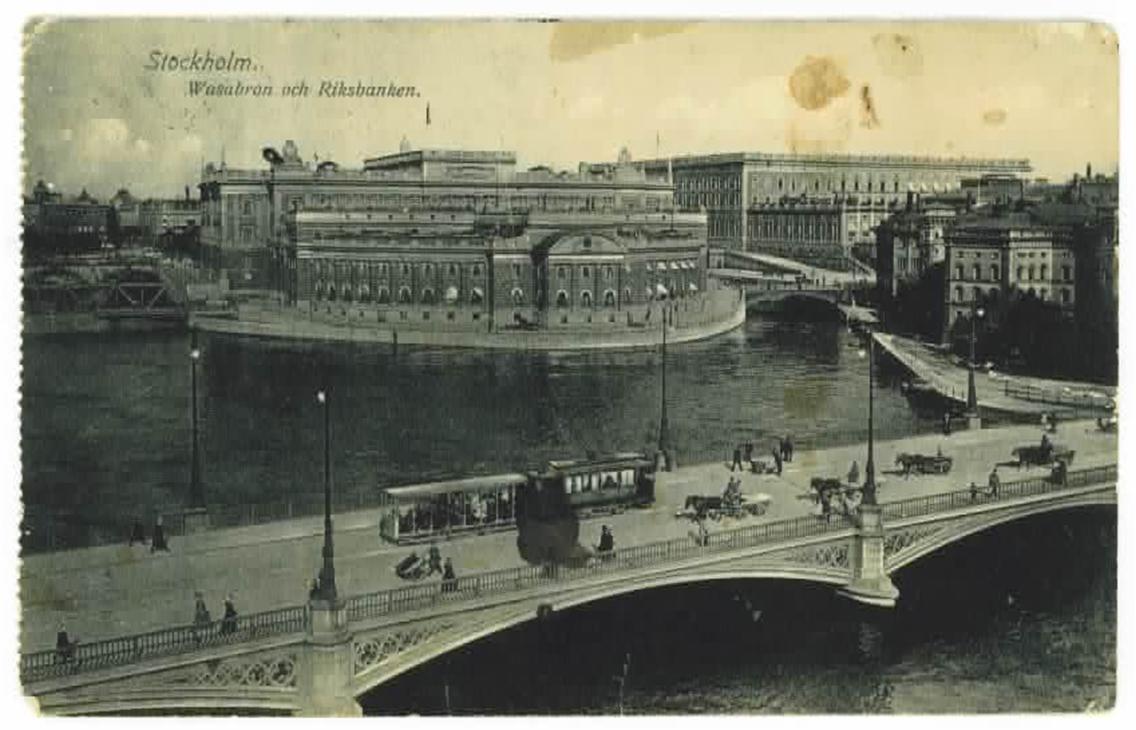
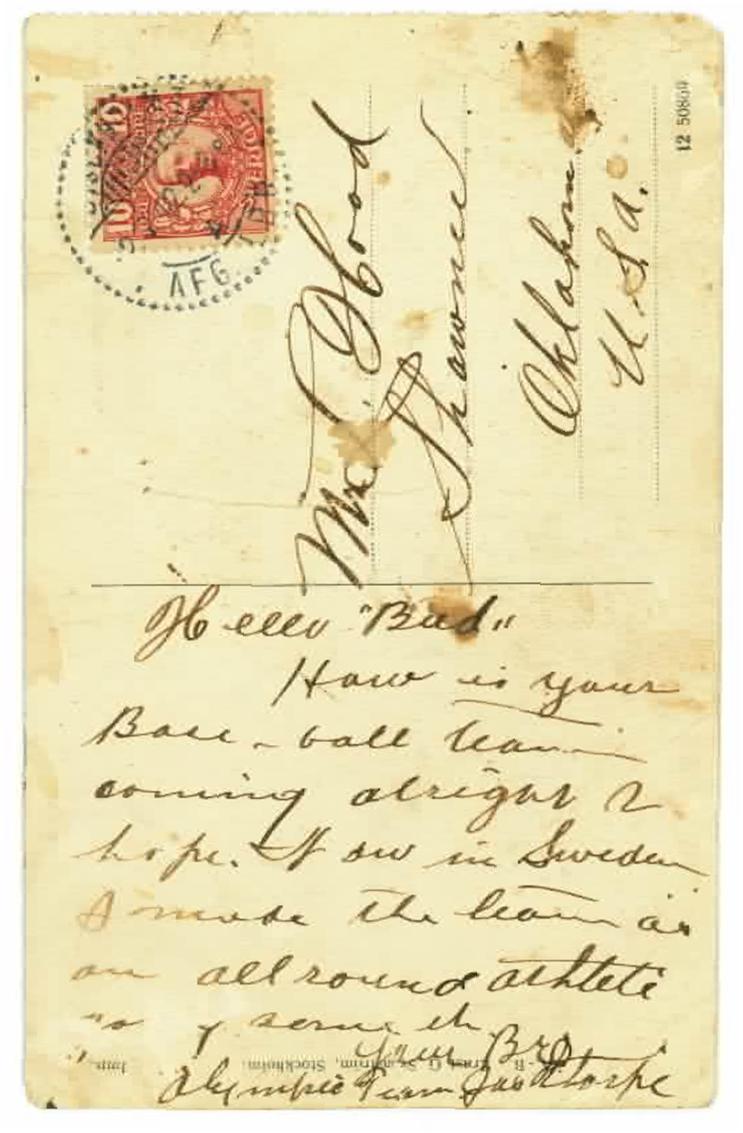
A postcard that Jim Thorpe sent to a childhood friend from the 1912 Stockholm Olympics is being offered for sale. Front and back views of the postcard are provided below.
Luther Hood, recipient of the card, was an Absentee Shawnee and a good friend of the Thorpe family. The families continue a strong friendship today. In tribal culture when a relative dies the family adopts someone to take that person’s place. It seems that Luther may have been an adopted brother to Jim Thorpe, who lost several very close family members, including his twin brother, when he was young. That is why he would have used the terms “Bud” and “Bro.”
The stamp on the card is from Sweden. Closer inspection is required to determine the postmark. The U. S. Olympic team, other than the distance runners and Thorpe, used the ship they traveled over on, the SS Finland, as their hotel during the Olympics. Perhaps the postcard was sent from the Finland.
Bob Wheeler is assisting the owner of what is surely an expensive item in selling it. If you are interested, contact Bob at bobwheelerwrc@aol.com


Tags: 1912 Olympics, Luther Hood, postcard, Robert W. Wheeler, Shawnee, signature, Stockholm
Posted in Carlisle Indian School, Jim Thorpe, Pop Warner | Leave a Comment »
May 19, 2010
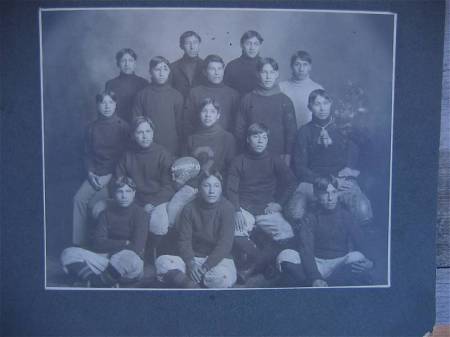
A couple of days ago, I got an email from a local collector of Carlisle Indian School artifacts enquiring about the legitimacy of a photo currently offered for sale on ebay. I looked at the item and noticed that the seller claims it is either a 1903 or, more likely in his estimation, a 1913 photo of the Shoemakers football team from Carlisle Indian School. I had never seen a photo of a shop team before but was well aware that such teams existed. Large shops had their own teams while smaller shops would have joint teams. Debating societies had teams. The band even had a team! When he was superintendent, Major Mercer claimed to have 14 teams to outfit. Each year the varsity would get new uniforms. Their old ones would be passed down to another team. Besides the varsity, the second team played a schedule of games as did the junior varsity. Selling athletic equipment to Carlisle was a lucrative business.
The seller said that he bought the photo from an enrolled member of the White Earth reservation in Minnesota. On the rear of the photo is written “Joe Libby Dec. 19, 1903.” Joe Libby was from the White Earth reservation and didn’t make the varsity until a few years later. I would say that this photo is real.
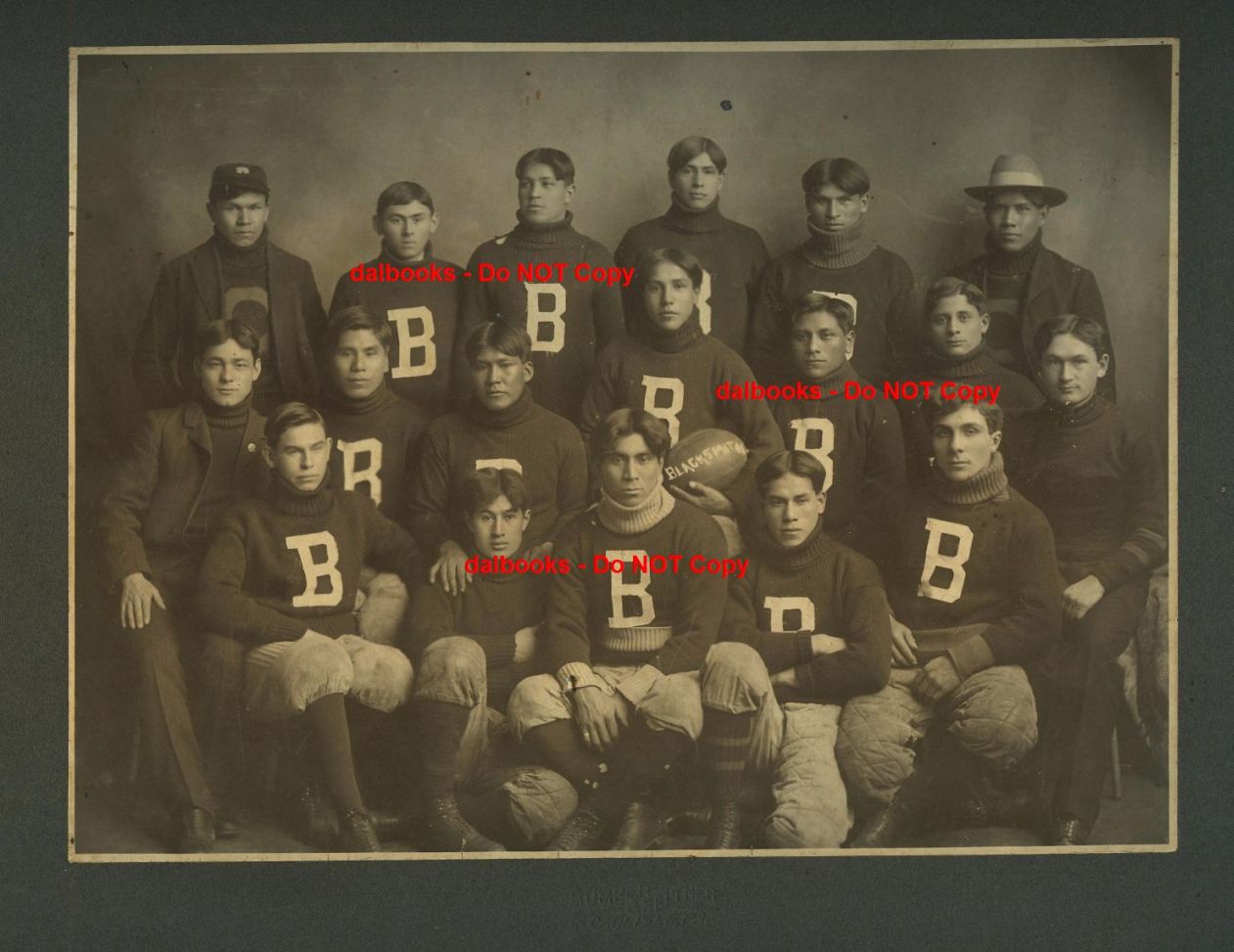
The very next day, I came across a collection of items that appear to have come from Mitchell Pierce’s estate. One of the items was a photograph of the Blacksmiths team. I think this photo is also real. Note the two lettermen on either end of the back row. They were probably experienced players who were coaching the Blacksmiths, most probably because that was their trade.

Both the Shoemakers photo and the collection that includes the Blacksmiths photo are still up for sale as of this writing, but the Shoemakers won’t be up much longer.
Tags: Blacksmiths, Mitchell Pierce, Shoemakers, White Earth Agency
Posted in Carlisle Indian School, Football, Joe Libby | Leave a Comment »



 Tom Benjey's Weblog
