January 25, 2011
It is with some trepidation that I return the blog from its vacation. Readers have been very supportive, so supportive in fact that more people read the blog while it was on vacation that had read it for several weeks. Also, one day had a record high number of readers. (Actually, one day in August 2008 was a bit higher but that was due to a glitch of some sort.) Even though more people are reading the blog when I don’t write anything than when I do, I will persist in continuing to put some thoughts in digital ink.
Jeff Miller, who is working on a biography of Pop Warner, wrote me with questions regarding the origin of the famous hidden-ball play. He found that others claim that John Heisman first used that play: “The Orlando Sentinel ran an article in which it stated that John Heisman used it first in a game against Vanderbilt in 1895. Leather Helmet Illustrated claims Heisman first used it in a game against Pop Warner’s University of Georgia team in 1895.” Recalling reading Warner’s account of his using the trick play, I thought I should investigate the matter a bit.
The first thing I did, even before pulling Warner’s autobiography off the shelf, was to do a quick search on Heisman and the hidden ball play. Not surprisingly, I found something different than what was in Leather Helmet Illustrated. The Encyclopedia of Alabama entry for Heisman includes the following:
“The Vanderbilt game in 1895 was memorable for the introduction of a hidden-ball play into the game. Trailing Vanderbilt, 9-0, in the second-half, Heisman instructed Auburn quarterback Reynolds Tichenor to stuff the ball under his shirt. The wedge of players surrounding him then scattered to all parts of the field, distracting the Vanderbilt players. Tichenor, who pretended to be tying his shoe, got up to run down the field unopposed for a touchdown. The play would later be outlawed.”
To be continued…
Tags: Jeff Miller, John Heisman, Reynolds Tichenor
Posted in Carlisle Indian School, Football, Pop Warner | Leave a Comment »
January 13, 2011
This blog will soon celebrate its third birthday. This post is the 293rd in about 150 weeks which amounts to two 300-word posts a week for a total of about 90,000 words, not counting comments or off-line emails. Click and Clack, the Car Talk guys, give their puzzler every summer off and there’s only one puzzler per week on their radio show. So, it’s time for this blog to have a vacation. It will be taking next week off. Faithful readers can use this time to read (or reread) some of the older postings on topics of interest.
This is also an opportunity for readers to propose topics for future postings or to supply information about Carlisle Indian School football players or the single-wing that aren’t widely known. The simplest way to get such information to me is to email me at Tom@Tuxedo-Press.com.
This is also an opportunity to spend some time reading books (hopefully mine) that you have on your shelf but haven’t got around to reading.
Tags: Car Talk Puzzler, Click & Clack
Posted in Carlisle Indian School | 3 Comments »
January 11, 2011
After reflecting on the matter a little, I recalled that Frank Hudson had lived in Bucks County when the two prior censuses were taken in 1920 and 1910. Perusing those censuses revealed that the Buckingham Township farm on which Frank Hudson lived and worked was owned by Charles (S. or L.) Smith and his wife Ruthanne Rockefeller Smith. Charles was French-speaking due to being born in Alsace-Lorraine. However, the 1910 census listed him as being German. Perhaps his origin was modified after WWI. The elderly Smiths apparently died between 1920 and 1930, probably leaving the farm to one or both of their daughters.
Frank Hudson was classified as Indian in 1910 but, from 1920 on, was listed as being white. It appears that he stayed with the Smiths from the time he left Carlisle. His student file indicates that he started working for a C. Smith in Lingohocken, Bucks County, Pennsylvania in 1894 and following years. His “Report After Leaving Carlisle” listed him as working as a farm hand in Wycombe, Pennsylvania in 1909. (Wycombe and Lingohocken appear to be unincorporated areas near each other.) S. J. Nori reported that, beginning in 1910, he was farming on shares (sharecropping) in Wycombe. Given that the 1910 census placed him on the Charles Smith farm in 1910 and that Smith was already in his mid-70s at that time, it is logical that Frank was farming on shares instead of just working as a hired hand. That he stayed on for at least another decade as indicated by the 1930 census argues for him having more of a stake in the farm than as a hired hand. Whether he ever obtained an ownership position remains to be seen. That will probably require a trip to Doylestown to unravel.
Tags: Charles Smith, Lingohocken, Ruthanne Rockefeller Smith, Wycombe
Posted in Carlisle Indian School, Football, Frank Hudson | Leave a Comment »
January 6, 2011
The Spruance Library in Doylestown, Pennsylvania, the seat of Bucks County, has a tiny bit of information on Frank Hudson in their files: “Frank Hudson, died Dec. 24, 1950 in Wycombe, PA.; full blooded Pueblo Indian. Leaves no known relatives.” While it’s not a lot of information, it tells us some important things we didn’t know before. We now know the exact date and general location of his death. It supports but does not affirm our belief that he didn’t marry and didn’t have any children. One newspaper article—a couple of sentences at most—used the phrase “on his farm” when announcing his death. For decades after leaving Carlisle, it was reported that he worked on a farm in Bucks County, so his living on a farm at the time of his death wasn’t surprising. Now to research where he was living.
The 1930 census listed Frank Hudson, 50, as living with sisters Clara and Edna Smith, 60 and 45, respectively. These three ages were probably the census taker’s approximations. Clara was listed as a farmer and Frank as a laborer. Edna’s occupation was listed as “none.” Perhaps she was disabled or otherwise unable to work. She may even have functioned as cook and housekeeper because farmer’s wives’ occupations were also categorized as “none” on this page. The operation was listed as “general farm” as were others on the page. The three of them were likely living on a diversified farm, the norm for that day and place. The sisters were probably spinsters as both had marital statuses of S(ingle). Neither was widowed or divorced.
I called the Bucks County Courthouse to determine if they had any other information on Hudson. No will was probated for him after his death. That probably means that he owned no property solely in his name if at all. The Recorder of Deeds Office has a number of properties owned at one time by Frank Hudsons. It will take a trip to Doylestown to see if any of them were our Frank Hudson.
Tags: Bucks County, Clara Smith, Doylestown, Edna Smith, Pueblo, Spruance Library, Wycombe
Posted in Carlisle Indian School, Football, Frank Hudson | Leave a Comment »
January 4, 2011
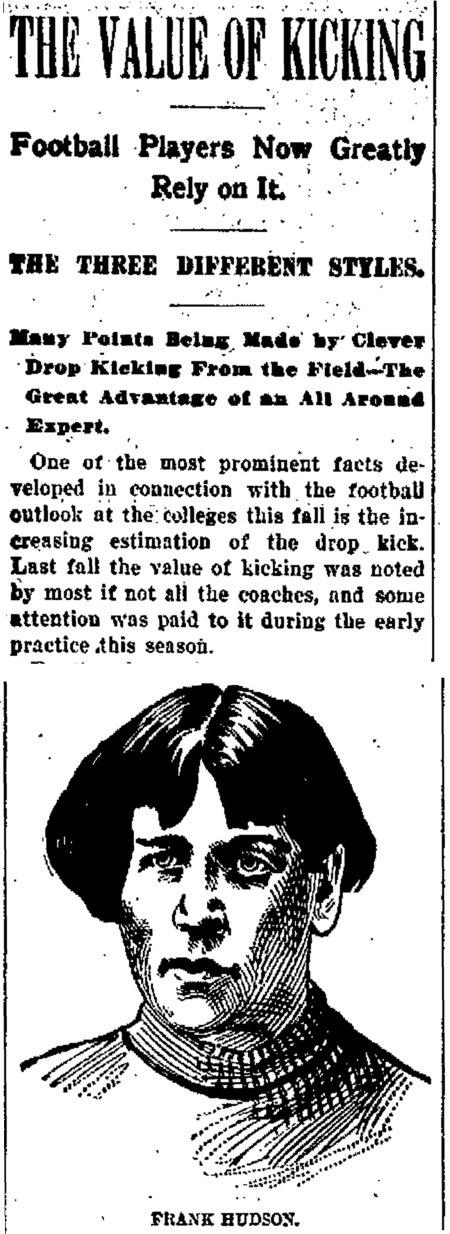
Yesterday, Frank Hudson’s grand nephew contacted me regarding information concerning the great drop-kicker, particularly the date and place of his death. The latest information I had on Hudson was in the 1930 census that showed his location as being on a farm in Bucks County, Pennsylvania, the place he relocated to when leaving Carlisle. The information trail had run dry there a few years ago when I was actively researching his life. Knowing that some information sources had become available since that time, I decided to see if any of them had any new (to me) information on him.
Knowing that old census data is released every ten years, I checked to see if the 1940 census is now available. It isn’t but is scheduled for release on April 1, 2012. That means that next year I will be able to fill in some holes of missing data on the people I have researched. It also means that I probably won’t know what Frank Hudson’s were in 1940 until then.
I decided to take a shot at searching old newspapers again because additional newspapers are added to NewspaperArchive.com every day. My search found two mention of Hudson’s recent demise—one in January 1951, the other in December 1950. The 1951 mention contained very little information, but the 1950 article placed him on a farm near Wycombe, in Bucks County, Pennsylvania. That would have made him somewhere between 70 and 75 years old when he died, a ripe old age for a man of his generation.
Now that I know where he was living when he died, I know where to look for more information on his later life. I expect that Bucks County has a very active historical society. Perhaps they will have an obituary for him. Now for the hard part—waiting for their response.
Tags: 1940 census, All-American, Bucks County, Drop kick, Wycombe
Posted in Carlisle Indian School, Frank Hudson | Leave a Comment »
December 30, 2010
In one of my earliest blogs, I mentioned learning something at the very first book talk I ever gave. That began a trend as it is not unusual for an attendee to inform me about something I didn’t know. At a recent talk at a nearby retirement home, a resident asked me about Emerson Metoxen. About all I knew about him was his name because he attended Carlisle Indian School in its latter days after athletics were deemphasized. So, I was of little help to the woman who asked if I knew anything about the man she called “Uncle Chief.” I thought little further about the conversation as I am behind schedule on several projects until I received a letter in the mail.
That letter contained two old newspaper articles about Emerson Metoxen, one of which was written after he was inducted into the Lebanon Valley College Hall of Fame and the other after he died in 1989. Also included was what appears to be a flyer that tells about Metoxen’s activities at Valley Forge summer camps after his retirement as an educator. All three pieces contain biographical information about him. His achievements after leaving Carlisle were many and his life story deserves documenting.
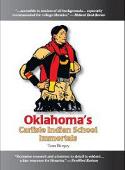
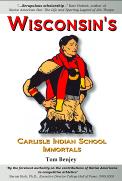
But where to document his well-lived life is the question. He had the misfortune of being too young to star on the great Carlisle teams as he was just getting playing time as a substitute when WWI brought football at Carlisle to an end. So, he doesn’t fit well into Wisconsin’s Carlisle Indian School Immortals. However, he was an Oneida and several Oneidas’ life stories are included in that book. Perhaps a smaller (and less expensive to buy) book focused on Oneida football players would provide an appropriate place to tell his story. I’d like to hear (read) your thoughts on that idea.
Tags: Chester High School, Emerson Metoxen, Lebanon Valley College, Radnor Jr. High, Valley Forge, York College
Posted in Carlisle Indian School, Football | Leave a Comment »
December 28, 2010
Historians are familiar with Carlisle’s impressive victories over Army, first in 1905 and later in 1912. But few know that Carlisle almost replaced Navy as the Cadet’s end-of-season foe in 1913. Newspapers started hyping the 1913 football season in early August that year. First, it was announced that, “The Army, after several years of defeat by the Navy, is going to follow a new policy this season and there are few hard games on the soldiers’ list. A new feature of Army’s schedule will be a game on November 1 with Notre Dame.” On August 8, a news report datelined Trenton, NJ announced that negotiations were being held to move the Army-Navy game to the local fairgrounds. An August 12 news report out of Annapolis reported that, “Army and Navy football managers are at loggerheads over arrangements for the annual football game. The date is to be Nov. 29. West Point has objected to the number and situation of seats accorded them at Philadelphia and proposed the game be played at West Point and Annapolis alternatively or in New York every year. Navy stands pat on Franklin Field at Philadelphia.”
The August 28 Washington Post announced that the 1913 Army-Navy game was off and that, on that very day, Pop Warner would be signing a contract for the Carlisle Indians to play Army at West Point on November 29. The next day’s paper blared, “West Point-Carlisle Game Is Officially Announced,” “General Dismay at Naval Academy,” and “Took It for Granted That Game Would Eventually Be Arranged.” Army and Navy officials in Washington retained hopes that the inter-service game would yet be played.
On September 2, Navy officials threatened to break off all relations with West Point unless the school’s football teams meet on the playing field that year. The day after that, the Secretary of the War Department called a meeting with the two academies’ athletic directors and hammered out an agreement for Army and Navy to meet on November 29 at the Polo Grounds in New York City. The Washington Post reporter covering this story mused, “Just how Army will get out of the Carlisle muddle remains to be seen.”
Tags: Polo Grounds, Washington Post
Posted in Carlisle Indian School, Football, Pop Warner, William Garlow | Leave a Comment »
December 24, 2010
Researching John Russeau’s adult life in Rice Lake should be much easier than finding the details of what he did before WWI. As to his military service, one would expect that the Canadian Army would have records on its WWI units and soldiers as does its U.S. counterpart. That John Russeau wasn’t a star football player at Carlisle Indian School doesn’t diminish what he did later in Rice Lake. The people who named a field after him and voted him into the Rice Lake Hall of Fame knew him and are well aware of his contributions to the town. “Indian John” earned these honors with his dedication and hard work.
I would recommend to his many descendants that they get together to look at all the artifacts John left behind. They should also commit to paper all the stories he told them and any other things they have heard about him. Different people could take on specific tasks. For example, one person could research his exploits as a boxer who fought under the moniker “Black Jack.” That project should yield some interesting stories in itself.
Someone else could investigate his time at Hayward Indian School. Another could look into his time at Reserve. Another could research John’s ancestors. Still another could pour over the Chronotype, day by day, from about 1900 forward. That job might need to be broken up by decades or something so more than one person can work on it. From experience I can say with certainty that it will be tedious. After finishing the Chronotype, other local papers could be considered.
John Russeau led a long, full life and had a positive influence on his community. His life story deserves to be recorded, not just for his family but for the community at large. Doing this would be a greater honor for him than any that have been previously bestowed.
Have a very Merry Christmas.
Tags: Black Jack, Chronotype, Indian John, John Rousseau, John Roussian, John Russeau, John Russian, Rice Lake Hall of Fame
Posted in Carlisle Indian School | Leave a Comment »
December 21, 2010
Much research of John Russeau’s life remains to be done. Fortunately for his family, much of that work can be done near to or in his home area. He told Carlisle Indian School officials he played tackle on the Haywood Indian School football team. It is believed that he also played for that team in a game against Rice Lake when he was home recuperating from football injuries received at Carlisle. Perhaps the Chronotype and Hayward Indian School publications covered those games.
What John did during the period after he left Carlisle and before he joined the Canadian Army is essentially unknown. In the fall of 1913, he wrote his old friends from Superior, Wisconsin to wish them well in the upcoming football season. Some years later, he testified in the Cameron Dam matter that he was in Salt Lake City, Utah part of the year. What he did the rest of the time is anyone’s guess at this point.
At some point, Russeau joined the Canadian Army and served in England. Whether he went to the front is not known. What is known so far is that, in late 1918, he met Lillian Furner in London. She was leaving a theater and he was coming in—at least until he saw her. Lillian later said, “And then he didn’t go in at all!” They were married six months later, on April 3, 1919. About six months later, they embarked for Canada, probably because he was still in the Canadian Army. After landing in Nova Scotia, they made their way to Montreal where they caught a slow train to Reserve, Wisconsin. They left the reservation in the spring to live their lives in Rice Lake from then on. The highlight of her time on the reservation was being guest of honor at a chivari.
To be continued…
Tags: Cameron Dam, Canadian Army, chivari, John Rousseau, John Roussian, John Russeau, John Russian, Lillian Furner
Posted in Carlisle Indian School | 2 Comments »
December 17, 2010
Reviews of the programs for the athletic banquets for years 1908-10 (Carlisle’s athletic banquets covered calendar years not school years) found no mention of John Russeau (in any of the various spellings). That means that he didn’t get enough playing time in any of the varsity sports to letter at Carlisle. That he appeared in the 1908 team photo shows that he was on the team, probably as one of the scrubs. That he was assigned the task of coaching the Painters implies that Pop Warner thought he understood the game well enough to teach younger players how to play the game. Unfortunately, he is also credited with some things that he most likely didn’t do.
For example, his Rice Lake Hall of Fame biography includes this statement: “John played at tackle and end on both sides of the line and scored two touchdowns, one on a 20 yard pass reception against Baltimore College in 1906 and the other on a fumble recovery in the end zone against Carlisle Prep College.” The Carlisle varsity never played a Baltimore College. However, Baltimore City College was playing high school teams around that time and may have played Carlisle’s Second Team (sometimes called “The Hustlers”). There was no school called Carlisle Prep College but Dickinson College did have a preparatory school, (called Conway Hall from 1905 to 1917) that Carlisle’s varsity annihilated in 1908 53-0 when the season opener with Albright College fell through because they didn’t field a team that year. It’s quite possible that John Russeau recovered a fumble in the end zone against them because everyone got to play in blowouts like that one. He may have gotten into the game with Mt. St. Mary’s if it had materialized.
The Second Team was to play home games against the Swatara team of Steelton on October 10 and Conway Hall on Thanksgiving. They were also to play road games in Washington and Baltimore. The Third Team (also called “The Hustlers”) also had a schedule of games against athletic clubs, college reserves and prep schools. John probably played in several of these games, one of which was played in Baltimore against Walbrook Athletic Club. This punting contest played in a snowstorm which made it unlikely that Russeau caught a pass in that game. He probably played in several second and/or third team games and may have scored in some of them. But there is no evidence found of him playing in a varsity game.
To be continued…
Tags: John Roussian, John Russeau, John Russian, Rice Lake Hall of Fame, The Hustlers, Walbrook Athletic Club
Posted in Albert Exendine, Carlisle Indian School, Football, Pop Warner | 2 Comments »


 Tom Benjey's Weblog
