As reported in the previous post, Angel Charley claimed the striking of the Redskins name resulted from “billions of dollars from investors in the ‘Change The Name’ movement.” Just imagine what could be done with just one million dollars to help people on the poorest reservations to improve life for them and their descendants. And she claims multiple millions were raised for the effort, some of which were from taxes you paid. All of this was spent because a relatively small group of people didn’t like a professional football team’s name and logo. This was in spite of polls among Native Americans which found that the vast majority had no problems with the name and some reservation schools have adopted the name for their teams.
The Redskins management was pressured into making the change for largely financial issues related to stadia. With the old administration about to decamp from Washington and a new one with very different ideas regarding the name about to move in, it’s possible the name could be changed back.
Ticket sales are also an issue. 2023 ticket revenue was lower than the lowest figure from 1010 through 2018. 2024 figures aren’t known yet because the season isn’t over yet. Years ago, the previous owner had a waitlist of 155,000 for season tickets. Now, there is no waitlist. The name change may not be the sole reason for the reduced interest in following the team. The team’s on-field performance hasn’t exactly been exciting. This year is potentially their first winning season since 2016, and it was only 8-7-1! It’s been a long time since they were contenders for the Super Bowl. Fans aren’t happy about that either. Maybe seeing the old logo on T-shirts and jerseys might revive a little enthusiasm toward supporting the team.
Daines continues to fight for reinstatement of the Redskins logo honoring John “Two Guns” White Calf but the team’s current owner, Josh Harris, is firm in his position abut not changing the team’s name back.
On Saturday, Mary Papenfuss included the following in an article she wrote for The Independent web site:
“The decision to change the name and mascot came after years of organizing from Native communities and allies, and billions of dollars from investors in the ‘Change The Name’ movement. Going back on this commitment should be a non-starter,” Angel Charley, executive director of IllumiNative, said in a statement.
One word jumped out at me when I read it, so I put it in boldface type so readers couldn’t miss it. I didn’t make this up. Activists spent billions, meaning not just millions but multiple billions, of dollars getting the Redskins name changed.
Three questions come quickly to mind:
Where did these billions of dollars come from?
Where did these billions of dollars go?
What else could these billions of dollars have been used for?
IllumiNative.org, the website for Angel Charley, describes the organization thusly: “IllumiNative is a Native woman-led racial and social justice organization dedicated to increasing the visibility of—and challenging the narrative about—Native peoples.”
The 2023 Form 990 states the income that year as $2,126,490, coming almost entirely from two unnamed individuals. $5,000 came from a third unnamed individual. The 2023 return was for a partial year because the organization was formed in 2023. Obviously Angel Charley could not have been at this organization very long due to it’s having been in existence only a short time. She was with Coalition to Stop Violence Against Native Women the previous seven years. It was probably at her previous position where the billions of dollars were raised to get an NFL team to change its name and logo. But this doesn’t tell us where the money came from.
A September 7, 2023 article by Kerry J. Byrne of Fox News identified the likely source of the billions in funding. The National Congress of American Indians (NCAI) had lobbied for decades to erase the Redskins name for decades. He claimed they bragged about their work “fostering a proactive partnership” with the team. Could that mean threatening the team if they didn’t bend to NCAI’s wished?
But where did the NCAI get the billions in funding Angel Charley claimed had been spent in this campaign. One need look no further than George Soros and his Open Society Foundations. He has hundreds of billions of dollars available to use toward changing society in the way he wants. One recent example is the number of attorneys general and district attorneys he got elected by funding their campaigns. The result of that has been the crime waves experienced in the jurisdictions the electees control. Soros isn’t NCAI’s only funder. Their website lists seven federal government agencies and five tax-exempt foundations which give them taxpayers’ money.
We now know Angel Charley’s claim was probably accurate but what was the money spent on?
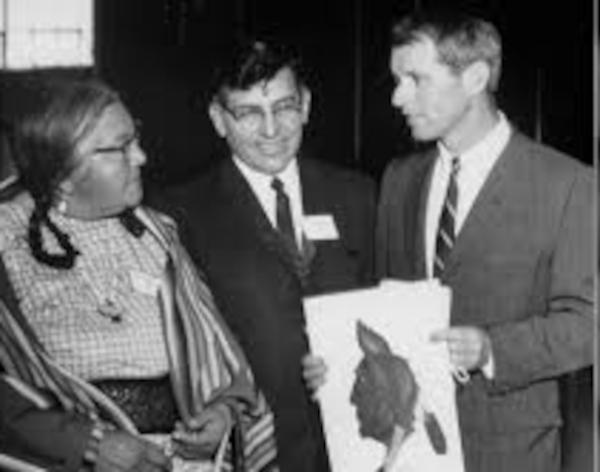
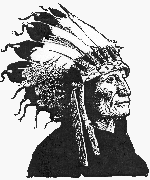
An interesting piece of news came over the wire Monday evening: ownership of the Washington Redskins, er Commanders, management has agreed to un-cancel the Redskins logo that had served the team admirably from 1972 to 2020. In 1971, Blackfeet Tribal Chairman Walter “Blackie” Wetzel felt the “R” on Redskins’ helmets was not a proper representation for the American Indian. He took action on his beliefs by sorting through a number of photographs. From these, he selected a portrait of Piegan Blackfeet Chief John “Two Guns” White Calf and presented it to Redskins management. That photo is in the photograph of Wetzel with Robert F. Kennedy. An artist was assigned to adapt the image to logo form.
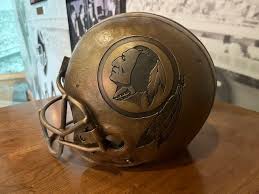
Some claim the head on the Buffalo Nickel was used as the model. Others claim White Calf was also the model for the nickel. White Calf’s profile is shown next to the logo on a football helmet. I’m no expert in such matters but the logo sure looks like it was modeled after White Calf and the Buffalo Nickel as well. That would make sense if White Calf was the model for the nickel, too.
The logo created was put in use in 1972 and lasted until 2020, when activists associated with the National Congress of American Indians (NCAI), a George Soros-funded organization, successfully got it and the team’s name and logo discontinued. Activists have gone to great lengths to memory-hole the logo, including not allowing it to be used on throw-back jerseys. Television networks have gone so fat as to blur out the logo when running films of old games.
The purge hasn’t been received well by both football fans and Native American groups. The Native American Guardians Association (NAGA) has been fighting for some time to get the team’s name changed and the logo returned to usage. Descendants of Wetzel and White Calf have been arguing for the logo’s reinstatement. One response from the current team owners was to create a memorial to Blackie Wetzel on the third floor of Northwest Stadium, formerly FedEx Field. That may not last long because the owners want to remove to Washington, DC proper by building a new stadium where old RFK still stands.
Bronze helmet with old logo created for the memorial
Their plans have hit a snag due to being in the Federal district controlled by the U. S. Government. Senator Steve Daines of Montana had been opposing the project until Monday. As residents of his state, he has supported the Blackfeet in having the logo un-canceled. Resurrecting the logo is far from getting the team name restored but it is a step in that direction.
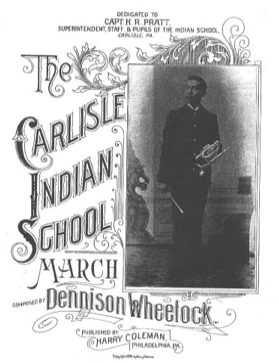
I was just informed that the Carlisle Town Band will be playing “Carlisle Indian School March” at their concert on Sunday. Several years ago, I found the sheet music for it in the National Archives. Unfortunately, Dennison Wheelock only provided a score for piano. Some years ago, I gave the sheet music to the band so their arranger could write the parts for the various band instruments. At long last the scoring has been finished and the Carlisle Town Band will be playing Wheelock’s march in a concert for the public.
Prior to this, all unmusical me was able to do was to input the piano score into MuseScore and get a synthesized piano output. You can play it by clicking on here. You may have to skip over an ad or two before it plays.
Earlier, I was able to get the Second Presbyterian Church choir to sing the Carlisle School Song, written by Pop Warner. To hear it click here.
I hope to get a recording of the fully instrumented version of Carlisle Indian School March.
Robert “Bob” Wheeler and his wife, Florence “Flo” Ridlon received the AAU Gussie Crawford Lifetime Achievement Award for their several-decades-long work in championing Jim Thorpe and getting his Olympic medals and records reinstated by the International Olympic Committee (IOC).
“The award is intended to recognize those whose efforts, both on and off the playing field, have paved the way for great change in amateur sports. First awarded in 2016, this is the seventh time the AAU Crawford Award has been given out.”
Bob is best known for his definitive biography Jim Thorpe. Dr. Ridlon received her Ph.D. in sociology from Syracuse University and has written two published works: A Black Physician’s Struggle for Civil Rights: Edward C. Mazique and A Fallen Angel: The Status Insularity of the Female Alcoholic.
It was Flo’s research in the Library of Congress that found the written copy of the 1912 Olympic Rules that had fallen behind other books on the shelf. Jim’s disqualification was disqualified by those rules, which set the challenge date as no longer than a month after the Olympics were played. Thorpe’s challenge was placed months later, making it invalid according to the rules.
Bob and Flo have worked decades in getting Thorpe’s medals and records returned and reinstated, making recognition of their work long overdue.
I heard rumors of the Jim Thorpe Memorial at Jim Thorpe, PA being refreshed. Let’s hope they’re true.
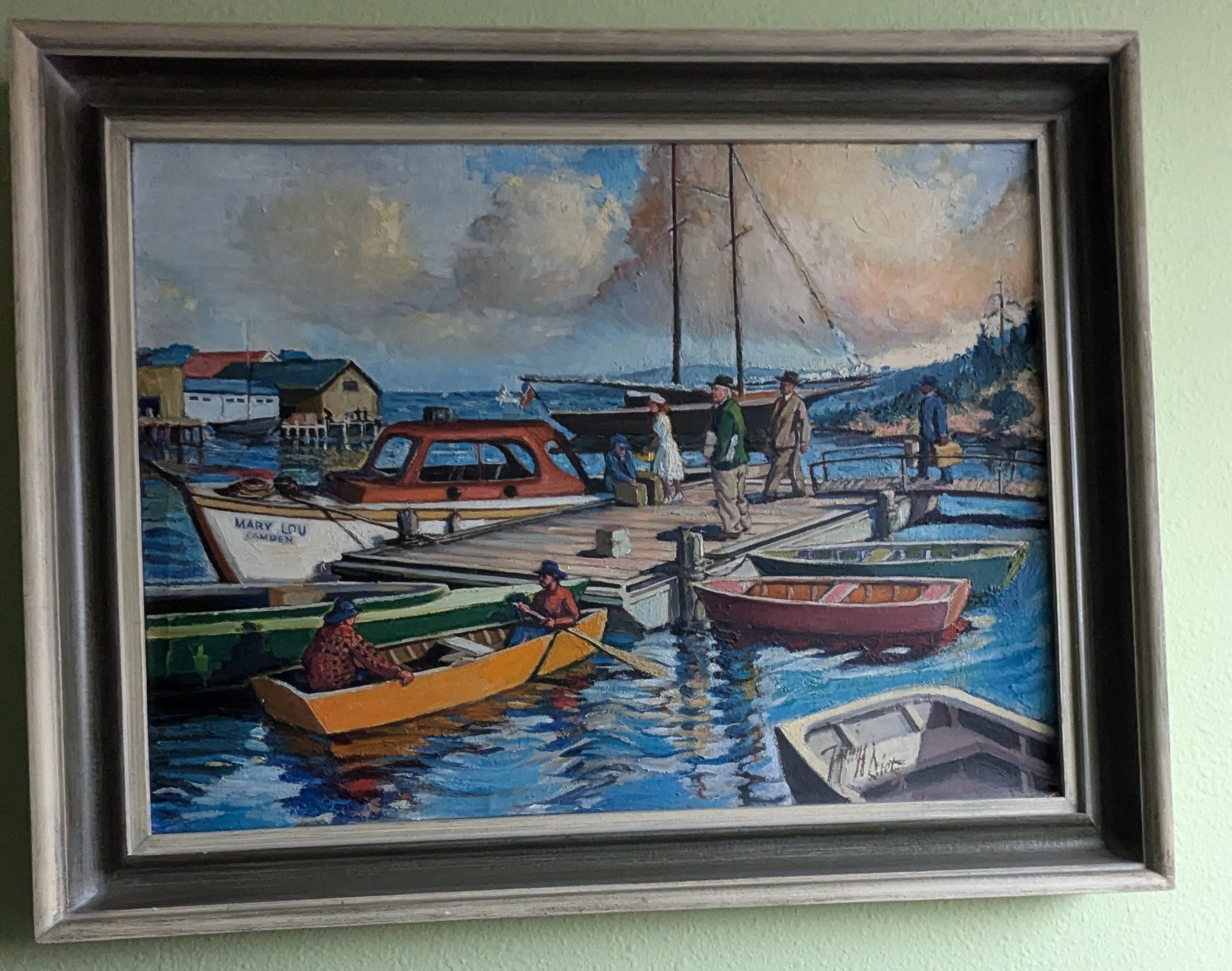
One of the things I’m occasionally asked to do is to verify that a painting was done by Lone Star Dietz or estimate what one would sell for on the open market. I am completely unable to estimate the value of Dietz’s (or anyone else’s) paintings. However, I’ve seen enough of his works to make an educated guess regarding it authenticity. Another factor in my reasoning is that the sales I’m aware of have been of relatively small amounts, so small that counterfeiting his paintings wouldn’t be a worthwhile enterprise.
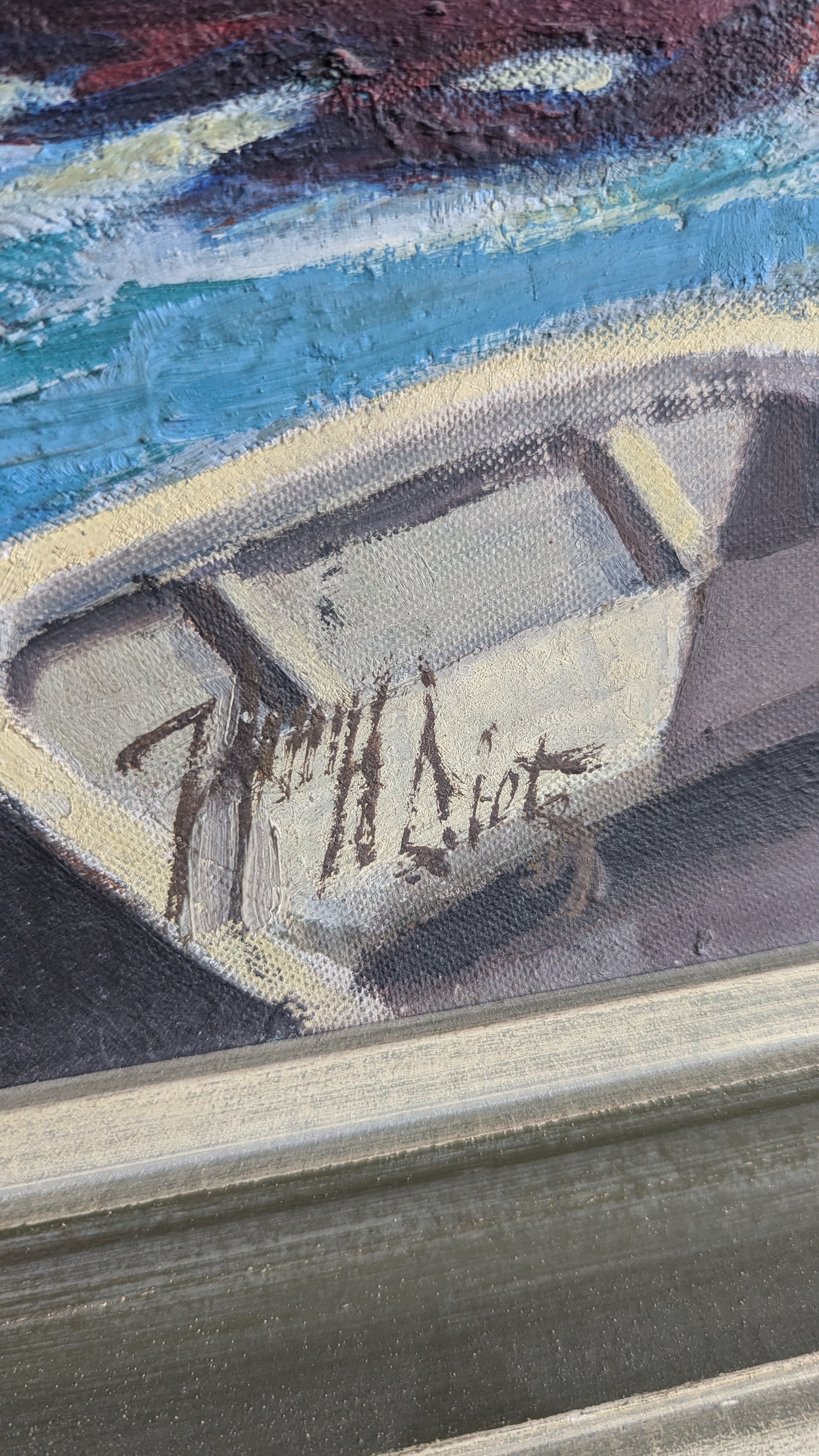
Like many artists, Dietz changed the signature he used on his paintings and illustrations, so expecting his signature to always be the same is unrealistic. I was recently sent three photos of parts of a painting someone purchased relatively recently.
The first photo is of a harbor scene painted on a canvas board (included above). The artist’s signature is located in the lower right hand corner and is blown up in the third photo (at the bottom of this article). The second photo (below)is of the back of the painting. Harrison Art Center may be where Dietz bought art supplies and had paintings framed while he was assisting Pop Warner coach the Temple Owls football team. The store seems to be no longer in business.
I bought a painting titled “Vacation Land” some years ago. The work, also painted on canvas board, seems similar enough that it might have been painted by the same person. It is signed “William Dietz.” On the back below the title of the painting is “by Wm H Dietz.” His birth certificate, recorded five years after his birth, gives his name as William Henry Dietz. He signed the painting one way and put his name on the back another way. This inconsistency is not unexpected.
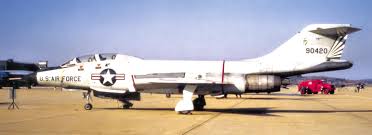
I stumbled across a video about Operation Thirsty Camel the other day. My first assignment in the Air Force after tech school was to the 405th Armament and Electronics Maintenance Squadron (405th A&E) at Clark AFB in The Philippines. I was trained to maintain MG-13 and MG-10 Automatic Weapons Control Systems on F-101B and F-102A aircraft, respectively because these systems were almost identical. At Clark there were two squadrons of Deuces (F-102s) and no F-101s. The MG-10 system used radar and infrared to track enemy bombers and shoot them down with the missiles and rockets kept inside the aircraft.
One of the squadrons we maintained, the 64th FIS, was relatively new to the base, arriving in 1966. When I arrived in early 1967, all of the Deuces were camouflaged but did not have the large squadron codes on their tails yet. Some of the 64th birds had unusual brackets. Oldtimers told me that the brackets were from the in-flight refueling systems that had been installed on the 64th planes to get them from Paine Field, Washington to the P.I. during operation Thirsty Camel.
Century Series fighter planes were not usually equipped for in-flight refueling, but the Vietnam War heating up necessitated getting more interceptors across the Pacific in a hurry. I was told that two planes were assigned to each tanker, a KC-135, for the flight. Fighters suck up so much fuel that one or the other of the pair was always getting refueled. The fuel usage may not have necessitated that, but it was advisable to keep as much fuel in each plane as possible in case an emergency erupted.
Follows is a link to the video about Operation Thirsty Camel. It’s hokey in places but is a fun watch. The first planes to go weren’t from the 64th. They were from a squadron that was sent to Okinawa. The 64th pilots and birds went a few months later.
Two things happened last week related (in my mind) to this post. First, American interceptors were scrambled to confront Chines and Russian planes over the Bering Sea, and second, The Russians Are Coming, The Russians Are Coming was shown on Turner Classic Movies.
First things first. A pair of intruding bombers, a Russian TU-95 Bear and a Chinese H-6 flew over the Bering Sea, close to American airspace. Three interceptors were scrambled to deter the bogies: an American F-16 and an F-35 plus a Canadian CF-18. The intruders departed without incident. In my day, a pair of F-102s from the 317th FIS at Elmendorf AFB near Anchorage, Alaska would have made the intercept as they did numerous times back then.
Second. The Russians Are Coming, The Russians Are Coming was set in 1966 on the fictitious Massachusetts island named Gloucester but was filmed in California. The story started with a Soviet (it was the height of the Cold War at that time) submarine running aground by an incompetent crew. Eventually, the Air Defense Command dispatched two interceptors to investigate. A pair of F-101Bs flew across the screen. Since this movie came out while I was in tech school for the MG-13 weapons control system that was used on that model aircraft, it was especially interesting to me. Before that, I hadn’t even seen a photo of an F-101. An odd coincidence occurred because, had it been real life, the Air Force would have sent two planes from Otis AFB in Massachusetts. Based at Otis was a squadron of F-101Bs. With the film being made in California, the nearest interceptors were the F-101Bs stationed at Hamilton AFB.
When I my tour in the Far East was up, which included TDYs to Vietnam and Thailand, I received orders for the 49th FIS at Griffiss AFB in Rome, New York. I looked forward to working on F-101s, the planes the 49th had at that time. However, during my transit from halfway around the world, the 49th’s F-101s were replaced with F-106s from Kincheloe AFB, Michigan. The F-106 started out as an F-102B but so many changes were made, including the weapons control system, I was then working on the MA-1 system, also manufactured by Hughes Aircraft. It used transistors where the MG-10/MG-13 systems used vacuum tubes, the functions were similar. I was discharged on December 26, 1969 without ever touching an F-101.
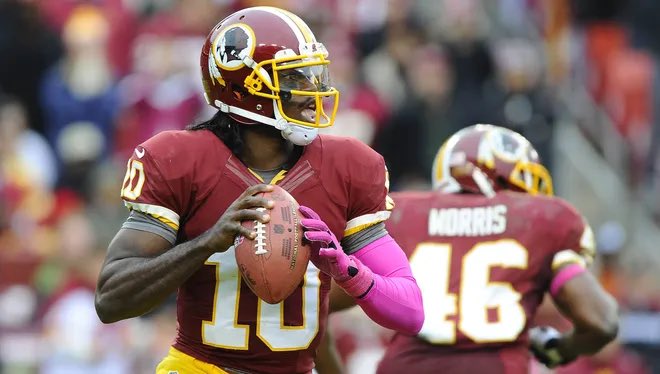
The news media are running reports that Robert Griffin III, aka RGIII, is urging fans to urge the Washington NFL franchise owners to reinstate the team’s former logo. This week he posted on X (formerly Twitter) the following message: “Dear Washington Commanders fans, this is a safe space. Would you be happy if the old logo was brought back?” The message was accompanied with his photo (above) in the old uniform. That post received 13 million views, 11 thousand replies, 2.9 thousand reposts, and 88 thousand likes.
He followed that up two days later with this question: “Would you rather Washington keep the current name or go back to the Football Team?”
The final results for the second question were 39.6% for Washington Commanders and 60.4% for the Washington Football Team. The generic name won by a 3 to 2 margin. That’s like saying a majority would rather have no name than Commanders.
The article on FanBuzz went on to include the results of a 2004 poll of 700 self-identified Native Americans of which less than 10 percent were offended by the name. Still, powerful activists were able to convince journalists and corporations that this term, which was originated by the Piankashaws in 1769 to differentiate themselves from white and Black men.
Perhaps lack of fan support will convince Commanders owners to consider a change.
Is Caitlin Clark the next Jim Thorpe or Red Grange? I’m not speaking from an athletic sense but from an economic sense. The WNBA is in a similar situation as was professional football in 1915—except they have a sugar daddy. The WNBA operates as a loss and the NBA’s largess keeps them solvent. This subsidy makes possible paying WNBA players salaries comparable to those of their college classmates who graduate with useful degrees.
In 1915 professional football wasn’t even professional. It was semi-pro. If the team turned a profit, it was divided among the players. If there was no profit, they got nothing. Players supported themselves working regular jobs, some of which were very physical. The games were played on Sunday, not because high school games were played on Friday and colleges played on Saturday. They were played on Sunday because that was the only day most players had off from the jobs that supported themselves and their families. The 40-hour work week wasn’t instituted until 1940. Before that, most worked six days a week.
When Jack Cusack, the Canton Bulldogs semi-pro team manager, offered Jim Thorpe $250 a game to play for his team, the other managers thought he would run his team into bankruptcy. Even larger sums had been paid to ringers for single games, but no player had been paid anything to rival this amount for each and every game. The result was that attendance more than doubled at Canton’s games, making both Canton and its opponents more solvent. Keep in mind that Thorpe’s last college game was played in 1912, the same year Big Jim won gold medals in both the decathlon and pentathlon at the Stockholm Olympic games. After that, he played Major League Baseball for the New York Giants and, after the 1915 season, coached the Indiana University backfield.
The next major step in solidifying professional football as a going concern occurred a decade later at the end of the college season when Illinois star Red Grange left college to turn pro for the Chicago Bears. “The Galloping Ghost”, “The Wheaton Iceman,” or “Number 77” had gained mythical status in 1924 when he scored four touchdowns in twelve minutes against mighty Michigan. The NFL had been formed five years earlier with Jim Thorpe as its nominal commissioner. The league was far from solvent up to that time. Teams came and went, including most of the founders. Things changed when Charles C. “Cash and Carry” Pyle signed Grange to a $100,000 contract.
The question now is Will Caithlin Clark elevate the WNBA as Thorpe and Grange raised pro football?
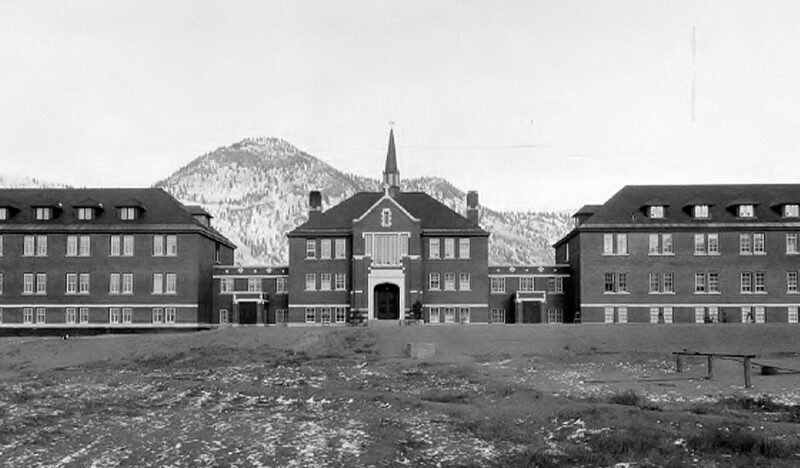
In recent years, much ink has been splashed on newsprint regarding graves of students at government or church operated off-reservation Indian schools. Not infrequently, things that happened at other schools were attributed to Carlisle Indian School without evidence to back up the claims. Some of the most egregious claims were made about schools operated by the Roman Catholic Church in Canada.
The discovery of a child’s tooth and a juvenile rib bone by a tourist and stories of elders and knowledge keepers about dead students being buried at night in the orchard of Kamloops Indian Residential School in British Columbia led to conclusions that missing children were buried in mass graves on the site. Ground-penetrating radar was brought in to determine if the orchard was indeed a mass burial site. The study indicated that 215 possible graves were located under the ground but excavations would be needed to determine if human remains were present or not. Technicians operating the equipment indicated that tree roots, metal objects, and stones could also be detected.
Dr. Sarah Beaulieu, a modern conflict anthropologist who teaches at University of the Fraser Valley, who performed the search, revised the initial estimate of probable grave sites downward to 200 after considering previous excavation work done in the area that may have affected the results.
This discovery led to Pope Francis issuing a formal apology for the Catholic Church’s role in operating the government Indian schools and reporting by all the major media in the United States in Canada. It also led to the burning of at least 85 historic Catholic churches and the appropriation of hundreds of millions of dollars by the Canadian Federal government.
7.9 million was spent to excavate the site. It has now been reported that the excavation found no mass grave site or any human remains.















 Tom Benjey's Weblog
