Archive for the ‘Washington State University’ Category

Minority Coaches

March 28, 2008

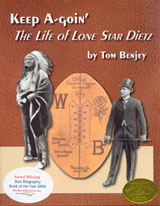
Yesterday I came across a December 8, 2007 article in The News Tribune out of Tacoma, Washington. In it reporter Todd Miles wrote, “Not since 1917 have the Washington State Cougars had a minority head coach in football.” Putting aside the fact that Washington State’s teams weren’t called the Cougars in 1917, the statement is still incorrect. Yes, Lone Star Dietz coached the 1918 Mare Island Marine team that was featured in WSC’s yearbook because ten players were from WSC. And, although Dietz considered it Washington State’s second Rose Bowl team, it didn’t wear crimson and gray. The major error is that not one but two minority coaches were overlooked. This is why we study history.

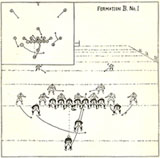
When Dietz was unceremoniously dumped in early 1919, WSC wanted another coach who was steeped in the Warner system because Dietz had been wildly successful with it. So, the administration looked for someone with experience, not just with the single and double-wing formations but with the whole system. Recall that Ace Clark thought that the way Lone Star conditioned his players and reduced the amount of scrimmaging left them in better shape for the games. Albert Exendine was a logical choice but he was under contract at Georgetown. Eventually Gus Welch was tracked down on a former battlefield in France and recruited for the job.

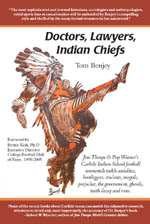
Gus Welch was Chippewa from Wisconsin and Al Exendine was Delaware and Cherokee from Oklahoma, but they have a lot of similarities. Both attended Carlisle Indian School and starred on its teams, Exendine at end and Welch at quarterback (blocking back in Warner’s single-wing). Both got their law degrees from Dickinson School of Law (now part of Penn State) across town from the Indian school. Both had long careers of coaching football in the fall and practicing law the rest of the year. Both were inducted into the College Football Hall of Fame as players. And both coached Washington State. Welch led the team from 1919 through 1922 and Exendine took over in 1923, lasting through the 1925 season. Each has a chapter devoted to him in Doctors, Lawyers, Indian Chiefs.

So, Washington State has a history of hiring minority head football coaches, just not lately.
Welcome!

March 7, 2008

Welcome to my world. For most of the new century I have been researching the lives of Carlisle Indian School football stars, something that has been a very rewarding experience. Along the way we – my wife Ann assists in the research and sometimes finds some unexpected things – have met some interesting and very helpful people. We have also discovered things for which we can’t find places in the books but which people may find interesting. Let’s start with something recent.

In the summer of 2002, Ann and I took a tour of Tanzania with a group of 10 people. At night when we were all assembled for the first time, the guide subjected us to the dreaded circle routine. When it was my turn to introduce myself, I said that I was writing a book on Lone Star Dietz. A woman a couple of places away from me in the circle responded, “Do you mean Lone Star Dietz the football coach?” I responded in the affirmative and asked how she knew about him. The woman – Betty Tyler – informed me that, when she was a child the Dietzes lived next door to her in Reading, Pennsylvania, where he coached the Albright College football team at that time. I was shocked to meet someone who actually knew Dietz in a group of 10 people on the other side of the world.

Betty’s mother, Dorothy Hawkins, was living near Charleston, South Carolina at the time and, although in her 90s, had a very clear mind. That fall Ann and I visited some friends in Charleston – the ones who arranged the Africa trip – so I could interview Mrs. Hawkins. Dorothy was a lovely person and shared information about Lone Star that one cannot find in newspaper reports or public files. She was very helpful, especially because she and her family moved to Pittsburgh and kept in contact with the Dietzes who were also living there after the war. Through Betty and her mother I was also able to interview Betty’s brother. That interview was conducted over the phone because he lives in San Francisco. He recalled Lone Star parading up and down the street in his Sioux regalia and challenging the kids to tug on his pitch-black hair to show that it was all real.

Late last year we received some sad news: Dorothy Hawkins had died. In addition to the bad news, Betty Tyler gave us some good news. Betty’s mother had a painting Lone Star gave her many years ago and Betty didn’t have a place for it in her house. Knowing that I was so interested in Lone Star and would appreciate it, she gave it to me. What good fortune! Now I must reorganize my already cluttered office to give it an appropriate place on the wall.

To learn more about Lone Star Dietz, check out www.LoneStarDietz.com. To learn more about my upcoming book, check out www.Tuxedo-Press.com. If you’re interested in seeing video previews for the books, look at www.YouTube.com/TomBenjey.

Now I must go to the Cumberland County Historical Society to look at the Jim Thorpe letters they just acquired. More on that later.