Archive for the ‘Washington State University’ Category

My Washington

January 30, 2024

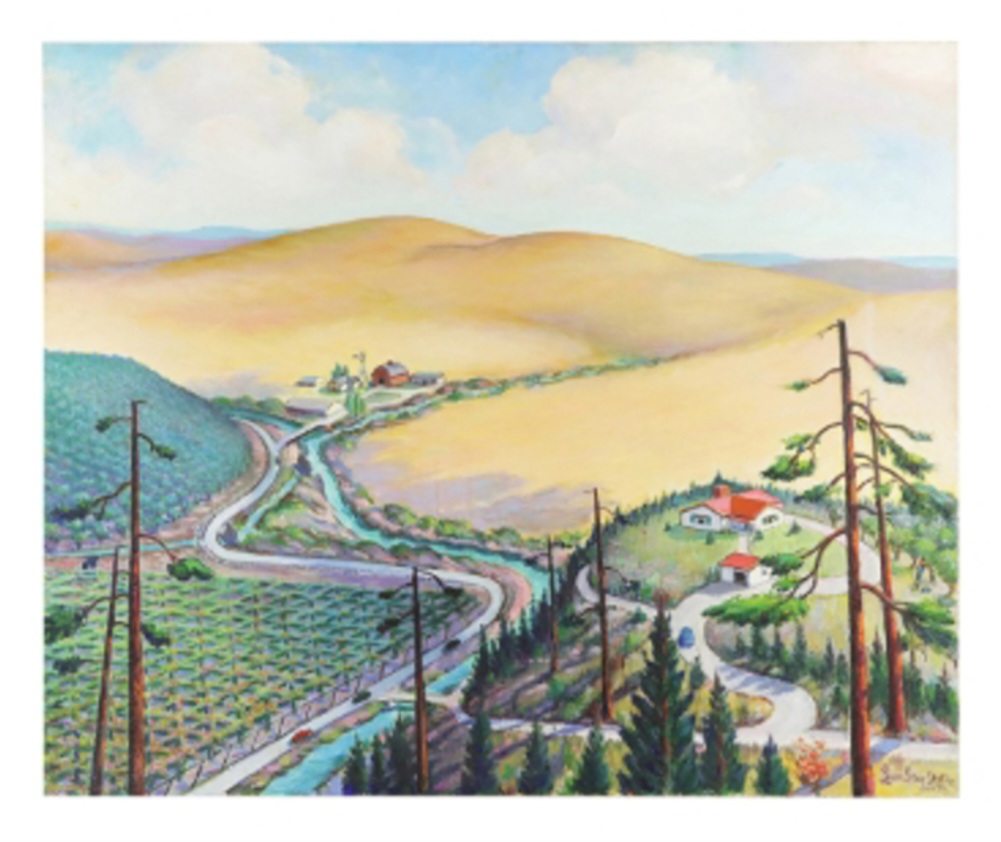
A commenter informed me of a Lone Star Dietz painting that had been sold for a high price at auction in 2022. That Dietz produced this particular painting while he was living in Reading, Pennsylvania is not a problem. Dietz attended the 40th anniversary celebration of Washington State’s victory over Brown in the 1916 Rose Bowl in Pasadena, California. While on the West Coast he traveled to Pullman, where he discussed the open coaching position. He likely did this painting on that visit. The minimum bid allowed by the auction was $2,000. The only bid received was for $2,400. One suspects that a family member or local institution was the purchaser. I’d appreciate hearing if the painting is seen hanging somewhere. The auction site included the following write-up, which is surprisingly accurate, about the painting:

Original oil on canvas painting by Lone Star Dietz, College Football Hall of Fame coach and second coach of the Washington Redskins. Following his coaching career, Dietz became a noted painter and had an exhibition of his works at Lehigh University in 1955. The offered painting is especially noteworthy, because it was produced for one of Dietz’s former players at Washington State, Ralph Boone, who was a key contributor in the club’s 1916 Rose Bowl victory. 

The colorful painting (44×36”), titled “My Washington” pictures the sprawling Yakima Valley, Washington state’s agricultural center, noted for its wine, apple, and hops production. Dietz has signed and dated the painting, “Lone Star Dietz Jan. ’56,” in the lower right corner. Dietz has added a lengthy dedication on the reverse of the canvas. In full: “’My Washington’ – From the Yakima Valley to the Palouse – It is a country of roving clouds – endless hills of growing wheat – Delicious apples – tall timber and fields of blooming hops/As painted for Ralph R. Boone a great football player, a fine gentleman and a warm personal friend – by his former coach – Lone Star Dietz – 1956.” The painting, which is stretched on board, remains in Excellent to Mint condition.

Ralph Boone was a running back who played under Dietz at Washington State. Boone scored the first touchdown of the game in Washington State’s 14-0 win over Brown in the 1916 Rose Bowl, which was just the second Rose Bowl game ever played, and the one that began the annual New Year’s Day tradition. Obviously, the ties between player and coach remained strong throughout the years, with the two forming a close friendship in later life, as the dedication of this painting will attest.

Lone Star Dietz was one of the most interesting figures in the history of both college and professional football. His heritage as a Native American was always questioned throughout his life, but he was a star football player at the Carlisle Indian School (1909-1912) under Pop Warner and a teammate of Jim Thorpe. Washington State marked his first college head coaching position, which he held from 1915 to 1917. (Dietz’s win in the 1916 Rose Bowl is still the school’s only Rose Bowl win.). Dietz eventually coached at seven other colleges, including Purdue, Louisiana Tech, and Wyoming. In 1933 he became the second head coach of the Washington Redskins in what was the club’s second season in NFL franchise history. While the story has never been confirmed, it was often said that team owner Preston Marshall named the club the “Redskins” in honor of Dietz’s heritage (the team was known as the Braves during its inaugural 1932 campaign). Dietz coached the Redskins for two seasons before returning to the college ranks. He retired from coaching in 1942, spending the remainder of his life as a painter right up until the time of his death in 1964. Dietz was elected to the College Football Hall of Fame in 2012. Please note: the size and/or weight of this lot will necessitate an increased shipping charge.

The Granddaddy of Them All Dies

December 29, 2022

Lone Star Dietz would roll over in his grave if he heard about this.

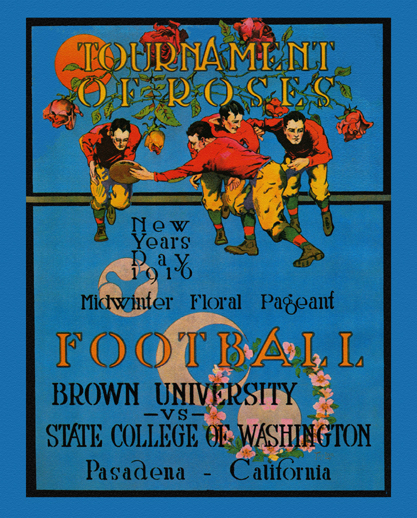
Distracted by several pressing issues, I paid scant attention to the headlines about the Rose Bowl this fall. Stumbling across an article by Pasadena-based Joe Mathews yesterday, I learned what the hubbub was about. Dietz’s Washington State warriors upset Brown in the mud on January 1, 1916, putting West Coast football on an even footing with the East, establishing the Rose Bowl as an annual event, and instituting the New Year’s Day football tradition. A major game, generally pitting an eastern challenger against a western defender, has been featured on January 1st each year since then, unless it falls on a Sunday as it does this year. In that case it is played on Monday the 2nd. Because of its historic importance, Keith Jackson called the Rose Bowl “The Granddaddy of Them All.” That old man dies Monday night at the end of the Penn State-Utah contest.

How did this happen? Mathews blames it on the perceived need to have a single national champion as lobbied for by President Obama and many others. While only four teams were involved in the playoffs, the Rose Bowl continued to be a major event. But with the playoffs expanded to twelve teams, the Rose Bowl wouldn’t likely have attracted highly ranked teams if it wasn’t part of the playoff system. Adding to the dilemma was the shift of two California schools from the Pac-12 to the B1G. The possibility of a western team, say USC, being the eastern invader becomes a distinct possibility, destroying the East-West nature of the game.

Seeing no viable alternative, the Rose Bowl has now thrown in with the NCAA championship scheme. Mathews figures future Rose Bowls will be quarter-final games. That long drop from importance brings with it a financial deficit. The Tournament of Roses will need to make that up somehow or the Rose Parade will become another tradition of the past. An era has sadly passed.

What Was Dietz Doing?

November 18, 2018

Lone Star - OregonianWhat did Lone Star Dietz do between early February of 1920, the time he left the Spokane, Washington jail after completing his 30-day incarceration, and late March 1921, when he signed with Purdue to coach their football team?
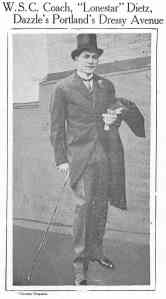
Dietz was broke in late 1919 after investing heavily in Washington Motion Picture Company. Having no money for his legal defense forced him to plead nolo contender to the draft-dodging retrial after the first one produced a hung jury locked at 8 to 4 for acquittal. An apparently sympathetic district attorney agreed to the wrist slap sentence in the county jail instead of a long one in a federal penitentiary like those given to others in the post-WWI hysteria. The news article announcing his release stated that he had been a “trusty” the last two weeks of his incarceration that began on January 8, 1920.

One can easily envision the affable Dietz playing cards with his jailers a la Rhett Butler—except that he had no money to gamble with. What he did afterwards is still unclear. Newspaper articles covering his release his release made no mention of his plans for the immediate future. He may have promoted Fools Gold, the movie he played a role in and helped fund, but that would have required finances on which to live. Another possibility is that he did movie work in Hollywood. He had experience and could have acted or done stunt work or various things behind the camera. That would have been a way for him to earn a paycheck. Football was out of season, so that wasn’t a possibility.

The Encyclopedia of Football, 15th Revised Edition by Roger Treat listed Dietz as having played guard for the Hammond Pros NFL team. At 36, Dietz would have been old, and likely too out of shape to play much. However, it would have brought him east and more available for other opportunities.

The November 12, 1920 edition of The Evergreen, Washington State College’s school newspaper, listed “Veteran Cougar Coaches.” According to this piece, Dietz was “Now engaged in theatrical business in New York.” A January 10, 1921 article in The Seattle Star titled “‘Lonestar’ Dietz Playing Behind N. Y. Footlights” had him “…playing behind the footlights in Woodward’s New York theatre.”

I have been unable to find out anything about Mr. Woodward or his theater. Any help in that regard would be most appreciated.

The March 229, 1921 edition of The Lafayette Journal Courier announced the hiring of Lone Star Dietz to lead Purdue’s varsity football team. That article also said that “…for the last two years he has been engaged in business activities on the west coast.”

Clearly, more information is needed to determine exactly what Dietz had occupied himself doing those thirteen-plus months between jail and Purdue football.

The Love Hermit?

January 14, 2018

Lone Star - Oregonian

Photo of Lone Star Dietz that accompanied original 1918 article

The author of the article I referred to in the previous message, Jim Kerschner, forwarded a link to the entire article. The article, when read in full, provided me with more information than my question about his Vaudeville career. Perhaps a little background is needed for those unfamiliar with the multi-talented Mr. Dietz. Prior to arriving in the Pacific Northwest in September 1915, he had worked as an artist illustrating Macalaster College publications, creating a mural out of grains grown at Chilocco Indian School for the Model Government Indian School Exhibit at the St. Louis World’s Fair, played of football teams at Macalaster College, Friends University and Carlisle Indian School, competed on the indigenous people’s team in the Anthropology Days event tacked onto the 1904 Olympic Games held at the St. Louis World’s Fair. He sang solos at Friends University and performed a war dance at the School of Industrial Art of the Philadelphia Museum (today’s University of the Arts), after which he gave a talk in what the Philadelphia Record described as “excellent English style, which might put an ordinary Philadelphian to the blush.”


In addition to serving as an assistant coach to Pop Warner and teaching art at Carlisle, he illustrated their literary magazine and ephemera. He and his first wife, the noted Winnebago artist Angel DeCora, also raised prize-winning Russian Wolfhounds in a kennel behind their apartment on Carlisle Barracks.

At Washington State College, in addition to coaching the football team, Dietz arranged songs and sang baritone while touring the state with the college’s chorus. He also gave talks to classes on topics such as architecture. Prior to arriving in Pasadena for the 1916 Rose Bowl, he arranged for his team to portray the football team in Tom Brown at Harvard and for a small role in the picture for himself. When his team returned to Pullman after the victory, he stayed on in Hollywood to arrange more picture work for himself.

The article Mr. Kerschner referred to in his piece listed three films Dietz had been in, one of which I hadn’t heard of before, The Love Hermit. It also credited him with writing the story for Lonestar, but couldn’t appear in the movie because it was filmed during football season.

The article also provides some information about Dietz’s Vaudeville career: “The rapid progress that is being made by your company here in Spokane toward the production of motion pictures has made me willing to change from my previously announced plan to spend the coming year on the vaudeville circuit.” More research is required to uncover exactly which talents he would have employed in his act.

Now to figure out how to search News.Google.com for articles not on-line when I spent numerous hours hunched over microfilm reading machines.

https://news.google.com/newspapers?nid=0klj8wIChNAC&dat=19180110&printsec=frontpage&hl=en page 6

Renewed Interest in Carlisle Indian School

December 27, 2015

While I wait on galleys for my Craighead book, I have received requests for interviews about Carlisle Indian School football players. The first was with the local paper to talk about the 100th anniversary of the 1916 Rose Bowl. The second is for a videotaped interview about the Carlisle Indian School football program for an upcoming documentary by Ernie Zahn, a Current Fellow with Filmmakers Without Borders. In the meantime, Washington State Magazine, the Washington State University alumni magazine published a short article they requested I write about the 1916 Rose Bowl. How, you might ask, is the 1916 Rose Bowl a Carlisle Indian School topic?

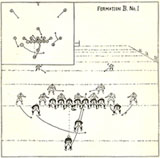
Lone Star Dietz played right tackle for Pop Warner’s legendary 1909-11 teams and became his protégé when he assisted the “Old Fox” coach the Carlisle teams from 1912 to 1914. After Warner took the head coaching job at Pitt, he recommended Dietz to head up the floundering Washington State program. Dietz brought Warner’s single- and double-wing formations to the Palouse and ran roughshod over the competition with them. A photo of the 1915 Washington State College team lined up in an unbalanced-right single-wing formation heads the Washington State Magazine article.

The Carlisle Sentinel interview resulted in an article in the December 26 edition titled “Rose Bowl: Lone Star Dietz coached first game in Rose Bowl Series.” Accompanying the article are two photos of Dietz: one in civilian clothes holding a cigar, the other in a Carlisle football uniform.

How much of the hour-long interview by the Filmmakers Without Borders fellow won’t be known for some time but the entire documentary Zahn intends to produce will be short. Because it is funded, he won’t be entering it in festivals or contests. Instead, he will be putting it up on YouTube.com when post-production work is complete.


Lone Star Dietz Article in Indian Country Today

August 14, 2012

Yesterday’s edition of Indian Country Today includes an article by Jack McNeel on Lone Star Dietz. The headline, which probably wasn’t written by Mr. McNeel, understandably focuses on Dietz’s posthumous induction recently into the College Football Hall of Fame. But the article covers more than that. He covered as much of Dietz’s highly eventful life as space would allow.

Something I particularly like is that McNeely chose to use a photograph of Dietz with the Washington State team that isn’t widely used. It’s nice to see something you haven’t seen before. In this case, I probably saw it briefly when going through the Washington State photo archives some years ago but didn’t remember seeing it.

There are a few things in the article that need a little bit of clarification. First, Tournament of Roses wasn’t arranging its annual football game in the fall of 1915 because they had only hosted a game once before and that was back in 1902. The Washington State victory over Brown in 1916 was what established the game as an annual event and much of the credit for that goes to Lone Star Dietz for putting West Coast football on the same level as the eastern powers.

The statement, “Soon after, many college sports were suspended for World War I,” may compress the timeframe too much for readers unaware of what happened during that period. Dietz’s men lost two games in 1916 and were undefeated again in 1917 but weren’t invited to Pasadena because of the popularity of military teams. It was after the 1917 season that college sports were curtailed freeing Dietz to coach many of his former players on the Mare Island Marines team.

The phrase “Indian agent from the Sioux Nation” may be misleading and cause unfamiliar readers to think the agent was an Indian. The agent was a white man assigned to the Pine Ridge Agency, one of several reservations on which Sioux live.

“Benjey’s research indicates that Dietz’s father took the dead baby…” would more accurately be phrased, Benjey’s research indicates that Dietz’s father claimed to have taken the dead baby…. However, W. W. Deitz (he spelled his name differently that Lone Star spelled it) denied that publicly.

Here is a link to the article:

http://indiancountrytodaymedianetwork.com/2012/08/13/william-lone-star-dietz-posthumously-inducted-into-football-hall-of-fame-128617

Huskies Were Cougars First

July 11, 2012

A combination of beastly hot weather that drained my energy coupled with being overwhelmed with work to get out has kept me away from my blog recently. I hope things let up for the rest of the summer.

Yesterday, I received a question regarding when the Washington State teams were first called Cougars. That person wanted to know if the 1918 Spalding’s Guide referred to the 1917 WSC as Cougars. It didn’t, but didn’t call most teams by their nicknames, either.

Washington State lore places the origin of the use of that name for their teams to an unnamed Bay Area sportswriter who wrote that the WSC team “played like Cougars” in their October 25, 1919 game with Cal, the second game played under Gus Welch’s leadership. A quick scan of newspapers of that time uncovered a short article in the October 25, 1919 Oakland Tribune stated “Washington State College, the Cougars, meets the University of California here today….” The post-game coverage written by Doug Montell did not use Cougars or any other nickname for the WSC team although it did refer to the California team as the Bears. Even if Montell had called them Cougars, the WSC team couldn’t have been dubbed with that name for its play against Cal because some unnamed person at the Oakland Tribune called them that before the game was played. Regardless, this wasn’t the first time a college team in the state of Washington took that name.

The March 17, 1918 edition of the Oakland Tribune (yes, it was that same paper again) included an anonymous piece stating that the University of Washington had officially named its teams Cougars. So, a year and a half before the Tribune called the WSC team Cougars, it claimed that Washington had claimed the name. Perhaps someone in the Tribune’s sports department had a feline fetish.


Lone Star Gets His Due

May 24, 2012

Tonight, the National Museum of the American Indian (NMAI) in Washington, DC holds a reception to kick off its new exhibit, “Best in the World: Native Athletes in the Olympics,” to celebrate the athletic achievements of Native Americans on the 100th anniversary of the 1912 Stockholm Games that featured legendary performances by Jim Thorpe and Lewis Tewanima. I am attending because Bob Wheeler, Jim Thorpe’s Boswell, is to speak there. While making preparations for attending this event, I received some unexpected news.

The National Football Foundation (NFF) released its selections for induction in the College Football Hall of Fame Class of 2012 and Lone Star Dietz was finally on the list. As blog followers probably know, Greg and John Witter, first cousins and rabid Washington State football fans, and I campaigned to get Dietz placed on the Hall of Fame ballot some years ago. Getting his won-loss record corrected was the key to getting him nominated but there were larger obstacles yet to come.

Lone Star Dietz died in 1964 and there are few people still alive that knew him. Also, he coached at schools with smaller alumni bases and less clout than the major football factories. Washington State, for example, couldn’t muster the support for him that, say, Ohio State could for John Cooper or Michigan could for Lloyd Carr. While both these recent coaches had very good careers, neither had the impact on the history of the game as did Dietz. It’s one thing to inherit a strong program and be a good steward, but it is quite another to rebuild a floundering program from the ground up, something that Lone Star did multiple times.

The closest he came was in 2006 when the selectors chose Bobby Bowden and Joe Paterno instead of the people who were on the ballot. A couple of years ago, when Lone Star’s name was dropped from the ballot, I gave up all hope of him ever being selected. I didn’t even know that his name was on the Divisional ballot this year, so was shocked when I started receiving phone calls from reporters on Tuesday afternoon.

All I can say is that it’s long overdue. Although he’s being brought in through the back door, so to speak, he will finally be in. He’s the first Carlisle Indian to be inducted as a coach; the rest were as players. Whether this honor is enough to offset the many indignities Dietz suffered and mollify the Lone Star Curse is yet to be seen.

http://seattletimes.nwsource.com/html/cougarfootball/2018262997_dietz23.html

http://www.spokesman.com/stories/2012/may/23/blanchette-wsu-legend-dietz-gets-his-due/

Artichoke Played for Carlisle

April 26, 2012

I thought I’d continue with the theme of Carlisle Indians who played football in WWI by looking through the 1919 Spalding Guide for references to the Carlisle team or its players. Before starting that, I checked to make sure that I hadn’t done it before as my memory isn’t as good as it once was.  In January of this year, I did a piece about the Carlisle students whose names I wasn’t familiar with who were playing on military teams. I recollect having mentioned that, although the 1918 Spalding Guide included Carlisle’s schedule for that year, none of these games were played because the school was closed shortly before the beginning of the football season in 1918. Fortunately, some names I do recognize can be found in the 1919 book, too.

Om page 22 is the photograph of the 1918 Georgia Tech “Golden Tornado.”  Joe Guyon is #8 and John Heisman is #12.  Charles Guyon (Wahoo) isn’t in the photo.  Perhaps, Heisman got rid of him by then.  Page 188 displays headshots of players and coaches for the 1918 Mare Island Marines team. Lone Star Dietz, #3, coached this team composed mainly of his former Washington State players. So may of them were on this team that this photo was published as part of the Washington State yearbook for that year. The New Year’s Day game in Pasadena on January 1, 1919 was the second one for those who had also been on the 1915 Washington State squad that had played in Pasadena in 1916.

Page 263 includes a write up for the Base Section No. 5 team from Brest, a major port of embarkation: “On January 19, 1919, a Base foot ball squad was organized under Lieut. W. C. Collyer, former Cornell half-back.  This squad was composed of the above mentioned engineers, together with several stars gathered together from different outfits. Of these, the most prominent was Artichoke, a former Haskell and Carlisle Indian star.” Not being aware of anyone named Artichoke, I am confident that the player in question was Chauncey Archiquette, Jim Thorpe’s early idol. Unfortunately, a team photo wasn’t included to see that Artichoke was indeed Archiquette.

Hawkeagle Also Played in 1917

April 23, 2012

Page 110 includes headshots of soldiers who played on the Camp Funston (Fort Riley, Kansas) football team in 1917.  Number 29 is Pvt. Thomas Hawkeagle (aka Pretty Boy and Hawk Eagle).  Nothing further could be found about him in the book but it is well known that he played on the 1914 Carlisle team and distinguished himself so much against Auburn that he figures prominently in the legends of the origin of the War Eagle cheer.  Hawkeagle was the last Carlisle player mentioned in the 1918 Spalding Guide for activity in the 1917 season.  There were likely others but they weren’t mention by Spalding or I just missed them.  John Flinchum was listed on page 224 as the captain of the 1918 team, playing at left tackle.  No coach was listed for 1918 because none had been hired at that point.

Non-players in the form of officials were listed in the back of the book on pages 233 through 249.  Officials were separated into various groups: collegiate, service and scholastic, as well as by region, state or conference.  Southern Officials were grouped by white and colored.  Even the officials that were set apart as being active-duty military had this separation even though the Service Officials did not.  Indians were not segregated from other officials as Indian players had been allowed to play on otherwise all-white teams for many years.  Oddly, only one former Carlisle player was listed as an official and that was Mike Balenti.

The advertisement for Warner’s 1912 book was still being run in the 1918 guide.  This time, it included an anonymous testimonial for “The coach of an unbeaten Western college” who was surely Lone Star Dietz whose Washington State team had gone unbeaten in 1917.  Dietz’s team was not invited to the Rose Bowl that year because military teams were drawing large crowds at that time.  Dietz and his players would be invited at the end of the 1918 season but that time they wore Mare Island Marine uniforms.