
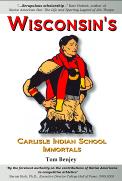
Oneida Carlisle Indian School Immortals is now available on Amazon.com.
Oneida Carlisle Indian School Immortals is now available on Amazon.com.
This week I received the invitation which follows and am sharing it to let as many people who might be interested in attending one or more of these events know about them.
I’m reaching out with heartfelt excitement to invite you to a very special family celebration honoring our grandfather, Joseph N. Guyon — legendary athlete, cultural ambassador, and beloved member of the Louisville community.
In partnership with Greg King, the Frazier History Museum, and the Louisville Bats, we’ll gather in Louisville this September to celebrate his incredible legacy.
🗓️ Event Schedule – September 16–17, 2025
📍Tuesday, September 16 – 6:00 PM Frazier History Museum 829 W Main St, Louisville, KY 40202 (502) 753-5663 An evening program celebrating Joe’s life and contributions as part of the museum’s Cool Kentucky exhibit.
📍Wednesday, September 17 – 9:00 AM Resthaven Memorial Park 4400 Bardstown Rd, Louisville, KY 40218 (502) 491-5950 A short graveside ceremony to honor Joe as the Pro Football Hall of Fame Medallion is officially presented and installed on his headstone.
📍Wednesday, September 17 – 12:05 PM Louisville Slugger Field 401 E Main St, Louisville, KY 40202 (502) 212-2287 Join us for Joe Guyon Day at the Ballpark, celebrating his years with the Louisville Colonels. A Guyon family member may throw out the first pitch, and there may be live interviews with family on the radio during the game.
This will be a powerful and joyful opportunity to reflect on Joe’s legacy and connect.
We’d love to have you with us.
With deep appreciation, Paul D. Guyon On behalf of the Guyon Family
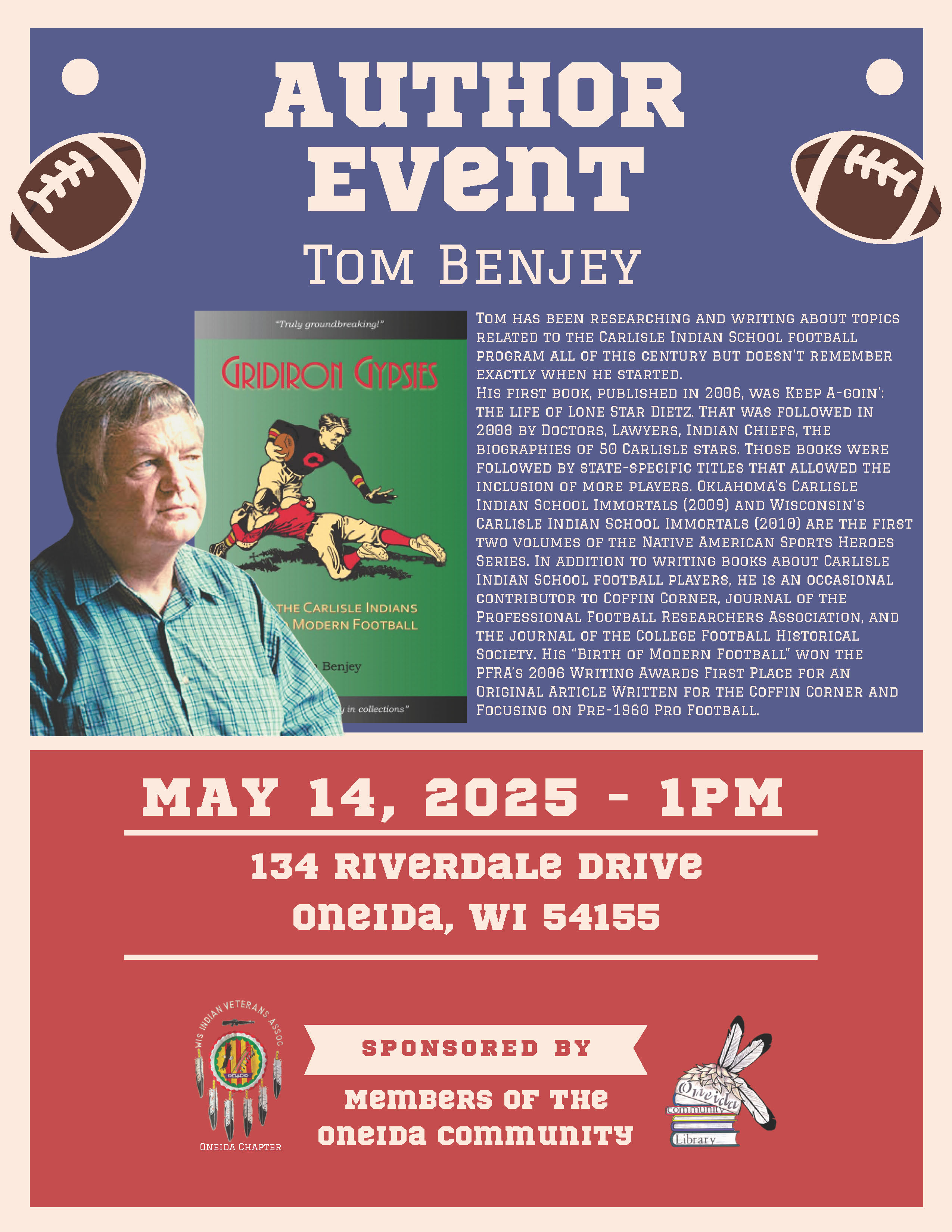
I will be presenting a program in Wisconsin about the young Oneida men who played football at the Carlilse Indian School on Wednesday, May 14. This should be a fun event.

While researching information for an article about Keewatin Academy, I came across a July 2010 blog posting by the late, great Bob Lemke. In it he stated:
“Like Thorpe, Guyon was a two-sport star who parlayed awesome athletic abilities into a life away from the White Earth Indian reservation near Brainerd, Minn.”
Joe Guyon was an incredible teammate of Jim Thorpe, both at Carlisle Indian School and in the pros. In between, he attended Keewatin Academy to prepare himself academically for college and to play on the Georgia Tech “Golden Tornado” football team. Few others have played on two legendary teams but that isn’t the reason Lemke’s statement jumped out at me. Parlayed…into a life away from the…reservation is what caught my eye.
Carlisle Indian School is being criticized relentlessly these days and critics often conflate it with other schools, even some in Canada. Carlisle was unique; it reflected founder Richard Henry Pratt’s philosophy and prepared students to farm their allotments on the reservation, if staying on the reservation was their desire, and for the others to be able to prosper off the reservation.
To my knowledge, no one has studied the difference in results for Carlisle students who didn’t permanently return to the reservation with those who parlayed their Carlisle educations into lives away from the reservation. Such a study would be difficult to make but could be enlightening.
Something simpler to look at would be deaths. Something that is ongoing at Carlisle Barracks, formerly the home of Carlisle Indian School, is the return of the remains of deceased students to the reservations from which the students came. It is sad so many children died. It is also sad so many children in the general population died during the period of time Carlisle operated (1879-1918). As an example, a prosperous local family, Richard Reynolds Craighead and his wife Mary, had nine children but only three survived early childhood. Children dying was a sad fact of life at the time. Another example of people able to obtain the best medical care available were the parents of two Keewatin Academy students, renowned structural engineer Joachim Giaver and his wife Louise, who lost three of their eight children in their infancy.
It might be that fewer children died at Carlisle than did on the reservations because Pratt provided better healthcare for the students than the government did for reservation residents. Studies have been conducted of deaths at the school. Now would be a good time to conduct a more comprehensive study. A control group already exists: the young people who stayed on the reservation and didn’t go to Carlisle or any other off-reservation boarding school. The results could be enlightening.
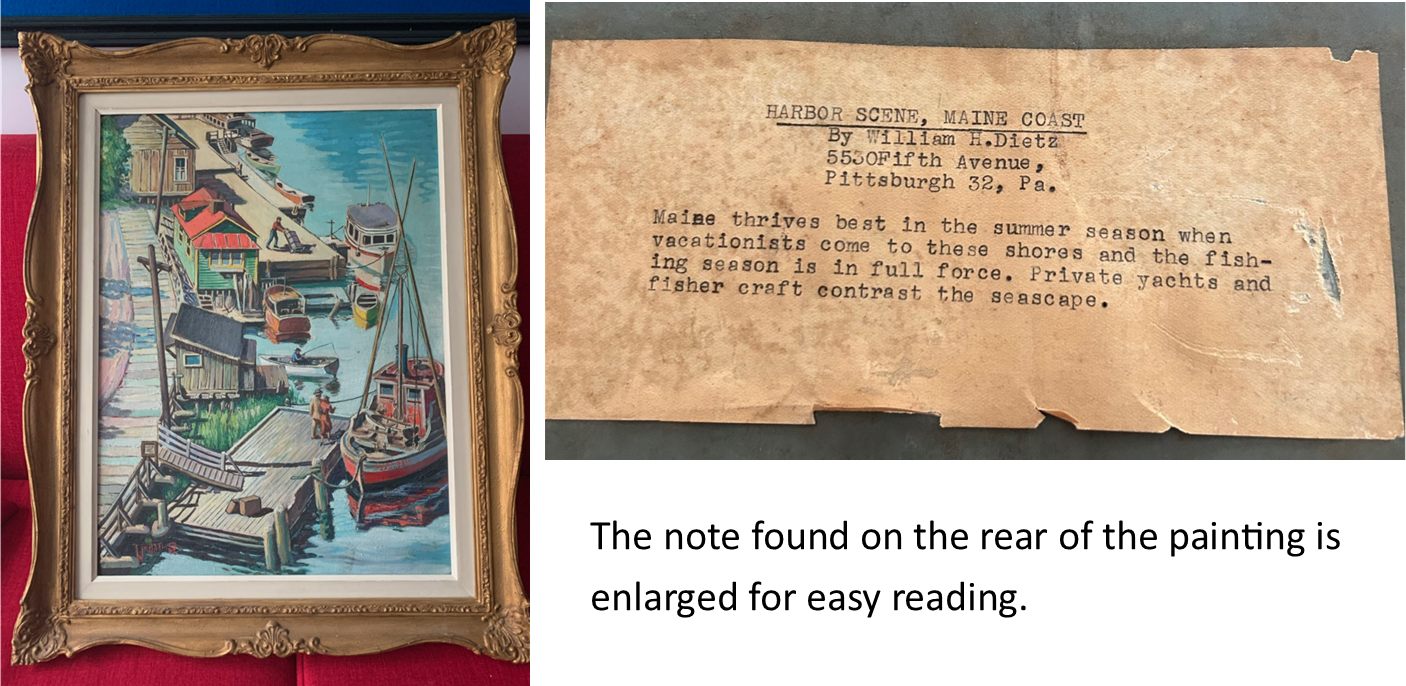
Every so often, someone asks my opinion about a painting purportedly done by Lone Star Dietz. I’m definitely not an expert and know nothing about pricing art but I’ve seen enough of Dietz’s work to be fairly comfortable recognizing them. I’m unaware of any selling for large amounts. That fact likely reduces the possibility of someone trying to pass off a work as Dietz’s when it was actually done by someone else.
I recently received an inquiry from someone wanting to sell a Dietz painting in his possession. I agreed to post front and back photos of the painting on my blog (Lone Star often put things on the backs of his paintings) and forward responses of people interested in it to him. I get nothing out of this other than the pleasure of seeing another of Lone Star’s works. This time I also learned the address at which he lived while in Pittsburgh, likely during WWII or the early 1950s. The apartment building still stands in the Squirrel Hill section of Pittsburgh.
A September 8, 1900 Australian paper, reported that Dennison and a 60-piece band sailed out of Boston for a “tour of the principal European cities.” The newspaper hadn’t gotten the word that the trip, and the tour of the eastern U. S. to raise funds for it, had been called off in May by school authorities. They gave the reason for the cancellation as the estimated cost of $15,000 “…was not feasible from a financial perspective.”
The June 15 edition of The Indian Helper reported, “The band has given up its trip to Paris and has disbanded. Many of the boys have gone to their homes in the west and some to the schools whence they came. Storekeeper Kensler has taken charge of the instruments and there will be no band music for some time.” Included in those dispersing were Dennison’s younger brother clarinetist James Riley Wheelock (often referred to as James or J. Riley) and noted violinist Zitkala-Sa (Yankton Dakota). In late-June, friends and coworkers gave Louisa and Dennison silver spoons, forks, and knives as going-away presents. Mrs. Cook recited a poem she had written in their honor. They left to visit with her family and rest in Minnesota.
In October, Dennison, who was then living in DePere, Wisconsin, took a position as a reporter with a Green Bay, Wisconsin newspaper. Later, he told a Lawrence Daily World reporter “..he would rather be a newspaper reporter than anything else he had ever known.” No article under his byline has been located to date but he may have had pieces published without attribution. He must have had some abilities as a writer because he won second prize in a writing contest at Carlisle in 1887. Although not eligible to vote yet, he campaigned for Republicans throughout Brown County.
The next month, he obtained the “contract for getting out a large quantity of popular from the Oneida Reservation for the Pulpwood company of this city [Appleton Papers?].” How he intended to accomplish this work wasn’t mentioned.
In February 1901, he gave a talk to the Epworth League’s annual state convention in Marinette, Wisconsin. The League was a Methodist organization of young adults from 18 to 35. Newspapers sometimes confused Dennison with his football-playing cousin Martin Wheelock.
In March, De Pere News announced:
“Dennison Wheelock has been given the contract to organize an Indian band for the Pan-American exposition at Buffalo. He will recruit a band of sixty pieces and will have his headquarters in New York.”
In July, he served as Assistant Conductor and cornet soloist for the Carlisle Indian School Band at the Pan-American Exposition in Buffalo, New York. Carlisle Bandmaster Lt. Joel B. Ettinger conducted the forty-five musicians. Moses Shongo (Seneca from New York) was the solo cornetist. Prior to going to Buffalo the band played two concerts at Reservoir Park in Harrisburg, Pennsylvania, a short train ride from the Indian school. The afternoon concert opened with a march titled “Carlisle Indian Band” by Wheelock. This might have been his “Carlisle Indian School March.” The band played entirely different pieces for the evening program.
In March 1902, Dennison took the job as bandmaster for Flandreau Indian School in South Dakota. He also served as disciplinarian and choir instructor. In November, Professor Wheelock, as he was often referred to, resigned to take the musical director position at Haskell Institute in Lawrence, Kansas, the largest Indian school in the west. His major task was to organize and prepare an Indian band for the 1904 St. Louis World’s Fair. At Haskell, he was also in charge of the orchestra and mandolin club. In early January, his new band gave a concert in the chapel. In late January 1903, the Wheelocks suffered another tragedy, the death of their baby boy Leland shortly before his first birthday. He was buried in the Haskell cemetery. A baby girl, Louise Frances, arrived in April to brighten their lives.
That month a listing of Haskell Institute band members included four familiar names because they later became Carlisle football stars. A fifth, Robert Bruce, aka Nagiyanpe, had played in the Carlisle Indian School band and led the town band. After getting the Haskell band in shape, Wheelock scheduled a tour from June 1 to December 24 of the following year. According to The Daily Gazette, over a million people heard them play in a five-week summer tour of Colorado resorts.
In April 1904, Dennison closed a contract with the World’s Fair to have a two-week engagement instead of the expected one week. His band was to play in connection with another band for three of the concerts. Lawrence Daily World reported:
“There is great rivalry for this contest, which it virtually is, and each band will play its best. Mr. Wheelock does not know what band he will have to play with. There is trouble in band circles over the playing there of Sousa and Innes, just before Mr. Wheelock’s band comes. These men are great rivals and personal enemies and trouble is expected when either one attempts to direct the other band. Under the rules when the two bands play together the bandmasters take alternate turns at leading. This is where the trouble is expected to start.” No such altercations were reported as having happened.
It went on to say that Wheelock had closed a contract for touring the country for five years, for which he would receive $23,000 a year plus railroad fares. Because of the band’s reputation, the lyceum bureau believed it would make good wherever it went.
The Haskell Band was an instant success at the St. Louis World’s Fair in June, reputedly drawing larger crowds than Sousa had drawn. After finishing their two-week engagement, the band toured the country, playing at Philadelphia, Cleveland, Indianapolis, Chicago and other musical centers, returning later in the season for another World’s Fair engagement. It even gave two concerts at Mt. Holly Park, near Carlisle, Pennsylvania during the tour.
The Carlisle band did not appear in St. Louis, likely because Superintendent was being retired around this time as punishment for statements he had made about the Bureau of Indian Affairs during a speech he gave at the Baptist convention. The fair’s resident band was from Chilocco Indian School, home of the model government Indian school exhibit’s director.
In late September, Dennison signed a four-year contract with Slayton Lyceum Bureau to make tours of the United States and Europe. Wheelock’s United States Indian Band, as it was then called, toured much of the country until mid-December when Wheelock disbanded his band for the winter and returned to his home in Lawrence, Kansas. Within days he was organizing a new band at Haskell. His plan was to build another all-Indian band, drill it until he left on tour, and hand it over to another instructor at the school.
In mid-March, he brought his family back to De Pere, where he intended to make it his future headquarters. By late April, band members were gathering at Steinway Hall in Chicago and doing “…some unusually hard work for a few weeks before going out on their concert tour.”
While in Fort Wayne, Indiana on the tour, Dennison shared this nugget with a reporter:
“The writing of music is one of the most uncertain occupations in which one can engage. Like the prospector who digs the soil in the hope of discovering hidden gold, the composer of music writes and writes and endeavors, in some instances, for years in the hope of striking a chord that will meet with popular approval.” He continued opining on the topic for several minutes more.
In late July, Louisa wrote a friend that, although she was still in Wisconsin, she intended on joining Dennison while he was on tour in the east. She related that her little daughter Louise had learned to speak the Oneida language and insisted on speaking it to everyone, including her Chippewa mother.
Dennison became ill with consumption (tuberculosis) in August and sold his interest in the band to his brother James. A Chicago specialist treated him for a few weeks and told him to spend the winter in Arizona. If he went, he didn’t stay long because he was back in Wisconsin by spring. He was apparently not idle during his convalescence because he was working as an attorney in November 1906. He had reputedly been studying under Pennsylvania lawyer John R. Miller.
So, Dennison Wheelock did not leave Carlisle in 1900 to practice law and invest in real estate. So, that all started nearly seven years later.

A month ago, I wrote that Carlisle Town Band member Dr. David M. Kammerer had taken the piano score for “Carlisle Indian School March” and scored parts for the various instruments in the band and they would be playing it at their concert the following Sunday. I had the pleasure of attending the concert and enjoyed hearing the march played with full instrumentation. Here is a link to a recording made of that portion of the concert: https://www.youtube.com/watch?v=2OjPSdnaFmM
Before we could hear the march played, we had to listen to an introduction given by an archivist from the local college that scanned the Carlisle Indian School records from the National Archives files. She gave a fair recital of composer Dennison Wheelock’s history up to 1900. He was an Oneida from Wisconsin who enrolled at Carlisle in 1885, in part to improve his musical skills. A cornet player, he excelled at Carlisle, both in music and academics. After graduating in 1890, he returned to the school in 1891 as an employee and to attend cross-town Dickinson College’s prep school. There, he also sang with the College’s glee club. He soon became the Carlisle Indian School bandmaster and married former student Louisa LaChapelle (Chippewa from Minnesota). They had a son, Edmund, in 1896, the same year Dennison wrote the march. They had a second son, Dennison Paull Wheelock, in 1899. A reason for the unusual spelling of the child’s middle name may have been friendship with or admiration of Carlisle teacher Fanny Paull. On March 28, 1900, Dennison and the Carlisle Indian School Band performed at Carnegie Hall. The first piece on their program was “Suite Aboriginal,” composed by Wheelock. He and the band toured, playing concerts at several venues in preparation for traveling to the Paris Exposition to perform. In late April, he was reported as saying the trip was not a certainty. In May, tragedy struck when their infant son died. After services at 2nd Presbyterian Church, the child was buried in the Carlisle Barracks cemetery. In June, Dennison resigned and left for a vacation in Minnesota.
The young archivist claimed that he returned to Wisconsin to work as a real estate agent and practice law. I knew that to be a false statement due to having researched the government Indian school exhibit at the 1904 St. Louis World Fair twenty years ago. What he actually did after leaving Carlisle will be covered in future postings.
As reported in the previous post, Angel Charley claimed the striking of the Redskins name resulted from “billions of dollars from investors in the ‘Change The Name’ movement.” Just imagine what could be done with just one million dollars to help people on the poorest reservations to improve life for them and their descendants. And she claims multiple millions were raised for the effort, some of which were from taxes you paid. All of this was spent because a relatively small group of people didn’t like a professional football team’s name and logo. This was in spite of polls among Native Americans which found that the vast majority had no problems with the name and some reservation schools have adopted the name for their teams.
The Redskins management was pressured into making the change for largely financial issues related to stadia. With the old administration about to decamp from Washington and a new one with very different ideas regarding the name about to move in, it’s possible the name could be changed back.
Ticket sales are also an issue. 2023 ticket revenue was lower than the lowest figure from 1010 through 2018. 2024 figures aren’t known yet because the season isn’t over yet. Years ago, the previous owner had a waitlist of 155,000 for season tickets. Now, there is no waitlist. The name change may not be the sole reason for the reduced interest in following the team. The team’s on-field performance hasn’t exactly been exciting. This year is potentially their first winning season since 2016, and it was only 8-7-1! It’s been a long time since they were contenders for the Super Bowl. Fans aren’t happy about that either. Maybe seeing the old logo on T-shirts and jerseys might revive a little enthusiasm toward supporting the team.


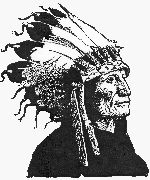
Daines continues to fight for reinstatement of the Redskins logo honoring John “Two Guns” White Calf but the team’s current owner, Josh Harris, is firm in his position abut not changing the team’s name back.
On Saturday, Mary Papenfuss included the following in an article she wrote for The Independent web site:
“The decision to change the name and mascot came after years of organizing from Native communities and allies, and billions of dollars from investors in the ‘Change The Name’ movement. Going back on this commitment should be a non-starter,” Angel Charley, executive director of IllumiNative, said in a statement.
One word jumped out at me when I read it, so I put it in boldface type so readers couldn’t miss it. I didn’t make this up. Activists spent billions, meaning not just millions but multiple billions, of dollars getting the Redskins name changed.
Three questions come quickly to mind:
IllumiNative.org, the website for Angel Charley, describes the organization thusly: “IllumiNative is a Native woman-led racial and social justice organization dedicated to increasing the visibility of—and challenging the narrative about—Native peoples.”
The 2023 Form 990 states the income that year as $2,126,490, coming almost entirely from two unnamed individuals. $5,000 came from a third unnamed individual. The 2023 return was for a partial year because the organization was formed in 2023. Obviously Angel Charley could not have been at this organization very long due to it’s having been in existence only a short time. She was with Coalition to Stop Violence Against Native Women the previous seven years. It was probably at her previous position where the billions of dollars were raised to get an NFL team to change its name and logo. But this doesn’t tell us where the money came from.
A September 7, 2023 article by Kerry J. Byrne of Fox News identified the likely source of the billions in funding. The National Congress of American Indians (NCAI) had lobbied for decades to erase the Redskins name for decades. He claimed they bragged about their work “fostering a proactive partnership” with the team. Could that mean threatening the team if they didn’t bend to NCAI’s wished?
But where did the NCAI get the billions in funding Angel Charley claimed had been spent in this campaign. One need look no further than George Soros and his Open Society Foundations. He has hundreds of billions of dollars available to use toward changing society in the way he wants. One recent example is the number of attorneys general and district attorneys he got elected by funding their campaigns. The result of that has been the crime waves experienced in the jurisdictions the electees control. Soros isn’t NCAI’s only funder. Their website lists seven federal government agencies and five tax-exempt foundations which give them taxpayers’ money.
We now know Angel Charley’s claim was probably accurate but what was the money spent on?
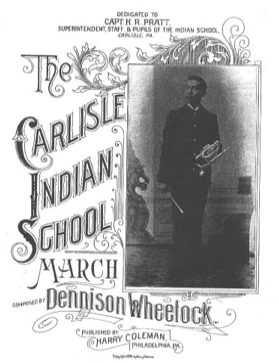
I was just informed that the Carlisle Town Band will be playing “Carlisle Indian School March” at their concert on Sunday. Several years ago, I found the sheet music for it in the National Archives. Unfortunately, Dennison Wheelock only provided a score for piano. Some years ago, I gave the sheet music to the band so their arranger could write the parts for the various band instruments. At long last the scoring has been finished and the Carlisle Town Band will be playing Wheelock’s march in a concert for the public.
Prior to this, all unmusical me was able to do was to input the piano score into MuseScore and get a synthesized piano output. You can play it by clicking on here. You may have to skip over an ad or two before it plays.
Earlier, I was able to get the Second Presbyterian Church choir to sing the Carlisle School Song, written by Pop Warner. To hear it click here.
I hope to get a recording of the fully instrumented version of Carlisle Indian School March.

 Tom Benjey's Weblog
