Archive for the ‘Single-Wing’ Category
December 5, 2008
Jim Sweeney, the life-long Army fan who told me about the Sports Illustrated article, shared with me that on Thanksgiving Day he was able to watch, on ESPN2 no less, two Jesuit high schools from New York City play each other in an 85-year long Thanksgiving tradition. Xavier High played Fordham Prep at Fordham Field in the Bronx. Sweeney’s (also JoePa’s) alma mater, Brooklyn Prep, was, until it closed in 1973, the third Jesuit high school in the City. You probably already know that Joe Paterno played tailback in Brooklyn Prep’s double-wing and that his brother, George, was fullback. Something few of us know is that both Xavier and Fordham Prep are NOW running the single-wing. What a treat it must have been for Jim to watch these teams in the comfort of his living room.
Another result of the Sports Illustrated article or the fact that NFL teams are dabbling with the single-wing is that I was interviewed yesterday by the local NBC affiliate about the connection between the Wildcat formation and Carlisle Indian School. After interviewing me, reporter George Lettis visited Carlisle Barracks and shot part of his piece on Indian Field. WGAL’s website has an article on its website that can be found at http://www.wgal.com/sports/18199527/detail.html. The broadcast video can be found at http://www.youtube.com/watch?v=iP9FogxDRII. In addition to footage of Lettis and me, portions of the documentary Tom McCue and I made to celebrate the 100th anniversary of the single-wing are included. Narrator Lynn Myers’ voice comes through loud and clear.
It will be interesting to see how long NFL coaches run the Wildcat or other versions of the single-wing before they admit that the fundamental formation was developed a century ago by Pop Warner for the Carlisle Indians. Some think that NFL coaches will continue to obfuscate this point so as not to appear to be behind the times by 100 years.
Tags:Brooklyn Prep, Fordham Prep, George Lettis, James Sweeney, Joe Paterno, Lynn Myers, Miami Dolphins, Sports Illustrated, Tom McCue, WGAL, Wildcat formation, Xavier High
Posted in Carlisle Indian School, Pop Warner, Single-Wing | 4 Comments »
December 2, 2008
The December 1 issue of Sports Illustrated has an article on the single-wing. The writer, Tim Layden, first discusses the formation’s current use at Apopka High 15 miles northwest of Orlando and in the NFL by the Dolphins in their unexpected victory over the unsuspecting New England Patriots. Also mentioned is Todd Bross, organizer of the annual spring conclave at Kings College in Wilkes-Barre, PA. (It was Todd Bross and Ted Seay who urged me to research Pop Warner’s correspondence course in football that was first published in 1908). Layden discussed the renaissance the single-wing is undergoing but was apparently unaware that little Windber Area High School is running it as he was probably unaware of my documentary in which they were featured.
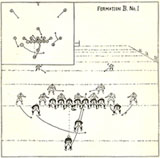
The article talks about viewing old films over Ed Racely’s garage on Cape Cod. Racely, now 80, has been studying the single-wing longer than anyone. Layden then goes into the single-wing’s history beginning with President Theodore Roosevelt’s 1905 threat to ban the game unless rule changes weren’t made to clean up the game. He goes on the mention that Pop Warner coached Carlisle Indian School from 1907 to 1914 and quotes Warner as having first used early incarnations of the single wing by the Carlisle Indians in response to the 1906 rule changes. He is apparently unaware of Pop’s earlier tenure at Carlisle (1899-1903) and of my research that uncovered Warner’s weeklong visit with the Carlisle coaches shortly before the start of the 1906 season. He made no mention of the revisions to Warner’s correspondence course between 1909 and 1911, nor did he mention my publication of the offense pamphlets from the correspondence course. The diagrams found those pamphlets represent the earliest known documentation of the single-wing. A 1924 newspaper interview of Warner was accompanied by a diagram of a formation that “The Old Fox” designed in 1902 to protect injured linemen Antonio Lubo, Martin Wheelock and Albert Exendine and to adjust for injured first-string center, Nikifer Schouchuk. It’s too bad that wingback diagram wasn’t made public a couple of decades earlier. The Sports Illustrated article can be found at:
http://vault.sportsillustrated.cnn.com/vault/article/magazine/MAG1149161/index.htm
Tags:Bill Belichick, Ed Racely, Miami Dolphins, New England Patriots, Nikifer Schouchuk, Sports Illustrated, Ted Seay, Tim Layden, Todd Bross, Wildcat formation, Windber
Posted in Albert Exendine, Antonio Lubo, Carlisle Indian School, Football, Martin Wheelock, Pop Warner, Single-Wing | 5 Comments »
August 18, 2008
Perhaps because this is the 100th anniversary of the 1908 Olympics, Ed Farnham, grandnephew of Frank Mt. Pleasant, has been deluged by the media for interviews. Numerous newspaper and television reporters in the Buffalo, NY area, where Ed lived and the Olympic athlete lived, have been calling Ed constantly. Some of the newspaper articles are available on-line. Links to them are provided at the bottom of this piece. So far, none of the TV video has been posted on-line, but if it is in the future, I will provide a link to it.
Although this media attention comes at a cost to Mr. Farnham, he probably views it as a good thing because Frank Mt. Pleasant, viewed at the time as the best all-around athlete of his day, has been largely forgotten. These interviews give Ed the opportunity to better educate the public regarding the Tuscarora people and their contributions. One of the ways he does that is to direct them to the Native American Museum of Art (NAMA) which is located inside Smokin’ Joe’s Trading Post where he is general manager. Frank Mt. Pleasant’s medals are on display amongst the other Native American art and artifacts. The recent publicity should encourage more people to visit the museum and learn more about both the track star and his people.
In my small way I’m trying to correct the slight to Frank Mt. Pleasant a bit. In addition to devoting a chapter in Doctors, Lawyers, Indian Chiefs to him, I have nominated him for induction into the local chapter of the Pennsylvania Sports Hall of Fame, the first step in getting him inducted into the statewide HoF. Dickinson College and Indiana University of Pennsylvania have already inducted him into their halls of fame.
Native American Museum at Smokin’ Joe’s: http://www.nativeamericanmuseumart.com/
Buffalo News article: http://www.buffalonews.com/cityregion/niagaracounty/story/411478.html
More about the museum: http://buffalo.yourhub.com/NiagaraFalls/Stories/Sports/Professional/Story~503924.aspx
Tags:1908 Olympics, Buffalo, Ed Farnham, Native American Museum of Art, Smokin' Joe's, Smokin' Joe's Trading Post, Tuscarora
Posted in Carlisle Indian School, Frank Mt. Pleasant, Single-Wing | 3 Comments »
July 4, 2008
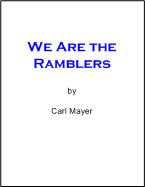
In 2006 while making a documentary on the single-wing formation I had the pleasure of visiting with the Windber Area High School football team because they are now running the single-wing – again. During the course of events I was made aware of a few parts of Windber’s storied history and, just before leaving town, met Carl Mayer who was then working on a history of Windber football. Last week I learned that his work is now available in book form and, while acquiring my copy, asked Carl for a physical description of the book because I haven’t seen it yet. In his words:
“The front and back covers of this soft cover book are in color, all photographs on the inside are black and white, just as you assumed. It is an 8.5 X 11 inch book with 304 pages. This book covers the history of Windber High School football from its beginning up to the 2007 season. Included are numerous stories pertaining to venues played and the role Camp Hamilton has played in its history. Team photographs are included from 1914 thru 2007 (Except for 1914, 1915, 1916, 1918, 1919, they could not be found) with these team photographs are records for that football year and starting line-ups. Also included are drawings and caricatures from the late 1950’s, each of which tell a story.”
If you are interested in knowing more about We Are the Ramblers, click on the book link at the right. BTW, Windber was the home of Johnny Weismiller but I don’t think he played football. Carl can set you straight if I’m wrong. He can be reached at fern1616@verizon.net.
Tags:Carl Mayer, DeMarco, Frank Kush, Ramblers, Weismiller, Windber
Posted in Football, Single-Wing | Leave a Comment »
June 23, 2008
This year marks the 250th anniversary of the building (perhaps hewing may be more accurate) of Forbes Road. The Seven Years War between France and Britain was raging around the globe. Pennsylvania found itself at the epicenter of the North American theater of what Americans generally call the French and Indian War. General Forbes set out from Carlisle in 1758 to take Fort Duquesne (present-day Pittsburgh) from the French. He followed Indian paths from Carlisle south along what is today Route 11 to Chambersburg and headed west along what later became Route 30. He widened and improved the crude existing roads and, beginning at Bedford hacked his way west to Pittsburgh. 157 years later, in 1915, Pop Warner likely followed the same route when he left Carlisle to take the reins at the University of Pittsburgh.
Warner took more than his belongings to Pitt; he also took his single- and double-wing offenses. But before football season started, he held a summer camp for his players at Camp Hamilton, a facility Pitt owned just outside the town of Windber. To get to Windber, Warner would have backtracked on Forbes Road past Ft. Ligonier and halfway to Bedford before heading north to Camp Hamilton. It was at Camp Hamilton that Pop schooled his new players in the intricacies of the single- and double-wing. Many Carlisle players headed west to Altoona and Pittsburgh to play for independent teams, but they would not have followed Forbes Road because they most likely traveled by train.
Camp Hamilton became an expensive luxury for Pitt during the Depression, so ownership of it passed to Windber Area School District. In 2003, after posting Windber’s 500th win, Coach Phil DeMarco was looking for something new. That something new turned out to be the single-wing. So, the single-wing returned to Camp Hamilton after a long absence, not so long, however, as Pop Warner’s absence from Pittsburgh. Windber ran the single-wing at Camp Hamilton back in the 1930s when they won two state championships with it by beating John Harris one year and Steelton another.
The 250th anniversary of Forbes Road celebrates more history than the victory of the British over the French, it also honors the opening of the Northwest Territory to settlement and other things that traveled along the road, wanted or not.
Tags:Camp Hamilton, Carlisle, Forbes Road, French and Indian War, Phil DeMarco, Seven Years War, Windber
Posted in Carlisle Indian School, Football, Pop Warner, Single-Wing | Leave a Comment »
May 27, 2008
The advance reading copies (called ARCs in the trade) arrived for my new book and are being sent out to reviewers. This is a big moment in a writer’s life: seeing thousands of hours of hard work turned into something tangible. In the old days (pre-computer), ARCs were called galleys, bound galleys or galley proofs. Authors, editors and publishers go over these babies with a fine-tooth comb looking for errors, typos or things that have changed since writing was complete. It is an impossible task because, after all this scrutiny, some typos escape and find their way into the final book. But we try.
Another important use of ARCs is to see how the photos and artwork come out in print. Overall they came out very well, better than expected. But a cartoon about the Oorang Indians from a 1922 Baltimore newspaper is too dim. The challenge now is to figure out how to darken it without losing the detail.
This weekend I received some additional information and a correction regarding Louis Island from a family member who happened to see a previous blog. That was fortuitous because I want the book to be as accurate as possible. This blog is already proving to be of some value. That encourages me to continue with it.
Having these ARCs provides local booksellers the opportunity to provide their customers something extra. People can look at an ARC and pre-order the book if they choose. The bonus, besides being sure of getting a copy of the book as soon as it comes out, is to receive an inscription of his or her choice signed by the author. On-line booksellers also take pre-orders but personalized inscriptions are impractical.

Tags:Add new tag, ARC, biography, book, galleys, Louis Island
Posted in Albert Exendine, Alex Arcasa, Antonio Lubo, Archie Libby, Arthur Sheldon, Bemus Pierce, Benjamin Caswell, Caleb Sickles, Carlisle Indian School, Charles Guyon, Charles Williams, Dickinson College, Doctors, Lawyers, Indian Chiefs, Ed Rogers, Elmer Busch, Emil Hauser, Football, Frank Cayou, Frank Hudson, Frank Mt. Pleasant, Fred Broker, George May, George Tibbits, George Vedernack, Gus Welch, Hawley Pierce, Henry Broker, Hugh Wheelock, Isaac Seneca, James Johnson, James Phillips, Jim Thorpe, Joe Bergie, Joe Guyon, Joe Libby, Joel Wheelock, John B. Flinchum, Leon Boutwell, Lone Star Dietz, Louis Island, Martin Wheelock, Nicholas Bowen, Nick Lassa, Pete Calac, Pete Hauser, Pop Warner, Sampson Bird, Single-Wing, Stacy Matlock, Stancil Powell, Thomas St. Germain, Victor Kelly, Washington Redskins, Washington State University, Wauseka, William Baine, William Gardner, William Garlow, William Newashe | Leave a Comment »
May 9, 2008
I have become aware that a historically significant letter written by Pop Warner is up for sale on an Internet site: http://www.historyforsale.com/html/prodetails.asp?documentid=227287&start=2&page=48
The letter was written on October 8, 1951 on Warner’s personal stationery as he was retired by that time and living in Palo Alto, California, where he had earlier coached Stanford University. The letter to Col. Alexander M. “Babe” Weyand contains Warner’s recollections as to when he invented various things and his opinions as to which Carlisle victories were the most significant.
This letter is important because it helps clarify issues currently being debated, some of which I am to blame for raising the issue. Due to Alison Danzig’s writing it had long been thought that Warner had developed the single- and double-wing formations later than Warner states in this letter. I based my 2006 documentary celebrating the centennial of the birth of modern football on statements Warner made in his landmark 1927 book on football and some other sources. This letter supports my position. In their recent books on Jim Thorpe, Sally Jenkins and Lars Anderson generally support the position that Carlisle pioneered modern football when the rules changed drastically in 1906. But Warner’s letter partially debunks their positions that the double-wingback was first unleashed against Army in 1912. He also lists what he considered Carlisle’s most important victories. The 1912 Army game was not among them. More on that in a future post.
The question I have is: why is this important letter up for sale and not in an archive? Two repositories come quickly to mind; Cumberland County Historical Society (CCHS) or West Point – CCHS because it holds numerous records and artifacts from the Carlisle Indian School and West Point because it holds Weyand’s papers. I don’t know if West Point buys papers for its collection but CCHS certainly does. It recently purchased 28 letters written by Jim Thorpe in the 1920s that had nothing to do with Carlisle. The asking price for the Warner letter is about twice what CCHS paid for each of the Thorpe letters. One of the reasons historical documents are so expensive is that there are autograph collectors who are willing to pay large sums just for signatures of famous people. But Warner’s letter to Weyand is valuable for the information it contains.
Tags:Alexander Weyand, Alison Danzig, Army, Cumberland County Historical Society, double-wing, Lars Lars Anderson, Sally Jenkins, West Point
Posted in Carlisle Indian School, Football, Jim Thorpe, Pop Warner, Single-Wing | 2 Comments »
May 5, 2008
The best part of doing this research is the people you meet. The most recent are Iris Davis and Dick Boganwright. Driving back from a wedding in Madison, Wisconsin brought us near Mentone, Indiana where Iris and Dick live. Iris has a photo of their uncle, Louis Island, in his WWI uniform. The photo is mounted in an oval frame with curved glass, something that makes scanning difficult. Taking a photo of a photo that is under glass presents problems of its own, but they were dealt with. By now you may be wondering why I’m babbling on about this.
Louis Island played quarterback, mostly backup, at Carlisle and eventually became a star in the early pro game. He eventually settled in Fort Wayne, Indiana and married Phebe Harsh, who was raised on a farm near Mentone, which is not far from Fort Wayne. Iris Davis and Dick Boganwright’s mother was one of Phebe’s sisters. Iris and Dick remember Dr. Island from family gatherings when they were children. They also remember when he contracted tuberculosis and died. They also remember when his son died from what they thought might have been muscular dystrophy. Dick and Iris recalled that Louis had a grandson who was left the area with his mother when he was a child.
Meeting relatives of Carlisle players is always a pleasure. Sometimes people are surprised to learn that their grandfather or uncle was famous at one time or was a great athlete because their memories of him are often of an old man. The telephone conversations that preceded the visit got them thinking about their uncle and they later remembered things about him that they had forgotten long ago. The visit gave me the opportunity to share with them what I had learned about their uncle.
Tags:Haskell Institute, Louis Island; Fort Wayne Friars
Posted in Carlisle Indian School, Football, Louis Island, Single-Wing | Leave a Comment »
April 1, 2008
At long last an oversight or, as many view it, a snubbing is being corrected. Lone Star Dietz should have been inducted into the College Football Hall of Fame decades ago but hasn’t been. Some view this as just another example of Indians being abused by white men. Dietz has been inducted into a number of halls of fame including the prestigious Helms Athletic Foundation Hall of Fame back in the 1970s. His role in establishing the New Year’s Day football tradition, most notably the Rose Bowl, is reason enough to induct him. But that’s not all. His won-loss record qualifies him for induction and that’s saying something. Lone Star Dietz did not nestle into a successful program and ride that horse for decades; he undertook a number of reconstruction efforts and turned programs around. On the few occasions he couldn’t turn a perpetual loser into a winner, he got the student body excited.
So, why hasn’t he been inducted? Until a few years ago the Hall had his record wrong and didn’t consider him qualified. Now that the record has been corrected he is eligible and his name has been on the ballot. A couple of years ago he came close but while the ballots were being counted, the Honors Committee (now that’s a dubious name) decided they wanted to induct Joe Paterno and Bobby Bowden. There was one hitch: Paterno and Bowden’s names weren’t on the ballot because, as active coaches, they weren’t eligible. That problem was easily dealt with. All they had to do was to change the rules in midstream. Presto! Paterno and Bowden were eligible and the men whose names were actually on the ballot were forgotten. Sorry, Lone Star.
But this year he’s getting a fair shake and is belatedly being inducted. Perhaps this will lift the Lone Star Curse from Washington State.
April Fool!
Tags:Hall of Fame
Posted in Lone Star Dietz, Single-Wing, Washington Redskins, Washington State University | Leave a Comment »
March 28, 2008
Yesterday I came across a December 8, 2007 article in The News Tribune out of Tacoma, Washington. In it reporter Todd Miles wrote, “Not since 1917 have the Washington State Cougars had a minority head coach in football.” Putting aside the fact that Washington State’s teams weren’t called the Cougars in 1917, the statement is still incorrect. Yes, Lone Star Dietz coached the 1918 Mare Island Marine team that was featured in WSC’s yearbook because ten players were from WSC. And, although Dietz considered it Washington State’s second Rose Bowl team, it didn’t wear crimson and gray. The major error is that not one but two minority coaches were overlooked. This is why we study history.
When Dietz was unceremoniously dumped in early 1919, WSC wanted another coach who was steeped in the Warner system because Dietz had been wildly successful with it. So, the administration looked for someone with experience, not just with the single and double-wing formations but with the whole system. Recall that Ace Clark thought that the way Lone Star conditioned his players and reduced the amount of scrimmaging left them in better shape for the games. Albert Exendine was a logical choice but he was under contract at Georgetown. Eventually Gus Welch was tracked down on a former battlefield in France and recruited for the job.
Gus Welch was Chippewa from Wisconsin and Al Exendine was Delaware and Cherokee from Oklahoma, but they have a lot of similarities. Both attended Carlisle Indian School and starred on its teams, Exendine at end and Welch at quarterback (blocking back in Warner’s single-wing). Both got their law degrees from Dickinson School of Law (now part of Penn State) across town from the Indian school. Both had long careers of coaching football in the fall and practicing law the rest of the year. Both were inducted into the College Football Hall of Fame as players. And both coached Washington State. Welch led the team from 1919 through 1922 and Exendine took over in 1923, lasting through the 1925 season. Each has a chapter devoted to him in Doctors, Lawyers, Indian Chiefs.
So, Washington State has a history of hiring minority head football coaches, just not lately.
Tags:Ace Clark, Dickinson School of Law, Mare Island Marines, Penn State, Rose Bowl
Posted in Albert Exendine, Carlisle Indian School, Football, Gus Welch, Lone Star Dietz, Pop Warner, Single-Wing, Washington State University | Leave a Comment »





 Tom Benjey's Weblog
