Archive for the ‘Pop Warner’ Category

John Two Guns White Calf

February 8, 2024

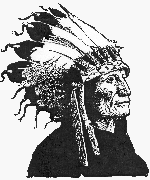
Kerry Byrnes has written a most interesting article about how John Two Guns White Calf, whose image adorned Washington Redskins helmets and logos starting in 1972 before being canceled in 2020. The entire article can be found here:

https://www.msn.com/en-us/news/us/canceled-tribal-chief-white-calf-face-of-the-redskins-generates-new-support-nationwide/ar-BB1hQwhC

One thing I learned was that NCAI, the organization that got the Redskins name canceled, is funded by George Soros. Soros is the person who funded numerous candidates for Attorney General and District Attorney offices. Those people are the ones who have created havoc in their cities and states by refusing to charge criminals with serious crimes and to release them without bail if they get arrested.

I enjoyed reading Byrnes’ article because, on the whole, it is accurate where most pieces on the Redskins or Carlisle Indian School are not. However, one sentence is incorrect: “The franchise changed its name to the Boston Redskins as a tribute to their hosts and to maintain their Tammany identity and uniforms.” This error regarding the uniforms was previously promulgated in a Boston newspaper (the Globe if I recall correctly) in an attempt to smear owner George Preston Marshall for being cheap.

The 1932 Boston Braves wore plain blue jerseys with gold numerals. The 1933 Boston Redskins sported maroon uniforms with an Indian head on the front with gold stripes on the collar and wrists. Because the new team colors were so similar to those of Carlisle Indian School (red and old gold) and that Head Coach Lone Star Dietz was also an artist, he may have designed the new uniforms. He borrowed the idea of putting an Indian head on the front of the jerseys from the Chicago Blackhawks ice hockey team. He probably used the same Tammany image as had been used on the Braves letterhead (but not on their uniforms). The Redskins were forced to wear the old Braves uniforms the first week of the season because their new ones hadn’t arrived yet.

Discount on Gridiron Gypsies

February 4, 2024

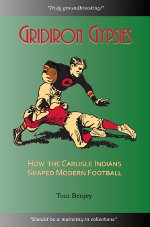
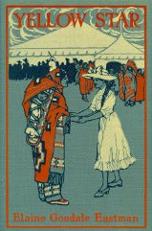
One of the printers that print my books now offers the ability to purchase books they print directly from them rather that from the publisher or a reseller. The advantage to the buyer is that books can be bought at a discount and with a reduced shipping charge. The disadvantage is that personal inscriptions aren’t available. As an experiment, Gridiron Gypsies has been enrolled in this program. To order a book this way, either take a photo of the QR Code above with your cellphone camera and follow the link or click on the book cover below.

Either way, Gridiron Gypsies only costs $19.79 plus $3.00 shipping.

Disinformation About Jim Thorpe (revised)

January 26, 2024

University of Oklahoma Press has announced the upcoming release of the updated edition of Robert W. Wheeler’s definitive biography Jim Thorpe: World’s Greatest Athlete. Written a half century ago, Wheeler has much to add to the story of Jim Thorpe’s legacy since he and his wife, Florence Ridlon, have worked tirelessly for decades to get the Olympic medals and records restored. More information can be found at: https://www.oupress.com/9780806194240/jim-thorpe/

While we’re thinking about Jim Thorpe I want to focus on an article published by James Best of NBC Sports that get about everything about him wrong. https://www.nbcsportschicago.com/nfl/chicago-bears/a-look-at-the-history-of-jim-thorpe-and-native-americans-in-football/186374/

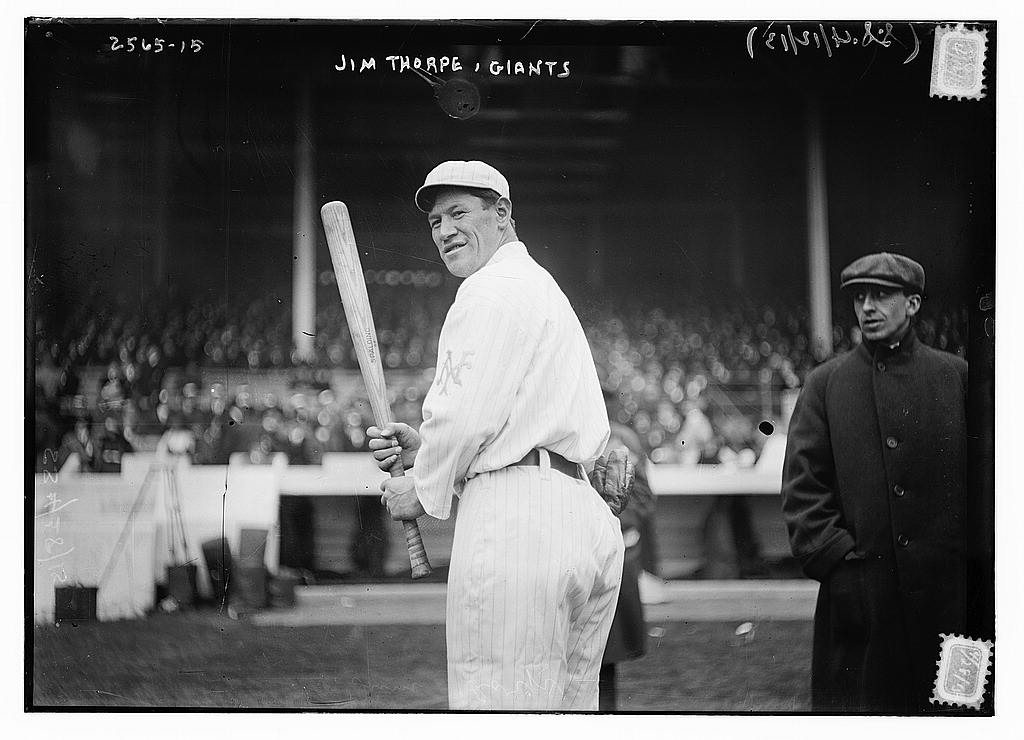
Under the headline Who was the first Native American football player? Best states, “Thorpe was the first Native American to play in the NFL.” If he had glanced at the team roster or a game program he would have noticed that two of Thorpe’s backfield partners were former Carlisle Indian School teammates, Pete Calac and Joe Guyon. Thorpe was late to the professional game relative to other Carlisle players when he joined the Canton Bulldogs in 1915. In fact, it was old Carlisle end William Gardner who Jack Cusack sent to Bloomington Indiana to recruit Thorpe to play for the Bulldogs. An accurate statement would have been that Jim Thorpe was the first Pete Rozelle for the fledgling NFL.

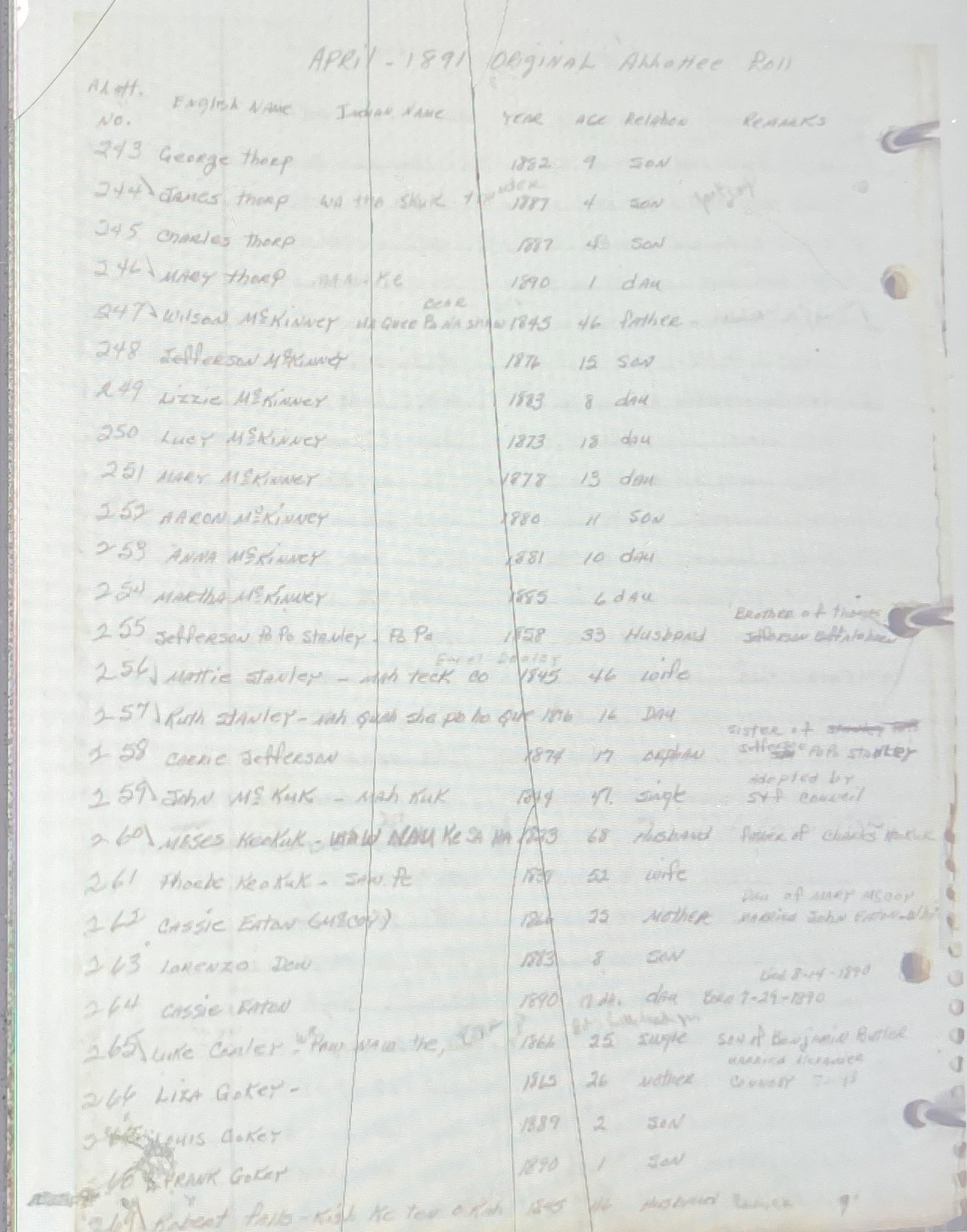
Best’s next sentence began, “Thorpe was born in 1888….” Like many of his contemporaries, Jim Thorpe’s date of birth isn’t known definitively. Yes, he gave 1988 for the year of his birth on his WWII draft papers. Carlisle’s records suggest that he was born in 1887. It is possible he shaved a year off his age to make him appear to be more attractive to the military. His actual birth date won’t likely ever be known. After I first published this, I learned that a Sac and Fox researcher had discovered the tribe’s original 1891 allotment records. It shows that Jim and his twin brother Charley were born in 1887. This is the earliest document discovered so far that lists Jim’s year of birth. The 1892 tribal roll available on Ancestry.com lists their ages as five. That would make their years of birth 1887.

The next sentence states that he attended Carlisle Indian Industrial School in 1907. It would have been clearer if Mr. Best had done a little research and noted that Thorpe arrived at Carlisle in 1904 but his athletic talents hadn’t developed to the point of beating Carlisle track stars until 1907.

Best’s next paragraph begins, “Thorpe decided to try football in 1911….” He neglected to mention that Thorpe cajoled Pop Warned into putting him on the football team in 1907. He mostly rode the bench that year as he learned the game by watching experienced players. The next year he was a starter and performed so well Walter Camp named him to his All-American Third Team for 1908.

Best was correct as far as he went in stating Thorpe “helped Carlisle beat some of the best teams in the nation like Army, Harvard, Syracuse, Pittsburgh and Nebraska.” Carlisle players considered everything about Harvard to be the best and held great post-game celebrations in the evenings after the 1907 and 1911 victories over Harvard. They always enjoyed beating Army but the loved beating the Johnny Harvard. Pop Warner savored the wins over Amos Alonzo Stagg’s 1907 Chicago team and Dartmouth’s 1913 squad, games in which Thorpe wasn’t a factor, more than the others. He considered the 1907 and 1911 squads to be his best at Carlisle.

A later paragraph began, “After completing his final collegiate season, Thorpe participated in the 1912 Olympic Games…” If the author of this article had possessed a calendar, he would have known that the Olympic Games, which were competed in the summer, were over before the start of football season in the fall.

That’s enough for today. I suggest that readers find other sources for information about Jim Thorpe rather than NBC Sports. Wheeler’s book would be my first choice.

Turn Every Page

October 6, 2023

The famous biographer of Robert Moses and LBJ, Robert Caro, tells of an admonition the cigar-chewing editor on his first job as a reporter told him, “You’ve got to turn every page, kid.” In another land-use battle into which I’d gotten myself embroiled, Caro’s admonition proved true once more. A neighbor uncovered an important detail I had missed. I had gone through all of the township’s ordinances I thought pertinent at the conditional-use phase but the neighbor went a step further and perused the ordinances for a later phase, subdivision and land development (SALDO). In them was a tiny nugget crucial to our case. Some might consider this akin to finding a needle in a haystack, a very sharp needle.

The ordinance he found dealt with the maximum impervious coverage allowed in a wellhead protection zone. The limit varied depending on the underlying zone. The land on which the commercial soccer complex was to be built was zoned agricultural conservation (AC), which normally allowed 25% impervious coverage. However, when a wellhead protection zone overlays an AC zone, the maximum allowable impervious coverage is only 15%.

When our attorney informed the soccer club that their plan, which called for 25% impervious coverage, would fail getting approval, the club withdrew their plan and investigated another, more suitable location. To conform to the ordinance at the original site, the plan would had to be scaled down to fewer artificial turf fields than the soccer club wanted. Turning every page saved the community from an ill-designed facility.

Caro also recommended visiting the important places in a subject’s life. He used sticking his fingers in the thin layer of topsoil at LBJ Ranch to discover the reason LBJ’s father went broke trying to farm that land. Last year I was asked to comment on the most recent book on Jim Thorpe because of my work researching the Carlisle Indian School football program and its players. This book got a lot of hype because it was written by a Pulitzer Prize winner, but that didn’t mean it didn’t have serious errors of the type Caro admonished writers to avoid. Two of the most egregious errors in the book have to do with Carlisle itself and the parade held in Thorpe’s honor after the 1912 Olympics.

During a Q & A session at a talk he gave at the local library, I asked Mr. Maraniss about Caro’s recommendation to visit the site. He claimed that, because he conducted his research during COVID, he didn’t visit Carlisle. That excuse seemed lame to me because the COVID lockdown was over months before his book was released. Had he visited Carlisle, one assumes he would not have described Carlisle Barracks as being on a hill outside the city of Carlisle. Locals laugh when they hear this because Carlisle Barracks is not on a hill and no one ever considered Carlisle to be a city.

His second egregious error, regurgitating an erroneous newspaper account of the parade following the 1912 Olympics, may not have been made had he actually driven around the center of town. That article placed the train station at the square opposite the James Wilson Hotel. The station was across from the Jimmy Wilson, as locals call it, but neither were at the square. The routing of the parade as described in that article made no sense. Anyone familiar with the town’s layout spots that immediately. Had Maraniss turned every page, he would have found an article in a different newspaper that described the event in such detail that he must have known Thorpe was going to get off the train at the junction at the eastern edge of town to avoid the crush at the square and to give him time to visit with friends and officials at the Indian School before joining the parade.

I doubt if Caro’s recommendations would have stopped Maraniss of claiming that Carlisle had beaten Princeton because they never did. In six tries against the Tigers, Carlisle scored only once and that was in the 1896 game. Warner complained that certain teams stopped playing the Indians after they became a good team. However, Princeton gave Carlisle its only loss in 1907, Thorpe’s first year on the squad, and stopped playing them after 1910, just in time to avoid Thorpe’s return and the return of strong teams.

Which Was Best, 1911 or 1912

September 12, 2023

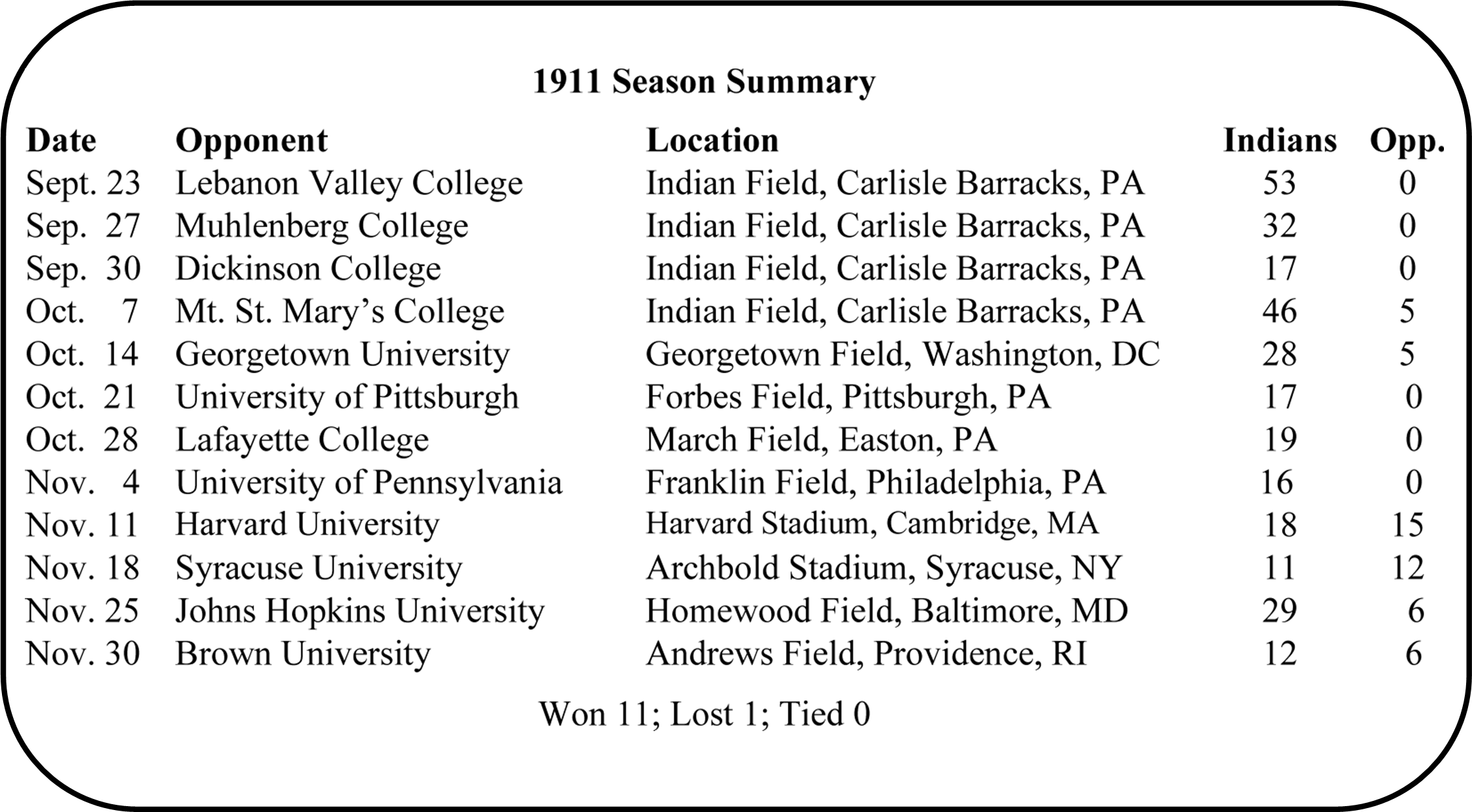
I was recently asked what I thought was the stronger Carlisle team, 1911 or 1912. That is a question that has been raised several times. Let’s start by looking at schedules and results first. The 1911 team went 11-1-0, missing an unbeaten season by a single-point loss to what Warner considered an inferior Syracuse team. They beat two of the Big Four, Penn and Harvard, for only the second time in the team’s history. The Indians scored 298 points while giving up 49. Six teams were shut out, including Pitt, Penn, and Lafayette.

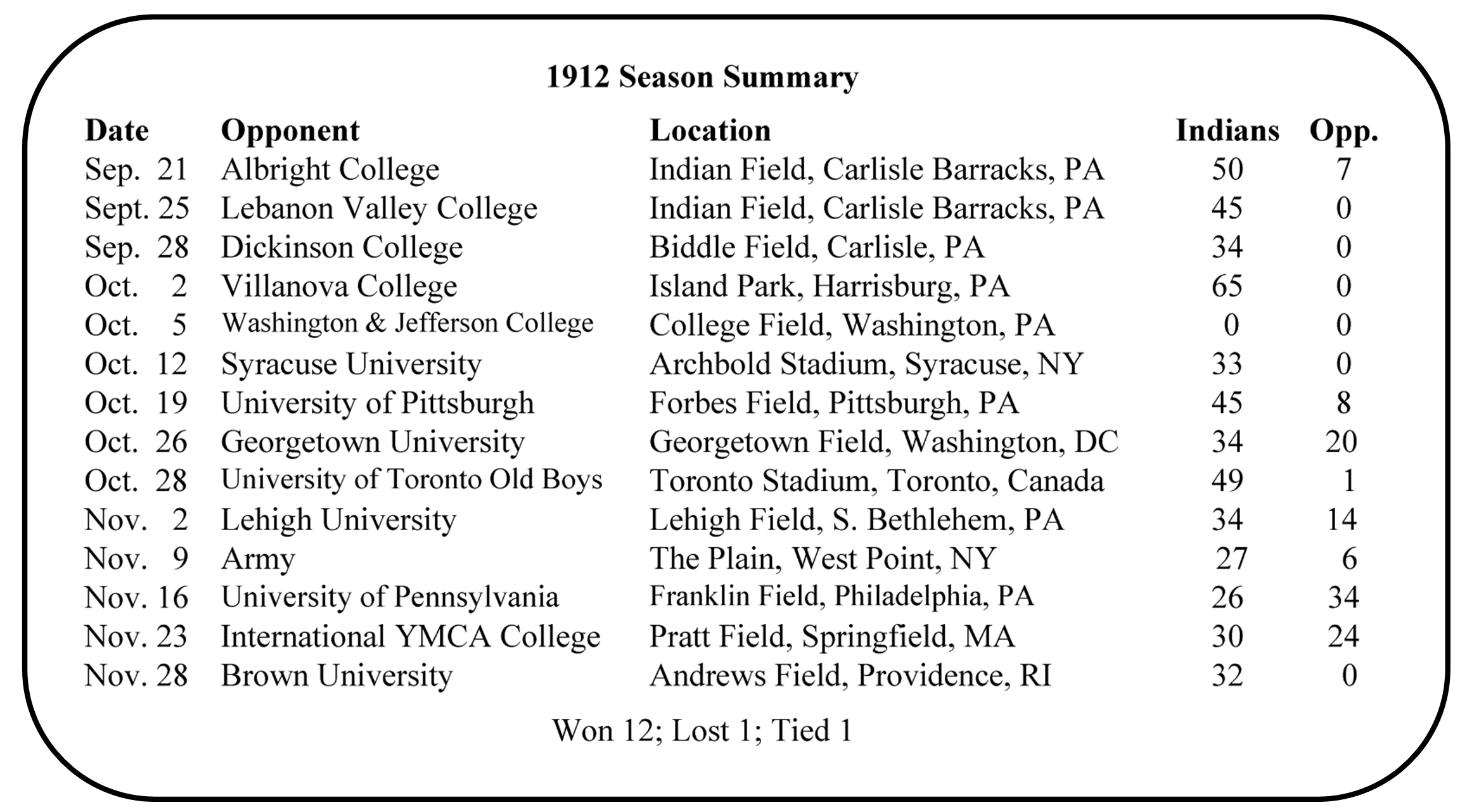
For 1912, like Steckbeck before me, I credited Carlisle with a 12-1-1 record. They shut out five teams where the 1911 version blanked six opponents. They only played one of the Big Four, Penn, and lost to the Quakers. For comparison purposes, I would eliminate the 49-1 game with the University of Toronto Old Boys because the opponent was a rugby team whose players had never played American football. Other Carlisle opponents, even the weakest, knew the rules and had played the game for some years. Dropping the Toronto game reduces Carlisle’s 1912 results to 11-1-1. Eliminating points from the Toronto game from Carlisle’s record leaves the 1912 team with 455 points scored and 113 points given up for the season.

Computing the ratio between points scored over points allowed gives the 1912 team 4.03 points scored for each point given up. The 1911 team’s ratio was 6.08 points scored per point allowed. While the 1912 version was a scoring machine, its defense gave up more than twice as many points, 113 as the 1911 squad did, 49.

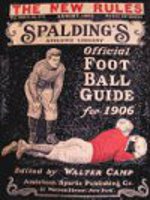
In the 1912 Spalding’s Guide, George Orton of Penn wrote of the 1911 Indians, “…whatever inferiority they may have shown in defensive work, they more than made up by the much greater brilliancy, variety, and power of their offense.”

When evaluating the 1912 team Orton wrote, “…defensively they were not strictly first class.”

Something to keep in mind when reading about eastern teams in the Spalding’s Guides is that articles discussing those teams were written by representatives of IVY League schools who were biased toward those institutions’ teams. They never considered strength of schedule or the fact Carlisle played all its major games away from home.

The 1912 tie, which 1911 didn’t have, was a scoreless affair with Washington & Jefferson. This would be a mark against the 1912 squad. Now, let’s compare the teams’ losses. Warner, through the school newspaper, blamed the one-point loss to Syracuse on a sloppy field to “Poor generalship, poor kicking, and numerous penalties for offside play and holding” and “Thorpe’s kicking and playing in general was disappointing.” Thorpe missed an extra point that would have tied the game.

The 34-26 1912 loss to Penn was due to “the careless work of Carlisle’s backfield, their mistakes on signals, their fumbles, and their failure to intercept forward passes over the goal line, together with a fumbled punt, practically gave their opponents every score they made and enabled Pennsylvania to score 34 points with very little effort on their part.”

Both losses were bad but the one to Penn was worse. Carlisle couldn’t blame its poor play on a muddy field this time.

While researching this article, I discovered an error in Gridiron Gypsies. The season summary table for 1912 did not include the 33-0 victory over Syracuse. It was covered in the text but not in the table. A correction has been sent to the printer but who knows when corrected books will be printed. The corrected table follows.

A Likely Outcome

August 29, 2023

Two posts ago I opined that, had Jim Thorpe not left Carlisle in 1909 to play summer baseball and instead returned to school, he would have had a good chance of receiving tutelage as a minor league baseball player. I need to revise this conjecture and not just because he had tried out unsuccessfully for the 1908 Olympic games.

Had Thorpe returned to Carlisle for the 1909 fall term, he would have likely had another good season, his third year of eligibility for football, improving the Carlisle team’s 8-3-1 record. He might even have made Walter Camp’s Second Team. If he ran track in spring 1910, he would have used up his four years of eligibility and there were no Olympic tryouts that summer or the next. His track career would probably have come to an end because no economic opportunities existed for track and field at that time. Had he played football in the fall of 1910, he would surely have improved on Carlisle’s 8-6 record and might have made Camp’s All-America First Team, but he wouldn’t have been as dominating as he was in 1911 and 1912 because his body wouldn’t have the extra year of growth it had when he returned in 1911.

Jim would have used up all his college football and track eligibility by the end of 1910. With football not having a professional league yet, only semi-pro teams existed at the time. The irregular and unreliable income from semi-pro football would not have been enough to support him. His only likely professional athletic opportunity at that time would have been minor league baseball. He had already tried that route. While it’s impossible to know if the 1911 baseball season would have worked out better this way than it already did. Perhaps a better team in a more stable league would have picked him up. But, with two summers already under his belt, the team that signed him that summer was in a league that was insolvent, resulting in Jim being out of a job and back in Oklahoma with no good options on the horizon.

Returning to Carlisle would not have been an option because all his eligibility had been used up. Other schools would have been reluctant to enroll him because of the reactions to Frank Mt. Pleasant playing for Dickinson College in 1908 after having played for Carlisle. Some schools refused to play Dickinson if Mt. Pleasant was on the field. The four-years-of-eligibility rule was being enforced.

Had Jim returned to Carlisle after the 1909 summer, he would likely have had fewer options in 1911 than he had after not returning in 1909. Ranching would have been a good outcome for him.

Assumptions

August 25, 2023

Everyone knows what happens when one assumes something, so I don’t need to repeat the rest of that saying. In my last blog post I assumed Jim Thorpe had not tried out for the 1908 Olympic team and was quickly corrected by a couple of readers. Since I hadn’t bothered to look into Thorpe’s possible competing in the 1908 games, it was a good time to do a little research.

Carlisle’s 1908 track competitions started on April 25 with Penn’s Relay Carnival, as it was referred to at that time. The best track and field men across the country competed at this event. Pop Warner sent several members of his squad but the relay team and Thorpe was the only ones to medal. The relay team came in third in “Event No. 22” and Jim tied for first in the high jump with “Long John” Miller of Indiana University by clearing 6’1”. Thorpe was awarded first place by winning the coin toss.

The May 9 dual meet with State College must not have taken place. Both schools’ newspapers announced it preceding the event, but neither published the results. And no coverage was found in regular newspapers. Perhaps weather conditions caused it to be canceled. Next up was a May 14 dual meet with Syracuse at Elmira, New York. Steady rain and chilling temperatures prevented record times from being posted. Frank Mt. Pleasant, who was training for the Olympic tryouts, didn’t participate but Jim Thorpe did well scoring 21 of the winning team’s points. He won the 120-yard hurdles, 220-yard hurdles, and running high jump, while place second in the shot put and broad jump.

On May 23, Carlisle hosted a three-way meet against Swarthmore College and Dickinson College, producing a resounding victory for the Indians. Thorpe broke school records while coming in second in the shot put and winning the 220-yard hurdles. He also won the high jump and broad jump but came in third in the 120-yard high hurdles.

Carlisle last meet of the season was for the 1st Annual State Intercollegiate Championship in front of 8,000 spectators at Harrisburg on May 30. The Indians won the meet with a 17 ½ point margin over second-place finisher Lafayette. Pitt, Penn State, Swarthmore, Dickinson, Lehigh, Washington & Jefferson, and Gettysburg each scored at least one point in the meet. Jim won the high jump with a jump of 6’0”. He came in second in the 220-yard hurdles and the 16-pound shotput. Carlisle’s season was over but Thorpe’s wasn’t.

Pop Warner brought Jim Thorpe, Frank Mt. Pleasant, Lewis Tewanima, John Corn, and Walter Hunt back to Franklin Field, the site of the Penn Relays, for the Olympic tryouts. Mt. Pleasant came in second, ¼ inch behind the first place finisher in the broad jump. Thorpe didn’t place in either the high jump or broad jump. Tewanima came in third in the 5-mile run but Corn and Hunt didn’t place in that event. Only Mt. Pleasant was initially selected for the team. Tewanima was added to the supplemental list later. Thorpe reputedly spent the summer in Oklahoma.

What Might Have Been

August 19, 2023

While discussing an article I had written about the 1908 Carlisle Indian School football team, the editor of the journal that is going to publish it in the spring asked about Jim Thorpe’s contributions. 1908 was Thorpe’s second year on the football team, the first as a starter. He played well and Walter Camp selected him for his All-America Third Team. The 1908 team wasn’t nearly as good as the 1907 squad, the best Carlisle had fielded to that point, having defeated both Harvard and Penn.

Jim Thorpe left Carlisle after the spring 1909 track season to play summer baseball in the Carolinas. He didn’t return to Carlisle as a student or athlete the next two school years. When Albert Exendine ran into Thorpe in Anadarko, Oklahoma during the summer of 1911, he saw a different person than the skinny kid he had tutored for track events. Jim had left as a boy but would return with the muscular physique of an adult man.

What Thorpe accomplished in 1911 and 1912 on the football field, in track and field, and in the Olympics is well known. When thinking about this, it dawned on me that had Thorpe returned to Carlisle at the end of summer 1909 and continued competing for Carlisle, he would not likely have accomplished what he did when he returned two years later. The additional size and strength he had gained helped him immensely in both football and track.

The 1908 Olympics were held after the end of a successful 1908 track season but Jim wasn’t encouraged to try out for the team. Two other Carlislians were on America’s 1908 squad, Lewis Tewanima and Frank Mt. Pleasant. So, Warner was well aware a team representing the country was being assembled but, as much as he valued Thorpe on his team, he apparently didn’t consider Jim ready to compete internationally.

Thorpe would have likely had another good year playing football in 1909, maybe even making Walter Camp’s Second Team. He would have used up his four years of eligibility in track in spring 1910 and for football in that fall. He might have even made Camp’s First Team but he wouldn’t likely have been as dominating as he was in 1911 and 1912, years he wouldn’t have competed in had he not taken the two-year hiatus. His only likely professional athletic opportunity would have been minor league baseball. Had he taken that route, he could have received the tutelage he needed to develop into a complete major league player.

Filled out, Warner encouraged Jim to try out for the 1912 Olympics and trained him for the games. The adult Jim Thorpe had the size and strength to run roughshod over the best football players in the country and to top the best cindermen in a grueling variety of events. Had he returned to Carlisle after playing summer baseball in 1909, he would not likely have been a two-time Walter Camp First Team All-American or gold medal winner in either the pentathlon or decathlon at the 1912 Summer Games. He may not have even tried out for the team.

Rather than harming Jim, playing summer baseball ultimately led to him achieving things few others have been able to do. He is still considered the finest all-around athlete the world has ever produced. The skinny kid could not have won the gold medals but he might have ultimately had a long, successful baseball career.

Single Wing vs T-formation

August 9, 2023

The August 2023 edition of the College Football Historical Society journal includes a most interesting article and I’m not just saying that because it also includes one of mine. The piece I’m talking about has to do with the College All-Star Game of 1948. For those not old enough to remember these games, a group of the top college players played against the reigning NFL champion in Chicago before the start of the year’s football season. The coach of the AP mythical national champions led the collegians. This year it was Notre Dame’s Frank Leahy. This series ran from 1934 through 1974.

The pros were represented by the Chicago Cardinals, a team that seldom earned this honor. More unusual were the numbers of Notre Dame and Michigan players on the college roster: fourteen Irish and eight Wolverines. In those days, the single-wing reigned in Ann Arbor where the T-formation ruled in South Bend. Aficionados of each system extolled the virtues of their offense of choice. Leahy, a T-formation man, saw his chance to prove which was the better approach with so many highly skilled players of each system on his roster.

So, he split his team into two squads based on which formation they were accustomed to running. Thirty-three single wingers and twenty-nine from T-formation schools. He assigned assistants—his assistants for the game were head coaches from other schools—familiar with the single wing to coach that squad while he and assistants who used the T-formation coached the other one. He told the players he hadn’t decided which scheme to use in the big game against the pros and would have the squads play each other to determine which system he would use in the big game.

The contest was held on August 14, 1948 in front of a crowd of 23,450 wildly cheering fans at Northwestern’s Dyche Stadium. To find out what happened that day and six days later when the college boys went against the Cardinals in front of 101,220 spectators at Soldier Field, you’ll have to get your hands on the journal. To receive your own copy, email rayscfhs@msn.com or write:

  • Ray Schmidt
  • PO Box 6460
  • Ventura, CA 93006

Honoring Joe Bergie

April 26, 2023

I previously mentioned receiving communications from descendants of the Carlisle Indians. This week an email came from Joe Bergie’s oldest surviving granddaughter discussing his induction into the Montana American Indian Athletic Hall of Fame in 2020. Because of Covid, like many other things, his enshrinement was delayed until 2021. She credited her cousin, Carol Gilham, with doing the considerable amount of work necessary to get a star athlete who played his last game a century ago recognized.

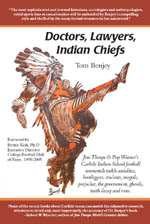
Joe Bergie was not a minor football player at Carlisle, an entire chapter of Doctors, Lawyers, Indian Chiefs is devoted to him. Space doesn’t permit including all of that here. I’ll just hit the high spots. Joe arrived at Carlisle in 1910 and played on the scrubs as he learned the rudiments of the game. He played center, an important position for teams employing the single- and double-wing formations, on the great 1911 and 1912 teams. He excelled at defense and carried the ball well when given the opportunity at fullback. Pop Warner considered him to be the greatest center to ever don a Carlisle uniform. In the spring, he also starred at lacrosse when it replaced baseball at Carlisle.

After leaving Carlisle, Joe played on several pre-NFL semi-pro teams, even serving as the coach while playing for one of them. World War I, in which he served in the Army and was shipped overseas, where he remained until January of 1919. After his discharge, a hand injury ended both his football career and his brief turn as a professional wrestler.

Author’s note. A guy in my outfit in the service was named Bergie. We pronounced it Bergee. Recently, I was informed the proper pronunciation is Berjee.

Joe Bergie in Carlisle Indian School football uniform.