Archive for the ‘NFL’ Category

Leon Boutwell Got Drafted

December 19, 2025

While research Keewatin Academy, I stumbled across a mention of Leon Boutwell as having been drafted during WWI. Seeing that reminded me of the statement I’ve both seen and heard lately that Indians weren’t made citizens until 1924. How then could a non-citizen Chippewa Indian like Leon Boutwell be drafted?

The short answer is that Boutwell was a citizen as were many Indians, but how did he become a citizen? There were multiple ways for Indians to become citizens as listed by Wikipedia below:

Key Pathways to Citizenship Before 1924:

Why It Was Complicated:

Richard Henry Pratt, founder and superintendent of Carlisle Indian School for 25 years urged Indians to become citizens in order to acquire the full rights of being an American. Many were reluctant to do so because citizens were required to pay taxes, become eligible for military drafts, as well as for other reasons. Apparently, Boutwell or one of his parents did something to get him made a citizen. He listed himself as a natural-born citizen on his WWI draft registration card and answered “No” to “Do you claim exemption from draft?” So, he must have considered himself to be a citizen. But why?

The eligibility for Federal aid form, completed April 26, 1915 lists both his parents as citizens. His father, who is 1/16 blood Chippewa, owns no land but his mother, who is listed as being 1/3 blood, owns 160 acres. Leon owned 80 acres at that time and had sold another 80 acres. This land ownership suggests that Leon’s parents and he became citizens after accepting allotments, which must have been quarter sections (160 acres). His father likely didn’t receive an allotment because he was only 1/16 blood and the requirement for eligibility was probably ¼ blood.

Did Joe Guyon Set Up Knute Rockne for Jim Thorpe?

September 26, 2025

In a February 1966 interview by The Canton Repository writer Charlie Powell, Joe Guyon shared his version of the often-told story of Knute Rockne’s crashing collision with Jim Thorpe in the November 1915 Canton-Massillon game. The difference in this telling of the tale is that Joe injected himself as “a blocking back” into the story:

“Thorpe returned to the huddle after Rockne stopped him for the second time at the line of scrimmage and turned to his would-be blocker [Guyon] and said, ‘You gotta push him inside. We run the play again, but you block like you have.’

“The blocker took the advice, goofing up purposely, and Rockne came barreling in to meet Thorpe. This time, though, Thorpe was ready and Rockne was sent flying.”

The rest of the telling followed familiar lines.

How could sportswriters and football historians have missed Joe Guyon’s presence in this game? His name didn’t appear in newspaper reports but that isn’t unexpected because players often appeared under assumed names. Fisher, for one example, was listed in the Canton line-up at right halfback but no one actually named Fisher was on the field. The other three in the backfield, Skeet Lambert, Jim Thorpe, and Carp Julian, were real people. Could Guyon have been playing as Fisher? Right halfback, wingback in the single and double wing formations Guyon and Thorpe ran at Carlisle Indian School under the tutelage of Pop Warner, was responsible for blocking the defensive end on an end sweep play. If Joe Guyon was playing as Fisher, this story could be true. But was Guyon able to play in the game?

In 1915, Joe Guyon was attending Keewatin Academy in Wisconsin and starred on its football team. That factor alone might have made his attendance impossible. Looking a little deeper, Keewatin played DePaul University in Chicago on Thanksgiving Day. After the game, Guyon would likely have had the rest of the week off school and could have made his way to Canton by Saturday to practice for the Sunday game with Massillon.

Jack Cusack was no help in determining if Guyon played. His recollection was that most players, other than Thorpe, played under assumed names. Profootballarchives.com includes a roster for the 1915 Canton Bulldogs. As expected, Fisher wasn’t listed but Don Peters a 220-pound fullback from Carlisle Indian School was. However, Carlisle Indian School files include nothing about Don/Donald Peters. It might have been Joe Guyon but Pete Calac played fullback and played for Canton after leaving Carlisle at the end of the 1916 football season. Carlisle’s 1915 season ended on Thanksgiving Day, leaving him time to go to Canton, Ohio if he could slip away.

Researchers with The Professional Football Researchers Association disagreed in their article, “Thorpe Arrives: 1915”: “Most Cantonites quickly discovered that ‘Fisher’ was really Earle ‘Greasy’ Neale, the head coach at West Virginia Wesleyan.” Unfortunately, the authors of that 15-year-old article have died so we can’t ask them any questions. We may never know for certain who set up Rockne for Thorpe to annihilate.

Canceled by Facebook

November 26, 2023

A month ago, I posted an article to Facebook that was nearly identical to the last one I posted here. By lunch I was canceled. No explanation. No appeal. No nothing. I am now banned from Facebook for life.

It isn’t all bad because I’ll save money. Promoting my books on Facebook didn’t increase sales. I will save the time I spent reading useless things but I will miss reading what friends, acquaintances, and schoolmates are up to these days.

Why exactly did they ban me? I can only guess. At the end of the article, I included a quote from a former Carlisle Indian School student who wrote in positive terms about his experience at the school. It is against wokester ideology to mention the good Carlisle did. That is not allowed. Earlier postings about the Native American Guardians Association’s (NAGA) attempts to have the Washington NFL team revert to calling themselves Redskins surely didn’t endear me to the activists and guilty white liberals who demanded the team to drop that name in the first place.

In respond to a 1912 letter requesting information about his life after leaving the school, George responded in part:

The likely offending passage follows.

“ I feel as that my learning while at Carlisle Indian Industrial School was the foundation of my success in life so far. Does it pay to educate the Indians? Certainly it does. Today there are white people that don’t live far from me that can’t write their own names. Does it pay to educate white children?”

Historian Demands Redskins Name Be reinstated

September 7, 2023
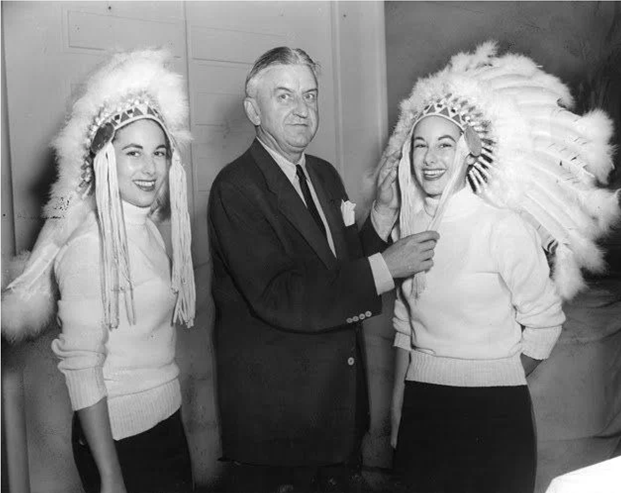
George Preston Marshall (center)

Andre Billeaudeaux, historian and co-founder of Native American Guardians Association (NAGA), thinks opponents of the Redskins name don’t know what they’re talking about. “These people are just ignorant. It’s toxic ignorance. It’s group think. It’s the psychology of a group that has no idea what they’re doing, but they won’t listen to us [NAGA], either.”

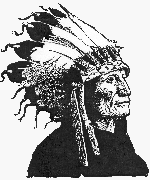
The origin of the Redskins name and logos go back to 1912 when James Gaffney, of New York’s Tammany Hall, purchased the Boston Rustlers National League baseball team. He renamed the team as the Braves and used an image inspired by Saint Tammany for the team’s logo. That image is prominent on the left sleeve of Babe Ruth in a photo taken in 1935.

When a group including Washington laundry magnate George Preston Marshall purchased an idle NFL franchise and established a team in Boston, they named the team the Braves. It was common for upstart NFL teams to name themselves after established baseball teams, particularly when they shared the same field. The new Braves’ uniforms didn’t include an Indian motif. Instead they wore jerseys of a simple design in Marshall’s company’s colors: blue and gold.

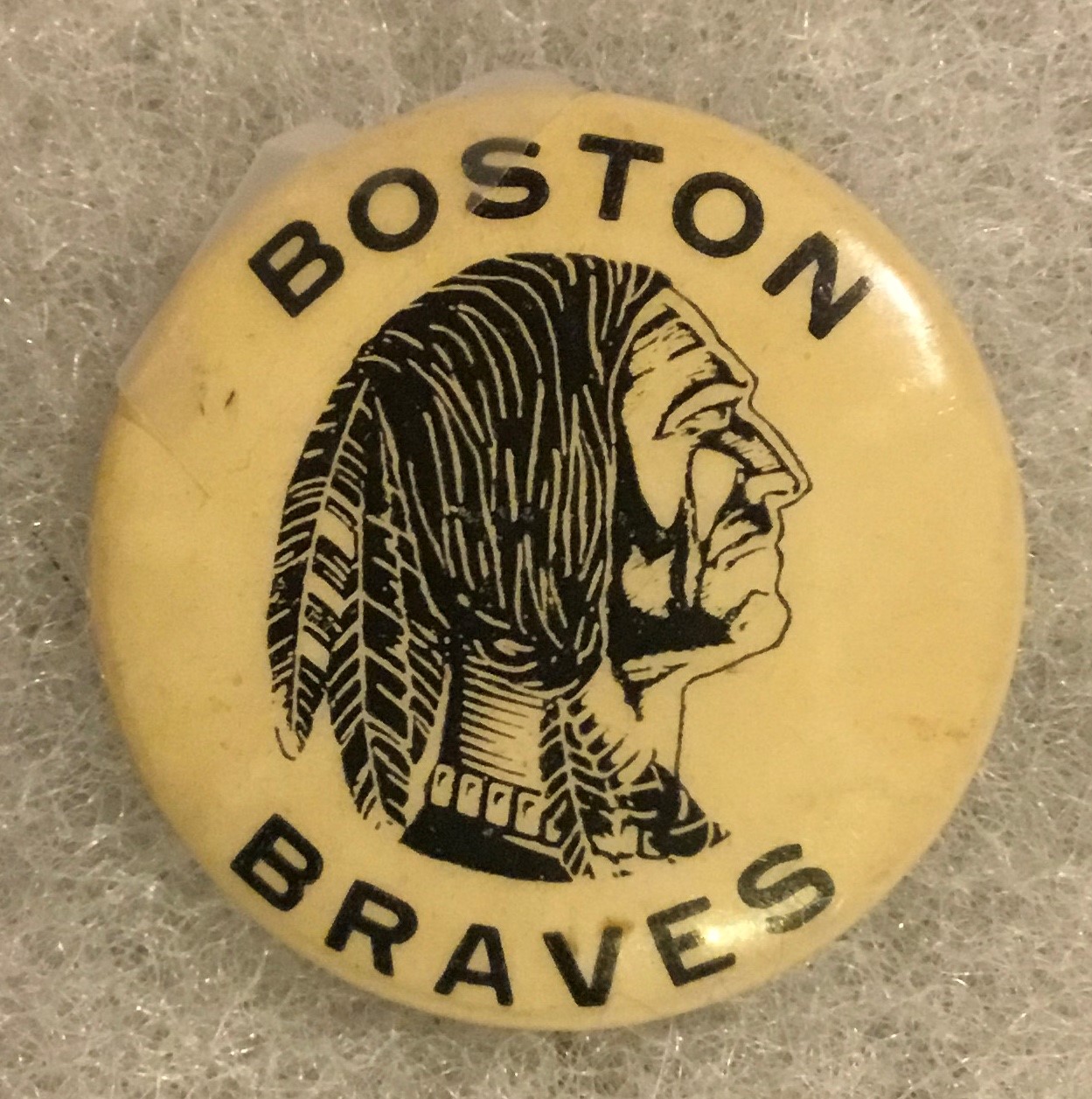
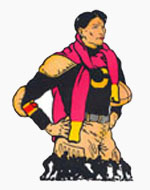
As a .500 first season, Marshall’s cohorts left, leaving him as sole owner of the team. He fired the coach, Lud Wray, and hired Lone Star Dietz, a Carlisle Indian School alum who had had success coaching at the college level. Dietz brought four of his Haskell Institute (today’s Haskell Indian Nations University) Fighting Indians star with him. The figure on the Braves’ letterhead and pin is different than the one used by the baseball team. On the baseball team logo, the man wore a headdress where the football logo image only had three feathers. I’m not qualified to determine if the football team used Saint Tammany’s profile or not. Having red on the letterhead suggests that the team’s colors changed shortly after Dietz became their head coach. The existence of the pin argues against Dietz changing the logo because he was only with the team a short amount of time before the team name was changed and it was during the off season. So, the logo on the button was probably created for the 1932 season.

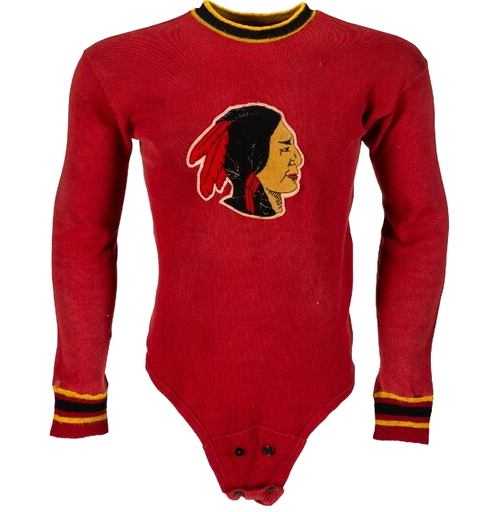
One question never asked is: Why did Marshall change the team’s colors? A 1933 jersey shown below has red as the primary color and is trimmed with gold and black bands. These colors are similar to Carlisle’s colors and the stripes on the cuffs are reminiscent of the below-the-elbow stripes on the Indians’ jerseys. Some have attributed the design of the Redskins’ logo to Lone Star Dietz. The image may have preceded him; it’s not clear when the team adopted it. Dietz likely borrowed the concept from the NHL Blackhawks’ design and placed the logo on the front of the jersey.

Probably to save money, Marshall moved the team from Braves Field to Fenway Park. To eliminate confusion with the baseball team, he felt he had to change the name. Some think red was chosen because they were then based on the Red Sox home field. A Boston newspaper writer claimed that Marshall chose the name to save money by not having to buy new uniforms. As shown in this piece, both colors and design of the team’s uniforms changed when the team’s name changed. However, the team had to wear the old uniforms in the first game of the 1933 season because the new ones hadn’t arrived yet.

Billeaudeaux thinks otherwise. “Redskins is not about race. It’s a warrior who’s gone through the bloodroot ceremony. “They shave their heads and surrender their souls to their Creator. They paint themselves red as if they were born new into the world.”

“The Redskins were the only minority representation in the entire NFL and it was a real person, not a mascot,” said Billeaudeaux. “The name Redskins is a national treasure and for that reason it should be protected. It’s a cultural treasure and deserves to be protected and understood. It’s not just about the football team. It’s about the DNA of the nation.”

NAGA members aren’t the only people who prefer Redskins for the team name. As of this writing, 130,790 people had signed NAGA’s petition demanding the team name be changed back to Redskins. “Redskins Fans Forever,” a Facebook group with 61,600 members, refers to the team only by its historic name. 

Ninety percent of Native Americans around the country supported the Redskins name in a Washington Post poll in 2016, as the woke assault on the traditional name grew stronger.

Red Mesa High School on a Navajo reservation in Arizona recently installed a new football field with the Washington Redskins logo on the 50-yard line.

Redskins Revival Continues

September 1, 2023
Christina King & Carolyn Steppe in their Redskins regalia

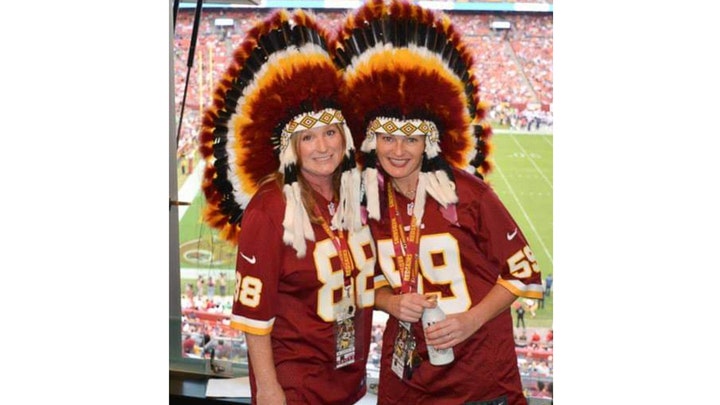
More has happened regarding the Redskins naming controversy. Former luxury-box owner—can you imagine how much the team lost when she dropped it?—Christina King texted “We just signed the petition from NAGA…We [she and her sister Carolyn Steppe] will come back as suite owners when the name reverts back to the Washington Redskins.“ to Matthew Laux, a premium-seat sales manager. She gave up her suite when previous owner Dan Snyder capitulated by dropping the “Redskins” name in 2020. King stated, “We’re Redskins fans, not Commanders fans. We’re not coming back until the name comes back. They’ve taken these images from sports. They bowed to the woke and they’re trying to erase Native American history.” 

Laux responded, “You understand the people that started this petition is a fake group, right?”

That statement did not sit well with NAGA—Native American Guardians Association. Fullblood Dakota Sioux NAGA President Eunice Davidson responded, “We’re not a fake group. We’re tribal-enrolled members from tribes across the United States.” NAGA had posted an on-line petition to have the team’s name changed back on June 21. It stated, in part:

“The name “Redskins” carries deep cultural, historical, and emotional significance, honoring the bravery, resilience, and warrior spirit associated with Native American culture.

“It was never intended as a derogatory or offensive term but as a symbol of respect and admiration. Changing the name abruptly disregards the positive legacy that the Redskins name has built over the years and disorients the passionate fans who have invested their emotions, time, and unwavering support in the team.”

As of last Monday, August 29, the petition had garnered 128,000 signatures.

The NFL team’s spokesperson stated that Laux does not represent the team.

NAGA co-founder, historian Andre Billeaudeux, author of How the Redskins Got Their Name, stated, “We’re in it to win it….’Toxic ignorance’ has fueled the effort by woke professors and academics to erase Native American history from the nation’s sports and pop-culture lexicon .

Team President Jason Wright responded to a question about the name change, “”It is not being considered. Period.”

More next time on the team’s history.

Single Wing vs T-formation

August 9, 2023

The August 2023 edition of the College Football Historical Society journal includes a most interesting article and I’m not just saying that because it also includes one of mine. The piece I’m talking about has to do with the College All-Star Game of 1948. For those not old enough to remember these games, a group of the top college players played against the reigning NFL champion in Chicago before the start of the year’s football season. The coach of the AP mythical national champions led the collegians. This year it was Notre Dame’s Frank Leahy. This series ran from 1934 through 1974.

The pros were represented by the Chicago Cardinals, a team that seldom earned this honor. More unusual were the numbers of Notre Dame and Michigan players on the college roster: fourteen Irish and eight Wolverines. In those days, the single-wing reigned in Ann Arbor where the T-formation ruled in South Bend. Aficionados of each system extolled the virtues of their offense of choice. Leahy, a T-formation man, saw his chance to prove which was the better approach with so many highly skilled players of each system on his roster.

So, he split his team into two squads based on which formation they were accustomed to running. Thirty-three single wingers and twenty-nine from T-formation schools. He assigned assistants—his assistants for the game were head coaches from other schools—familiar with the single wing to coach that squad while he and assistants who used the T-formation coached the other one. He told the players he hadn’t decided which scheme to use in the big game against the pros and would have the squads play each other to determine which system he would use in the big game.

The contest was held on August 14, 1948 in front of a crowd of 23,450 wildly cheering fans at Northwestern’s Dyche Stadium. To find out what happened that day and six days later when the college boys went against the Cardinals in front of 101,220 spectators at Soldier Field, you’ll have to get your hands on the journal. To receive your own copy, email rayscfhs@msn.com or write:

  • Ray Schmidt
  • PO Box 6460
  • Ventura, CA 93006

NFL Drafts 3 Albright College Players

April 26, 2020

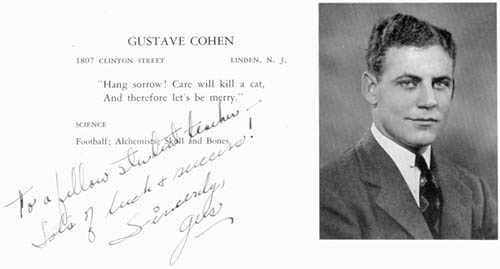
Today’s post is something different. It isn’t mine. I rejected offers from others who have offered to supply posts in the past. But this time it was me who did the asking. Sheldon Cohen wrote up a short piece on the 80th anniversary of the 1940 NFL draft that I find very interesting. He is the son of Gus Cohen who, among a number of other things, played football at Albright College under Coach Lone Star Dietz. We met at Dietz’s induction into the Albright College Hall of Fame. Lone Star was important to Gus and his family because he acted like a second father to Gus, who had lost his father to an early death.

Gus graduated from Albright College in 1940 where he was an All-East and 2nd/3rd team All-American lineman, playing for 2 Hall of Fame coaches, Biggie Munn (who recruited Gus from high school and later became famous as the coach and AD at Michigan State) and Lone Star Dietz (Pop Warner’s coaching protege). The draft which concluded today marks 80 years from the time Gus was drafted.

The draft and professional football were both very different. Somehow, Gus had 2 offers from NFL teams–the Philadelphia Eagle offered him a $1,000 bonus and the Brooklyn Dodgers $500. He had friends on both teams, namely his college teammate, Dick Riffle, on the Eagles (Dick was an All-American at Albright and All-Pro for the Eagles) and Leo “Moose” Disend on the Dodgers (Moose later played for the Green Bay Packers).

Gus decided to sign with the Dodgers for less money. His eldest brother, Sam (after whom I’m named), had been murdered in 1939 and Gus was very close to his mother, Sadie (after whom Sandy* is named). Signing with the Dodgers enabled Gus to be with his mother and family in New Jersey after Sam’s untimely passing at the age of 39.

Things are obviously very different with the draft and the NFL today. The one connection the family has with the NFL is cousin Barbara Bashein’s daughter, Dr. Robin West, who is Head Team Physician of the Washington Redskins (the team was named after Lone Star, a Native American, by George Preston Marshall in 1933 when the team was the Boston Braves and Lone Star was the coach).

Times have changed.

*Sandy is Gus’s daughter and Sheldon’s sister.

GusCohen

From a classmate’s 1940 Albright College yearbook.


Renewed Interest in the Oorang Indians

September 23, 2017

Oorang Indians Willis.jpg

Yesterday’s mail brought an unexpected pleasure. I opened a package that obviously contained a book. But I had no memory of ordering a book from anyone. The label said it was from Rowman & Littlefield in Blue Ridge Summit, Pennsylvania. I knew some book publishers made their home in that town as the late John Kallmann had once worked for a publisher located there. I still had no idea what book it might be.

Opening the package, I found a copy of Walter Lingo, Jim Thorpe, and the Oorang Indians: How a Dog Kennel Owner Created the NFL’s Most Famous Traveling Team by Chris Willis. It was a book I knew was coming out because Chris and I had conversed about the topic and a question he had about Eagle Feather led to some serious investigation and a series of blog posts about this mysterious player.

Wanting to thank him for the book, I tried to send Chris an email, but couldn’t find his address. An inopportune computer crash in early August had wreaked havoc had lost numerous email messages and addresses. (Perhaps I should write about the fallacies of making backups using Microsoft’s utility.) I would appreciate it if someone would send me his email address.

The book had a feel different from others I’d felt. That it had no jacket because the jacket information was printed directly on the hard cover wasn’t new. What was new was the feel of it. Rather than having a hard, glossy finish, the cover had a matt finish that is soft to the touch.

Inside this beautiful book, I found an acknowledgement to me. An entire paragraph. WOW! Thank you, Chris.

Over the last couple of years, I had received questions from multiple persons about the Oorang Indians. Apparently, this most unusual NFL team had gathered renewed interest. Maybe the NFL needs to rejuvenate the team to attract fans. It needs to do something after tickets for Thursday’s Rams-49ers game went for $15!