Archive for the ‘Lone Star Dietz’ Category

Single-Wing Revisited

July 28, 2009

When addressing the incorrect assertion that Pop Warner had developed the single-wing formation while he was coaching at Pitt and Stanford in the 1920s by www.footballhistorian.com, I neglected to include a piece of evidence that demonstrates this statement is patently false.

Below is a photograph of the 1915 Washington State College team lined up in an unbalanced-line single wing formation. The photo can be found on page 79 of Richard Fry’s beautiful book, The Crimson and the Gray: 100 Years with the WSU Cougars, which has unfortunately gone out of print. (Something needs to be done about that.) The identities of the players, uniforms and helmets accurately date the photo. Lone Star Dietz, a single-wing aficionado, coached WSC for the 1915-17 seasons, so it is logical that his team would run it and the double-wing.

Dietz played on the Carlisle Indian School teams from 1909-11, then assisted Pop Warner from 1912-14. After the end of the 1914 season, Warner and Dietz headed to greener pastures. Warner took the head coaching job at Pitt and Dietz caught the train to Pullman.

If Warner hadn’t developed the single-wing at Carlisle as he said, this photo would mean that Lone Star came up with it on his own and never took credit for it, which is highly unlikely. Some of the confusion may be of Warner’s making.

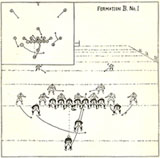
Pop’s correspondence course (1908-11) and his first coaching book (1912) do not include this formation; they show earlier evolutions with balanced lines. The formation in the photo is the one Warner calls Formation A in his 1927 book. He likely held back his best stuff in his earlier publications because it is doubtful that Dietz would have been running the unbalanced-line single-wing as a primary formation in 1915 had it not been perfected used at Carlisle some years before.

WSC Single-Wing 1915

Redskins Trademark Safe for Now

May 21, 2009

Last Friday, a three-judge panel of the U. S. Court of Appeals in Washington upheld the D. C. Circuit Court’s decision that the plaintiffs had waited too long in filing a suit against the Redskins’ trademark which was originally registered in 1967. This time around (law suits were first filed against the Redskins in 1992), based on the much shorter delay (seven years and nine months) since Mateo Romero’s 18th birthday. Apparently minors are not allowed to file such suits. The other six plaintiffs are much older and waited far longer to file. The judge also ruled that the attack on the team’s cheerleaders, the Redskinettes, was also filed too late. However, these lawsuits are far from over. Suzan Shown Harjo, President of the Morning Star Institute and one of the plaintiffs, told reporters that a group of younger plaintiffs are ready to challenge the trademarks. Don’t expect this fight to end anytime soon. A franchise that isn’t so successful would probably relocate to greener pastures long before this thing is resolved.

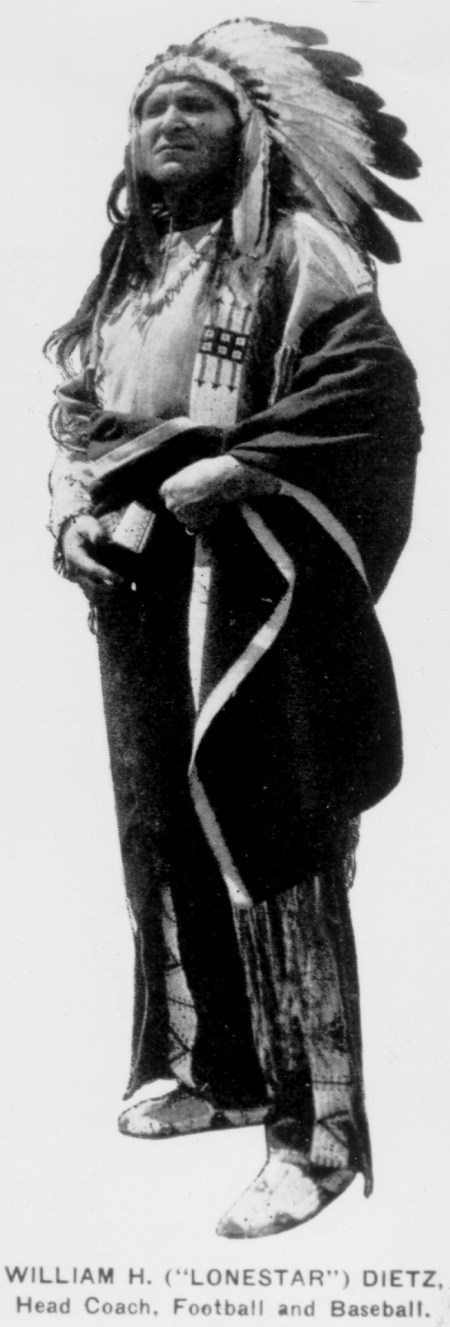
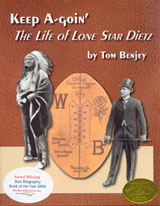
I follow this issue because owner George Preston Marshall named the Redskins in honor of Lone Star Dietz, his new head coach in 1933. Dietz has been at the epicenter of this controversy for years. Dietz’s heritage has been an issue since his draft evasion trial in 1919. *** Begin unabashed plug *** My 2006 book, Keep A-goin’: the life of Lone Star Dietz discusses the issue of his birth at great length. *** End unabashed plug ***

Indians Dissed by Halls of Fame

May 4, 2009

Last week was a bad week for Indian athletes. Both players and coaches continue to be overlooked for honors they deserve. Lone Star Dietz was passed over again for Induction into the College Football Hall of Fame as a coach. He was inducted into the prestigious Helms Foundation years ago but the College Football Hall of Fame didn’t even think he was eligible until a few years ago. It wasn’t until Washington State super-alum Greg Witter and I did some research and got Dietz’s win-loss record corrected that they put his name on the ballot. By then he had been dead for almost 40 years and very few people are still alive that remember him. But he’s not the only Indian the College Football Hall of Fame has dissed or the only Hall of Fame to diss an Indian athlete.

Last week the West Shore Chapter of the Pennsylvania Sports Hall of Fame inducted its new class. Frank Mt. Pleasant, who I nominated last year, wasn’t picked. It’s hard to imagine how the chapter local to his greatest achievements could overlook one of the greatest of the Carlisle Indians, but they did. Fortunately, the West Shore Chapter isn’t the only option. He was already inducted into the Indiana University of Pennsylvania Hall of Fame for his work there as a coach after his playing days were over. Maybe their chapter will induct him.

Recently, questions have come in about the Haskell Institute star John Levi. He was considered to be as good as Jim Thorpe in every aspect of the game but kicking. Thorpe himself considered Levi to be the best athlete he had ever seen. Unfortunately for John, Carlisle Indian School did not exist when he came of age. The mantle of Indian sports leadership passed to Haskell Institute in Lawrence, KS after Carlisle closed. Although Levi and his Haskell teammates had great records under Coach Richard Hanley, they seldom played in front of the eastern media. That kept John Levi from being named to the major All America teams. He was named to minor ones but that wasn’t enough to get him elected to the Hall of Fame. J

im Thorpe wasn’t the only Indian to lead the nation in scoring (198 points in 1912); John Levi outscored everyone in both 1923 and 1924 (149 and 112 points, respectively). His teammate, Mayes McLain outdid him and everyone else in 1926 with 259 points. Barry Sanders holds the all-time single-season scoring record with 234 points. By my math, he scored 25 fewer points than Mayes McLain. Why doesn’t McLain hold the record?

Legendary coach Charles Moran isn’t in either although he had a great record, including the legendary 1921 defeat of Harvard by his Centre College Praying Colonels. Maybe it’s because he coached Mike Balenti and Victor “Choc” Kelley in his first year at Texas A & M.

Will Hall of Fame Move?

April 26, 2009

The National Football Foundation has not yet been moved to induct Lone Star Dietz into the College Football Hall of Fame but the results of this year’s voting haven’t been released yet. I just learned that Dietz’s 1916 Rose Bowl win over Brown was historic in a way of which I was previously unaware. While it is well known that Washington State’s 14-0 defeat of Brown put West Coast football one the map, established the Rose Bowl, and the New Year’s Day football tradition. What I didn’t realize was that game was the first victory of a West Coast team over a team from east of the Alleghenies. Brown traveled the longest distance to play in a game to that point. The 1899 Carlisle Indians defeated the University of California in San Francisco for what was likely the previous longest distance traveled.

The Big Four, Harvard, Yale, Princeton and Penn, rarely played games away from home other than when they played each other. So, it was to see that Penn played Oregon on New Year’s Day 1917 in Pasadena. But Penn was more flexible in playing games away from home than were the Big Three. In those days, Penn would generally play a road game against a team like Brown or Dartmouth and for several years participated in a home-and-away series with Michigan. So, adding a second road game was probably more easily accommodated by Penn than it would have been by the Big Three. Regardless, Penn became the second team east of the Alleghenies to lose to a West Coast team when they lost to Oregon 14-0 in the 1917 Rose Bowl.

Dallas boosters recently announced plans to relocate the College Football Hall of Fame from South Bend, IN to Dallas. Oil man T. Boone Pickens has reputedly agreed to put up the money to cover the Hall’s relocation costs. It remains to be seen if the College Football Hall of Fame would relocate from the homes of the Gipper and the Four Horsemen and the rest of the Irish legends.

Rebirth of Chilocco Indian School

March 27, 2009

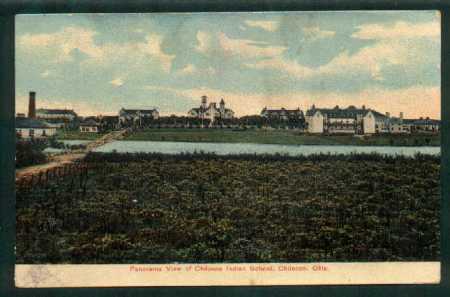
While conducting research on Lone Star Dietz in Kansas and Oklahoma, we drove past the long-closed Chilocco Indian School. Seeing that the gate was unlocked, we drove in the lane past cultivated fields, the school’s lake, and eventually into the center of the school’s campus. A caretaker noticed us wandering about and inquired about our presence there. She was puzzled because the gate was supposed to be locked as the grounds were not open to the public. She graciously allowed us to continue looking around.

The school closed its doors and, other than part of it being used by a drug rehabilitation program for some years, it has been fallow since 1980. Ivy has grown over some of the beautiful stone buildings. Decay would make renovating the campus an expensive undertaking, but well worth the investment. After bemoaning the sad state of this beautiful campus for some years, I came across something on the web that caught my eye.

Chilocco, “The Light On The Prairie,” has been deeded over to Council of Confederated Chilocco Tribes (CCCT) which consists of representatives from Kaw Nation, Otoe-Missouri Tribe, Pawnee Nation, Ponca Nation, and Tonkawa Tribe. The outer portions of the campus, consisting of large agricultural fields have been divided up among the five tribes for development . The 165 acres which comprise the central campus are held jointly. The Alumni Association, with a grant from Conoco-Phillips 66 Oil Company, is restoring the cemetery. The CCCT is raising money to be used to restore the buildings and create a museum. The Chilocco campus has been on the National Register of Historic Places for some time and is under consideration for nomination as a National Historic Landmark.

Some Carlisle students, such as Iva Miller (Jim Thorpe’s first wife), faculty and administrators also spent parts of their careers at Chilocco. I first became aware of Iva and Chilocco at the St. Louis World’s Fair of 1904. That story is told in Keep A-goin’: the life of Lone Star Dietz.

Chilocco Indian School campus

Chilocco Indian School campus

Lone Star Dietz Belongs in Hall of Fame

March 5, 2009

The National Football Foundation released the 2009 ballot for the College Football Hall of Fame and Lone Star Dietz’s name is on it again, but don’t get too excited. Lone Star Dietz should have been inducted into the College Football Hall of Fame decades ago but hasn’t been. In my opinion, Dietz shouldn’t need an HoF-worthy win-loss record (something he has) to gain admission to the Hall. His 1915 season culminated by the 1916 Rose Bowl in itself should be enough. He took over a Washington State team that had had a string of losing seasons and led them to the best record on the West Coast that year. As a reward, he was given the honor of defending the honor of the west in a New Year’s Day game to be played in Pasadena after the parade. At that time West Coast football was considered to be inferior to the Eastern brand. In 1899 the Carlisle Indians defeated the University of California in a Christmas Day game played in San Francisco and this was before the Indians hit their stride. A 1902 New Year’s game was played in Pasadena between Michigan and Stanford but it was a failure because Stanford threw in the towel in the second half while losing 49-0 because they could no longer field 11 players without broken bones. They waited until 1916 to give it another try.

Dietz and his team demonstrated to the entire country that West Coast football (at least Dietz’s team) was the equivalent of Eastern Football when they beat Coach Eddie Robinson’s fine Brown University team that featured Fritz Pollard. They also established the New Year’s Day football tradition, the Rose Bowl, and all the other bowls that would follow. Some Eastern sportswriters considered Washington State to be national champs that year. Dietz didn’t need to do anything more to deserve induction, but he did and did it well. Robinson and Pollard were inducted half a century ago but not Dietz. He was inducted into the Helms Foundation long ago but not the College Football Hall of Fame.

For years the HoF had incorrectly computed his win-loss record and deemed him unworthy of consideration. Their mistake was finally corrected in this century, so almost no one alive remembers him. Also, his selection would probably not result in as large a number of banquet tickets being sold as did Bowden’s and Paterno’s. Thus the HoF has little incentive to induct him.

lonestar-wyoming1

A Visit to Sports Immortals

February 12, 2009

Last week I was finally able to visit the Sports Immortals museum in Boca Raton, FL. Joel Platt has collected over a million items of memorabilia from the various major American Sports (read don’t expect to see a lot of soccer and cricket stuff). Do expect to see championship belts won by Joe Louis and John L. Sullivan, the most expensive baseball card, Jim Thorpe’s football helmet, and a plethora of other items squeezed into a small space. Platt has embarked upon a campaign to raise $100M to build the ultimate sports museum. To that end Platt is putting together a traveling exhibit to tour the country and raise seed money to get the fundraising started in earnest. A much larger facility is needed. Mayor Reed of Harrisburg would surely love to have the Sports Immortals for the All-Sports Museum he wants to build on City Island near the Senator’s field. However, the price tag for Platt’s collection would have to be out of Reed’s reach. Considered by many to be the most complete sports memorabilia collection to have ever been put together, only the federal government would have the resources to both acquire the collection and build a worthy building in which to house it. Until the Smithsonian decides to do something, Joel will keep following his dream. Of particular interest to me was a painting of old Pittsburgh that Lone Star Dietz painted in 1951. Below is a photo of Joel Platt holding that painting. Dietz entered the painting in the Advertising Artists of Pittsburgh Annual Show and won third prize. Lone Star lived in Pittsburgh after WWII and operated the Liberty Academy on Liberty Avenue. “Pittsburgh Just Grew” was done in a style different from others I have seen in Dietz’s work. The colors in this painting still jump off the canvas over 50 years later.

Pittsburgh Just Grew

Some Good Scholarship

February 9, 2009

A couple of years ago Angel DeCora’s biographer wrote, “I noticed Benjey did not seem to have access to several of my sources, including Ewers’ papers from the Smithsonian archives…” I didn’t understand her comment because I did have access to John C. Ewers’ Smithsonian file. However, I found some errors in his article on Dietz and saw no point in including those in my book. Now I know what she meant. In a chapter on Dietz that was removed from her recent book, Linda Waggoner makes the following statements:

When his sentence was over, Dietz returned to the east, taking a temporary job at the Philadelphia School of Industrial Art in “Design and Lettering” for the 1920-1921 academic year.[63] Perhaps, he wanted to revisit the past he spent with Angel, but football was still his first love. In 1922 he was hired to coach at Purdue University in Indiana. At the end of January 1923 he married Doris O. Pottlitzer, a “Jewish heiress,” just a week after he was fired from Purdue for illegal recruiting.

Like Ewers before her, Waggoner appears to have misinterpreted The Pennsylvania Museum and School of Industrial Art Circular for 1920-21. Beginning on page 41 of that circular is a list of former students and their last known occupations. They were probably not aware that Dietz was no longer teaching at Carlisle and hadn’t been doing that since 1915. Sara MacDonald, Public Service Librarian at The University of the Arts, successor organization to The Pennsylvania Museum and School of Industrial Art, explained this to me some years ago and reiterated that again last week.

uart1920-21

Waggoner’s explanation would have been convenient for me because I haven’t found out what Dietz was doing in the year between when he got out of jail in 1920 and the time he took the coaching job at Purdue in 1921. I have no explanation as to why Waggoner has him coaching the Boilermakers in 1922 and marrying Doris in 1923. He coached Purdue in only one year, 1921, and married Doris in early 1922. They then relocated to Ruston, LA where he coached Louisiana Tech in 1922 and 1923. Lone Star may have thought Doris was a cracker heiress, but it doesn’t look like she was. I suspect that his 1-6 record at Purdue had more to do with his firing than the accusations made against him.

The blog’s owner responded to the Waggoner post that included the above extract as follows:

I look forward to some real scholarship about Dietz’ true identity. I think it’s time to clear this up. Please keep a’goin with this. For those unaware, ‘Keep a’goin'” is the phrase that repeats in the chorus of the Carlisle Indian School song Pop Warner is credited with writing.

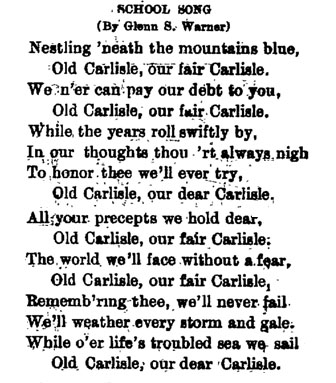
Here’s some real scholarship. “Keep a-goin’” was NOT a phrase that Warner repeated in the Carlisle school song. Follows is the school song as published in the January 25, 1907 edition of The Arrow. Also included is the poem from his 1927 book, Football for Coaches and Players, the place where the phrase can actually be found.

 carlisle-school-songkeep-a-goin-poem1


I picked this phrase for the title of Lone Star Dietz’s biography because of the way he kept going in spite of numerous setbacks and because he had it in his hand when he died. He also illustrated the book from which it came.


Common Misconceptions About Carlisle Indian School

January 26, 2009

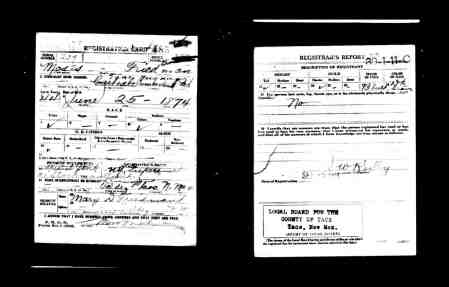
Google Alerts inform me of “news” on the internet regarding Lone Star Dietz, most of which I ignore. Although the most recent alert was a message largely concerned with Moses Friedman, that blog contains some misconceptions that are probably widely held. Matt is understandably confused by some of the entries on Friedman’s draft card (below) but those inconsistencies aren’t the worst problems. The misconceptions I consider serious are discussed in the paragraphs that follow.

  1. He could pass off the Moses as a given name perhaps, but not Friedman, especially considering that students kept an anglicized version of their Native name.

While it is true that some students were assigned anglicized versions of their original names, my experience researching Carlisle Indian School football players has been that the Anglicized names were generally assigned to an elder in the family, often at the agency in which the family was recorded. By the time Carlisle started fielding a football team in the 1890s, there had been so much intermarriage between Indians and whites that the majority of players I researched carried the family name of a white ancestor. For a small example, I seriously doubt if any of the six Carlisle Indians who were inducted into the College Football Hall of Fame carried Anglicized names, bastardized perhaps, as in the case of Guyon. Those names are:

a.     Albert Exendine (may have originally been Oxendine)

b.    Joe Guyon (probably Guion originally)

c.     James Johnson

d.    Ed Rogers

e.    Jim Thorpe

f.      Gus Welch

Had Friedman’s father married an Indian woman, he could easily been named Moses Friedman, although I am unaware of any evidence that indicates that he has Indian heritage. The point is that his name said nothing, one way or the other, about whether he had Indian heritage or not. Another point is that the Anglicized versions that are known for these men, Bright Path (Jim Thorpe) for one, are nothing like the names they were known by at Carlisle.

  1. My initial thoughts were of Lone Star Dietz, but why would he attempt to pass himself off as Indian with such a German sounding name?

As shown by the sample of European names above, by the 1890s a mixed-blood Indian could carry almost any European surname. Germans may have intermarried less than the French, English and Irish, but surely some did. Having the last name of Dietz (or Deitz as his father spelled it), is probably the weakest argument against him.

  1. However, Native-Americans were not exempt from the draft, …

Non-citizen Indians were exempt from the draft, but citizens weren’t. Indians as a group weren’t granted citizenship until after WWI, so most were not required to serve. However, the fact that so many volunteered and served with distinction speaks well for their bravery and patriotism. A significant number even went to Canada to enlist before the U. S. entered the war.

  1. As an aside, even though I have his date of birth I cannot find any Moses Friedman born in America, let alone Cincinatti [sic], on that date or even in 1874!

It was not unusual at all for births not to be recorded at that time. My own paternal grandmother had no birth certificate and she was born over a decade later.

Friedman’s draft registration is surely confusing, most likely because he was confused. As to why he would check the white box for race and also check the citizen box for Indian: my guess is that, knowing people of any race could be citizens or non-citizens, he ignored the Indian heading when he checked the citizen box. I am unaware of any attempt by Friedman to claim Indian heritage.

A look at his then current employment might shed some light as to why he put Carlisle as his permanent address. He was then doing “special work as stockman for NY Supreme Court” in Taos, NM. After resigning from his position as Superintendent of Carlisle Indian School and being acquitted in Federal Court, Friedman was probably taking any work he could get. His work in Taos sounds like it was temporary and Friedman may have had as yet established a permanent location after leaving Carlisle.

http://ciis.blogspot.com/2009/01/moses-friedman-and-lone-star-dietz-both.html
wwidraftcard-friedman

Captain of Industry at Thorpe Premier

December 25, 2008

Another Brown end made the trip to Pasadena. Furber I. Marshall was born in New Hampshire to a Avard L., originally form Nova Scotia, and Mabelle, from New Hampshire. When Furber was quite young the family moved to Newport, RI where Avard managed the Newport Beef Company which was affiliated with Swift and Company. Furber played football only one year in high school but starred at basketball. He played center on Rogers High School state championship team in 1913. Later that year as President of the Rogers High School Athletic Association, he presided over a meeting in which it was decided to admit girls as members. In December he served as the chief press agent for the operetta “Bul-Bul” that was put on by the Rogers Glee Club. In February the basketball team lost its captain when Furber contracted blood poisoning in his foot. In September 1914, the man who had been president of the class of 1914 at Rogers High School became the freshman class president at the University of Pennsylvania. September 1915 found him enrolled at Brown University and playing end on its football team. Furber was in Pasadena but saw the game from the bench, most likely, as his name didn’t show up in game reports. In the 1916 season he became a star.

In August 1917, after the U.S. entered WWI, Furber Marshall joined the Army Aviation Corps and was commissioned as a 1st lieutenant after completing flight training in May of 1918. After the war, he completed his degree at Brown as a member of the class of 1919. He then worked in the petroleum industry for eight years, got married, and lived in Chicago for a time. After that he started his own company, Marshall Asbestos Corp, which he operated in Troy, NY. Later, he merged his company with Bendix Aviation Corporation as the Marshall-Eclipse Division and was president of Bendix Service Corp for many years. In 1943 he took over as president of Pharis Tire & Rubber in Newark, OH. The 1950s found him in central PA where he was president of Carlisle Corp., which was best known at that time for making bicycle tires and tubes.

Thus, this captain of industry was in Carlisle in 1951 for the premier of “Jim Thorpe–All American.” The Cumberland County Historical Society has a photo of him with Jim Thorpe and Governor John S. Fine at ceremonies before the premier. He surely talked with his old nemesis at that event, because Lone Star Dietz, coach of the Washington State team that beat Brown in the 1916 Rose Bowl, was also present.

Marshall died in 1957 in Carlisle, leaving behind his wife, the former Sarah Hall, and his mother. He was inducted into the Brown University Hall of Fame in 1975.