Archive for the ‘Lone Star Dietz’ Category
May 23, 2011
We interrupt the coverage of Carlisle’s 1903 post-season trip to the West Coast to ask for a little help with another topic dear to our hearts. Coverage of that trip should continue with the next post. David Neft discovered some 1919 newspaper articles that list Lone Star Dietz as having played pro football. Of course, we’re dying to know more about this. Unfortunately, he didn’t have time to get copies of these articles. So, we’re asking anyone who has access to the newspapers in question, probably on microfilm, to send us scans of the articles.
Mr. Neft found that the Detroit Free Press had Dietz playing halfback for the Detroit Maroons on October 26 and November 9, 1919. The article also had three other Carlisle players in the Maroons’ lineup, including tackles Big Bear and Chief Cloud.
Other research has found listings of Dietz playing three games for the Columbus Panhandles in 1920 at guard and tackle, but no photos have been found to substantiate those claims. Dietz was 35 in 1919, an old age for athletes at that time, a factor that argues against him playing pro football in 1919 and 1920. On the other hand, his exact whereabouts in the 1919 and 1920 football seasons are not known and he is belied to have been broke and out of work at that time. Previous conjectures have him working in the motion picture industry at that time, but he was also available to play football. Any assistance would be most appreciated.
November 9
Tags:David Neft, Detroit Free Press, Detroit Maroons
Posted in Carlisle Indian School, Football, Lone Star Dietz | Leave a Comment »
March 22, 2011
Every so often, either in a newspaper article or on a football forum, questions about the origin of the Redskins team name emerge. This time the question was raised on a www.extremeskins.com forum. Although it is repetitive to answer the same question periodically, it is probably necessary. A person interested in clarifying the issue asked me for a quote. It follows:
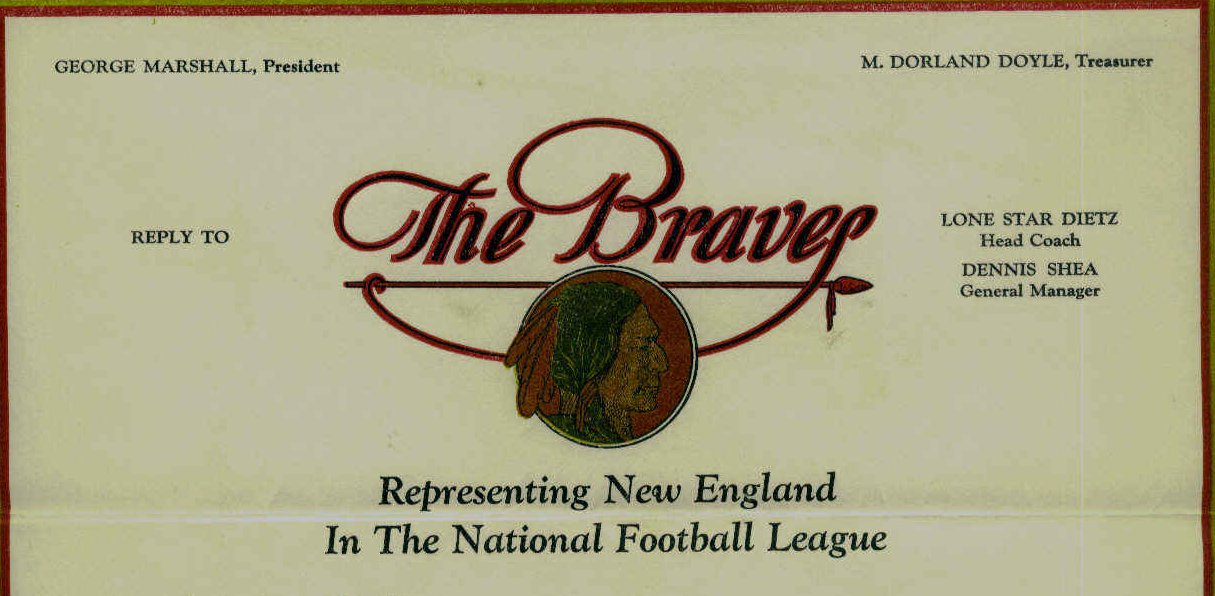
“Lone Star Dietz was hired to be head coach of the Boston Braves after the 1932 season. Sometime after his hiring, the team moved to Fenway Park necessitating a name change. I have seen Boston Braves stationery with Dietz’s name on it. That shows that he was hired before the name change. George Preston Marshall’s granddaughter wrote an op-ed to the “Washington Post” some years ago in which she stated that Marshall renamed the team in honor of Dietz (and, possibly, of the four Haskell players Dietz brought with him). Dietz coached the Boston Redskins in 1933 and 1934. This is all spelled out in my biography of Dietz.”
Some on the forum thought that the name change was influenced by the name of the baseball team that played in the Redskins new home of Fenway Park, the Red Sox. It may have. After all, Marshall could have named his team the Indians or something else in honor of Dietz. The Red in Red Sox may even have guided him toward Redskins without him realizing it.
Some sources state that the team name change occurred before Dietz’s hiring but I have evidence that contradicts that: Braves letterhead with Dietz’s name on it. It is highly unlikely that Marshall would have authorized the printing of letterhead with the wrong team name on it or with a name that he intended to change in the near future. That would have been wasting money, something that George Preston Marshall didn’t make a habit of doing. The masthead of that letterhead follows:

Tags:George Preston Marshall
Posted in Carlisle Indian School, Football, Lone Star Dietz, Washington Redskins | 1 Comment »
March 11, 2011
The 2011 ballot for the College Football Hall of Fame came out this week with Lone Star Dietz’s name removed. This is yet another snub to a Carlisle Indian School player. Dietz has also been snubbed by the Rose Bowl Hall of Fame as a demonstration of their ingratitude. After all, where would the Rose Bowl be without Dietz? Nothing the College Football Hall of Fame does surprises me anymore. A few years ago, when Dietz should have been inducted, the selection committee ignored the votes for the seven coaches on that year’s ballot and selected two coaches who were not on the ballot because they were not eligible for induction due to the fact that they were still actively coaching. So, the ironically named Honors Committee, in an Animal Farm-like move, changed the rules to make these two eligible and selected them even though no voter received a ballot with their names on it. Unfortunately, Dietz isn’t the only Carlisle Indian to be snubbed by a Hall of Fame.
The Pennsylvania Sports Hall of Fame has failed to induct Olympian Frank Mt. Pleasant into even a regional chapter is astounding. If Mt. Pleasant’s football and track accomplishments at Carlisle aren’t enough, consider what he did elsewhere in Pennsylvania. That he has already been inducted in both the Dickinson College and the Indiana University of Pennsylvania Halls of Fame indicates that he accomplished quite a bit while at each of those institutions on top of what he did at Carlisle. Frank is no stranger to being snubbed, as Walter Camp, who only gave him Honorable Mention on his 1907 All America team for being not rugged enough because he was too injured to play in the Chicago game, the Indians’ 11th game of the season. I’m not holding my breath for the PA Sports Hall of Fame doing the right thing anymore than I am for the College Football HoF. But these aren’t the only Carlisle Indians deserving of honors.
The College Football Hall of Fame does not have a category for athletic trainers but it does have a catch-all category called contributor, though. Wall ace Denny pioneered the role of athletic trainer first as a student at the Indian school and, later, as a member of the staff, and for decades after that with Pop Warner at Stanford and Temple. Before Denny started assisting Pop Warner with the care of the players’ bodies, there was no such thing as an athletic trainer as we know it. But Wallace Denny changed all that and should be remembered for it.
If Carlisle Indian School had a large alumni organization and could guarantee large ticket sales for induction events, these men might have a chance, but they don’t and little money would be raised by their selection.
Tags:1908 Olympics, All-America team, College Football Hall of Fame, Pennsylvania Sports Hall of Fame, Rose Bowl Hall of Fame, Wallace Denny, Walter Camp
Posted in Carlisle Indian School, Football, Frank Mt. Pleasant, Lone Star Dietz | Leave a Comment »
February 25, 2011
A chance viewing of an old movie during Turner Classic Movie’s celebration of Oscar’s Month shed a little light on the mystery regarding Lone Star Dietz’s birth. According to her testimony at Dietz’s trial, the woman who raised him stated that her baby was born dead and that her husband disposed of the body and replaced it with a live baby a few days later. She raised the baby, Lone Star Dietz, as her own. Many people today consider her testimony as far-fetched and unbelievable. The movie, To Each His Own, deals with this very issue.
Corinne Piersen, played by Mary Anderson, was despondent over losing her baby, not wanting to live when Olivia de Havilland’s character’s seemingly abandoned baby was brought to her. Instantly, she was better, wanting to live and raise the baby as her own. While we men cannot fully appreciate what it must be like for a woman to carry a baby for nine months and die immediately after birth or be stillborn, we do have some sense of how terrible it must be and how depressed a woman might get over such a tragic loss. Few would deny that a woman who just lost her baby, her first and only baby, would be despondent, but many would not accept that the woman would be able to shift her love quickly to a baby about whom she knew nothing.
To Each His Own makes it believable that a grieving mother could do just that. It makes it more plausible that flaxen-haired Leanna Ginder Dietz would accept Lone Star, with his coal-black mop of hair even as a baby, as her own to raise even though he did not resemble her. Perhaps someone will provide a woman’s perspective on this.
Tags:John Lund, Leanna Ginder Dietz, Mary Anderson, Olivia de Havilland, To Each His Own
Posted in Lone Star Dietz | Leave a Comment »
February 10, 2011
Two days later, on November 12, Samuel Avery, Chancellor of the University of Nebraska, reported that he had received a telegram the previous evening from C. R. Weldon, President of the Southern California University of Nebraska Club and acting for an unnamed Pasadena committee, inviting the University’s football team to play a representative of the Pacific coast for a game on New Year’s Day. The University of Washington was suggested as the probably coast team. For Nebraska to attend, permission was needed not only from the University but from the Missouri Valley Conference as well. According to a report published on the 16th, the University of Nebraska athletic board had met on the evening of the 15th and had approved the trip. The Cornhuskers “…would probably be pitted against the Washington state university team.” In addition to getting permission from the Conference, before formal acceptance could be made, they must receive “…assurance that the Washington state abides by Missouri Valley rules of playing. Coach Stiehm said this evening that the players and himself were in favor of making the trip….”
On November 17th, the following news report came out of Pasadena:
“Washington State College and Brown University football teams will meet here on New Year’s Day. This was announced today by A. J. Bortonneau, manager for the Rose Tournament Association, who said that these football elevens definitely had been decided upon. Telegrams were sent to the representatives of the schools today Mr. Bortonneau said, in which tentative plans were completed.”
A November 21 dispatch from Providence, Rhode Island, announced that Brown University had been selected by the Tournament Association after negotiations with Harvard, Yale and Cornell had broken down. Their opponent would be the University of Washington. Seward A. Simons of Los Angeles, 1st Vice-President of the AAU, came east to arrange the details.
Although the final matching had been set, there was still plenty of confusion. More research is necessary to sort out the reasons for the confusion.
Tags:A. J. Bortonneau, AAU, Brown University, C. R. Weldon, Missouri Valley Conference, Samuel Avery, Seward A. Simons, Tournament of Roses, University of Nebraska, Washington State College
Posted in Carlisle Indian School, Football, Lone Star Dietz | Leave a Comment »
February 1, 2011
Recently James Vautravers asked me a question about the 1911 Carlisle-Harvard game which was arguably the Indians’ greatest victory:
Everything I have ever read about the 1911 Carlisle-Harvard game says that Percy Haughton was in New Haven scouting Yale that day. But almost everything I’ve read about the game is false. So I was wondering if this might be false too.
Wheeler’s Jim Thorpe book (which omits all the popular false info about this game) does not directly confirm or deny the story, but he has a quote from Haughton which seems to imply that Haughton was at the game to witness it.
Do you know whether or not Percy Haughton was actually in New Haven that day?
Most of what Wheeler included about Percy Haughton regarding the 1911 Carlisle-Harvard game was quoted from Pop Warner as indicated in Wheeler’s endnotes. A reader could easily interpret what Warner said to imply that Haughton was present at the game. However, Warner attended only one of Iowa State’s games in 1895, the year that he coached two teams: Iowa State and Georgia. Actually being present at a game was less important for a head coach than it is today for several reasons. First, coaches not only did not call the plays then, they were prohibited from doing so. Coaches’ legal involvement in the flow of the game was greatly limited as compared to today. Second, team captains played a much larger role then than now. Lone Star Dietz even had to resort to bribery to get his quarterbacks to call pet plays that they didn’t like. Captains were much more involved in the running of the team than they are today. And there was generally only one captain because players played both ways and very often were on the field for the whole game. So, it is plausible that Haughton may have been away scouting Harvard’s rival for their upcoming grudge match. A parallel would have been Bo Schembechler skipping the Michigan-Wisconsin game to scout the Buckeyes.
To be continued…
Tags:1911 Harvard football, Bo Schembechler, James Vautravers, Percy Haughton, Robert Wheeler
Posted in Carlisle Indian School, Football, Jim Thorpe, Lone Star Dietz, Pop Warner | Leave a Comment »
December 6, 2010
Lone Star Dietz was inducted into his home town’s Hall of Fame in 2002. On Sunday, another Carlisle Indian was honored similarly by Rice Lake, Wisconsin. John Russeau, who spent much of his youth nearby in the town of Hayward in adjoining Sawyer County. He graduated from Superior High School in Douglas County, which is a bit further north along, not surprisingly, Lake Superior. He began his football career at Superior High School from which he graduated in 1905. After that, he played a bit for the Hayward Indian School team from his then home town. About then, he enrolled at Carlisle Indian School in Pennsylvania.
John’s name was first mentioned to me almost a decade ago by local Rice Lake historians but I found nothing about him relating to the Carlisle football team. I didn’t do an exhaustive search but, finding nothing about him in Steckbeck or in game reports I had looked at while researching Lone Star Dietz, who was at Carlisle while John was there, I concluded that he wasn’t a starter on the varsity team and forgot about him.
Later, I learned that he might have also been known as John Russian. While reading Carlisle Indian School newspapers as part of the research for Wisconsin’s Carlisle Indian School Immortals, I came across two articles in The Carlisle Arrow in which he was featured. On April 30, 1909, it was reported that he paid the school a visit while in the country on outing. He reportedly said that he was living in a good home and was being paid good wages. The second mention was in the November 26, 1909 edition. That one focused on sports:
“The Painters football team came out victorious over the Specials last Saturday, in a struggle for the shop team honors, by the score of 6 to 20. As the Painters have won all their games thus far their success reflects the earnest efforts of their coach, John Russian, in rounding out such a good team from so few candidates.”
To be continued…
Tags:Hayward Indian School, Rice Lake, Sawyer County, Superior High School
Posted in Carlisle Indian School, Football, Lone Star Dietz | Leave a Comment »
November 29, 2010
Pop Warner is viewed by most historians as the great football innovator and especially for his work at Carlisle Indian School. However, not all the innovations at Carlisle were Warner’s brainchildren. In 1906, the Indians were coached by former players Frank Hudson and Bemus Pierce who Warner helped prepare for the revolutionary rule changes that were implemented that year. After Warner departed for Cornell to start his season, Hudson and Pierce were pretty much on their own. But that wasn’t much of a problem. The Carlisle Indians were called a lot of things but witless wasn’t one of them.
One of the major rule changes was the legalization of the forward pass. Completing a pass wasn’t the easiest thing to do, particularly when both teams wore similar brown or black leather helmets. Passers needed a way to identify the eligible receivers. So, during the very first season in which the forward pass was legal, the Indians experimented with special helmets to help the passer find his target. The November 21, 1906 edition of The Lake County News described this early attempt at receiver identification. Five players wore snow white helmets and one wore a blazing red one. The article used the term headgear rather than helmet which, given the early state of helmet development, is probably more accurate. Given that the four backs and two ends are eligible to receive passes, the total of six special helmets makes sense. It seems fair to surmise that the red one would be worn by the player who does most of the passing and that the white ones are worn by those who can go out for passes.
In 1933, Michigan State started using a winged helmet for all its players to differentiate their men from the defenders. Less than a decade later, Lone Star Dietz’s Albright College team painted crosses on the tops of the receivers’ helmets but didn’t invent that idea as it had been used before, possibly even at Carlisle.
Tags:Forward pass, Painted helmets, Winged helmets
Posted in Bemus Pierce, Carlisle Indian School, Football, Frank Hudson, Lone Star Dietz, Pop Warner | Leave a Comment »
November 25, 2010
While doing a little research at the Pro Football Hall of Fame in Canton, Ohio recently, I came across a photocopy of a newspaper article titled “Backfield of Indians—Plan of Jim Thorpe.” The article began by saying that Thorpe planned on fielding an Indian backfield for the Canton Bulldogs during the 1919 season. The name of the newspaper and date were not on the copy but the paper must have been local to Canton or nearby Massillon because the third paragraph began, “Guyon’s presence here…” which implies that the paper is local to the team’s location. Discussing the possible line-up for the 1919 season suggests that the article was written after the end of the 1918 season, definitely after Armistice in November 1918. Sometime in 1919 is more likely because the article stated, “…will reach shores not later than September.”
The writer discusses how Thorpe plans to reunite with three of his former Carlisle teammates all in Canton’s backfield. Gus Welch would play quarterback (blocking back in the single-wing, wingback in the double-wing), Joe Guyon and Thorpe would be the halfbacks, and Pete Calac would be the fullback. All had played together on the 1912 Indian team but Guyon and Calac were needed on the line to replace Lone Star Dietz and Bill Newashe at the tackle positions because they were no longer playing on the team. Welch, Guyon and Calac were all in the backfield on the 1913 edition but Thorpe had departed by then.
Thorpe’s dream of being reunited fell through because Gus Welch took the head coaching position that had opened up with Lone Star Dietz’s dismissal. Thorpe, Calac and Guyon played pro ball together for several years and won championships in 1919 and 1920. Thorpe tried to field the same all-Indian backfield in 1917 but Joe Guyon elected to play college ball for National Champions Georgia Tech, was named to Walter Camp’s All America Second team at halfback, the same honor he received in 1913, his last year at Carlisle.
Tags:Canton Bulldogs
Posted in Carlisle Indian School, Football, Gus Welch, Jim Thorpe, Joe Guyon, Lone Star Dietz, Pete Calac, William Newashe | Leave a Comment »
September 2, 2010
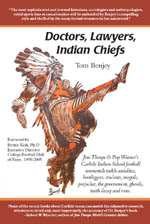
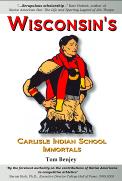
The second volume of the Native American Sports Heroes Series is now out and available to readers. Wisconsin’s Carlisle Indian School Immortals was released yesterday and is expected to be of interest to libraries and readers interested in Native American history, sports and government Indian boarding schools. This book follows the following players from their youths on the reservation, through their times at Carlisle to their later lives:
- Chauncey Archiquette
- Wilson Charles
- Wallace Denny
- Lone Star Dietz
- Louis Island
- James Johnson
- Frank Lone Star
- Jonas Metoxen
- Thomas St. Germain
- Caleb Sickles
- George Vedernack
- Gus Welch
- Hugh Wheelock
- Joel Wheelock
- Martin Wheelock
- Charles Williams
- William Winneshiek
Readers will learn who became doctors, lawyers and Indian chiefs. Some became musicians and led all-Indian bands. One was invited to join Richard Byrd’s Second Antarctic Expedition. Another was instrumental in establishing the Rose Bowl. Readers will also learn more about the naming of the Washington, DC NFL team and about the all-Indian NFL team. Several served in WWI even though non-citizen Indians were not drafted. Most lived long, productive lives but some didn’t. Some married girls they met at Carlisle, others married white girls and still others married girls from the reservation. One even married a congressman’s daughter.
The reading level is such that anyone from seventh grade through senior citizen can appreciate it and It is my hope that school children will read it to gain a better understanding of their history.
Tags:Frank Lone Star, Jonas Metoxen, Wallace Denny, William Winneshiek
Posted in Caleb Sickles, Carlisle Indian School, Charles Williams, Chauncey Archiquette, Football, George Vedernack, Gus Welch, Hugh Wheelock, James Johnson, Joel Wheelock, Lone Star Dietz, Louis Island, Martin Wheelock, Pop Warner, Thomas St. Germain, Washington Redskins | 2 Comments »

 Tom Benjey's Weblog
