Archive for the ‘Lone Star Dietz’ Category

Deerskin paintings

April 4, 2008

Every so often I am blessed by an email that comes out of the blue from a person I don’t know or have ever heard of before that brightens my day (or several days) considerably. One such message came from Barr Shriver. Mr. Shriver’s grandparents, Barr and Marie Cox “Nana” Crawford, lived in the same apartment building in Pittsburgh as the Dietzes for several years in the early 1950s. Barr’s grandparents and the Dietzes became good friends during this period.

Barr Crawford worked in the truck parts department at Hoover Dam during its construction and made friends with many Indians. When he worked as a salesman with International Harvester (IH) during the Great Depression, the Indians didn’t have enough money to pay for the repair parts they needed. So, Mr. Crawford allowed them to trade beautiful blankets and art for the parts needed to keep their trucks running.

Having grown up in Montana, the Crawfords appreciated Indian art and understood the hardships Indians had undergone. Seeing Lone Star’s artwork, they struck a deal with him. Their son-in-law, Barr Shriver’s father, was a hunter and supplied two deer hides that he had had tanned and Lone Star had them mounted as if they were canvases and trimmed to about 14 by 16 inches. On one he painted a bust of an Indian woman and on the other a self-portrait in his war shirt and headdress. He signed the colorful paintings with the distinctive signature he used on his artwork at Carlisle.

After the Crawfords died, the paintings passed to Barr Shriver’s mother, their daughter. One of the things I mourn is that much of Lone Star’s art has been lost over the years. That, fortunately, is not the case this time. The Shrivers are proud to have and appreciate what are two-of-a-kind paintings and family heirlooms.

Lone Star Dietz selected for Hall of Fame

April 1, 2008

At long last an oversight or, as many view it, a snubbing is being corrected. Lone Star Dietz should have been inducted into the College Football Hall of Fame decades ago but hasn’t been. Some view this as just another example of Indians being abused by white men. Dietz has been inducted into a number of halls of fame including the prestigious Helms Athletic Foundation Hall of Fame back in the 1970s. His role in establishing the New Year’s Day football tradition, most notably the Rose Bowl, is reason enough to induct him. But that’s not all. His won-loss record qualifies him for induction and that’s saying something. Lone Star Dietz did not nestle into a successful program and ride that horse for decades; he undertook a number of reconstruction efforts and turned programs around. On the few occasions he couldn’t turn a perpetual loser into a winner, he got the student body excited.

So, why hasn’t he been inducted? Until a few years ago the Hall had his record wrong and didn’t consider him qualified. Now that the record has been corrected he is eligible and his name has been on the ballot. A couple of years ago he came close but while the ballots were being counted, the Honors Committee (now that’s a dubious name) decided they wanted to induct Joe Paterno and Bobby Bowden. There was one hitch: Paterno and Bowden’s names weren’t on the ballot because, as active coaches, they weren’t eligible. That problem was easily dealt with. All they had to do was to change the rules in midstream. Presto! Paterno and Bowden were eligible and the men whose names were actually on the ballot were forgotten. Sorry, Lone Star.

But this year he’s getting a fair shake and is belatedly being inducted. Perhaps this will lift the Lone Star Curse from Washington State.

April Fool!

Minority Coaches

March 28, 2008

Yesterday I came across a December 8, 2007 article in The News Tribune out of Tacoma, Washington. In it reporter Todd Miles wrote, “Not since 1917 have the Washington State Cougars had a minority head coach in football.” Putting aside the fact that Washington State’s teams weren’t called the Cougars in 1917, the statement is still incorrect. Yes, Lone Star Dietz coached the 1918 Mare Island Marine team that was featured in WSC’s yearbook because ten players were from WSC. And, although Dietz considered it Washington State’s second Rose Bowl team, it didn’t wear crimson and gray. The major error is that not one but two minority coaches were overlooked. This is why we study history.

When Dietz was unceremoniously dumped in early 1919, WSC wanted another coach who was steeped in the Warner system because Dietz had been wildly successful with it. So, the administration looked for someone with experience, not just with the single and double-wing formations but with the whole system. Recall that Ace Clark thought that the way Lone Star conditioned his players and reduced the amount of scrimmaging left them in better shape for the games. Albert Exendine was a logical choice but he was under contract at Georgetown. Eventually Gus Welch was tracked down on a former battlefield in France and recruited for the job.

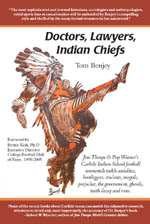
Gus Welch was Chippewa from Wisconsin and Al Exendine was Delaware and Cherokee from Oklahoma, but they have a lot of similarities. Both attended Carlisle Indian School and starred on its teams, Exendine at end and Welch at quarterback (blocking back in Warner’s single-wing). Both got their law degrees from Dickinson School of Law (now part of Penn State) across town from the Indian school. Both had long careers of coaching football in the fall and practicing law the rest of the year. Both were inducted into the College Football Hall of Fame as players. And both coached Washington State. Welch led the team from 1919 through 1922 and Exendine took over in 1923, lasting through the 1925 season. Each has a chapter devoted to him in Doctors, Lawyers, Indian Chiefs.

So, Washington State has a history of hiring minority head football coaches, just not lately.

Booktalk surprises

March 18, 2008

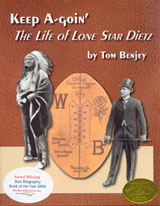
It was almost two years ago that I gave my first booktalk on Keep A-goin’: the life of Lone Star Dietz. Things went smoothly until the question and answer session when a gentleman informed me that a photo in my book had an incorrect caption. The caption below a photo on page 290 of two men in business suits flanking a smaller young man in his Albright College  football uniform read, “Jim Thorpe shows Leo Disend some tricks as Lone Star looks on.” There can’t be anything wrong with that, I thought, because it came straight from an Albright College yearbook. Also, I knew what Jim Thorpe and Lone Star Dietz looked like, so it couldn’t be wrong. Or so I thought.

The gentleman then informed me that the player in the photo was not Leo Disend. He didn’t know who it was but he was sure it wasn’t Moose, as Leo was better known as. The man identified himself as Sid Disend, Leo’s bother. Well, I couldn’t argue with him because he surely knew what his brother looked like. He also said that the layer in the photo was not wearing Leo’s number. I then had to find out who the mysterious number 31 in the photo was.

The next day I emailed Francine Scoboria, Manager of Advancement Communications at Albright College, to inform her of this long-standing error. She researched the issue and found that the mystery man was John Killiany, class of 1946, varsity quarterback.

The lesson in this was that errors made decades earlier, this time over 60 years before, often are assumed to be correct years later. So, when you’re researching the past, don’t be surprised when you encounter conflicting information. Either or both source may be wrong.

Now I’m off to research the great Dickinson College crockery riot of 1912.

April 8, 2008

It is with sadness I report seeing the following in today’s Harrisburg Patriot-News:

Sidney DisendSid Disend, 86, of Harrisburg, died Sunday April 6, 2008 at the Carolyn Croxton Slane Hospice Residence on Linglestown Road.
Born in Roselle, NJ, he was the son of Samuel and Sarah Disend. Sid graduated from Albright College in Reading, PA with a degree in Education then served his country in World War II at the Battle of the Bulge in the U.S. Army as a sergeant in the 95th Division, Field Artillery.
He was the owner/operator of Ess & Dee Venetian Blind Company then retired as Regional Sales Manager for the R.W. Norman Company of Salisbury, NC, responsible for the entire Northeast territory.
He was a member of Temple Ohev Sholom, a member of the Brotherhood, and Principal of the Religious School. He was the Past President of the Harrisburg Jaycees, and the recipient of their first Honorary Life Membership. He was the Founder and Past President of the Wilson Park Civic Association, Founder and Past President of the Latshmere Crime Watch, a charter member of the Susquehanna Rovers Volksport Association, and a founding member of the Capital Area Greenbelt Association.
Sid was also an active volunteer at the Harrisburg State Hospital, the Jewish Home of Greater Harrisburg, a Dispatcher for the Susquehanna Township’s Indian Wheels, an Instructor with the Literacy Council, and, with his wife Shirley, was responsible for the development of the “Five Senses Gardens, on the Greenbelt.
Sid is survived by his wife of 64 years, Shirley, son Jeff and his wife Kay of Atlanta, son Randy of Harrisburg, and several nieces and nephews.
A memorial service will be held on Wednesday, April 9, 2008 at 11:00 a.m. in the Bookstaber Chapel of Mount Moriah Cemetery. An additional memorial service will be held in the Manor at Oakridge, 4500 Oakhurst Blvd., Harrisburg, PA on Thursday, April 10, 2008 at 2:00 p.m.
Arrangements by Fackler-Wiedeman Funeral Home, Harrisburg. There will be no viewing or visitation.
Memorial contributions may be made to the Five Senses Gardens, c/o Capital Area Greenbelt Association, P.O. Box 15404, Harrisburg, PA 17105 or Hospice of Central Pennsylvania, P.O. Box 206, Enola, PA 17025.
Sid has donated his body to science through the Humanity Gifts Registry at the Hershey Medical Center. wiedemanfuneralhome.com
 

Helen Keller letter

March 13, 2008

The Oklahoma Historical Society in Oklahoma City has a treasure trove of interesting material. Ann and I were there researching Lone Star Dietz’s time at the 1904 St. Louis World’s Fair. If the Oklahoma Historical Society doesn’t seem to be a logical location for such research, consider that it holds Chilocco Indian School archives and that Chilocco’s Superintendent McGowan was in charge of the model government Indian school exhibit at the World’s Fair. (However, it wasn’t a world’s fair, it was the Louisiana Purchase Centennial Exposition held a year late. The scale and scope of the exhibits probably caused attendees to give it that name.) Superintendent McGowan also moved Chilocco’s printing operation to St. Louis where students printed daily editions of Indian School Journal during the fair.

Lone Star Dietz worked in the model government Indian school doing artwork, most notably a mosaic of an Indian hunter made from grains grown at Chilocco. Other information about Dietz’s activities at the fair was found in various issues of Indian School Journal and in files held by the archives.

It was in one of those files that Ann found a folded piece of paper that appeared as if it might be a letter. When she unfolded it, it was indeed a letter typed on a typewriter. At the bottom of the letter was a hand-printed signature in block letters. The signature was Helen Keller’s. The text of the letter Miss Keller was an apology that she had to turn down the invitation to visit the Indian school exhibit because of a prior commitment. An Indian School Journal article discussed a visit to the exhibit by a group of blind children, one of whom Lone Star allowed to feel his face so that the child could “see” what an Indian looked like.

Finding something in an archive file that the archives do not know they possess is not as rare an occurrence as one might think. Archives hold many thousands if not millions of documents and do not have the manpower available to read everything they have. The person who originally created the file probably knew the letter was in it but did not view it as significant enough to note elsewhere. I found a photo of Lone Star Dietz in a different archive in a folder labeled unknown student. Lone Star Dietz was in pencil on the back of the photo. An earlier patron had likely misfiled the photo.

Next time we’ll discuss surprises in question and answer sessions at booktalks.

Welcome!

March 7, 2008

Welcome to my world. For most of the new century I have been researching the lives of Carlisle Indian School football stars, something that has been a very rewarding experience. Along the way we – my wife Ann assists in the research and sometimes finds some unexpected things – have met some interesting and very helpful people. We have also discovered things for which we can’t find places in the books but which people may find interesting. Let’s start with something recent.

In the summer of 2002, Ann and I took a tour of Tanzania with a group of 10 people. At night when we were all assembled for the first time, the guide subjected us to the dreaded circle routine. When it was my turn to introduce myself, I said that I was writing a book on Lone Star Dietz. A woman a couple of places away from me in the circle responded, “Do you mean Lone Star Dietz the football coach?” I responded in the affirmative and asked how she knew about him. The woman – Betty Tyler – informed me that, when she was a child the Dietzes lived next door to her in Reading, Pennsylvania, where he coached the Albright College football team at that time. I was shocked to meet someone who actually knew Dietz in a group of 10 people on the other side of the world.

Betty’s mother, Dorothy Hawkins, was living near Charleston, South Carolina at the time and, although in her 90s, had a very clear mind. That fall Ann and I visited some friends in Charleston – the ones who arranged the Africa trip – so I could interview Mrs. Hawkins. Dorothy was a lovely person and shared information about Lone Star that one cannot find in newspaper reports or public files. She was very helpful, especially because she and her family moved to Pittsburgh and kept in contact with the Dietzes who were also living there after the war. Through Betty and her mother I was also able to interview Betty’s brother. That interview was conducted over the phone because he lives in San Francisco. He recalled Lone Star parading up and down the street in his Sioux regalia and challenging the kids to tug on his pitch-black hair to show that it was all real.

Late last year we received some sad news: Dorothy Hawkins had died. In addition to the bad news, Betty Tyler gave us some good news. Betty’s mother had a painting Lone Star gave her many years ago and Betty didn’t have a place for it in her house. Knowing that I was so interested in Lone Star and would appreciate it, she gave it to me. What good fortune! Now I must reorganize my already cluttered office to give it an appropriate place on the wall.

To learn more about Lone Star Dietz, check out www.LoneStarDietz.com. To learn more about my upcoming book, check out www.Tuxedo-Press.com. If you’re interested in seeing video previews for the books, look at www.YouTube.com/TomBenjey.

Now I must go to the Cumberland County Historical Society to look at the Jim Thorpe letters they just acquired. More on that later.