August 11, 2008
Thorpe received a lot of hype, even before dominating the Pentathlon tryouts. One such example is shown below. As coach of the Carlisle track team, Pop Warner placed himself in charge of Thorpe’s and Tewanima’s training for the Olympics. As part of their training regime he had them sit out most of the school’s spring meets. So, for the first time in several years, a team other than Carlisle won the Pennsylvania Intercollegiate Athletic Association’s track meet held on Hargest’s Island (today’s City Island) at Harrisburg. Thorpe did not attend the meet but Tewanima made an appearance. He ran 18 miles from the Indian School to Hargest’s Island, arrived at the field when the 2-mile run was underway. According to the report in The Carlisle Arrow, “he circled the field amid the cheers and applause of’ nearly everyone on theground. Tewanima made the eighteen-mile run in a little less than one hour and fifty minutes and seemed fresh at the finish and able go many more miles.”
Thorpe’s absence gave others an opportunity to shine. Bruce Goesback placed 1st in the 220 hurdles, 3rd in the 120 hurdles, 4th in broad jump and high jump. Possum Powell finished 2nd in both high jump and shot put. John Squirrel was 3rd in both 440-yd dash and broad jump. Sampson Bird came in 2nd in the hammer throw and 4th in discus. Gus Welch place 2nd in the half-mile and won the 440-yd dash but was disqualified of “alleged interference” with another runner. Arthur Coons placed 3rd in pole vault, Joel Wheelock came in 4th in both hurdle events, and Blackdeer, the only distance man to score points, came in 4th in the 2-mile run.
Carlisle still placed second to Penn State without its Olympians and beat all other colleges in the meet.

Jim Thorpe's Physique
Tags:Arthur Coons, Blackdeer, Bruce Goesback, City Island, Hargest's Island, Lewsi Tewanima
Posted in Carlisle Indian School, Gus Welch, Jim Thorpe, Joel Wheelock, Pop Warner, Sampson Bird, Stancil Powell | Leave a Comment »
May 27, 2008
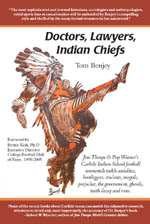
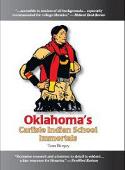
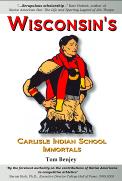
The advance reading copies (called ARCs in the trade) arrived for my new book and are being sent out to reviewers. This is a big moment in a writer’s life: seeing thousands of hours of hard work turned into something tangible. In the old days (pre-computer), ARCs were called galleys, bound galleys or galley proofs. Authors, editors and publishers go over these babies with a fine-tooth comb looking for errors, typos or things that have changed since writing was complete. It is an impossible task because, after all this scrutiny, some typos escape and find their way into the final book. But we try.
Another important use of ARCs is to see how the photos and artwork come out in print. Overall they came out very well, better than expected. But a cartoon about the Oorang Indians from a 1922 Baltimore newspaper is too dim. The challenge now is to figure out how to darken it without losing the detail.
This weekend I received some additional information and a correction regarding Louis Island from a family member who happened to see a previous blog. That was fortuitous because I want the book to be as accurate as possible. This blog is already proving to be of some value. That encourages me to continue with it.
Having these ARCs provides local booksellers the opportunity to provide their customers something extra. People can look at an ARC and pre-order the book if they choose. The bonus, besides being sure of getting a copy of the book as soon as it comes out, is to receive an inscription of his or her choice signed by the author. On-line booksellers also take pre-orders but personalized inscriptions are impractical.

Tags:Add new tag, ARC, biography, book, galleys, Louis Island
Posted in Albert Exendine, Alex Arcasa, Antonio Lubo, Archie Libby, Arthur Sheldon, Bemus Pierce, Benjamin Caswell, Caleb Sickles, Carlisle Indian School, Charles Guyon, Charles Williams, Dickinson College, Doctors, Lawyers, Indian Chiefs, Ed Rogers, Elmer Busch, Emil Hauser, Football, Frank Cayou, Frank Hudson, Frank Mt. Pleasant, Fred Broker, George May, George Tibbits, George Vedernack, Gus Welch, Hawley Pierce, Henry Broker, Hugh Wheelock, Isaac Seneca, James Johnson, James Phillips, Jim Thorpe, Joe Bergie, Joe Guyon, Joe Libby, Joel Wheelock, John B. Flinchum, Leon Boutwell, Lone Star Dietz, Louis Island, Martin Wheelock, Nicholas Bowen, Nick Lassa, Pete Calac, Pete Hauser, Pop Warner, Sampson Bird, Single-Wing, Stacy Matlock, Stancil Powell, Thomas St. Germain, Victor Kelly, Washington Redskins, Washington State University, Wauseka, William Baine, William Gardner, William Garlow, William Newashe | Leave a Comment »






 Tom Benjey's Weblog
