Archive for the ‘Joe Guyon’ Category
April 26, 2012
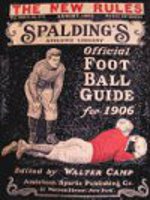
I thought I’d continue with the theme of Carlisle Indians who played football in WWI by looking through the 1919 Spalding Guide for references to the Carlisle team or its players. Before starting that, I checked to make sure that I hadn’t done it before as my memory isn’t as good as it once was. In January of this year, I did a piece about the Carlisle students whose names I wasn’t familiar with who were playing on military teams. I recollect having mentioned that, although the 1918 Spalding Guide included Carlisle’s schedule for that year, none of these games were played because the school was closed shortly before the beginning of the football season in 1918. Fortunately, some names I do recognize can be found in the 1919 book, too.
Om page 22 is the photograph of the 1918 Georgia Tech “Golden Tornado.” Joe Guyon is #8 and John Heisman is #12. Charles Guyon (Wahoo) isn’t in the photo. Perhaps, Heisman got rid of him by then. Page 188 displays headshots of players and coaches for the 1918 Mare Island Marines team. Lone Star Dietz, #3, coached this team composed mainly of his former Washington State players. So may of them were on this team that this photo was published as part of the Washington State yearbook for that year. The New Year’s Day game in Pasadena on January 1, 1919 was the second one for those who had also been on the 1915 Washington State squad that had played in Pasadena in 1916.
Page 263 includes a write up for the Base Section No. 5 team from Brest, a major port of embarkation: “On January 19, 1919, a Base foot ball squad was organized under Lieut. W. C. Collyer, former Cornell half-back. This squad was composed of the above mentioned engineers, together with several stars gathered together from different outfits. Of these, the most prominent was Artichoke, a former Haskell and Carlisle Indian star.” Not being aware of anyone named Artichoke, I am confident that the player in question was Chauncey Archiquette, Jim Thorpe’s early idol. Unfortunately, a team photo wasn’t included to see that Artichoke was indeed Archiquette.

Tags:Artichoke, Base Section 5, Brest, Golden Tornado, John Heisman, Mare Island Marines, Rose Bowl
Posted in Carlisle Indian School, Charles Guyon, Chauncey Archiquette, Football, Haskell Institute, Joe Guyon, Lone Star Dietz, Washington State University | Leave a Comment »
April 17, 2012
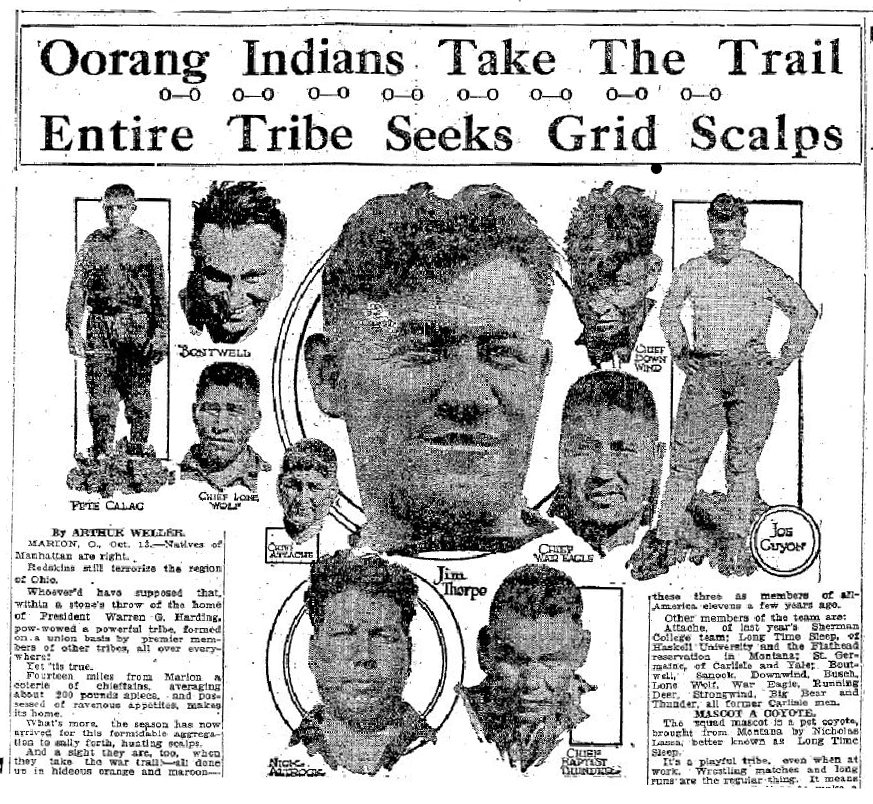
The photo on page 30 of Carlisle Indian School’s starting eleven for 1917, the last team that would represent the school, includes one player who would be heard from later, Nick Lassau. To learn more about Nick, aka Long Time Sleep, read up on the Oorang Indians of 1922 and 1923. Note that Carlisle’s uniforms had changed to include stripes across the midriff and the stripes that had been below the elbow were moved up above the elbow to align with the midriff stripes. Page 35 may contain the last thing written about a Carlisle team in a Spalding’s Guide: “Carlisle showed improvement over the previous year, but until they get a team of first rate caliber they will do well not to schedule so many matches with the big colleges.”
Page 41 begins the section on Foot Ball in West Virginia with the All-West Virginia Elevens selected by H. A. Stansbury, Athletic Director of West Virginia University. It was no surprise that Pete Calac of West Virginia Wesleyan headed the list. No other Carlisle Indians were on it, most likely due to not playing for a West Virginia school.
Page 50, immediately preceding the Foot Ball in the District of Columbia section, contains a photograph of the Georgetown University team on which the players are numbered but no legend is provided. Number 2, front row center in a sweater, is Georgetown’s Head Coach, Al Exendine, star end on the great 1907 Carlisle team. Georgetown was the class of DC college teams as had become the norm under one of Warner’s former assistants.
John Heisman, Head Coach of Georgia Tech, authored the Review of Far Southern Foot Ball. So, it is no surprise that he named Joe Guyon to his All-Southern Team at half-back. About his own team, Heisman wrote, “This team was considered by many as the best of the year anywhere. Whether it was or not need not here be debated. But certain is that in Strupper, Guyon and Hill it possessed three back-field men who were the equal of any other three that could be named the country over.” He said nothing about Guyon’s brother.
<next time—More Carlisle Players in The Great War>
Tags:Golden Tornado, John Heisman, Strupper
Posted in Albert Exendine, Carlisle Indian School, Charles Guyon, Doctors, Lawyers, Indian Chiefs, Football, Joe Guyon, John B. Flinchum, Nick Lassa, Pete Calac, Pop Warner | Leave a Comment »
April 15, 2012
Beginning on page 7, Camp discussed three unbeaten eastern teams, two of which had ties to Carlisle. Carlisle’s former coach, Pop Warner, completed his third consecutive undefeated season at Pittsburgh since leaving Carlisle after the 1914 season. More on Georgia Tech later.
When discussing the state of Pacific Coast football on page 9, Camp gives a Carlisle alum high marks: “Washington State, with seven veterans of the previous season’s team, was again coached by ‘Lone Star’ Dietz, and under his guiding hand established a clear title to the Pacific Coast Championship…She [Washington State] would give many eastern teams a hard battle.”
On page 11, in lieu of his annual All America Team, Camp lists Honorable Mention college players. Ends selected included Pete Calac, formerly of Carlisle, then playing for West Virginia Wesleyan. Backs included Joe Guyon, formerly of Carlisle, then playing on Georgia Tech’s undefeated “Golden Hurricane” team.
Page 13 listed All-America selections made by other pundits. Dick Jemison of the Atlanta Constitution named Guyon to his All-America team as a half-back. Lambert G. Sullivan of the Chicago Daily News placed William Gardner at end on his The Real “All-Western” Eleven on page 17. The All-Southern Eleven picked by seven football writers in the South placed Joe Guyon at half-back. And Fred Digby of the New Orleans Item put Guyon at full-back on his All-Southern Eleven as did Zip Newman of the Birmingham News. “Happy” Barnes of Tulane did the same. Closing out the college all-star teams on page 23 was the All-West Virginia Eleven picked by Greasy Neale, coach of West Virginia Wesleyan. He selected his own player, Pete Calac, as one of the ends.
A photo of the Georgia Tech team appears on page 8 of the 1918 Spalding’s Guide. Figure number 1 is Head Coach John Heisman. That is no surprise. Neither is it that number 13 is Joe Guyon. The last person listed, number 22, is C. Wahoo. From previous research, I know that is Charlie Wahoo, Joe Guyon’s brother Charles Guyon, who also used the fabricated name of Wahoo. That all the other figures in the photo are numbered in order and that Wahoo is positioned out of order is suspicious. So is that his figure is smaller than the others. It’s well known that Heisman didn’t think much of him and that he used recruiting his brother for the team to leverage an assistant coaching position for himself. Could this picture have been “photoshopped” to include him using a primitive tool available at the time?

<next time—More Carlisle Players in The Great War>
Tags:Dick Jemison, Fred Digby, Georgia Tech, Golden Tornado, Greasy Neale, Happy Barnes, John Heisman, Lambert Sullivan, Walter Camp, Xip Newman
Posted in Carlisle Indian School, Charles Guyon, Doctors, Lawyers, Indian Chiefs, Football, Joe Guyon, Lone Star Dietz, Pete Calac, Pop Warner, William Gardner | 2 Comments »
November 25, 2010
While doing a little research at the Pro Football Hall of Fame in Canton, Ohio recently, I came across a photocopy of a newspaper article titled “Backfield of Indians—Plan of Jim Thorpe.” The article began by saying that Thorpe planned on fielding an Indian backfield for the Canton Bulldogs during the 1919 season. The name of the newspaper and date were not on the copy but the paper must have been local to Canton or nearby Massillon because the third paragraph began, “Guyon’s presence here…” which implies that the paper is local to the team’s location. Discussing the possible line-up for the 1919 season suggests that the article was written after the end of the 1918 season, definitely after Armistice in November 1918. Sometime in 1919 is more likely because the article stated, “…will reach shores not later than September.”
The writer discusses how Thorpe plans to reunite with three of his former Carlisle teammates all in Canton’s backfield. Gus Welch would play quarterback (blocking back in the single-wing, wingback in the double-wing), Joe Guyon and Thorpe would be the halfbacks, and Pete Calac would be the fullback. All had played together on the 1912 Indian team but Guyon and Calac were needed on the line to replace Lone Star Dietz and Bill Newashe at the tackle positions because they were no longer playing on the team. Welch, Guyon and Calac were all in the backfield on the 1913 edition but Thorpe had departed by then.
Thorpe’s dream of being reunited fell through because Gus Welch took the head coaching position that had opened up with Lone Star Dietz’s dismissal. Thorpe, Calac and Guyon played pro ball together for several years and won championships in 1919 and 1920. Thorpe tried to field the same all-Indian backfield in 1917 but Joe Guyon elected to play college ball for National Champions Georgia Tech, was named to Walter Camp’s All America Second team at halfback, the same honor he received in 1913, his last year at Carlisle.
Tags:Canton Bulldogs
Posted in Carlisle Indian School, Football, Gus Welch, Jim Thorpe, Joe Guyon, Lone Star Dietz, Pete Calac, William Newashe | Leave a Comment »
August 13, 2010
Large newspapers of the day recorded the October 15, 1922 game simply as Canton 14 – Oorang 0 but that doesn’t begin to tell the story. In the early days of the NFL, the Canton Bulldogs were a powerhouse team that featured Jim Thorpe and his Carlisle Indian School teammates, Joe Guyon and Pete Calac, in the backfield. But in 1922, Jim Thorpe and Walter Lingo formed the Oorang Indians franchise to, at least in theory, compete with Canton for championships. Oorang’s results were anything but competitive as Father Time’s inexorable crush was their greatest opponent. However, they more than rose to occasion when they battled the eventual league champions. And battle they did.
Few details of the game were covered by the national media but a Massillon, Ohio newspaper and the hometown paper of one of the players provided some unexpected coverage of the hard-fought battle. After a scoreless first half, the Bulldogs scored their two touchdowns in the third quarter. The Evening Independent told the story, “During that part of the contest the game almost developed into a free-for-all when the Indians gave battle to several Canton linemen who used their fists on an opponent, guilty of kneeing one of the Canton halfbacks. Throughout the game, Thorpe’s charges played in a most determined fashion, and bloody faces were not uncommon.”
A skeptic might conclude that this was slanted by a reporter from the Bulldogs’ rivals’ lair but The Lebanon Daily News provided some verification when it wrote, “William Winneshiek…was the recipient Sunday of an extraordinary compliment from the football players of the Canton Bulldog professional team. Winnie played center against them for the Oorang Indians and as an expression of appreciation of his wonderful playing and good sportsmanship, he was presented with the football used in the game and also a gold watch. The game developed into a slugging match, but evidently the Lebanon Indian played the game and kept out of the fights.”

Tags:Canton Bulldogs, Oorang Indians, William Winneshiek
Posted in Football, Jim Thorpe, Joe Guyon, Pete Calac | Leave a Comment »
July 17, 2009
While researching the 1905 Carlisle-Massillon game for an article in an upcoming issue of The Coffin Corner, I noticed that Chauncey Archiquette played in that game. I hadn’t previously realized that he was back in a Carlisle uniform in 1905, but he most definitely was. That line-ups in newspaper coverage of games played that year generally include his name support that fact. In Steckbeck’s Fabulous Redmen, the line-ups for the 1904 Carlisle-Haskell game are on the page opposite the beginning of his discussion of the 1905 season. I noticed that Archiquette was in the line-up for that game as well. However, he wore a Haskell uniform. A look into Archiquette’s file showed that, after graduating from Carlisle in 1899, Chauncey had enrolled in a commercial course at Haskell. Newspaper accounts of Haskell games indicated that he had indeed played football for Haskell. This also explains how Archiquette happened to be at Haskell where, among other things, he became a young Jim Thorpe’s idol.
Few Carlisle players played against their old team after leaving the school. James Phillips, for example, refused to suit up for Northwestern in 1903 when they played the Indians. Instead, he watched the game from the stands. Joe Guyon is a notable exception in that he played in the humiliation of the hapless 1917 squad. He started the game but played just a little more than a quarter in which time he scored two touchdowns. Archiquette joined that small group in 1904 when the two Indian schools met for the only time.
Steckbeck marked nine Haskell players’ names with asterisks to denote that, after the 1904 thrashing, they “later enrolled at Carlisle.” It is worthwhile to note that Pop Warner was not at Carlisle for neither the 1904 season when the game was played, nor for the 1905 and 1906 seasons when many of the players transferred.
Tags:Massillon Tigers, The Coffin Corner
Posted in Carlisle Indian School, Chauncey Archiquette, Haskell Institute, James Phillips, Jim Thorpe, Joe Guyon, Pop Warner | Leave a Comment »
January 26, 2009
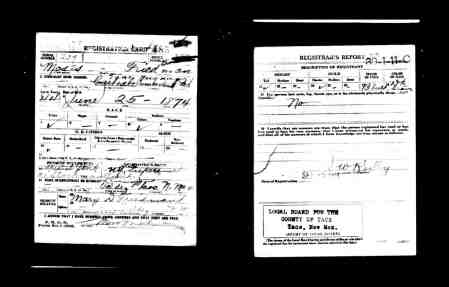
Google Alerts inform me of “news” on the internet regarding Lone Star Dietz, most of which I ignore. Although the most recent alert was a message largely concerned with Moses Friedman, that blog contains some misconceptions that are probably widely held. Matt is understandably confused by some of the entries on Friedman’s draft card (below) but those inconsistencies aren’t the worst problems. The misconceptions I consider serious are discussed in the paragraphs that follow.
- He could pass off the Moses as a given name perhaps, but not Friedman, especially considering that students kept an anglicized version of their Native name.
While it is true that some students were assigned anglicized versions of their original names, my experience researching Carlisle Indian School football players has been that the Anglicized names were generally assigned to an elder in the family, often at the agency in which the family was recorded. By the time Carlisle started fielding a football team in the 1890s, there had been so much intermarriage between Indians and whites that the majority of players I researched carried the family name of a white ancestor. For a small example, I seriously doubt if any of the six Carlisle Indians who were inducted into the College Football Hall of Fame carried Anglicized names, bastardized perhaps, as in the case of Guyon. Those names are:
a. Albert Exendine (may have originally been Oxendine)
b. Joe Guyon (probably Guion originally)
c. James Johnson
d. Ed Rogers
e. Jim Thorpe
f. Gus Welch
Had Friedman’s father married an Indian woman, he could easily been named Moses Friedman, although I am unaware of any evidence that indicates that he has Indian heritage. The point is that his name said nothing, one way or the other, about whether he had Indian heritage or not. Another point is that the Anglicized versions that are known for these men, Bright Path (Jim Thorpe) for one, are nothing like the names they were known by at Carlisle.
- My initial thoughts were of Lone Star Dietz, but why would he attempt to pass himself off as Indian with such a German sounding name?
As shown by the sample of European names above, by the 1890s a mixed-blood Indian could carry almost any European surname. Germans may have intermarried less than the French, English and Irish, but surely some did. Having the last name of Dietz (or Deitz as his father spelled it), is probably the weakest argument against him.
- However, Native-Americans were not exempt from the draft, …
Non-citizen Indians were exempt from the draft, but citizens weren’t. Indians as a group weren’t granted citizenship until after WWI, so most were not required to serve. However, the fact that so many volunteered and served with distinction speaks well for their bravery and patriotism. A significant number even went to Canada to enlist before the U. S. entered the war.
- As an aside, even though I have his date of birth I cannot find any Moses Friedman born in America, let alone Cincinatti [sic], on that date or even in 1874!
It was not unusual at all for births not to be recorded at that time. My own paternal grandmother had no birth certificate and she was born over a decade later.
Friedman’s draft registration is surely confusing, most likely because he was confused. As to why he would check the white box for race and also check the citizen box for Indian: my guess is that, knowing people of any race could be citizens or non-citizens, he ignored the Indian heading when he checked the citizen box. I am unaware of any attempt by Friedman to claim Indian heritage.
A look at his then current employment might shed some light as to why he put Carlisle as his permanent address. He was then doing “special work as stockman for NY Supreme Court” in Taos, NM. After resigning from his position as Superintendent of Carlisle Indian School and being acquitted in Federal Court, Friedman was probably taking any work he could get. His work in Taos sounds like it was temporary and Friedman may have had as yet established a permanent location after leaving Carlisle.
http://ciis.blogspot.com/2009/01/moses-friedman-and-lone-star-dietz-both.html
Tags:Moses Friedman
Posted in Albert Exendine, Carlisle Indian School, Ed Rogers, Gus Welch, James Johnson, Jim Thorpe, Joe Guyon, Lone Star Dietz | 10 Comments »
September 5, 2008
Yesterday’s email brought a curious announcement. I am going to receive a free, signed copy of a new book to be released soon. The Toilet Paper Entrepreneur by Mike Michalowicz, about which I know nothing, was looking for humorous bathroom graffiti. I sent in my all-time favorite from the back of the men’s room door at The Blessed Oliver Plunket, a bar/restaurant featuring live entertainment located across the street from the Cumberland County Historical Society. The Plunket, as it was better known, has numerous stories to tell but I’m not the one to tell them. In the late 70s, as I was leaving the men’s room, I noticed a scribble on the door:
No sign of intelligent life…Kirk Out
Apparently that witticism has found its way into a book.
Back to Donna Newashe McAllister’s question…
I expected that more people would comment on this and would like to see more myself. So, I’ll share some of my thoughts.
My wife and I have discussed this issue to some degree and I think it is an issue with multiple facets. First, I’m not so sure that American Indian athletes have necessarily declined. Judging today’s athletes with those who were at the Carlisle Indian School may not be fair. Those guys were world-class athletes coached by one of the most innovative coaches of all time. Pop Warner is criticized much today but few question his knowledge or his ability to coach football. During its heyday, Haskell had fine athletes and was led by Dick Hanley, Lone Star Dietz and Gus Welch, all of whom were excellent coaches. Dietz belongs in the College Football Hall of Fame. Neither Haskell nor the tribal colleges can afford to hire coaches of their caliber today.
Bob Wheeler tells me that Bill Thorpe shoots better than his age, 80, in golf. To compare anyone with Jim Thorpe is unfair. He was the greatest athlete of all time and could do anything well. I can’t imagine how he could be competitive in the pole vault, but he was. Sam Bird’s grandchildren and great-grandchildren are big in the rodeo. Some of the others didn’t have children and many settled off the reservation. For example, Joe Guyon was a big star at Carlisle, Georgia Tech and in the NFL where Joe Guyon, Jr. played for Catholic University.
But you seem to be focused more on leadership than on athletic ability. It appears to me that many of the better leaders did not return to the reservation after finishing at Carlisle or Haskell. Several were officers in WWI and were leaders in the service but didn’t return to lead their tribes. Some kept one foot in each world and their children found more opportunity in white society. For example, Thomas St. Germain’s son, grandson and great-grandson were/are renowned research physicians at Tulane University School of Medicine.
It may be that Indians are playing leadership roles individually but not together as a group. MANY of the Carlisle players went into coaching but Dietz, Exendine and Welch were about the only ones who made it their life’s work. Coaching was an even more precarious occupation then than now and only the best schools paid well. So, most devoted their considerable talents to other occupations. Even Exendine and Welch practiced law in the off-season.
Surely, other people have some insight into this issue.
Tags:Bill Thorpe, Blessed Oliver Plunket, Bob Wheeler, Dick Hanley, Mike Michalowicz, The Toilet Paper Entrepreneur
Posted in Albert Exendine, Carlisle Indian School, Football, Gus Welch, Jim Thorpe, Joe Guyon, Lone Star Dietz, Pop Warner, Sampson Bird, Thomas St. Germain, William Newashe | 2 Comments »
August 28, 2008
One of the most difficult and time-consuming things my editor has me do is to provide players’ full names. Now James G. Sweeney, a lawyer from Goshen, New York and a 50-year West Point supporter, has requested that I help him identify a number of players. Sweeney is writing an article about the 1905 Carlisle-Army game that was approved by the War Department but can’t find players’ first names in newspaper reports. Apparently because I write about Carlisle Indian School football, he thought I’d know all the players’ names. I wish it were so.
Finding the biggest stars’ first names isn’t too difficult and, by now, I can give most of them off the top of my head, assuming that I don’t have a senior moment. Even identifying them wasn’t a piece of cake. One of the reasons for that was that some of them played under multiple names. For example, Emil Hauser was better known as Wauseka and his brother, Pete, was also a star player; Charles Guyon went by Wahoo and, to confuse things further, his younger brother, Joe, came along a few years later and made an even bigger name for himself; and William H. Dietz played as Lone Star. Linda Witmer’s The Indian Industrial School: Carlisle, Pennsylvania 1879-1918 includes a list of students that attended Carlisle. Although incomplete, it nonetheless is a useful tool. One of the problems in identifying players is that many siblings and cousins attended the school. Determining which one is the correct person is a challenge.
Carlisle Indian School publications are invaluable resources. In 1905 the school newspaper went by The Arrow. The school had no literary magazine at that time. Most of the big games were covered by The Arrow. Often articles from big-city papers were reprinted in it. From them we get our cast of characters, if only by their last names. Varsity football players were often active in the literary and debating societies because they were among the oldest on campus. Write ups of these societies’ activities often included full names. Football stars often got press for more mundane activities because they were famous. These pieces often included their first names. Players other than stars received less coverage.
Graduation coverage included full names for the graduating class and much coverage of the individuals in that class. Because most students had little proper schooling before coming to Carlisle and often at advanced ages, they were unwilling or unable to commit to lengthy courses of study that would lead to graduation.
My ace in the hole is the athletic or football (it varied) banquet. This time I hit pay dirt because the coverage of the 1905 football banquet (held in early 1906) included not only the menu for the banquet and the toasts given, but a complete roster of the players on the team with those who lettered identified with Xs. Well not exactly complete. Chauncey Archiquette’s name was omitted. Perhaps Jeffrey Powers-Beck has the reason for his omission from the list in Chief: The American Indian Integration of Baseball, 1897-1945 when he states that Archiquette, then 28, was an 1898 Carlisle grad who had played football and other sports during his days at the school and returned as staff in 1905 but played again. This was the same Archiquette a 1953 Los Angeles Mirror article claimed was Jim Thorpe’s boyhood idol.

Tags:1905 Carlisle Army game, Carlisle vs. Army, Chauncey Archiquette, James G. Sweeney, Jeffrey Powers-Beck, Linda Witmer, The Real All-Americans, Wahoo
Posted in Carlisle Indian School, Charles Guyon, Emil Hauser, Football, Jim Thorpe, Joe Guyon, Lone Star Dietz, Pete Hauser, Wauseka | 2 Comments »
August 21, 2008
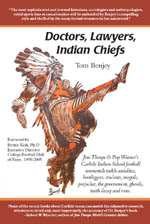
With the release of a new book starts another adventure – radio interviews. The first one I’m doing for Doctors, Lawyers, Indian Chiefs is with Warner Lewis on his Lewis at Large Smart Talk Radio show out of Lawrence, Kansas. The interview is being taped and will be aired the week of August 25 to 31 on KLWN Lawrence, KFRM Clay Center, KLKC Parsons and possibly other stations in eastern Kansas. Warner interviewed me two years ago on his sports talk show after Keep A-goin’: the life of Lone Star Dietz was released. It was a great experience. There are strong ties between Carlisle, PA and Lawrence, KS beside the fact that Lone Star Dietz played for Carlisle Indian School and coached Haskell Institute (now Haskell Indian Nations University) in Lawrence. When athletics were deemphasized at Carlisle, the leadership mantle was passed to Haskell where, during the 1920s and very early 1930s, the Fightin’ Indians were, as Ray Schmidt described, the lords of the prairie.
But more than the mantle passed from Carlisle to Haskell. Students also transferred to Haskell as well, Nick Lassaw for one. Nick was perhaps better known by the moniker given to him when he played for the Oorang Indians: Long Time Sleep. However, transferring between the two government Indian schools did not start at that time; it had a long tradition. The most notable example was after the 1904 Carlisle-Haskell game held at the St. Louis World’s Fair, the only time the schools played each other, when eight football players including the Guyon and Hauser brothers and several others came east to play for the stronger team.
There are other reasons that make Lawrence an appropriate to kick off my radio tour. Bernie Kish, Executive Director of the College Football Hall of Fame, 1995-2005, now lives in Lawrence. Bernie wrote a forward for Doctors, Lawyers, Indian Chiefs and I’m waiting for him to write a history of Haskell.
Tags:Bernie Kish, Haskell Indian Nations University, Haskell Institute, KLWN, Lawrence Kansas, Lewis at Large, Ray Schmidt, Smart Talk Radio, Warner Lewis
Posted in Carlisle Indian School, Charles Guyon, Doctors, Lawyers, Indian Chiefs, Football, Joe Guyon, Lone Star Dietz, Nick Lassa, Pete Hauser, Wauseka | Leave a Comment »



 Tom Benjey's Weblog
