Archive for the ‘Jim Thorpe’ Category

No Hall of Fame for Jim Thorpe

June 29, 2010

Shortly after Jim’s body had been moved to the Rose Hill Mausoleum in Tulsa, one of his sons, Bill Thorpe, wired Governor Murray to protest the removal, stating that it was done without the approval of the deceased’s children. The Shawnee Chamber of Commerce was in an uproar over losing $3,000 that was donated by area residents, but their fund-raising effort for the project hadn’t advance beyond the planning stages. A month earlier, she threatened to move the body if progress wasn’t made and she carried out that threat.

Plans in Tulsa didn’t advance much either. The JayCees considered it briefly but found that there were “too many complications.” In early November, still in 1953, reports came out of Mauch Chunk, Pennsylvania that two neighboring boroughs were considering merging, naming the new municipality after Jim Thorpe, creating a national shrine in his honor, and building a hospital for the treatment of cancer and heart patients (Thorpe suffered from both).

According to Bruce Heydt, managing editor of British Heritage magazine, Patricia Thorpe found her way to Mauch Chunk after meeting with Bert Bell, then the Commissioner of the NFL. She had seen a TV broadcast about Mauch Chunk’s revitalization efforts and Bell was looking for a location for the Pro Football Hall of Fame. They negotiated with Mauch Chunk officials and struck a deal. In addition to the above-named items, the Pro Football Hall of Fame would be located in the newly-incorporated Jim Thorpe, Pennsylvania. Bell died before he could bring the Hall of Fame to Jim Thorpe and it went to Canton, Ohio, the city for which Big Jim had his greatest professional years.

It appears that the town fulfilled its side of the agreement but Mrs. Thorpe and Bell were unable to provide everything they promised. The outcome may have been considerably different had Bert Bell succeeded in bringing the Hall of Fame to Jim Thorpe.
Jim Thorpe to be Moved?

June 25, 2010

Yesterday, Jack Thorpe, the son of Jim Thorpe, sued the Borough of Jim Thorpe, Pennsylvania, for the return of his father’s remains. When asked about the law suit that was filed in Federal Court in Scranton, he stated that he waited until the last of his sisters had passed to avoid disharmony in the family. The sisters, children of Jim Thorpe’s first wife, especially Grace the activist, supported the eastern location for their father’s remains. Jack and his brothers were the issue of Big Jim’s second marriage. The arrangement to have her, by the time this happened, very late husband interred in what had previously been called Mauch Chunk and East Mauch Chunk were made by Jim’s third, and last, wife.

The State of Oklahoma had the opportunity to provide a fitting memorial after he died but failed to support it. In the spring of 1953, the Shawnee, Oklahoma Chamber of Commerce planned to erect a memorial to Jim Thorpe on an 80-acre tract at a cost of $100,000. The State Legislature even appropriated $25,000 toward the cost of the memorial, but Governor Johnston Murray vetoed it. The Chamber of Commerce gave Mrs. Thorpe $3,000 in “expense money” with understanding that she would bring the body to Shawnee.

By early September, little money had been raised and she said that the rent on the crypt in Shawnee hadn’t been paid and that, “I was afraid he’d wind up in Potter’s Field.” The Chamber of Commerce was unaware that crypt rental was due. She then moved his body to Tulsa where plans “are pretty far along.” She announced that a five-man committee, of which three were Tulsans, had been formed to build a monument to be known as the Jim Thorpe memorial and foundation somewhere in the Tulsa area. (to be continued)

George Woodruff’s Coaching Record

June 8, 2010

Recently, biographer David O. Stewart asked “Who’s Checking the Facts?” in his blog at: http://207.56.179.67/david_stewart/2010/05/whos-checking-the-facts.html. In that blog, Stewart pointed out a gross error in a book that “just received a respectful review from NPR.” The book in question described Aaron Burr as “tall, elegantly dressed…” when it is widely known that Burr was short and that he was called “little Burr.” Stewart wonders “Why don’t book reviewers catch such howlers? Laziness? Ignorance? You tell me…” I have asked myself similar questions with regard to the 2007 books on Jim Thorpe by Sally Jenkins and Lars Anderson. Stewart’s question caused me to revisit Jenkins’s glaring omission of the 1905 Carlisle-Army game.

While trying to determine where Jenkins came up with a 10-5 record for the Carlisle Indians (she apparently included the Second Team’s loss to Susquehanna University on the same day the Varsity lost to Harvard), I noticed that Advisory Coach George Woodruff is generally credited by usually accurate sources, such as the College Football Hall of Fame and cfbdatawarehouse.com, with Carlisle’s 10 wins and 4 losses that year. This error is understandable because head coaches normally lead their teams for the entire season. That was not the case for George Woodruff and the 1905 Carlisle Indians.

After the Indians beat the Cadets at West Point on November 11, 1905 (the first time the Indians played Army), Woodruff left the team and headed to Washington, DC for a government job. Thus, his record for 1905 was 7-2. The remaining 5 games should have been awarded to Woodruff’s assistant, Ralph Kinney. Woodruff’s old friend, Gifford Pinchot, had taken the helm of the newly formed U. S. Forest Service and needed legal counsel. Woodruff accepted the position as the first Chief Legal Officer for the Forest Service.

Eliminating the 3 wins and 2 losses for games played after he was no longer coaching Carlisle does not dilute Woodruff’s worthiness for induction in the College Football Hall of Fame in the least. It’s just that records should be accurate.

Jim Thorpe’s Eye Disease

May 27, 2010

While looking through some 1911 newspapers about the 1911 Carlisle-Syracuse game for an article Ray Schmidt is doing for the College Football Historical Society, I came across a piece about Jim Thorpe having eye surgery. The December 12, 1911 edition of The Washington Post included a special from Carlisle, Pa. dated Dec. 6 titled, “Thorpe Under Knife” and subtitled “Great Indian Athlete Is Operated On for Eye Trouble.” This was news to me. I was completely unaware that Jim Thorpe had had eye trouble when he was young.

A quick scan of Thorpe biographies revealed nothing nor did the Carlisle Indian School newspaper and literary magazine. Apparently, wire services didn’t pick up this article and Thorpe biographers didn’t stumble across it. A reason for that may be that trachoma was so prevalent among Indians at that time that it was not surprising that Jim would have had it. Richard Henry Pratt devoted several pages to eye disease among the Indians in his autobiography because it was a large problem with which he dealt.

Dr. Cornelius R. Agnew of New York City visited Fort Marion and became interested in improving conditions for the Indians. Agnew was a frequent visitor at Carlisle and a significant benefactor. On each visit, he would examine ill students and recommend treatments for them. He also treated students with trachoma at his office in New York. After his demise, his protégé, Dr. L. Webster Fox, of Philadelphia stepped up and treated students for free, charging the school only a dollar a day for room and board in his hospital. Fox treated Carlisle students for 20 years and, during this time, trained the school’s physicians in performing certain treatments. So, by the time Jim Thorpe developed trachoma, the school’s physician was probably able to do the surgery himself.

The article pointed out that Thorpe was unable to read Walter Camp’s article in which he named Thorpe to his All America first team, but was able to listen to someone read it to him. Apparently, the surgery was successful because good vision is necessary to hit a major league fastball.

Jim Thorpe 1912 Olympics Postcard

May 24, 2010

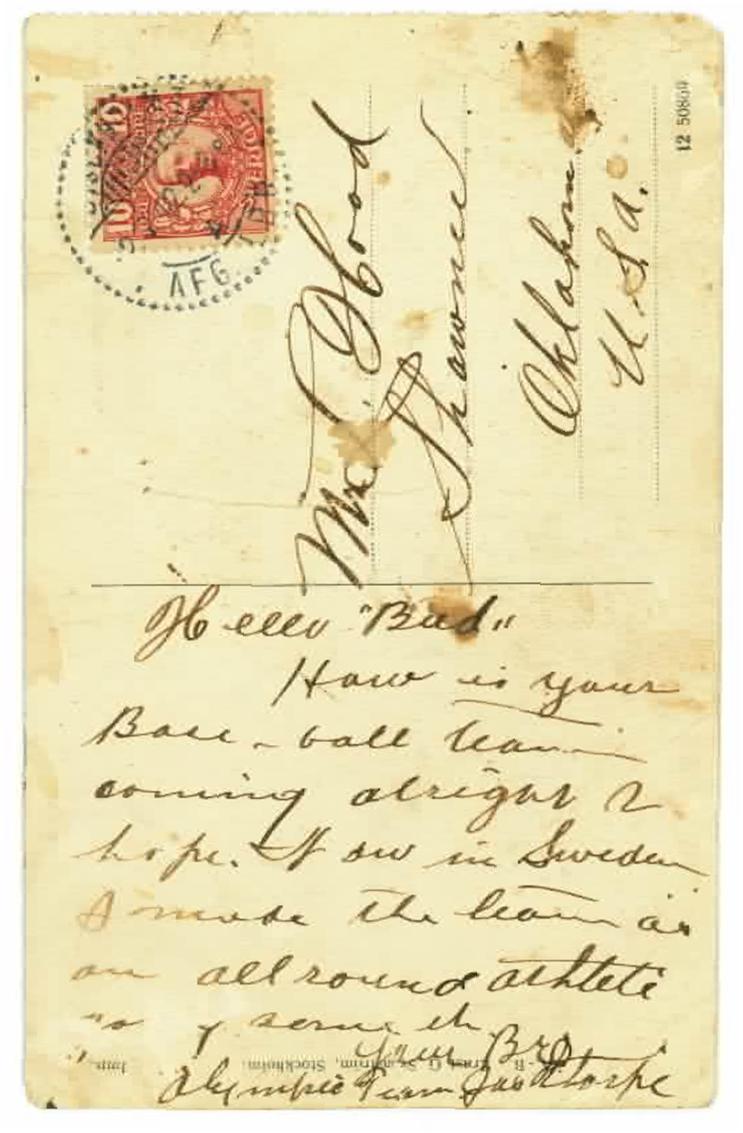
A postcard that Jim Thorpe sent to a childhood friend from the 1912 Stockholm Olympics is being offered for sale. Front and back views of the postcard are provided below.

Luther Hood, recipient of the card, was an Absentee Shawnee and a good friend of the Thorpe family. The families continue a strong friendship today. In tribal culture when a relative dies the family adopts someone to take that person’s place. It seems that Luther may have been an adopted brother to Jim Thorpe, who lost several very close family members, including his twin brother, when he was young. That is why he would have used the terms “Bud” and “Bro.”

The stamp on the card is from Sweden. Closer inspection is required to determine the postmark. The U. S. Olympic team, other than the distance runners and Thorpe, used the ship they traveled over on, the SS Finland, as their hotel during the Olympics. Perhaps the postcard was sent from the Finland.

Bob Wheeler is assisting the owner of what is surely an expensive item in selling it. If you are interested, contact Bob at bobwheelerwrc@aol.com


More Misinformation from a Journalist

May 17, 2010

While wrangling grandchildren in Bethesda, MD this weekend, my wife took the impressionable young minds into a bookstore. 12-year-old Joey, a bookie if there ever was one, picked up a copy of The Redskins Encyclopedia by Michael Richman. When he showed it to my wife, she immediately noticed several errors in a paragraph that deals with Lone Star Dietz. The offending paragraph can be found on page 3:

The hands-on Marshall fired Wray, too, and replaced him with William “Lone Star” Dietz, a part-blood Native American. Dietz recruited six football stars from the Haskell Indian School in Kansas, where he had once played with the great Jim Thorpe and later coached for four years. The recruits included “Chief” Larry Johnson, Louis “Rabbit” Weller, and John Orien Crow. The charismatic coach told his players to pose with war paint, feathers, and full headdresses before the 1933 home opener against the Giants.

Where to start? Let’s do them in the order they appear:

1. Dietz recruited six football stars from Haskell

I’ve read this elsewhere but can only verify that he brought four former Haskell students with him—the three Richman listed plus David Ward.

2. …from Haskell Indian School in Kansas…

They came from Haskell Institute (today’s Haskell Indian Nations University) in Lawrence, KS not Haskell Indian School.

3. …where he [Dietz] once played

There is no record of Dietz ever enrolling at Haskell Institute or playing on their football team. He did coach there from 1929 to 1932.

4. …where he [Dietz] once played with the great Jim Thorpe

Lone Star Dietz played with Jim Thorpe at Carlisle not Haskell.

Jim Thorpe attended Haskell Institute before attending Carlisle but did not play on the school’s football team.

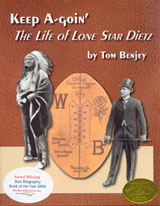
What is discouraging is that the author is a veteran journalist and should know that he should have checked his facts. It would have taken him little time to find these errors had he just consulted my biography of Lone Star Dietz and Bob Wheeler’s biography of Jim Thorpe. It is no surprise that yet another journalist has made less than accurate statements about Jim Thorpe and Carlisle Indian School, but it is unfortunate because most readers accept that the author has his facts right and don’t check for themselves.

Hang Time for a Watermelon

May 6, 2010

Today’s mail brought a new article by Jim Sweeney entitled, “Hang Time for a Watermelon: Did Thorpe Really Do It?” Jim first read about Thorpe’s celebrated feat in Bill Crawford’s 2005 biography, All American: the rise and fall of Jim Thorpe. Later, he read Steckbeck’s matter-of-fact recounting that implied superhuman feats were routine for the world’s greatest athlete.

The day was October 21, 1911; the place was Pittsburgh, Pennsylvania; and the opponent was the University of Pittsburgh. In the middle of Carlisle’s greatest season, Thorpe put on an exhibition that is still being talked about 99 years later. The Carlisle Arrow carried several accounts of the game from Pittsburgh newspapers, but the Dispatch told the story in the most detail:

“So fast were the Carlisle players that only twice during the many punting duels engaged in were Pittsburg players able to bring out the ball after it had been booted into their territory. Indeed, on two occasions, Thorpe, who kicked wonderfully well for Car lisle, got down the field under his own bootings, capturing the ball each time. Once he kicked a beautiful long spiral almost into the midst of five Pitt players and got down the field in time to grab the Pigskin, shake off three or four would-be tacklers and dart 20 yards across the line for a touchdown.”

Sweeney doubted that it was humanly possible to do what the reporter said Thorpe did. No one today could punt the ball from deep behind his line, recover from the awkward position a punter is in after kicking the ball, race downfield through his teammates and the opposition, position himself under the ball, and outjump others for it. Jim analyzed each aspect of the alleged feat to determine if it was even possible. When his article is published, I’ll inform you as to where it can be found so you can learn of his conclusions.

Jim Thorpe Sports Days

April 24, 2010

We interrupt the discussion of the 1910 Harvard Law School team to report on the annual Jim Thorpe Sports Days that kicked off yesterday with a flyby of two F-16 fighter jets from the Vermont Air Guard. Students from the war colleges of the various branches of the military compete in races and games each year on Indian Field at Carlisle Barracks, PA to continue a tradition that began in 1974. Indian Field is no stranger to athletic competitions; it is the field on which the Carlisle Indian School football teams played their home games. Jim Thorpe, Frank Mt. Pleasant and most of the others played their home games here. However, the Indians’ earliest games weren’t played on this field because it didn’t yet exist.

Superintendent Pratt reported on the football field in the September 1898 edition of The Red Man, the school’s newspaper at that time:

“The football team has not only continued to hold the high record it made, but through the earnings of the game a large and fine athletic field has been added to the school advantages. Ground adjoining the school was bought, leveled off, and a large, oval turf field, with a quarter mile running track, is now near completion.”

The field today is different from its 1898 configuration. The topsoil and its base were replaced over a century ago; a sprinkling system was added not many years after Indian Field was put into service; the track was upgraded a few times; and bleachers were eventually installed. Those wooden bleachers were replaced by the limestone-clad concrete grandstand years ago.

John Thorpe, grandson of Jim Thorpe, and George Yuda, son of Montreville Yuda, descendents of Carlisle Indian School students were present at the festivities.

The Sentinel’s coverage of Jim Thorpe Sports Days can be found at http://www.cumberlink.com/articles/2010/04/24/news/local/doc4bd25f2f21aa0440783186.txt

Carlisle Sentinel photo

Seek Restoration of Indian School

April 12, 2010

When looking for information on Asa Sweetcorn, I found a 1935 United Press article in which he was mentioned that had nothing to do with his exploits while at Carlisle. Titled “Seek Restoration of Indian School,” the article, datelined Carlisle, Pa., March 15, the article told of former Carlisle Indian School students’ attempt to reopen the school. Charles Dillon, who is best known for his role as “humpback” in the “hidden ball” play run against Harvard in 1903, spearheaded the movement. “Dillon, one of the greatest of the long line of football heroes who wore the colors of the old Indian School, was in town the other day sounding out sentiment on the proposed return of the Redskins.”

Dillon was on his way to Washington, DC to pry loose a few New Deal dollars to launch the program. He felt that little government money would be required to fund the school. He told some old friends in Carlisle, “Our aim is to build a college with Indian money, to be conducted by and for Indians. And only a comparatively few dollars are needed from the government to launch the program.” According to Mr. Dillon, “Scores of graduates of the erstwhile Carlisle Indian School are ready to contribute thousands of dollars toward establishing the school.”

He was to return to Carlisle the following week after negotiating with New Deal officials. Accompanying him were Jim Thorpe, Gus Welch, Albert “Chief” Bender and Asa Sweetcorn. That was a bad time for Indian schools to pry money out of the government. Lone Star Dietz left Haskell Institute in 1933 to coach the Boston Redskins after the government slashed Haskell’s budget. Gus Welch was well aware of funding issues as he replaced Dietz at Haskell. It is easy to understand why Dillon, Thorpe, Bender and Welch supported the initiative because they flourished at Carlisle. Sweetcorn’s involvement is curious because he was “canned” in Carlisle for his antics that reflected less than a studious attitude.

Source of Sweetcorn Misinformation

April 8, 2010

A July 1970 article about the Sisseton-Wahpeton tribe’s alcohol program that was written by Homer Bigart for the New York Times News Service appears to be the source of much of the misinformation about Asa Sweetcorn that Sally Jenkins used in her book about Carlisle Indian School. One paragraph from this unsourced article is the major culprit:

The most illustrious member of the tribe was Asa Sweetcorn, an all-time football hero who played with Jim Thorpe at Carlisle. Asa was a giant who reputedly wore a size 21 collar and could ram his head through wooden doors.

A quick look through Carlisle Indian School newspapers uncovered no mention of Asa Sweetcorn in any year other than 1910. The Washington Post listed him as the starting left guard for the game against Virginia. This supports Gus Welch’s assertion that Sweetcorn was a “running guard.” School newspaper coverage of some other 1910 games mentioned his play. No mention of him being in a Carlisle game before or after 1910 was found. Steckbeck only lists him as being on the varsity squad in 1910. However, his rosters were often incomplete. Asa may have been on the varsity before 1910 but wasn’t a starter. But no evidence has been found to support that.

So, Sweetcorn was not a star on the 1910 team, or any other year. So, he definitely wasn’t “an all-time football hero.” He didn’t play on the varsity with Jim Thorpe, as Thorpe only played on the varsity in 1907, 1908, 1911 and 1912. He was not at Carlisle in 1910 when Sweetcorn played. So, the two didn’t play on the same team unless, when younger, they played on a shop team together.

Sweetcorn may have bulked up after leaving Carlisle, but Welch’s description of him and his photograph in uniform differ from that. He was anything but a giant when at Carlisle. It is possible that he gained so much weight later that he needed a size 21 collar, but he surely didn’t when he was at the Indian School.