Archive for the ‘Jim Thorpe’ Category
November 25, 2010
While doing a little research at the Pro Football Hall of Fame in Canton, Ohio recently, I came across a photocopy of a newspaper article titled “Backfield of Indians—Plan of Jim Thorpe.” The article began by saying that Thorpe planned on fielding an Indian backfield for the Canton Bulldogs during the 1919 season. The name of the newspaper and date were not on the copy but the paper must have been local to Canton or nearby Massillon because the third paragraph began, “Guyon’s presence here…” which implies that the paper is local to the team’s location. Discussing the possible line-up for the 1919 season suggests that the article was written after the end of the 1918 season, definitely after Armistice in November 1918. Sometime in 1919 is more likely because the article stated, “…will reach shores not later than September.”
The writer discusses how Thorpe plans to reunite with three of his former Carlisle teammates all in Canton’s backfield. Gus Welch would play quarterback (blocking back in the single-wing, wingback in the double-wing), Joe Guyon and Thorpe would be the halfbacks, and Pete Calac would be the fullback. All had played together on the 1912 Indian team but Guyon and Calac were needed on the line to replace Lone Star Dietz and Bill Newashe at the tackle positions because they were no longer playing on the team. Welch, Guyon and Calac were all in the backfield on the 1913 edition but Thorpe had departed by then.
Thorpe’s dream of being reunited fell through because Gus Welch took the head coaching position that had opened up with Lone Star Dietz’s dismissal. Thorpe, Calac and Guyon played pro ball together for several years and won championships in 1919 and 1920. Thorpe tried to field the same all-Indian backfield in 1917 but Joe Guyon elected to play college ball for National Champions Georgia Tech, was named to Walter Camp’s All America Second team at halfback, the same honor he received in 1913, his last year at Carlisle.
Tags:Canton Bulldogs
Posted in Carlisle Indian School, Football, Gus Welch, Jim Thorpe, Joe Guyon, Lone Star Dietz, Pete Calac, William Newashe | Leave a Comment »
November 2, 2010
Now that we’ve dealt with some obvious errors in Rich Manning’s article, let’s get to the original issue: formations. The single-wing section in the Carlisle Indian School article in LeatherHelmetIllus.com starts this way:
In 1907, ‘Pop’ Warner returned to Carlisle. Together he and the Indians developed a new formation that would revolutionize football. The single wing shifted the halfback out wide, to outflank the opposing tackle. The new offense formed a shape that look like a wing. It opened up options and disguised intentions. The ability to show one thing and do another combined with the new rules made it possible to run, throw or kick at any time. ‘Pop’ Warner unveiled the new formation against the University of Pennsylvania, on Oct. 26, 1907.
I have read that the single-wing was unleashed in several different years due to Pop Warner’s inconsistent memory and writers’ imaginations. After researching this topic a bit, I came to believe that the single-wing did not arrive fully formed as the unbalanced-line, direct snap version depicted as Formation A in Warner’s 1927 book. I have concluded that the formation evolved over time as Warner implied on page 136 of his 1927 classic where he stated that it was first used by the Carlisle Indians and that he had used it or variations of it since the rules change of 1906. That he spent a week in Carlisle before the start of the season preparing coaches Bemus Pierce and Frank Hudson for the rule changes gives credibility for it having been first used by the Indians in 1906 when he wasn’t their coach. Fortunately, some documentation exists.
Warner began marketing a correspondence course on football in 1908 for which I have located and have reprinted the Offense pamphlet along with its annual updates. The 1908 pamphlet includes a number of offensive formations, which is not surprising as Warner was noted for tinkering with them. That newspaper coverage of the 1907 Penn game mentioned that multiple formations were used is not surprising. However, it is far from clear that end-back formation, the earliest documented version of Warner’s single-wing, was the formation being described for many of the plays as it didn’t feature a direct snap to a running back. That would come later. However, the punt formation did allow direct snaps to the backs and Warner had devised a set of running and passing plays from this formation.
He even described Play No. 17 thusly, “This is the long forward pass play used so successfully last season.” Last season would have been 1907, so this is likely the formation from which Frank Mt. Pleasant and Pete Hauser completed all those passes, not an early incarnation of the single-wing.
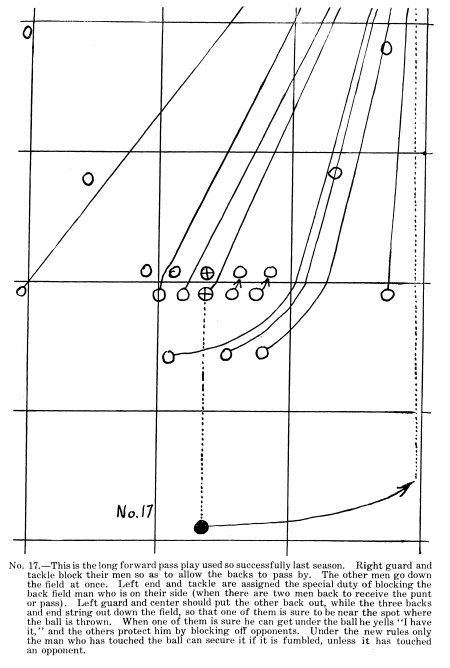
Play No. 17 from 1908 correspondence course Offense pamphlet
Tags:LeatherHelmetIllus.com, Rich Manning
Posted in Albert Exendine, Bemus Pierce, Carlisle Indian School, Football, Frank Hudson, Frank Mt. Pleasant, Jim Thorpe, Pete Hauser, Pop Warner, Single-Wing | Leave a Comment »
October 29, 2010
Let’s now look at Rich Manning’s statement regarding Jim Thorpe:
The [Pennsylvania] game also marked the debut of Jim Thorpe. He broke free for 45 yards the second time he touched the ball.
This statement didn’t ring true because Pop Warner wouldn’t likely put an untested player like the young Thorpe into the pressure of a big game. He was more likely to have given him some playing time in the warm up games to better prepare him for game situations. One of the purposes of the warm up games at the beginning of the season was to give new players playing time in game situations with little pressure. However, the 1907 schedule didn’t provide Warner much opportunity to try untested players. Lebanon Valley College and Susquehanna University were the only games with lopsided scores. Unfortunately, the reports for those games in the Carlisle school newspaper didn’t list the names of all the players who got into those games. One assumes that Jim Thorpe got significant playing time in the 91-0 blow out of Susquehanna. Although we don’t know that for sure, it wasn’t necessary to research that point because the write up of the Bucknell game provides all the information we need to show that Warner didn’t debut Thorpe against Penn.
The Indian School newspaper reprinted coverage from The Evening Sentinel about the Bucknell game, including, “After the next kick-off [Jim] Thorpe made a long run, but dropped the ball,” and in the second half, “Thorpe did most of the work carrying the ball, and proved an excellent ground gainer. He followed his interference well and held the ball.”
So, Warner debutted Jim Thorpe a week earlier than Manning stated, assuming that he didn’t play in the early blow outs or that they didn’t count because they were warm up games.
The next blog will deal with the errors in the article related to formations .
Tags:Bucknell University, Rich Manning, University of Pennsylvania
Posted in Carlisle Indian School, Football, Jim Thorpe, Pop Warner, Single-Wing | Leave a Comment »
October 27, 2010
I was recently asked if Pop Warner unveiled the single-wing against Penn in the Carlisle Indians’ fifth game of the 1907 season. Penn was actually Carlisle’s 7th opponent that year but that was probably just a typo made by the person asking the question. This was the first time I had heard (or read) that the single-wing was first used in that particular game. I have seen it attributed to several other times but not that one. A little research found a source for this claim but quite possibly not the only person to make it. Follows is an extract from an article on the Carlisle Indians in LeatherHelmetIllus.com:
‘Pop’ Warner unveiled the new [single-wing] formation against the University of Pennsylvania, on Oct. 26, 1907. So far that season no team had crossed the Quaker’s goal line. Carlisle was undefeated. A large crowd of 22,800 fans looked on. They were expecting a good game but they got more than they bargained for. Carlisle scored on the second play: a 40 yard pass from Hauser to Gardner, caught on the run. The diversified offense racked up 402 yards, to 76 yards for Penn., Carlisle went 8 of 16 passing. The game also marked the debut of Jim Thorpe. He broke free for 45 yards the second time he touched the ball. The Indians won 26 – 6.
After finding this, I set about locating game accounts in period newspapers. Before resolving the issue of the single-wing, I noticed a significant error—or the sports writers of the day had it all wrong. Nowhere did I find mention of (William) Gardner scoring a touchdown or anything else in that game. What I did find in the coverage by The Washington Post, The New York Times, United Press and other wire service accounts was that the Indians’ first score came on a field goal kicked by Pete Hauser early in the game. That score was followed by Fritz Hendricks’ 100-yard touchdown run after picking up Hollenbach’s fumble. Payne closed out the first-half scoring with a touchdown of his own around Penn’s end from the 4-yard line. Penn played better in the second half and didn’t allow Carlisle an offensive touchdown. However, Little Boy scored his touchdown by diving on a Penn punt that Albert Exendine had blocked and fell behind their goal line. Hauser closed out Carlisle’s scoring with a second field goal. Frank Mt. Pleasant kick the extra points after each touchdown. Although Mt. Pleasant and Hauser received much praise for their passing in this game, none of their tosses went for a touchdown to Gardner or anyone else.
The next blog will deal with the errors related to Jim Thorpe and the single-wing.
Tags:Albert Payne, Fritz hendricks, LeatherHelmetIllus.com, Little Boy, Rich Manning
Posted in Albert Exendine, Carlisle Indian School, Doctors, Lawyers, Indian Chiefs, Football, Frank Mt. Pleasant, Jim Thorpe, Pete Hauser, Pop Warner, Single-Wing, William Gardner | Leave a Comment »
October 20, 2010
Although several books written have been written about Jim Thorpe in recent years, little new information has been uncovered about him. The reason for that is that Robert W. Wheeler plowed so deeply when he researched everyone’s All American that little ground remained untouched. Bob spent seven years researching what began as an oral history of the great athlete for his master’s thesis. Most of the people he interviewed who knew or interacted with Thorpe are no longer alive and, thus, not available for other’s to interview. Bob has graciously allowed others to use his interview tapes. Some artifacts, such as scrapbooks, that Wheeler was able to study are now out of the Thorpe family’s hands and, in some cases, held by private collectors who do not make them available to researchers.
So, Big Jim’s recent biographers have stood on Wheeler’s shoulders in more than one way. Put another, perhaps better, way by Freddie Wardecker, there has been little point to anyone else writing a Thorpe biography since Wheeler’s. Dick Schaap put it succinctly when he said, “Robert W. Wheeler is Jim Thorpe’s Boswell.”
Recent Thorpe biographers have been invited to speak in Carlisle, but not Bob Wheeler—until now. He will be speaking at the inaugural Celebrate the Book festival at the Expo Center on Saturday at 2:00 p.m. And I have been given the honor to introduce him. Of course, I was far from the first choice, but due to other people having schedule conflicts and that I was going to be at the festival anyway, I get to do this. I may be doing this because the better choices were busy but that’s OK with me. Bob Wheeler’s odyssey across the country and his experiences along the way could make a separate book. If you’re within a couple of hours of Carlisle, it’s an easy drive. His is a talk not to be missed.
Tags:Robert W. Wheeler
Posted in Carlisle Indian School, Jim Thorpe | Leave a Comment »
September 15, 2010
Recently, a young man, who I will call Chapman, a twenty-something who is on his way to becoming a lawyer, described my books as being “non-mainstream” and concluded that I may be strange, for picking such subjects I suppose. While I may be strange, especially to a young person, there is nothing strange about the topics of my books. Perhaps someday he will come to learn that being “non-mainstream” is a good thing. The world doesn’t need another book on Lincoln; it doesn’t even need another one on Jim Thorpe. What is needed are books on people whose contributions should be remembered but won’t if someone doesn’t capture their life stories before they are lost to posterity. I only wish I had undertaken this earlier, while more of them were still alive.
My hat is off to Bob Wheeler for having the vision as a young grad student with no money to first convince his advisor that an aural history of Jim Thorpe was a worthwhile undertaking and then to hitchhike across the country to interview anyone still alive who knew Thorpe. I wish that I had had the vision to interview my grandparents, uncles and aunts when they were still alive, but I didn’t. Not only is part of my family’s history lost, but since few others had the vision to capture their families’ histories, we have lost much of our history collectively.
There are rewards to researching and writing these books, albeit not financial. This enterprise is akin to what the Iowa farmer alluded to when, after winning an $8M lottery and asked what he intended to do, he responded, “Keep on farming as long as the money holds out.” The real rewards come from the satisfaction of having played a small part in helping a families learn more of their own history or, occasionally, helping long-lost family members reconnect. Chapman, if you think Carlisle Indian School football players are an obscure topic, you should watch Book TV on CSPAN2 some weekend. There you will find some really obscure book topics but, if you’re lucky, you’ll also see Robert Caro and come to value his work which is at such a high level that the rest of us can only aspire to reach.
Tags:Robert Caro, Robert W. Wheeler
Posted in Carlisle Indian School, Jim Thorpe | Leave a Comment »
August 21, 2010
Yes, Robert W. Wheeler, author of the definitive biography of Jim Thorpe, is coming to Carlisle. On Thursday, the Friends of Bosler Library held a press conference to formally announce the inaugural Celebrate the Book festival to be held on Saturday, October 23 at the Expo Center in Carlisle, Pennsylvania. This will afford readers, sports fans and historians a rare opportunity to meet Bob Wheeler and to hear him speak. He will give a talk and take questions about his book. In many ways, I find how he conducted his research to be even more interesting than Thorpe’s life story.
After convincing his thesis advisor to allow him to write an aural history, a new concept at the time, Wheeler, a grad student with little financial backing, hitchhiked around the country to interview people who had been connected with Thorpe during his lifetime. Interviewing Thorpe was impossible as he died two decades before Wheeler set sail on his odyssey.
Almost everyone he interviewed is now dead and many of the artifacts he perused are no longer available to researchers. He interviewed every one he could think of who had a connection to Thorpe and anyone who would talk with him. Occasionally, it was even necessary to deal with unsavory characters, but he did that because it was necessary to be able to tell Big Jim’s story. He met with anyone from the obscure to President Eisenhower. He was so thorough that Dick Schaap referred to him as “Jim Thorpe’s Boswell.”
But Bob didn’t stop when his book was completed and his degree awarded. He and his new bride, Florence Ridlon, opened an office in what had been a closet in a Washington, DC hotel and worked doggedly to get Jim’s Olympic medals restored. Flo will be on hand to discuss her great find that made medal restoration possible.
Also speaking that day is Dr. Richard Sommers, Sr. Historian at the Military History Institute. In addition to housing military archives, the MHI also holds Carlisle Indian School records due to its having been located on Carlisle Barracks. Visiting the MHI and meeting Dr. Sommers are musts for anyone researching the Carlisle Indian School.
Y’all come and see us on October 23. More information can be found at www.CelebratetheBook.org.

Tags:Bob Wheeler, Carlisle Expo Center, Celebrate the Book, Dick Schaap, Eisenhower, Flo Ridlon, Florence Ridlon, Military History Institute, Richard Sommers, Robert W. Wheeler
Posted in Carlisle Indian School, Football, Jim Thorpe | Leave a Comment »
August 13, 2010
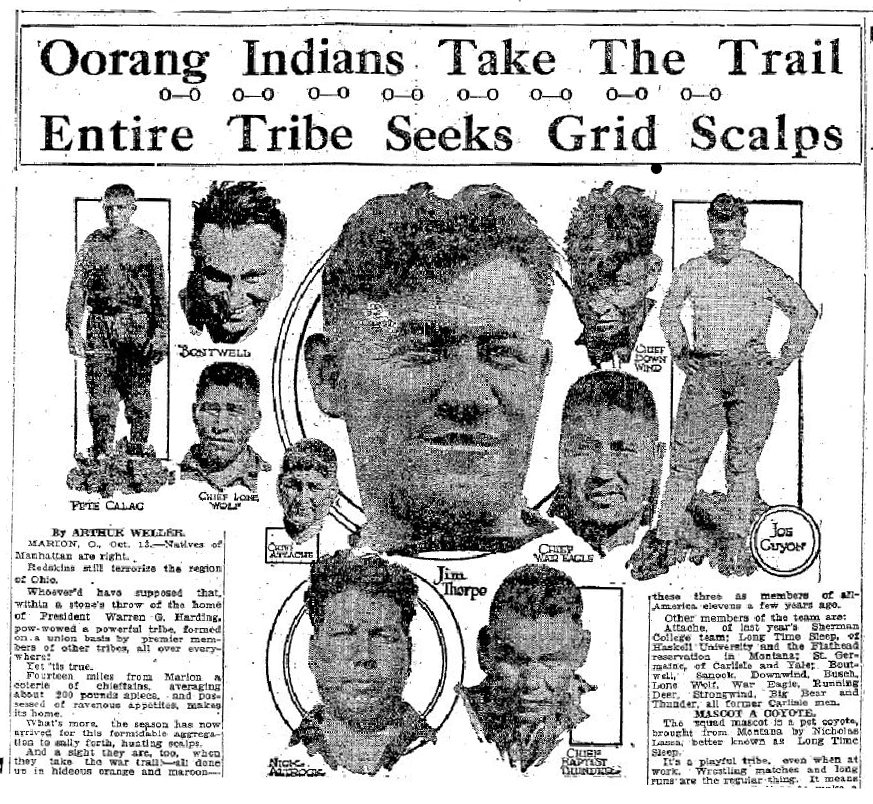
Large newspapers of the day recorded the October 15, 1922 game simply as Canton 14 – Oorang 0 but that doesn’t begin to tell the story. In the early days of the NFL, the Canton Bulldogs were a powerhouse team that featured Jim Thorpe and his Carlisle Indian School teammates, Joe Guyon and Pete Calac, in the backfield. But in 1922, Jim Thorpe and Walter Lingo formed the Oorang Indians franchise to, at least in theory, compete with Canton for championships. Oorang’s results were anything but competitive as Father Time’s inexorable crush was their greatest opponent. However, they more than rose to occasion when they battled the eventual league champions. And battle they did.
Few details of the game were covered by the national media but a Massillon, Ohio newspaper and the hometown paper of one of the players provided some unexpected coverage of the hard-fought battle. After a scoreless first half, the Bulldogs scored their two touchdowns in the third quarter. The Evening Independent told the story, “During that part of the contest the game almost developed into a free-for-all when the Indians gave battle to several Canton linemen who used their fists on an opponent, guilty of kneeing one of the Canton halfbacks. Throughout the game, Thorpe’s charges played in a most determined fashion, and bloody faces were not uncommon.”
A skeptic might conclude that this was slanted by a reporter from the Bulldogs’ rivals’ lair but The Lebanon Daily News provided some verification when it wrote, “William Winneshiek…was the recipient Sunday of an extraordinary compliment from the football players of the Canton Bulldog professional team. Winnie played center against them for the Oorang Indians and as an expression of appreciation of his wonderful playing and good sportsmanship, he was presented with the football used in the game and also a gold watch. The game developed into a slugging match, but evidently the Lebanon Indian played the game and kept out of the fights.”

Tags:Canton Bulldogs, Oorang Indians, William Winneshiek
Posted in Football, Jim Thorpe, Joe Guyon, Pete Calac | Leave a Comment »
August 2, 2010
John Luciew (pronounced Lucy), a reporter for Harrisburg’s Patriot-News, contacted me last week about the court case in which Jack Thorpe is trying to have his father’s remains brought to Oklahoma in perpetuity. Luciew was most interested in what I knew about Carlisle’s attempts, if any, to have Thorpe’s remains placed here back in 1953. I hadn’t looked into that before, so I had to do a little research. Freddy Wardecker, proprietor of Wardecker’s Menswear (formerly Blumenthal’s), gave me some information to go on and I was off to the races.
Jim Thorpe renewed acquaintances in 1951 when he was in Carlisle for the premier of his biopic, Jim Thorpe– All American. When he died just two years later, Carlislians wanted to honor him by locating his memorial here. A committee was formed, headed by attorney John B. Fowler (now deceased). The committee negotiated a location for the grave and monument near Indian Field at Carlisle Barracks where the young athlete made a name for himself when that facility was Carlisle Indian School. When Mauch Chunk entered the picture, Carlisle demurred, not wanting to get in a bidding war. In 1982, Sports Illustrated quoted Fowler as saying, “Pat wanted too much money. We felt like we were getting in a bidding war. We tried even after he died, but her price was too high.” Whether the Mauch Chunk group outbid others isn’t clear. What is clear is that they were actually able to raise the money and built the monument that stands there today.
Carlisle eventually placed a historic marker on the square next to the old courthouse. Some people think he is buried there but his remains are in the borough currently known as Jim Thorpe. Here is a link to the article Luciew wrote: http://www.pennlive.com/midstate/index.ssf/2010/08/town_of_jim_thorpe_is_ready_to.html

Photo by William Fischer, Jr.
Tags:Blumenthal, Carlisle Barracks, Fred Wardecker, John Fowler, John Luciew, Mauch Chunk, Oklahoma, Patricia Thorpe, Shawnee
Posted in Carlisle Indian School, Jim Thorpe | Leave a Comment »
July 10, 2010
Yet another biography of Jim Thorpe is to be released soon. Alfred A. Knopf, Inc. has announced that Native American Son: The Life and Sporting Legend of Jim Thorpe by Kate Buford will be released in October. Ms. Buford is the author of Burt Lancaster: An American Life. Buford’s reputation and history suggest that her book will be better than the other recent attempts at chronicling the great athlete’s life. Was she able to gain access to Jim Thorpe’s scrapbooks? It is believed that Robert W. Wheeler was the last Thorpe biographer to have them available for his research. They are now in the hands of a well-known collector of sports artifacts who doesn’t generally allow researchers to see them.
One thing that is sure is that the Kate Buford didn’t have access to the vast majority of the people Wheeler interviewed due to their demise during the intervening years. However, Wheeler taped his interviews on a bulky tape recorder that he lugged as he hitchhiked across the country to interview anyone he could find who had a relationship with Thorpe. He has made the recording of his interview with former West Point cadet Dwight David Eisenhower available to others, but even that hasn’t stopped other authors from writing inaccuracies about the 1912 Carlisle-Army game.
I am curious to learn more about Big Jim’s eye disease. Recently, I learned that he had eye surgery while at Carlisle. About all I have uncovered so far is that he was hospitalized for three days. Nothing was stated about the reason for the surgery. The medical records from his student file are long gone. Perhaps the person who took them or his descendants will return them or at least make their contents public. There are still things to learn about Jim Thorpe. This fall, we will see if this new biography shares any of them.
Tags:Burt Lancaster, Kate Buford, Knopf, Robert W. Wheeler
Posted in Carlisle Indian School, Football, Jim Thorpe | 7 Comments »





 Tom Benjey's Weblog