Archive for the ‘Haskell Institute’ Category

Even More 1903 Carlisle Stars

February 13, 2012

Ed Rogers and James Phillips weren’t the only Carlisle Indians to play for a future Big Ten team in 1903.  Player #4 (players on team photos in Spalding’s guides are conveniently numbered for the ease of the reader) on the University of Wisconsin team photo on page 20 is William Baine. He played for the Indians  from 1899 to 1900, then returned to Haskell Institute to play before enrolling at Wisconsin in 1903. Prior to coming to Carlisle, Baine had played for Haskell and its cross-town rival, the University of Kansas. While at Carlisle, William was enrolled in Dickinson College Preparatory School.

The photo of the 1903 Macalester College team on page 68 includes Lone Star Dietz as player #11. Dietz played for Friends University part of the 1904 season but a Friends team photo is not to be found in the 1905 Spalding’s Guide. Dietz enrolled at Carlisle in 1907. It isn’t clear what he did during the 1905 and 1906 seasons.

On page 123, Archie Rice, Sporting Editor of the San Francisco Chronicle, named Weller of Stanford as fullback of his 1903 All-Pacific eleven but mitigated that with his next sentence: “There is a possibility that Bemis [sic] Pierce of the Sherman Indians, but formerly of Carlisle, might be more valuable for the team than big Weller….” When Pierce left Carlisle for Sherman Institute in Riverside, California, the Carlisle school newspaper reported that he was to coach that Indian School team, but it appears that he also donned the moleskins to get into the action as a player.

That the 1903 season results and team photos for both Haskell Institute and Sherman Institute were omitted from the 1904 Spalding’s Guide is unfortunate. According the David DeLasses’ www.cfbdatawarehouse.com, Sherman Institute went 4-4 in 1903 with a win over Southern Cal and losses to Stanford and Carlisle. That site has Haskell Institute going 7-4 with wins over Texas, Kansas and Missouri and losses to Nebraska, Chicago and Kansas State. The 1905 Spalding’s Guide has a lot more about Haskell.

Carlisle to Play Utah on Christmas

April 26, 2011

The next day’s issue of Deseret News out of Salt Lake City announced the upcoming Carlisle-Utah game with more vigor but no new facts; “The University football players had better get their scalps in pretty good shape between now and Christmas, otherwise they may lose them. Word has reached the city that the Carlisle Indians are due to swoop down on the Varsity bunch that day, and if possible ‘lift their scalps.’ …Nothing definite has been decided upon but the probabilities are that a sufficient sum of money will soon be forthcoming to induce the Indians to come here. The [Christmas Day] game would be the biggest gridiron event of the season and would undoubtedly pay well.”

The November 27 issue of The Red Man & Helper included game scores for the entire regular season, including the victory the previous day, Thanksgiving Day, over Northwestern but made no mention of post season games, either possible or scheduled. The next day’s “Notes of the Gridiron” column, probably circulated via a wire service gossiped about possible post season games: “Notre Dame and Indians are talking of a post season game. Carlisle and Haskell may play Dec. 5 for the Indian championship.”

That Sunday’s Salt Lake Herald blared “Big Game for Christmas Day” and “Varsity Signs Contracts to Play Indians Here.” In part, the article stated, “This game will be none other than one in which the famous Carlisle Indians will play the principal part and the other team will be made up from the present eleven representing the state university, with the pick of the players on several of the other teams to fill in the weak spots on the varsity. The date of the game is Christmas and it will be played on Cummings field. The contracts for the game were signed several days ago by the members of the varsity athletic committee, but the facts were not given out until yesterday, The signing of the contracts by Coach Warner, for the Carlisle Indians, would indicate that there can be no hitch now and that the game will be a sure go.”

To be continued….

Carlisle Causes Eligibility Rule Changes

September 28, 2010

The on-field influences the government Indian schools, Carlisle mostly but also Haskell to some extent, had on the development of college football are well known. Less well-known are the impacts on the rules under which the game is played. Most football historians are aware that Carlisle Indian School was frequently criticized for not adhering to eligibility rules similar to those agreed to by the major colleges. In 1908, Pop Warner instituted a limit of four years of eligibility on the varsity team for Carlisle’s players. Years spent riding the bench without playing were most likely not counted against the four years. Something that is not known as well is that major colleges routinely ignored the fact that players they recruited from Carlisle had already played for four years prior to enrolling in college. That was about to change in 1905 if some had their way.

A November 29, 1904 article datelined Chicago that was printed in The Boston Globe announced that eligibility rules were about to be enforced more stringently, at least by some schools. “A meeting of representatives of leading western colleges” (read Big Ten) agreed on rule changes to which they were to comply. Two schools were singled out specifically: “Carlisle and Haskell Indian Schools, two formerly unclassified institutions, were raised to the ranks of colleges, and students who have competed for four years from those institutions in the future will not be allowed to compete in events controlled by western colleges.” Since Carlisle and Haskell seldom played more than a total of two games a year against the schools that became the Big Ten, this rule was probably aimed at the schools themselves. Several former Carlisle players had played for these schools after having used up their eligibility at the Indian school. Some that come quickly to mind are: Frank Cayou, Illinois; James Johnson, Northwestern; James Phillips, Northwestern; William Baine, Wisconsin; and Ed Rogers, Minnesota.

Next time – Freshmen.

Native All-Star Football Game July 24, 2010

July 6, 2010

The Native All-Star Football Game is for Native American and Alaska Native high school football players along with Canadian Aboriginals who will graduate in 2010 that are able to prove their Native heritage by holding a tribal identification card from a federally recognized Native American Indian Tribe or a Canadian Indigenous Tribe.

Since 2002, this game has given young Native American men the honor to finish out their outstanding high school careers, many of whom go on to compete at the collegiate level, and others who begin new endeavors outside of football.

The original idea and concept of the game started with a man named Jeff Bigger. He was the founder of the Native All Star Idea. The first season the two coaches asked to coach in the game were Carl Madison and Herman Boone. Bigger stumbled across them both as friends of an acquaintance and both were also US Army All American Bowl coaches. Carl was one of the first head coaches in the game as well as the winner of the first Native All Star Game. 

There has only been one year (2006) where the game was not under the direction of either Jeff Bigger or John Harjo. That year the name of the game was played in Lawton, OK and renamed the Jim Thorpe Indian All Star Football Classic. It pitted former Muscogee (Creek) Chief and former Jenks head coach Perry Beaver up against former Miami of Ohio coach Jim Wachenheim. Perry’s team walked away with the game with a score of 35-0. While the score was lopsided the game seemed closer and was exciting to watch. 

In 2007 John Harjo retook the reigns of the game and moved it back to Lawrence, KS once again and Haskell hosted the closest ever NAS finish. Dave Brown and his East team won with no time left on the clock with a 2 pt conversion. The final play of the game the running back for the West took the ball back into his own endzone to secure the win even giving Brown and company the safety, but he did not take a knee or run out of the endzone. Quick thinking by a corner from the East took the ball from him tying the game as the horn went off. The play was never called dead and it resulted in a game tying touchdown. Eventual Game MVP and Choctaw Central runningback Joshua Parkhurst punched in the 2 pt conversion and helmets went flying in an unforeseeable upset.

2008-The original 2008 game was to be held on the Soboba Reservation near Hemet, CA. Tragedy and turmoil on the reservation caused game officials to quickly change the location of the game and move it to the home of the Mississippi Band of Choctaw Indians near Philadelphia, MS. Miko Denson and A.D. Walt Wilson were very receptive and helpful in allowing the game to played at Choctaw Central. 6 months of planning and organizing were squeezed into 4 weeks and the NAS Football Game was given new life.  Dave Brown held off a 4th quarter offensive explosion by Coach Raymond and company for the victory.

In 2009 the head coaches were two former head coaches Bryan Raymond (Cherokee) and Jim Sandusky (Colville).  Both coaches lost in previous years and are great coaches and highly competitive.  Coach Raymond and the White team’s physical defense held the Red team’s prolific offense to 0 points.  Every time the Red’s got near the endzone the White team would tighten up in a bend but don’t break effort by a defense anchored by Matt Billy from McAlester, OK.  Billy, who won the Defensive MVP of the game, was also an Oklahoma All-State Selection. 

To find out more about this year’s game which is being played on July 24 at Bacone College in Muskogee, OK or the game’s history, check out http://www.nativeallstar.com/.

More Misinformation from a Journalist

May 17, 2010

While wrangling grandchildren in Bethesda, MD this weekend, my wife took the impressionable young minds into a bookstore. 12-year-old Joey, a bookie if there ever was one, picked up a copy of The Redskins Encyclopedia by Michael Richman. When he showed it to my wife, she immediately noticed several errors in a paragraph that deals with Lone Star Dietz. The offending paragraph can be found on page 3:

The hands-on Marshall fired Wray, too, and replaced him with William “Lone Star” Dietz, a part-blood Native American. Dietz recruited six football stars from the Haskell Indian School in Kansas, where he had once played with the great Jim Thorpe and later coached for four years. The recruits included “Chief” Larry Johnson, Louis “Rabbit” Weller, and John Orien Crow. The charismatic coach told his players to pose with war paint, feathers, and full headdresses before the 1933 home opener against the Giants.

Where to start? Let’s do them in the order they appear:

1. Dietz recruited six football stars from Haskell

I’ve read this elsewhere but can only verify that he brought four former Haskell students with him—the three Richman listed plus David Ward.

2. …from Haskell Indian School in Kansas…

They came from Haskell Institute (today’s Haskell Indian Nations University) in Lawrence, KS not Haskell Indian School.

3. …where he [Dietz] once played

There is no record of Dietz ever enrolling at Haskell Institute or playing on their football team. He did coach there from 1929 to 1932.

4. …where he [Dietz] once played with the great Jim Thorpe

Lone Star Dietz played with Jim Thorpe at Carlisle not Haskell.

Jim Thorpe attended Haskell Institute before attending Carlisle but did not play on the school’s football team.

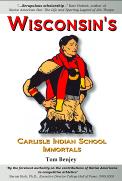
What is discouraging is that the author is a veteran journalist and should know that he should have checked his facts. It would have taken him little time to find these errors had he just consulted my biography of Lone Star Dietz and Bob Wheeler’s biography of Jim Thorpe. It is no surprise that yet another journalist has made less than accurate statements about Jim Thorpe and Carlisle Indian School, but it is unfortunate because most readers accept that the author has his facts right and don’t check for themselves.

Seek Restoration of Indian School

April 12, 2010

When looking for information on Asa Sweetcorn, I found a 1935 United Press article in which he was mentioned that had nothing to do with his exploits while at Carlisle. Titled “Seek Restoration of Indian School,” the article, datelined Carlisle, Pa., March 15, the article told of former Carlisle Indian School students’ attempt to reopen the school. Charles Dillon, who is best known for his role as “humpback” in the “hidden ball” play run against Harvard in 1903, spearheaded the movement. “Dillon, one of the greatest of the long line of football heroes who wore the colors of the old Indian School, was in town the other day sounding out sentiment on the proposed return of the Redskins.”

Dillon was on his way to Washington, DC to pry loose a few New Deal dollars to launch the program. He felt that little government money would be required to fund the school. He told some old friends in Carlisle, “Our aim is to build a college with Indian money, to be conducted by and for Indians. And only a comparatively few dollars are needed from the government to launch the program.” According to Mr. Dillon, “Scores of graduates of the erstwhile Carlisle Indian School are ready to contribute thousands of dollars toward establishing the school.”

He was to return to Carlisle the following week after negotiating with New Deal officials. Accompanying him were Jim Thorpe, Gus Welch, Albert “Chief” Bender and Asa Sweetcorn. That was a bad time for Indian schools to pry money out of the government. Lone Star Dietz left Haskell Institute in 1933 to coach the Boston Redskins after the government slashed Haskell’s budget. Gus Welch was well aware of funding issues as he replaced Dietz at Haskell. It is easy to understand why Dillon, Thorpe, Bender and Welch supported the initiative because they flourished at Carlisle. Sweetcorn’s involvement is curious because he was “canned” in Carlisle for his antics that reflected less than a studious attitude.

1923 Louisiana Tech-Centenary College Game

January 12, 2010

A reader submitted the photo included at the bottom of this post. I’m sorry that it isn’t clearer but this is what I was sent. I have never seen or even heard of one of these buttons before. It is purported to be a button for the 1923 Louisiana Tech-Centenary College annual Thanksgiving Day game. I can’t make out the date from the button but believe that it is authentic because Louisiana Tech played Centenary on Thanksgiving Day in 1922 and 1923, both years that Dietz coached in the Pelican State. Also, it seems unlikely that a forger would pick a relatively obscure event rather than one that would generate more interest (read a higher price). Let’s talk a little about Lone Star’s time in Ruston, Louisiana.

Lone Star coached the Bulldogs for two years compiling an 11-3-1 record with two of the losses coming at the hands of the Centenary Gentlemen. Less than half of those games were played at home at a time when strong teams generally played most of their games at home. (Note that Carlisle Indian School and Haskell Institute were strong teams that played most of their games on the road, a factor that makes their records all the more astounding.) Louisiana Tech had done well before Dietz’s arrival but against weaker opposition. He was apparently hired to upgrade the program and he did.

No reason was given for Dietz’s departure for Wyoming but money cannot be discounted. Wyoming wanted to upgrade its program and hired Dietz to do that. Also, Dietz had remarried in early 1922 to a woman from Indiana and may have needed more income. Even when single, the dapper Dietz was never known as being a miser.

Dietz’s history of putting life into previously lifeless programs while compiling a Hall-of-Fame worthy record is a strong argument for his induction into the College Football Hall of Fame.

Correct Information Is Hard to Find

January 8, 2010

A November 27, 1949 newspaper article by Deke Houlgate discussed the problems Warner Brothers were having with a screenplay for Jim Thorpe’s biopic. Several scripts had been written and discarded but a new one, titled “All-American,” was expected from the screenwriters soon. However, he questioned how good it would be given the problems the writers faced. He wrote, “One of the present problems at the Burbank studio seems to be that the records for this famous team–records that must reach back prior to World War I—no longer exists or are easily obtainable. The Army of the United States took over the school or campus, without asking, for the use of its fledgling doctors in 1917 and scattered students plus pertinent data all the way from Lawrence, Kansas, to Riverside, California.”

Like most newspaper reporters, Houlgate had some details wrong but he did better than most. First, the Army took Carlisle Barracks back in 1918, not 1917. Second, the facility wasn’t used for “fledgling doctors” as that came later. In 1918 it was used as a hospital to treat soldiers wounded in WWI. Houlgate went on to attempt to set the record straight on some legends that unfortunately still persist:

First off, Carlisle never had an undefeated, untied season. The Indians came close to a perfect record many times but always managed to lose at least one game. Next Jim Thorpe was not the first or only All-American. Third, Pop Warner did not bring Carlisle from obscurity to fame because Bemus Pierce and Metoxen were recognized as All-Americans by Walter Camp in 1896 or years before Glenn Scobie ever coached there.

Houlgate is correct about everything in the last paragraph except that Walter Camp first recognized a Carlisle player as a first team All-American in 1899 when he selected Isaac Seneca as a halfback. He may have named Pierce and Metoxen to his second or third teams but I don’t have a reference at hand to verify that. Whether or not Camp named Carlisle Indians to his All-America teams does not mean that Houlgate’s point is incorrect. The team and its star players were indeed famous before Warner was hired to coach them.

Video of Chilocco Indian School

November 28, 2009

Justin Tyler Moore informs us in his comment on Chilocco Indian School that he shot a video of the school, including interiors of some buildings, and posted it on the web. You can find his video at: http://www.abandonedok.com/chilocco-indian-school-revisited

From the video you can see that the buildings could be converted into a museum, resort or other worthwhile use. Thank you for posting this, Justin.

Archiquette Played Against Carlisle

July 17, 2009

While researching the 1905 Carlisle-Massillon game for an article in an upcoming issue of The Coffin Corner, I noticed that Chauncey Archiquette played in that game. I hadn’t previously realized that he was back in a Carlisle uniform in 1905, but he most definitely was. That line-ups in newspaper coverage of games played that year generally include his name support that fact. In Steckbeck’s Fabulous Redmen, the line-ups for the 1904 Carlisle-Haskell game are on the page opposite the beginning of his discussion of the 1905 season. I noticed that Archiquette was in the line-up for that game as well. However, he wore a Haskell uniform. A look into Archiquette’s file showed that, after graduating from Carlisle in 1899, Chauncey had enrolled in a commercial course at Haskell. Newspaper accounts of Haskell games indicated that he had indeed played football for Haskell. This also explains how Archiquette happened to be at Haskell where, among other things, he became a young Jim Thorpe’s idol.

Few Carlisle players played against their old team after leaving the school. James Phillips, for example, refused to suit up for Northwestern in 1903 when they played the Indians. Instead, he watched the game from the stands. Joe Guyon is a notable exception in that he played in the humiliation of the hapless 1917 squad. He started the game but played just a little more than a quarter in which time he scored two touchdowns. Archiquette joined that small group in 1904 when the two Indian schools met for the only time.

Steckbeck marked nine Haskell players’ names with asterisks to denote that, after the 1904 thrashing, they “later enrolled at Carlisle.” It is worthwhile to note that Pop Warner was not at Carlisle for neither the 1904 season when the game was played, nor for the 1905 and 1906 seasons when many of the players transferred.